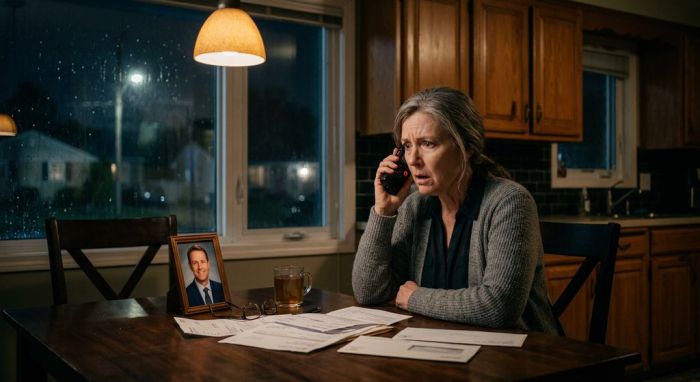
The night Dale kissed my forehead and told me he had one more crisis to fix at the office, I stood at the kitchen window and watched his headlights vanish up Willow Lane. Thirty years of those headlights. Thirty years of trusting that man with everything I had. And when I turned back to the table, I saw his briefcase sitting on the chair where he always dropped it, the latch sprung open, a small black recorder wedged between two folders.
I had never touched his briefcase, not once in three decades. He carried it like a second skin, and I figured a man who ran an insurance agency kept a hundred private papers in there, none of them my business. But something in my chest had already started to crack. Our daughter Emily had called me the week before, worried, saying Dad seemed nervous about money and had asked her to sign something she did not fully understand. Our son Jake, who rarely notices anything, mentioned that his father took a call in the garage with the door shut, whispering.
So I picked up the recorder. I told myself I was only checking it to set it on the charger, because Dale was always losing batteries and I was the one who fixed things in our house. It was the same excuse I had used for thirty years. The screen was dark, but the little red light blinked, and when I pressed play, I heard my husband's voice, warm and familiar, the voice that had talked me through my father's funeral and our daughter's first broken heart.
Except he was not talking to me.
"I'm telling you, Trish, it's working. She signs whatever I put in front of her. I had her notarize the home equity line last Tuesday and she just smiled and asked if we needed the money for the roof."
My hand started to shake. Trish was his office manager, a woman in her forties who sent me Christmas cards every year with handwriting so pretty I once joked she should have her own stationery line. I heard her laugh on the tape, the bright little giggle I had heard a hundred times at agency parties. "You're a genius, baby. Another year of this and we're gone. South Carolina. The house on the lake."
I sat down before my knees gave out. The recorder dropped onto the table, and I stared at it the way you stare at a snake that has been sitting in your kitchen the whole time, perfectly still, waiting. For the next hour I did not move. I listened to that call three more times, and each time I heard something new. The home equity line he mentioned was against a house we had paid off in 2006. I remembered the thick stack of papers he brought me last Tuesday, which I signed without reading because the garage door man had just pulled in and Dale was shouting that he needed it before the bank closed. He knew exactly what he was doing. He had spent thirty years learning the shape of my trust, and now he was folding it into a weapon.
The tape went on. They talked about the smoke screen expense account, about moving money into a credit union I had never heard of, about how I was so busy with the garden club and the grandkids that I never checked a single statement. He said my name the way you say the name of a piece of furniture, and that was the moment the love I had carried for thirty years turned into something cold and sharp.
I waited until the garage door opened at 11:40 that night. I heard Dale humming in the mudroom, call out "Ruth? You still up?" I walked into the kitchen, sat down across from him, and set the recorder on the table between us. The color that drained out of his face was the most honest thing he had ever shown me.
That night changed everything, but not in the way you might think. Dale did not confess. He did not cry. He looked at that recorder, and for one terrible second I thought I saw fear, but then he did what he had always done when cornered, he got busy. He told me the recorder was an old one he used for dictation, that the call was taken out of context, that Trish was a client he was advising, that I was overwrought and not thinking straight. He said it so gently, so reasonably, that for a moment I almost believed I had misheard my own ears.
Then he asked me something that should have been my final warning. "Ruth, sweetheart, have you been taking your blood pressure medicine?"
I had given him no reason to think that about me, ever. But I understood then what he was building. A paper trail about my health, my mood, my confusion, the kind of trail that makes a judge give a man everything. He had been laying that foundation for years, the loving husband with the difficult wife, and I had never once seen him lay a single brick.
The next morning I did the hardest thing I had done since burying my father. I drove to the office of Margaret Reyes, a forensic accountant whose name I had saved from a news story about a church treasurer who robbed his own congregation. Maggie was a tiny woman with enormous glasses and a filing system that would make the IRS weep with joy. I played her the tape, and she listened the way doctors listen to heartbeats, with her eyes closed, nodding. "Ruth," she said, "this is going to be worse than you think. And it is going to be better than you fear. Because this man left breadcrumbs everywhere. They always do."
She was right about the breadcrumbs. It took us six days to follow them. On the third day, Maggie found the credit union account in Charleston, South Carolina, with a little over two hundred thousand dollars in it. On the fourth day, she found the credit cards, four of them, opened in my name at stores where I had never shopped, maxed out and carrying balances I had never seen. On the fifth day, she found the notarized home equity line, one hundred thirty-five thousand dollars against a house I had scrubbed with my own hands for three decades. The signature on it was mine. Except it was not. Dale had practiced my handwriting the way a forger practices a counterfeit bill, and at the bottom of the page, beside the date, was a loop of my name that I almost could not tell from the real thing. Almost.
And on the sixth day, Maggie found the thing that made me weep. A deposit slip from nine years earlier, sixty thousand dollars, marked as business loan repayment, which should have gone into our joint retirement account. It never appeared there. It ended up in an account at a bank in Charleston that had been opened two months before the deposit, in the name of a trust I had never heard of. He had been planning this for nearly a decade. Our retirement, our savings, our daughter's wedding fund, all quietly dissolving while Dale hummed in the mudroom and called out "Ruth? You still up?"
Maggie put me in touch with a criminal defense attorney named Sandra Blake, a woman with a reputation for loving hopeless cases, and Sandra told me the truth about my position. The forgery was a state crime. The credit card applications in my name were identity theft, a federal crime. But none of it would matter if I could not prove Dale intended to keep the money and abandon me. I needed a confession. And that is where Trish came back into the story, although not in the way anyone expected.
Trish Landon had been Dale's office manager for six years and his secret partner for three. She was also the sister of a woman whose mother had lost her entire savings to an investment scheme back in 2017, a scheme run by a friendly insurance broker who promised a guaranteed eight percent return. When Sandra called Trish, the voice on the other end of the line did not sound like a villain. It sounded like a woman who had been trapped for three years. Trish said she had been in love with Dale, that he had promised her the lake house, that she believed every word until she found a receipt from a florist in Charleston and understood she was not the first girl he had painted a future for. She had stayed quiet because she was afraid of him. The only thing she had kept was her sister's mother's file folder, the one showing Dale's name on the paperwork of a scheme that had never once been reported as a crime. She offered us everything. And then she offered us more.
The day Dale came home with what he thought was his masterpiece, a set of divorce papers drafted by his own lawyer, papers that claimed I was financially unstable and incapable of managing the household, I was standing in the kitchen with the kettle on. He set the papers on the counter with the gentle, sorrowful look of a man doing something painful but necessary. I poured the tea. I let him talk. And when he finished, I told him the truth.
"The home equity line you had me sign," I said, "the bank sent me a courtesy copy of the notarized page. It's sitting in our safe deposit box with my real signature on top of it, the one from our mortgage in 1992. You are good, Dale. You are so good. But you practiced the wrong loop."
He laughed. He actually laughed. "Ruth, you can't prove anything. I've had the best lawyer in three counties for two years. By the time this is over, you won't have a pot to—"
The doorbell rang. Trish, wearing a wire provided by a very interested federal agent, had met Dale at the office that afternoon and asked him, gently, whether he was really sure Ruth knew nothing about the account in Charleston. And Dale, who always loved an audience, had laughed and said she knew less than she thought, that he had moved the money out of Charleston into a boat dealer's account in South Carolina, that Ruth was the easiest mark he ever had. He said it while the wire recorded. He said it while two deputies stood in my driveway, listening through an earpiece.
When he opened the door, the look on his face was the last honest expression he ever gave anyone. The deputies read him his rights in my entryway, in front of the framed photo of Emily at her graduation. He looked at me over his shoulder and said, "You were always too smart for me, Ruth." And I said the truest thing I have said in my life. "No, Dale. I was only ever too trusting. And you mistook that for weakness."
The trial did not take long. The recorder, the forged signatures, the wire, the Charleston accounts, and the sister's mother, who finally came forward and pointed at Dale with a shaking finger, all of it piled up like snow in February. The jury was out for four hours, and when they came back, the foreman looked at Dale and said guilty without a single note of hesitation. He received seven years in federal custody for identity theft and bank fraud, with another three to run concurrently on the state charges. The judge ordered restitution that stripped the Charleston accounts and the boat dealer's balance and the house he had bought for Trish on paper, though she had never once set foot in it. She testified against him with her voice steady and her eyes dry, and the prosecutor told me afterward he had never seen a witness so eager to tell the truth.
I expected to feel victorious when the gavel came down. Instead I felt exhausted, the way you feel when a long fever finally breaks. I went home to a house that was quiet, and I walked from room to room, and I realized that for the first time in thirty years, the silence in that house did not belong to Dale. It belonged to me.
The children came around slowly. Jake called two weeks after the verdict, and then Emily drove up from Madison with her husband and their baby, and my granddaughter slept in the room with the yellow walls and the stickers on the closet door. One evening, after the dishes were done, Emily said something I will carry forever. "I thought Dad was the steady one, Mom. I thought you were the one who got confused. That's what he told us. I'm so sorry we believed him." I hugged her and told her the truth, that none of us had seen it, that the whole point of people like Dale is that you cannot see them until you do. We sat on the porch until the fireflies came out, and I understood that the family I thought I had lost was not lost at all. It had just been waiting for the smoke to clear.
Maggie helped me untangle the last of the finances, and with the restitution I paid off every debt in my name, the ones he created and the ones I never knew about. I kept the house on Willow Lane. I put new gutters on it, the ones Dale had said we could not afford, and I planted rosebushes along the fence where he used to park his car. Last spring I opened a small used bookstore two blocks from the courthouse, called Ruth's Reading Room, exactly as unimpressive as it sounds, which is why I love it. On a good Saturday I make enough to pay the electric bill and buy one nice bottle of wine.
Sometimes I think about the tape, the little black recorder that sits in my desk drawer. I do not play it. I do not need to. People ask me at the bookstore whether I forgive him, and I tell them the same thing every time. Forgiving him was never the point. The point was that he believed he could take everything from me and walk away smiling, and instead he watched the light fade out of the room while forty-one people in the gallery took one long, shared breath of relief. Poetic justice does not always come with lightning and thunder. Sometimes it comes quietly, the way it did for me, in the form of a woman sitting at a kitchen table with a recorder in her hand and nothing left to lose.
I am sixty years old. I own my house, my name, my peace, and a little bookstore where the fireflies come out after dark. The other night, my granddaughter found the framed photo of Emily's graduation and asked who the man in it was. I looked at his face, the man who practiced my signature in the dark, and I said, "That was somebody I used to know, sweetheart. Before I found out who he really was." She nodded, the way children do, and went back to her book. And I stood there a moment longer than I meant to, thinking about how close I came to spending the rest of my life apologizing for a sin I never committed, in a house that was never his to take.
He thought he had won. He thought the tape was an old thing, forgotten, battery dead, something useless from a life I would never examine. People like Dale always think the truth is buried too deep to matter. But the truth was right there on the kitchen table, glowing in the dark, waiting for me to be brave enough to press play. I pressed play. And I never, not once, looked back.