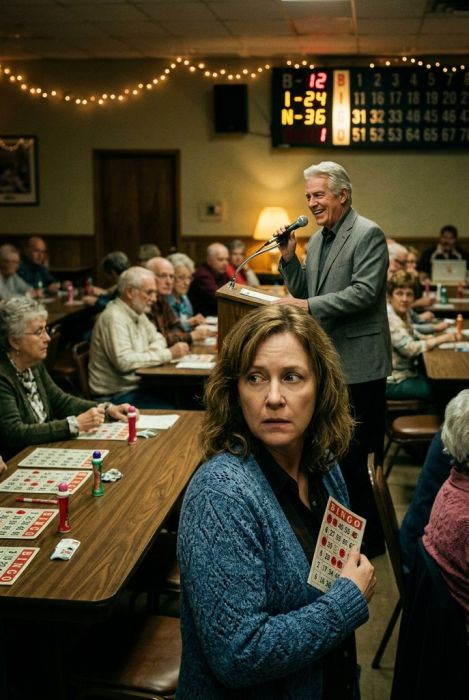
The night of the Blackout Jackpot, my mother Eileen sat in her usual seat, third row from the front, with her dobber in one hand and her lucky pink highlighter in the other. She had worn that aqua cardigan to St. Anne's parish hall every Wednesday for twenty-two years, ever since my father helped bring charity bingo to our little town of Hickory Bend, Indiana. She believed in that hall the way other people believed in churches. And for twenty-two years, Owen Parish had been the man running it: the man everyone adored, the man who called her "Eileen, my favorite luck-bringer" and made her feel like the room was brighter when she walked in.
She never saw what I saw the night before the jackpot. I had gone into the storage closet behind the office to hunt for a carton of coffee cups when my foot caught the corner of a loose floorboard. It lifted like a tongue. Underneath, wrapped in a green trash bag, was a second set of books. Bound in black leather with a gold cross stamped on the cover, it looked like the donation ledger they kept by the door. It was not. Page after page, the handwriting looped in that neat, friendly cursive I had watched a thousand times signing birthday cards. Owen's handwriting. Under the column marked "Payout" were names I knew. Winners who had supposedly taken home thousands over the years. Winners who had never once mentioned their good fortune at Sunday coffee hour.
I should have called the police that minute. Instead I did what most daughters do. I sat on the dusty floor and read every page, and by the time I finished, the hall had gone dark and my hands were shaking. The parish's share of the bingo proceeds had been shrinking for a decade, and now I understood why. The jackpots on the marquee were fiction. The winners in the ledger were the real fiction. For years, Owen Parish had been running the game with numbers he had chosen himself, and the money meant for the food pantry and the Father Mulligan Scholarship had been sliding into his pockets a few thousand dollars at a time. It was Dad's bingo. Dad's legacy. And nobody had noticed, because Owen was so good at making everyone feel loved.
I can describe Owen Parish in one sentence: he was the man you wanted at your table on the worst day of your life. He remembered that your grandson played trumpet and that your sister hated coconut cake. He paid the teenagers who cleaned the hall from his own pocket, or so he said, and he sang to the widows whenever the ball machine whined too long. When he hugged my mother after Dad's funeral, everyone in the receiving line cried. He was the first person in Hickory Bend to welcome me home when my marriage fell apart. He put a hand on my shoulder and said, "Karen, you come help us count the money. Numbers always told you the truth, right?"
That was the joke that broke everything. Because numbers do tell the truth, and for months I was the person making sure they told Owen's version of it. He had talked the parish council into hiring me as the official bookkeeper, a kindness, everyone said, to a woman down on her luck. I sat in the church office every Tuesday with a stack of receipts and a calculator, and Owen stood behind me humming, telling me which totals to record and which to leave for "the other ledger." I thought he was teasing me at first. Then I realized the other ledger was real, and that he believed I was too beaten down to ever look at it twice.
I looked at it twice. I looked at it twenty times, and each time I found a little more of my father's dream being quietly sold. The pantry, which used to feed forty families a week, was down to twelve. Father Barnes blamed the new state fees and the cold winter and the decline of church attendance, and Owen nodded along, sighing, offering to host an extra Tuesday game "for the children." I kept my mouth shut and my eyes open. I began carrying a small notebook, the way Dad had taught me, and I wrote down everything that did not match.
The pull-tab cash never balanced. The tear-off strips in the trash were always forty or fifty dollars short of the money in the drawer. The "charity" dividend that Owen announced every Saturday night appeared on no bank statement I could find. And then there was Lou Grissom. Lou was seventy-one, a retired fire marshal with a hearing aid and a memory like a steel trap, and he had been calling Friday night bingo since before I was born. One night after close, he poured himself a cup of cold coffee and sat down across from me with his own notebook. "You see it too," he said. It was not a question. "Look at the winners, Karen. Same six names, rotating like clockwork. His brother-in-law. His niece. The man who delivers his newspaper. I have been watching for eight months, and not one of those people has ever bought a single card."
That was the moment the story turned from suspicion to certainty. Lou had kept a list of every date, every winner, every payout, cross-referenced with the games on the wall board. The pattern was beautiful in its ugliness. Owen never won anything himself, of course. He was too smart for that. He let his wife's cousin win three thousand dollars on a night the hall was packed, and the cousin stood up and cried and said she would donate every cent to the new roof fund, and everyone applauded, and the roof fund never saw a dollar. I found that payment in the second ledger eleven days later, marked "Roof Candidate A."
I took the ledger to Father Barnes on a Tuesday afternoon when the church was empty. He read it in silence for a long time, then closed it and pressed both hands to the cover, the way he did before Mass. "I baptized that man," he said quietly. "I married him. I have watched him kiss babies and visit the sick, and I have been proud of him for thirty years." He looked up at me with wet eyes. "You are telling me I have been proud of the wrong man, and I am telling you that I believe you, and that I will help you, and that we will do this the right way, in the light." He gave me the parish bank records from a locked drawer and told me to take them straight to the state. He did not tell me to be careful. He told me to be brave.
I knew I could not do this alone even with the priest behind me, because small towns protect their beloved men, and Owen Parish was the most beloved man in Hickory Bend. If I walked into the police station waving a ledger, half the town would call me a bitter woman with a grudge. So I did something smarter. I asked Lou to introduce me to the only person who outranked a town's affection: the state. Lou knew Lena Hart, a field agent with the Indiana Gaming Commission, from a training seminar years earlier. Agent Hart listened to me for twenty minutes without once looking at her phone, and that was the first time in months I felt like someone believed me. "We have had our eye on the charity halls in this county," she said. "We were just missing the key witness." She asked me to keep the books exactly as Owen wanted them. She asked me to smile when he praised my work. And she gave me a box of marked hundred-dollar bills that I kept at the bottom of my purse, next to my mother's spare keys, for the whole month of waiting.
The plan came together for the Blackout Jackpot, because Owen could never resist a stage. He announced it six weeks early, printing tickets with a picture of the church on the front and a promise of twenty-two thousand dollars on the back. Every seat in the hall sold in three days. People from four counties bought cards. Owen walked the floor like a bridegroom, kissing cheeks, telling everyone this would be the night the church roof finally got fixed. Lou installed a new smoke detector over the payout table the week before, and the parish council thanked him for his vigilance. The little camera inside it recorded in perfect high definition, and the feed ran to a monitor in the kitchen that only Lou had the key to.
The night itself felt like a fever dream. My mother wore her lucky cardigan and said she could feel it in her bones. I sold pull-tabs with a smile so wide my cheeks ached, and every time Owen passed me he squeezed my arm and said, "Twenty-two thousand, Karen. We are going to feed this town for a year." He had no idea he was about to feed it in a different way. Agent Hart and two plainclothes officers from the state police were parked in a delivery van behind the rectory, listening to Lou's countdown on the wire, and I kept my hand on the marked hundreds in my purse and prayed my face would not give me away.
The last game was blackout, which meant a player had to cover every number on the card, and it always took forever. The crowd grew restless. The ball machine whined. Owen kept the microphone close to his mouth and told stories about the old days, about my father, about the year the roof leaked during the Thanksgiving game, and I watched the clock and thought about how much I hated him and how much I had once loved him, all at the same time. Around ten forty, his niece Callie shot to her feet, papers flying, screaming that she had it. Bingo. Blackout. Twenty-two thousand dollars. The hall erupted. Owen rushed to her table with the payout tray, his silver hair gleaming under the lights, tears in his eyes, and the room was so loud with joy that almost no one heard the kitchen door open.
The feed clicked over first. Every television in that hall, all four of the big screens the church had bought years ago, went dark for one second and then showed the office. It showed Owen's hands, clearly in frame, counting the marked hundreds into a paper envelope and whispering to his brother-in-law, "She screams loud, that one. Worth every dollar." The music stopped. The voices stopped. Callie looked up at her uncle with a face I will never forget, because it was the face of someone who realized she had just been caught on live television in front of four hundred neighbors. And then Lena Hart stepped through the double doors with her badge held high, and two officers followed her down the aisle, and the last thing I heard before the applause started was Owen Parish's microphone falling to the floor with a sound like a dropped dobber.
I want to say I felt triumphant. I mostly felt tired, and then I felt a grief that had nothing to do with the money. The man they led out in handcuffs was not the man who had brought me coffee when my husband left. He admitted to everything, which surprised no one who knew how proud he was. For twenty-two years, he had skimmed an average of nine thousand dollars a year from a charity game built by a man who had trusted him like a brother. The total came to two hundred and fourteen thousand dollars, and the judge, a woman who had played bingo at St. Anne's since she was a girl, made him pay every cent of it back before she sent him away for six years.
The hardest conversation was with my mother. I told her the whole story in her kitchen, and she listened with her hands folded around a cold cup of tea. When I finished, she reached across the table and took my hand. "I am not sad about the money, honey," she said. "I am sad that I loved him like family. But I am proud of you, and your daddy would be proud of you." It was the first time in months that I felt like I had done something right instead of just something hard.
The pantry reopened with real food and real shelves. The scholarship that carried my father's name went out to a girl from the high school who was the first in her family to go to college. Lou Grissom got a lifetime seat at the caller's table and a standing ovation the first Friday he picked up the microphone. And my mother, Eileen, still plays every Wednesday night, third row from the front, with her dobber and her pink highlighter. She just brings her own coffee now and keeps the receipts for the snack bar herself.
On the one-year anniversary of the Blackout, after the last ball was called and the hall emptied, Mom walked over to the plaque by the door and ran her finger over Dad's name. "He would have loved this," she said, "the whole town finally seeing the truth." She tucked her pink highlighter behind the frame, the way she used to tuck love notes into his lunchbox, and we walked out into the warm Indiana night with the pantry lights still glowing behind us. Karma had come for Owen Parish in front of everyone who ever loved him. It had taken its time, but it had kept every receipt.