The auction was supposed to start at nine. I walked in at 8:47 with my mother's china chest cradled in my arms and a folded copy of the bill of lading in the pocket of my jacket. Dale Vickers stood on a loading pallet with a microphone in his hand, smiling at the crowd like a man who had never lost a penny in his life. When he spotted me, he didn't even blink. He just waved me toward the folding chairs and said, "Welcome, folks. Let's hear it for the lady coming to the sale."
He had no idea that I was the reason the men in the gray coats were already moving through the loading bays. He had no idea that my mother's china chest had a tracking unit taped inside the lining. And he had no idea that the woman sitting in the second row with the leather folder was not a collector at all.
Two years before all of that, my husband Ray died of pancreatic cancer. I say it fast because saying it slow makes it real. We had been married thirty-four years, most of them good ones, and I had spent the last two of them learning how to make coffee for one and how to sleep on my side of an empty bed.
It was my daughter Megan who finally pushed me. She had given birth to our granddaughter Lily in Fort Worth, Texas, and she called me one night and said, "Mom, you can't rattle around in that big house alone forever. Come live near us." And because I knew she was right, I put the house in Kingman on the market.
The house sold in eleven days. The closing left me with a check larger than I expected, which meant I could afford to move properly. I found a small rental near Megan's neighborhood, one with a porch and a bedroom for Lily, and I started calling moving companies for quotes.
I got three estimates. The first two came from national companies, and they were polite and expensive. The third came from a man named Dale Vickers, who owned a local outfit called Red Rock Moving. He came to my door himself, which impressed me. He wore a clean white polo with his logo on it, shook my hand with both of his, and told me he had moved three senators and half the grandmothers in Flagstaff.
He had an A-plus rating with the Better Business Bureau. He sponsored the youth baseball team. His trucks carried a painting of the red rocks on the side and a slogan that read, "We Carry What You Cherish." His estimate was eleven hundred dollars cheaper than the next one down. It should have made me suspicious. Instead, it made me grateful.
Ray had left me a toolbox that his own father had left him, full of tools with wooden handles I could never bring myself to throw away. My mother had left me the china she carried from Ohio in 1952, wrapped in quilts, the same china that had been on our table for every holiday of my entire life. I told Dale about both of those things when he came to the house. I told him about Megan's request for Lily's crib, and about the photo albums, and about the rocking chair my father had made.
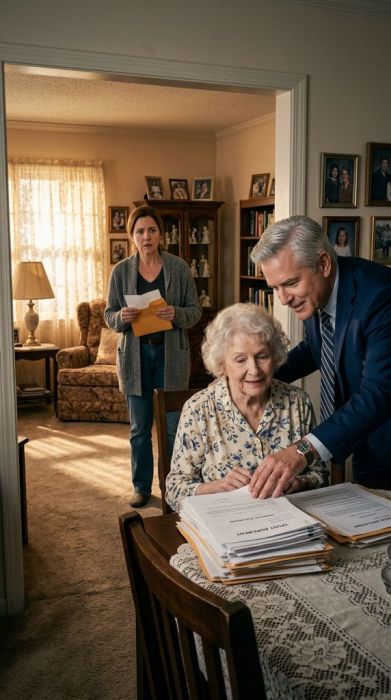
He listened with his head tilted, and when I finished he said, "Carolyn, we're going to take such good care of these things you'll wonder why you ever worried." I believed him. That is the part I still have to forgive myself for.
Moving day, the crew arrived at seven in the morning. They were quick and careful. They wrapped the china in padded quilts and labeled every box. The foreman, a wiry man named Ernie Cabrera, went through the house room by room with a clipboard and marked the inventory with me.
At the end, Dale appeared to walk through the empty rooms himself. He picked up a framed photograph of Ray that sat on the kitchen counter, looked at it, and set it down gently on top of the last box. "Anything you forget, you call us," he said. "That's the Red Rock promise." That was the last kind word I heard from any of them for a very long time.
I drove to Fort Worth with my cousin in a rental car. It took two days, and I checked my phone constantly the way you do when you have entrusted your entire life to strangers. On the morning the truck was supposed to arrive at my new rental, I got a call from a man who identified himself as the office manager at Red Rock's dispatch. His name was not Dale.
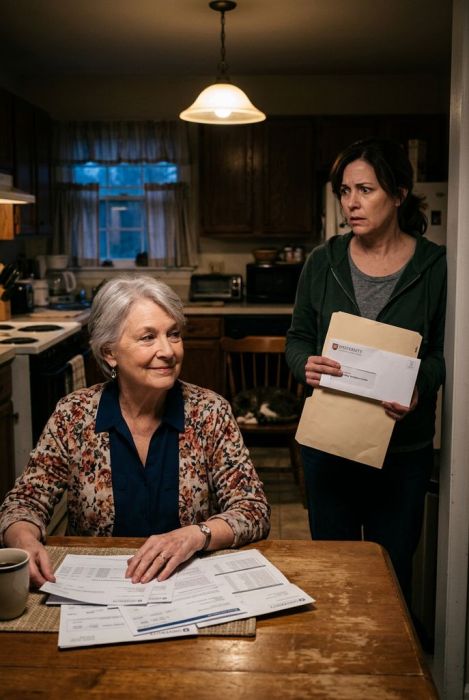
"Ma'am, we just reweighed the load here in Texas," he said. "The actual weight came in higher than the estimate. There's also a fuel surcharge, a stairs fee for the second floor, and a reweigh fee. The total balance due before we can unload is sixty-four hundred dollars."
I sat down on the floor of my empty kitchen. I was standing in a house with no furniture and no bed, and the men holding everything I owned were telling me I owed them more money than I had in my checking account. I called the number back three times and got the same pleasant voice. I asked to speak to Dale and was told he was "in the field."
I asked how a truck full of my belongings could suddenly weigh eleven hundred pounds more than it did when it left my house. The voice said the scale in Texas had "calibrated differently." I asked to see the weight tickets. The voice said they would be provided "at the time of balance settlement."
I did what any reasonable person would do. I called the police in Fort Worth, then the police in Flagstaff, then the Better Business Bureau. The police in Fort Worth said it was a civil contract dispute. The police in Flagstaff said the same. The BBB told me that Red Rock Moving had complaints over the years, but every one of them showed "resolved," because Dale had a habit of refunding just enough to make a complaint go away.
Then the office manager called back with the part they hadn't put in writing. "You've got thirty days of free storage," he said. "After that, it's a hundred dollars a day. And if the account goes unpaid past the storage window, the load is considered abandoned, and abandoned freight goes to auction."
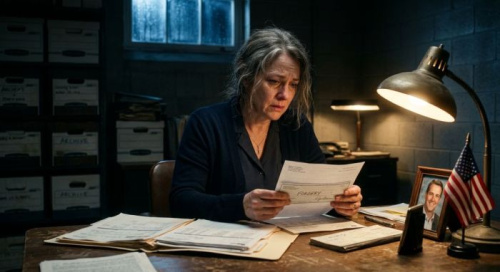
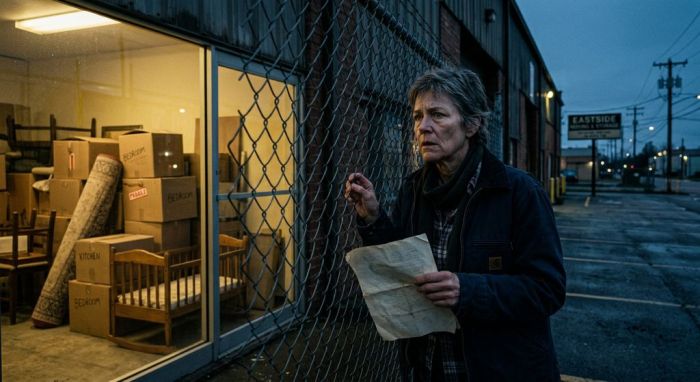
I asked how that could be legal. He said, "Read your contract." So I read my contract. And there it was, buried on page six under a heading about abandoned goods, in letters small enough to need a magnifying glass. Ray would have caught it. Ray read every contract like it was scripture. But Ray was gone, and I was a widow in an empty rental in a city where I knew three people, and I had just signed my life away to a man who smiled at funerals.
I did the only thing left to do. I got back in my cousin's car and drove to Flagstaff.
I parked across from Red Rock's warehouse on the second afternoon and stayed until the security lights came on. I watched crews load trucks and unload trucks. I watched a woman in a minivan sit outside the gate for three hours, crying. I watched a man in work boots pound on the office door until he gave up and drove away. And on the fourth morning, I watched Dale Vickers come out of his office carrying a cardboard box of files, get into his truck, and drive off toward the courthouse.
That was when Ernie Cabrera found me. He came out of the warehouse wearing the red polo, walked straight to my car, and said, "You're the widow who parked across the street for three days. You're not here for the scenery." Ernie was the foreman who had wrapped my mother's china in padded quilts and marked the inventory with me. He had been fired two days after my load left Flagstaff.
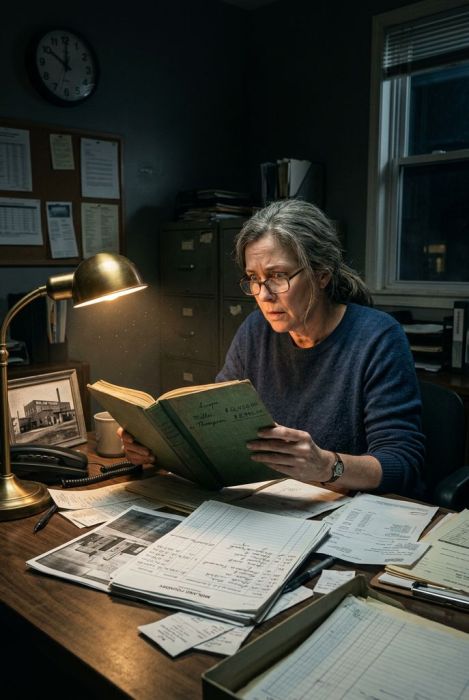
His crime, he told me, was refusing to call the family of a dying woman and tell them their load was being held for an extra four thousand dollars. "I kept notes," he said. "Every load that went into the hold. Every family. Every extra fee. Every threat. I didn't keep them because I'm brave. I kept them because I knew I'd need proof that I wasn't the only one who saw it."
He handed me a spiral notebook from his coat. Inside was a ledger of forty-one families over eighteen months. Names, dates, cities, the amount they were charged, the amount they were held for, and what was inside each load. Reading it felt like reading a graveyard. A wedding dress. A child's crib. A dying man's medications. A grandmother's quilts. Sixteen of those families had paid whatever was demanded. Nine had walked away and left everything behind. The rest were still fighting, like me, from a thousand miles away and getting nowhere.
"Here's the rest of it," Ernie said. "He's got an auction notice posted at the courthouse. Fourteen loads. Abandoned freight. Yours is number seven, listed as 'china, tools, household misc.' The date is the first Saturday of next month." I asked him what he needed me to do. "I need you to not scream," he said. "And then I need you to look at the files I photocopied before they fired me."
That night, in a motel room that smelled like pine cleaner, Ernie laid the whole scheme out on the bed. Red Rock's favorite trick was the lowball estimate. Dale would quote thousands below the going rate, because the point was never to move the load at the quoted price. The point was to get the load on the truck. After that, the price was whatever Dale decided it was, because the customer had no leverage left and their life was already rolling down the highway.
"The state won't touch it," Ernie said. "The corporation commission says it's civil. The police say it's civil. But there's one office that doesn't say civil, because these shipments crossed state lines." He was talking about the FBI.
It turned out I was not the first person to figure that out. When I finally got through to the field office in Phoenix, a special agent named Sandra Rao listened to my whole story without once interrupting. When I finished, she said, "Mrs. Bell, we've been building a file on Red Rock Moving for eleven months. Your call is the one we've been waiting for."
Here is what I learned in that office. Eleven months earlier, a retired couple from Missouri had reported a load of belongings held hostage in Arizona at an inflated price, and the Bureau had quietly opened a case. They had subpoenaed Red Rock's shipping records. They had interviewed three former employees. They had a suspect, a pattern, and a calendar. What they did not have was a clean moment where Dale Vickers committed the crime on the record, in front of witnesses, with his own confident smile on camera.
"I can do one better than a moment," I said. "I can give you the auction."
Special Agent Rao and I spent the next two weeks building the trap, and the beauty of it was that Dale built it for us. He scheduled the abandoned freight sale, mailed the notices, and hired the auctioneer all on his own. All we had to do was slip in beside him. During a routine pre-auction inspection, Rao's team opened my mother's china chest, taped a tracking unit the size of a matchbook inside the lining, and closed it back up exactly as they found it. Bidders would come. The bidding would start. And the moment the gavel came down on the last of my mother's plates, federal agents would step out of the crowd and take Dale Vickers in front of everyone he had ever swindled.
I asked Rao whether I should stay away. She said no. "You walked in with that load out of Kingman," she said. "You should walk in and watch it end. You've earned that." So I did.
The auction was supposed to start at nine. I walked in at 8:47 with my mother's china chest cradled in my arms and a folded copy of the bill of lading in the pocket of my jacket. Dale Vickers stood on a loading pallet with a microphone in his hand, smiling at the crowd like a man who had never lost a penny in his life. When he spotted me, he didn't even blink. He just waved me toward the folding chairs and said, "Welcome, folks. Let's hear it for the lady coming to the sale."
He opened the bidding with lot one, a man's clothes and a set of golf clubs. Then lot four, a sewing machine that made the woman beside me cry. When he reached lot seven, he stood on the pallet and waved at my chest. "China from 1952, folks," he said. "Tools older than half of you. You aren't going to see pieces like this again." He had no idea how right he was.
The bids climbed. A man in a denim jacket bid. A woman in the second row with a leather folder topped him. Dale nodded at her with genuine delight. "Ma'am, you've got an eye," he said. The gavel came down on my mother's china, and Dale stepped off the pallet and reached for the cash.
Before his fingers touched it, the woman with the leather folder stood up. "Special Agent Rao," she said, "Federal Bureau of Investigation. Mr. Vickers, you are under arrest." The folding chairs creaked as every person in the room let out the same breath. The men in gray coats moved through the loading bays and sealed the offices like they had practiced it a hundred times, because they had.
Dale Vickers went pale in a way that made him look thirty years older. He did not fight. He did not explain. He had spent his whole life telling people what they wanted to hear, and for the first time in his life there was no one left to convince.
The charges came down like a wall. Extortion, theft by deception, wire fraud, tax evasion, and a stack of federal violations under the law that governs household goods moved across state lines. The trial never happened, because Dale took a plea the way he had taken everything else, quickly and without a fight. The judge sentenced him to six years in federal prison and ordered him to pay back every dollar from every load in Ernie's notebook, more than four hundred thousand dollars in restitution.
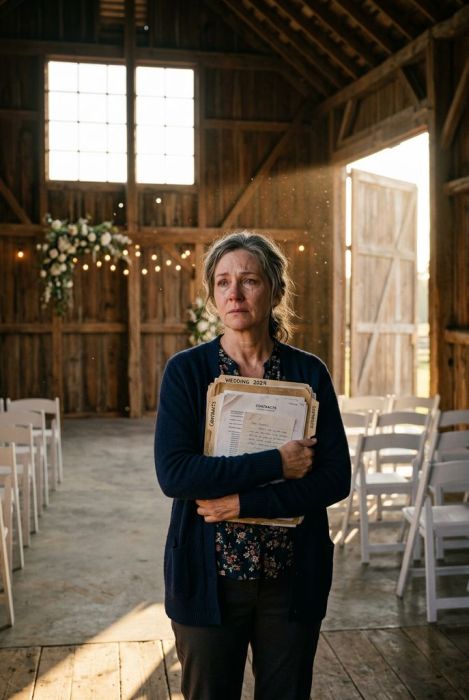
His trucks were seized. His house went to auction, which felt like a kind of poetry that no judge could have written. The warehouse was opened to the families, and forty-one loads went home. Some of them had waited more than a year. One woman in her eighties got back her wedding dress, still in the box. A young couple got back the crib their baby had grown out of somewhere else.
My china made it. Every plate, every cup, right down to the chips my mother had always called character. I carried it into my little house in Fort Worth and set the table for Thanksgiving with Lily's high chair beside it and Ray's rocking chair in the corner where my father had built it to fit.
Ernie went to work for the state consumer protection division, which means that somewhere in Arizona there is a man in a red polo who now spends his days teaching people exactly how the other men in red polos used to rob them. I do a talk at the senior center twice a year, and I always bring the bill of lading. It's the one thing Dale never checked. People ask me why I keep it, and I tell them the truth. I keep it because it's a receipt for something I thought I had lost forever, and because the next time someone tells you they will carry what you cherish, you should ask to see their papers.