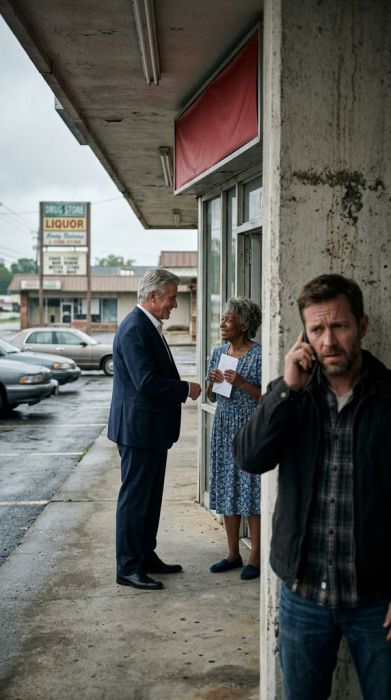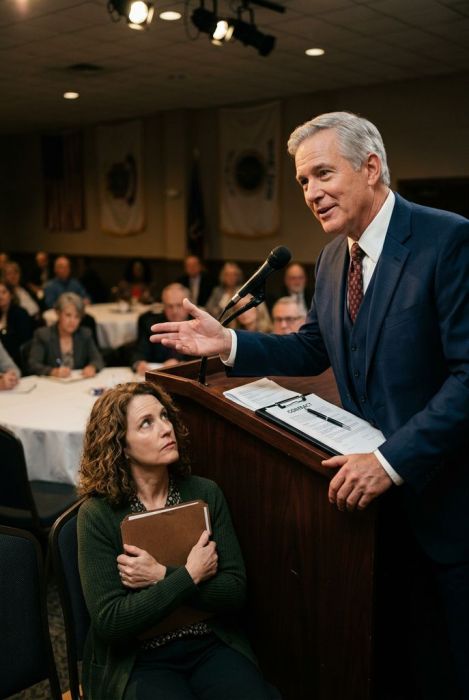
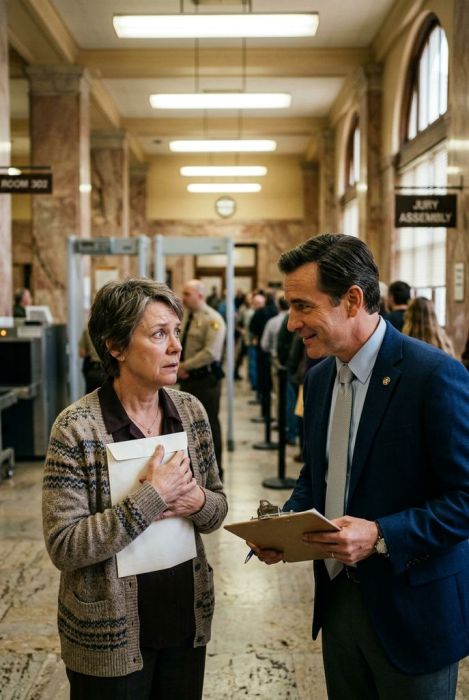
The man in the courthouse lobby had the kindest eyes I'd seen in years. He wore a navy blazer and a silver tie, and he carried a clipboard like he'd been born holding one. When I told him my son Caleb hadn't been released, his face folded into genuine concern, and he patted the seat beside him and said, "Honey, sit down. Let me sort this out."
I sat. I was so tired I would have sat on a burning stove that afternoon. It had been seventy-two hours since the phone call from the county jail, seventy-two hours of not sleeping, of reheating coffee I never drank, of standing in the same line at the same window and being told to come back tomorrow. My son, who fixed furnaces for a living and sent me flowers every Mother's Day, had been pulled over for a broken taillight and arrested on a warrant from six years ago—a speeding ticket he'd forgotten to pay in college, one that had grown collection fees and teeth until it turned into a bench warrant. Failure to appear. No violence, no drugs, nothing dangerous. Just paperwork and bad luck wearing handcuffs.
And then this man had appeared, as if the Lord had sent him. His name was Denny Calloway, and his business card said Gateway Bail Bonds, Suite 210. He showed me a laminated license with the county seal, and he explained in a voice like warm gravel that the judge had set Caleb's bail at seventy-five hundred dollars. He would post the bond himself, he said, for a ten percent premium plus a processing fee, and because of the weekend and the holiday pay for the bondsman on call, the total came to just about the entire amount. He was very sorry about that. He'd tried to talk them down.
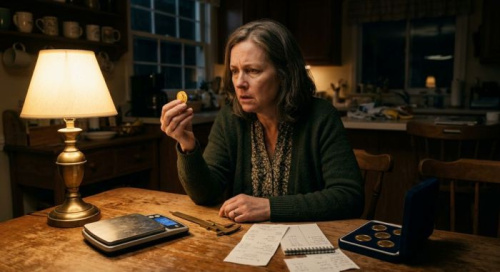
I didn't ask questions. That's the part that keeps me up at night. I didn't ask for a second opinion, or call the number on the card to check, or wonder why the county seal was slightly crooked. I was a fifty-eight-year-old hairdresser with three hundred dollars in checking, a paid-off Camry, and a son I would have sold my own bones to protect. I drove to my bank and did something I'd never done in my life: I withdrew my grandmother's CD, the one that had been maturing quietly since 1998, and I counted out seven thousand five hundred dollars in cash.
Denny met me back in the lobby with a receipt book and a smile. He wrote my name, Cora Jensen, and the amount in careful blue ink, tore out the customer copy, and handed it to me with both hands, like it was a diploma. "He'll walk out at six," he said. "You go home, make him something good, and don't worry about another thing."
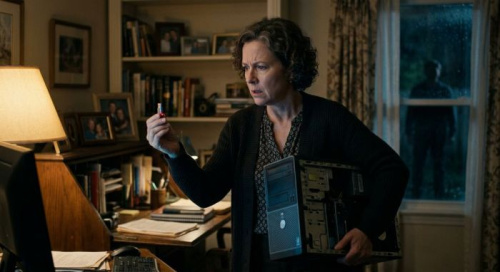
I went home and made meatloaf. I can still see myself doing it, standing at the counter in my good apron, mashing potatoes, glancing at the door. At six o'clock, the door didn't open. At seven, I called the number on the card. It rang eleven times and went to a mailbox that was full. At nine, I called the jail and asked for my son, and the woman on the phone said there was no bond on file under my name or his.
He stayed in jail that weekend. I stayed in my kitchen, in the dark, with the meatloaf going cold on the counter.
Monday morning I was back at the courthouse before the doors opened. I found the window with the sign that said BAIL BONDS AND LICENSES, and I put Denny's card on the counter and asked the clerk, a young woman named Renee Olmos, where Suite 210 was. Renee looked at the card like it was a dead bird. "Ma'am," she said, "there is no Suite 210. There's no Gateway Bail Bonds. And there's no license under Denny Calloway."
I felt the floor tilt. "He showed me a license."
"Then he showed you a good forgery," she said, and her voice went soft, the way nurses' voices do before they give you bad news. "You're the fourth person to show me this card since January."
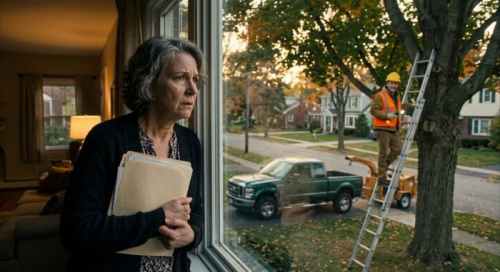
The fourth person. I gripped the counter and made myself breathe. My grandmother's money, my emergency, my promise to myself that I would never be a burden to Caleb the way my mother had been to me, had gone into the pocket of a man with kind eyes and a laminated lie. Caleb was still in a cell, eating jail food, losing his job by the hour, because I had tried to save him and instead had handed our whole future to a stranger in a blazer.
I should have screamed. That's what I wanted to do. But one of the things thirty-four years of cutting hair teaches you is that rage makes people stupid and quiet makes people listen. So I asked Renee, very calmly, if there were cameras in the lobby.
There were. And Denny Calloway knew every single one of their blind spots. That was the first clue that he was not a small-time jackleg. The camera above the south door cut out at 12:03 on Friday and came back at 12:11, exactly the window when he'd written my receipt. The camera in the east hallway was pointed at a plant. The only usable footage was from the coffee cart, and it was the woman who ran it, Noelle, who remembered him, because he'd bought a chamomile tea and thrown his little black receipt book in the trash when he thought nobody was watching.
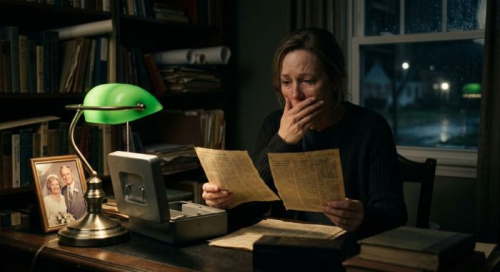
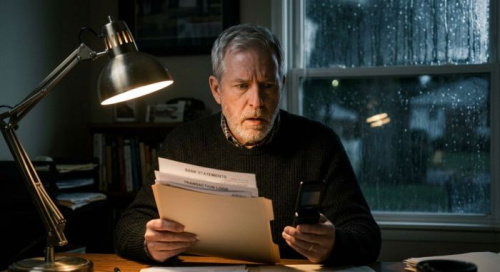
Noelle fished it out for me. I will never forget the weight of that book in my hands. It was one of those old two-part carbon books, worn at the corners, and inside were fourteen pages with names and dollar amounts—mine on the last page, and before mine a woman named Frances who paid six thousand in March, a man named Walter who paid four thousand eight hundred in May, a couple in August who paid nine thousand in cash, all of them written in that same careful blue ink. Every page was a family at their worst moment. Every page was my meatloaf going cold.
I found Walter Sizemore through the phone book, an old widower in Mishawaka who'd paid nearly five thousand dollars to get his grandson out of the county jail and then been too ashamed to tell anybody when the boy stayed locked up. When I showed up at his door and told him what had happened to me too, he cried. He'd been carrying that shame alone for five months. "I thought I was the dumbest man in Indiana," he kept saying, and I told him, no, the dumbest man in Indiana is the one who wrote the receipt.
That's when I got mad enough to get lucky. Walter still had the business card Denny had given him—a different card, from a different company, with the same warm-gravel name on it: Gary Endicott, Indiana Bail Services. And a voicemail too, a smooth voice confirming an appointment at a county jail in Michigan. Walter had saved it because he'd wanted to leave a review. I wanted to do more than review him.
I called the county fraud unit and asked for a detective, expecting to be shuffled to a voicemail that never called back. Instead I got Detective Paula Whitaker, a woman with a voice like sandpaper and twenty-two years of catching people exactly like Denny. Paula already had a file on him. Not under Denny Calloway, not under Gary Endicott, but under Dennis Oakes, a convicted con man who'd done time in Ohio for theft and had an active warrant in Michigan for the exact same trick. "Mr. Clipboard," the deputies called him. He'd been working the courthouse circuit for two years, always with a fresh alias, a laminated license, and a receipt book.
I asked Paula how we caught a man who never stayed in one county long enough to be recognized. And Paula, who had been waiting for somebody like me to call, said the best way to catch a fisherman is to put a fish on his hook.
That was the beginning of the trap. I told you I'd learned something from thirty-four years of listening to people: I knew Denny's pattern by heart now. He didn't chase his marks; he waited for them to come to him, desperate and tired, at the courthouse. So we gave him what he wanted. Paula arranged for a real booking—her own nephew, a college kid who owed the county nothing but agreed to help—brought in on a minor trespassing charge that would be dropped the moment the paperwork was done. Then she called me and said it was time to be an aunt.
I drove to the courthouse on a Thursday morning with six thousand dollars in my purse, every bill photocopied and dusted with powder that glowed blue under a bank light. I wore the same cardigan I'd worn the first time, and I stood in the lobby, and I let my face do what tired faces do. It took him eleven minutes to find me. I watched him come across the marble floor, clipboard out, navy blazer, silver tie, kind eyes. He'd changed his hair color, brown now with gray at the temples, and his name this time was Kevin Mercer of Hoosier Bail Services. He sat down beside me, touched my arm, and said, "Honey, tell me everything."
While he wrote my fake receipt in his fresh little book, three deputies in plain clothes were watching him from the stairwell. While he counted my marked cash twice, a camera above the water fountain that he'd never bothered to check was recording every second. When he stood up and told me my "nephew" would be out by noon, Detective Whitaker tapped him on the shoulder and said, "Mr. Oakes. Or do you prefer Endicott? Calloway? Mercer?"
He ran. Of course he ran. People like Denny always think they can outrun the moment their luck turns. He made it ten feet before a deputy put a hand on his collar, and he went down hard on the marble, and the money went everywhere, and I stood there watching the blue powder glow on his hands like stars. It was the most beautiful thing I ever saw that wasn't my son's face.
My son's face came later that afternoon, when the magistrate reviewed the case and released Caleb on his own recognizance—no bond, no fee, no Denny. It turned out the whole thing could have been free the entire time. That's what made me angriest, and that's also what made me strongest at the sentencing. Because when they searched Denny's apartment in Portage, they found a filing cabinet full of laminated licenses, twelve receipt books, and a ledger of victims across five states: forty-one names, three hundred and twelve thousand dollars, stretching back eleven years. The man had been collecting people's worst days like trading cards.
He took a plea in the end. Seven years in Indiana, plus a warrant waiting in Michigan, plus a probation violation in Ohio, which meant he'd be an old man when he finally walked free. Restitution on every dollar, including the six thousand we handed him in marked bills, which we'd already recorded and recovered, so the judge ordered that money to Walter and Frances and the others first. Forty-one victims. Fourteen of them stood in that courtroom, one by one, and told the judge what seven thousand or four thousand or nine thousand dollars had meant to them.
Walter Sizemore went before me. He stood up tall in his good jacket and said, "Your Honor, I'm seventy-one years old, and I've been ashamed of myself since May. This woman sitting back there is the first person who ever told me it wasn't my fault." Then he turned and nodded at me, and I cried harder than I'd cried since my husband Tom died.
Denny, Dennis Oakes, whatever name he was wearing that day, never once looked at us. He stared straight ahead while the judge read his sentence, and I understood that for men like him, looking at the people they've hurt is the one punishment they can't schedule around.
It's been a year now. Caleb still works at the furnace company. His boss held his job, and his crew bought him a toolbox when he came back. I still own Cora's Cuts, and a few of the women in town know the whole story, and they leave me extra-large tips in the spring, which I pretend not to notice. Walter and I get coffee every third Tuesday with three of the other victims, and we laugh more than you'd think. We call ourselves the bond club, and nobody gets to join unless they've been robbed by a man with a clipboard.
I think about my grandmother sometimes. The CD she left me was supposed to be my safety net, and for a few terrible days I thought I'd thrown it away on a liar with kind eyes. But here's what I know now: safety was never in the bank. Safety was the boy who came home, the clerk who took my card seriously, the detective who'd been waiting for my call, the old man who stood up in court and said it wasn't my fault. Denny took my money and my peace for a while. He never got my people, and in the end, that's what destroyed him.
The receipt book is in my nightstand drawer, under my grandmother's handkerchief. I keep it to remind myself that evil gets sloppy when it thinks it's winning. I keep it because fourteen names in blue ink turned one desperate woman into the trap that caught a man who thought he'd never be caught. And some mornings, when the light hits that worn black cover just right, I open it to the last page—the one with my name on it, the one that started all of it—and I smile.
The man with the kind eyes and the silver tie thought he'd robbed a tired woman at the county courthouse. He never figured out that the tired woman was the one setting the hook. My grandmother used to say that some people spend their whole lives writing checks that karma has to cash. When Dennis Oakes sat in that courtroom listening to fourteen victims read their losses out loud, I watched him finally see the balance. And it was everything.