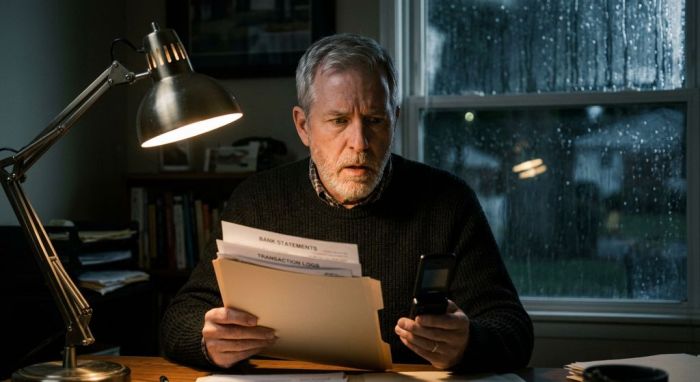
The night Diane filed for divorce, she stood in the doorway of our clinic and told me she'd hired a private investigator to prove I was the one stealing from us. Thirty-two years of marriage, and she delivered those words the way she used to announce that dinner was ready — flat, practiced, already certain of the outcome. She said them loud enough for Mrs. Harmon, who sat in the waiting room with her trembling beagle, to hear every syllable. The woman who had run our front desk for three decades looked at me like I was a stranger she'd caught going through her purse.
I should have been devastated. I was — but not for the reason she assumed.
Because two days earlier, I had found the first empty account. And I hadn't told a single soul.
My name is Tom Mercer, and for thirty-two years I've been the veterinarian in Harmony Creek, Ohio, a town small enough that everyone knows whose dog is limping before I do. Diane and I built the clinic together in 1992, when I was a green vet with more student loans than sense and she was the only person in the county willing to answer phones for a salary that barely covered gas. She painted the sign herself — "Harmony Veterinary Clinic" in cheerful yellow letters that still peel at the edges. She was the face of the place, the voice that calmed panicked owners, the woman who sent birthday cards to every animal we'd ever treated.
Everyone in town adored her. That was the hardest part of what I eventually learned.
Our daughter Emma was born in 1995, and for a long time we were the picture of a small-town success story. The clinic grew. We added a second exam room, then a surgery suite, then a boarding wing. Diane handled the books the way she handled everything — with an efficiency that made me feel like the lucky one. She'd say, "You heal them, honey. I'll keep the lights on." And I believed her. I believed her completely.
The changes started slowly, the way a river changes course — imperceptibly, until one day you look up and the water isn't where it used to be.
It began after Emma moved to Columbus to become a nurse. The house felt quiet. Diane started going to "accounting seminars" in the city, one weekend a month, always with a bright smile and a new handbag. I was proud of her, honestly. I told myself she was reinventing herself, that an empty nest had made her restless, that she deserved to do something for herself after thirty years of holding everything together.
I was a fool. But a fool with good instincts, as it turned out.
The first real clue came in the winter, during a routine inventory. Our heartworm medication numbers didn't add up. We'd purchased two hundred doses in October, but the log showed we'd dispensed only a hundred and forty. Diane laughed it off — "Vicki must have miscounted, honey" — and Vicki, our sweet young tech, went red and apologized for an error she never made. I let it go. I'm a veterinarian, not an accountant. I trusted the woman I loved.
The second clue was a vendor check. I found it in the mail stack by accident — a payment to something called Aurora Consulting LLC for "practice software licensing," twenty-four thousand dollars a year. I didn't remember signing it. When I asked Diane, she barely looked up from her desk. "IT services, honey. You know, the new system. I handle these so you don't have to bother."
I didn't bother. God help me, I didn't bother.
Then came the break-in back in January. Someone forced the back door of the clinic and stole a small supply of controlled medications. The insurance company insisted we upgrade the security system, including a camera in the rear office where we kept the drug cabinet and the file cabinets. Diane rolled her eyes about the whole thing. She didn't know the new camera also covered the bookkeeping desk in the corner, and that the system recorded audio. Neither did I, at first. The technician just said, "Full coverage, doc," and I signed the paperwork.
I didn't check the footage until the night I found the empty account.
That night is burned into me. It was the Tuesday after Diane's "seminar," and I was alone in the house for the first time in weeks because she'd announced she was staying at her sister's place in Millersburg "to think." I went to pay bills online, which I did once a month, and I opened our joint savings account the way I had ten thousand times before. The balance should have been roughly two hundred and forty thousand dollars — the cushion we'd built for Emma's future, for our retirement, for the clinic's expansion we'd talked about for years.
It was twenty-two thousand. And change.
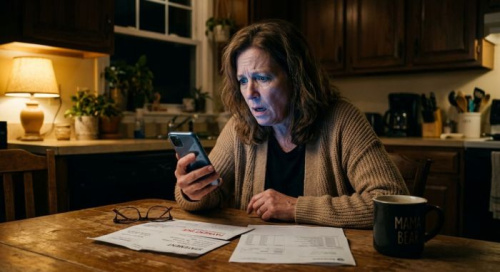
I stared at the screen until my eyes watered. I refreshed it three times. I called the bank, and a tired-sounding customer service rep named Marcus told me, with that rehearsed sympathy they use for people like me, that there had been a series of transfers over the past five years to an account at another institution. "You'll want to check with your financial advisor, sir."
I didn't have a financial advisor. Diane had started handling "the big picture" years ago, and I'd been glad to let her.
That night, I sat in my truck in the clinic parking lot with the engine off, and I pulled up the new security system's app on my phone. I scrolled back through the recordings from the rear office, looking for — I don't know what I was looking for. Proof that I was wrong. Proof that there was an explanation, a mistake, anything.
I found proof of something else entirely.
There, on the screen, was Diane — my Diane, the birthday-card lady, the town's favorite front-desk voice — sitting at the bookkeeping desk at eleven p.m. on a Thursday, holding a phone I'd never seen before. A cheap little prepaid phone, the kind you buy at the gas station with cash. She was smiling into it, and the audio caught her words clear as church bells.
"Once the divorce is final, we'll sell the clinic and be in Naples before the snow flies. Tom thinks Aurora is a software company. He doesn't even know the word 'invoice.'"
The man's voice on the other end laughed. "Five years, Diane. You're a genius."
"Not a genius, Darren. Just patient."
Darren. I knew that name. Darren Cole, the smooth-talking "practice consultant" who had sold us a software system eight years ago that never worked right, who had stayed in Diane's address book long after the contract ended, who sent her Christmas cards with return addresses in Columbus. I'd joked about him once — "That consultant sure does keep in touch" — and Diane had laughed and called me jealous.
She'd been laughing at me for years.
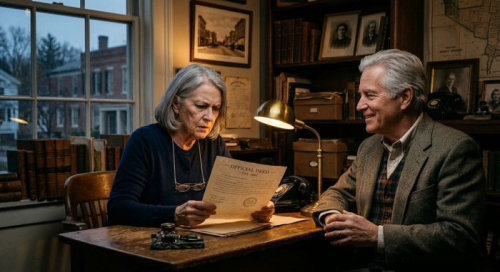
I won't pretend I handled it well. I spent that night in my truck, shaking, and then I spent the next morning sitting in the office of Ruth Calder, the only lawyer in Harmony Creek who didn't gossip, and I laid it all out. Ruth listened without interrupting, which is a rare and terrible thing when you're telling someone your wife has been robbing you for five years. When I finished, she leaned back and said, "Tom, you need to know something. Diane has already filed. She's alleging you've been draining the accounts to hide assets, and she's asked the court to freeze the clinic's operating funds."
She slid a document across the desk. It was dated three days earlier. My wife had filed for divorce before I'd ever seen the empty account.
That's when the real fog settled in. Because suddenly I understood: the empty account wasn't a robbery — it was a setup. Diane had emptied our savings, funneled the money into Aurora, and then planned to blame me. She'd spent years making herself look like the victim, the wronged wife, the saint who'd caught her husband stealing. And in a town like Harmony Creek, where everyone loved her and I was just the quiet man who smelled like dogs, the story would write itself.
Ruth filed our response and a motion to preserve evidence. Then we waited.
And then, three nights before the divorce hearing, my phone rang at 11:47 p.m. I almost didn't answer it — I'd been staring at the ceiling, doing the math on how much of my life Diane had sold to Darren Cole. But I answered. A man's voice said, "Tom Mercer?"
"Who's this?"
"My name's Ellis Crane. You don't know me, but your wife hired me two weeks ago."
I sat up so fast I pulled something in my back. "She — what?"
"She hired me to find your hidden assets and, quote, 'any women on the side.' She wanted me to bury you, Mr. Mercer. She paid me five thousand dollars up front, and she's got another five waiting when I deliver something she can use in court."
I felt the room tilt. "Did you find something?"
A long pause. Then Ellis Crane said, "I found her, Mr. Mercer. I've been a private investigator for nineteen years, and before that I was a state trooper. I've seen a lot of crooked people. But it takes a special kind of person to spend five years bleeding a good man dry and then pay someone to frame him for it."
I couldn't breathe. "You — you were working for her."
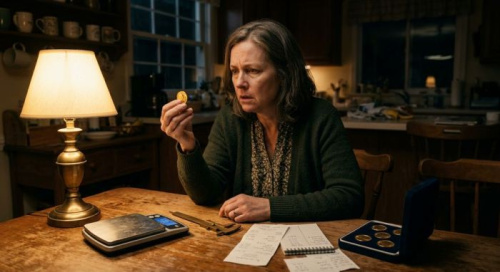
"I was. And I called you the minute I knew what she was." He cleared his throat. "I followed her for three days, Mr. Mercer. Your wife goes to a storage unit in Millersburg under her maiden name — it's packed with new furniture, boxes of jewelry receipts, and a cash box with about forty grand in it. She meets a man named Darren Cole twice a week at a motel off Route 62. And she keeps a second phone in her car, a prepaid thing she uses to call him. I photographed her using it, and I found it in the glove box when she left it parked at the motel. She thinks she dropped it in the parking lot."
"You — you took it?"
"I borrowed it. It's sitting in front of me right now, and I've got the messages saved. Do you want to know what your wife and Darren Cole have been planning, Mr. Mercer? Because I'll testify to all of it. I'd rather be the man who helped a good husband than the one who helped a thief bury him."
I cried then. I'd like to say I didn't, but I cried like a boy, right there in the dark, while a stranger I'd never met held my wife's secrets in his hands. And when I could talk again, I told him yes. Yes, I wanted to know everything. Yes, I'd pay his fee. Yes, I wanted to see her face when it all came apart.
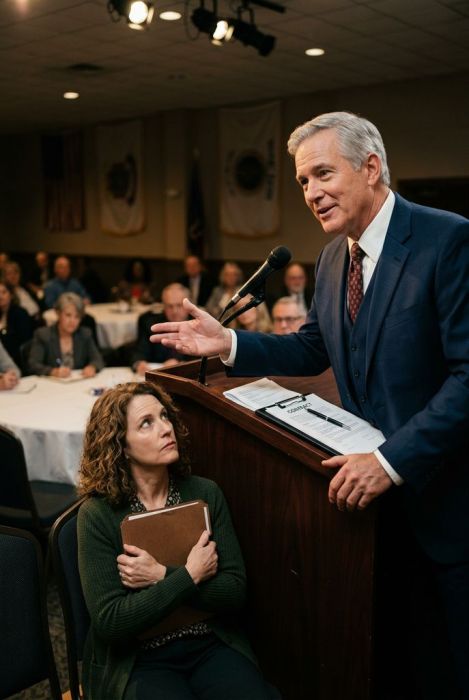
The hearing was set for nine o'clock on a Thursday in the county courthouse, in the mediation room with the windows that looked out over the old town square. Diane arrived twenty minutes early, in a pearl-gray dress she'd bought for the occasion, and she looked like the aggrieved widow of a marriage that had died by my hand. Her lawyer, Gerald Voss, was a shark from the city with a suit that cost more than my truck, and he began the morning with a performance worthy of a courthouse drama — the long-suffering wife, the faithful front-desk saint, the man who had bled their accounts dry and then tried to blame his wife for his own crimes.
He presented his "evidence." A string of transfers from our joint accounts, doctored to look like I'd made them. An email about a trip to Vegas, which I'd never written. A witness statement from a teller at the bank who'd supposedly seen me making large cash withdrawals.
Through all of it, Diane sat with a handkerchief pressed to her lips, her eyes glistening at precisely the right moments. She was good. She'd been good for thirty-two years.
Then it was Ruth's turn.
"Your Honor," she said quietly, "the respondent would like to introduce evidence of his own."
The judge — a patient, tired woman named Abrams — nodded. Ruth called her first witness: Ellis Crane.
Crane walked in with a worn leather satchel, and I watched Diane's face go through the whole journey in about four seconds. Confusion. Recognition. And then — I will never forget this — the dawning horror of a woman who understands that the man she paid to destroy her husband has just taken the stand on his side.
Crane laid it out methodically, the way he'd been trained to do for nineteen years. The storage unit in Diane's maiden name, Kessler. The photographs, dated and time-stamped. The cash box. The motel receipts. And then he held up a plastic evidence bag containing a small prepaid phone.
"Your Honor," he said, "this is the phone Mrs. Mercer kept in her car. The messages on it are between her and a man named Darren Cole. I'd ask the court to admit them — because they show a five-year plan to embezzle two hundred and eighteen thousand dollars from the clinic through a shell company called Aurora Consulting, and then to blame her husband for it."
Gerald Voss was on his feet, objecting, his voice climbing into a register I hadn't heard outside of opera. But the judge held up her hand, and the room went quiet, and the first message was read aloud. It was dated three years ago, a text from Diane's second phone: "Another invoice for Tom to sign in the pile. Aurora takes its cut Friday. Two more years and we're in Naples."
The mediation room went so silent I could hear the clock on the wall.
Then Ruth played the second piece. The security footage from our own clinic, the rear office, with audio. There was Diane at the bookkeeping desk, holding that same prepaid phone, laughing. "Tom thinks Aurora is a software company. He doesn't even know the word 'invoice.'"
Diane's handkerchief dropped. Her lawyer's face had gone the color of old paper. And the door at the back of the room opened, and Detective Paula Reyes of the county sheriff's office stepped in with two deputies, holding a warrant that Ruth's team had filed the previous afternoon — a criminal complaint for theft, embezzlement, and attempted fraud, based on the evidence Crane had handed over and the recordings I'd provided.
"Frances Diane Mercer," Detective Reyes said, in that flat, professional voice they teach you at the academy, "you're under arrest."
Diane looked at me then. I'd like to tell you there was regret in her eyes, or shame, or even fear. But what I saw was something colder — fury. Not at being caught. At being caught by me.
"Tom," she hissed, as the deputies took her arms, "you're going to regret this. Everyone in this town —"
"They already know, Diane," I said. "They're going to find out."
It took eleven months for the case to wind through the courts. The evidence was overwhelming: the second phone, the shell company registration in Darren Cole's name, the storage unit, the bank records, the security footage, and Ellis Crane's testimony. Diane's lawyer withdrew from the case before the preliminary hearing. She hired two more lawyers after that, each one quitting faster than the last.
In the end, she took a plea. Felony embezzlement, grand theft, and attempted fraud. Five years in state prison, full restitution of two hundred and eighteen thousand dollars — the court seized her share of the house, the car, everything she'd stashed in that storage unit. Darren Cole was charged as her co-conspirator and convicted a month later; he got four years and a lifetime ban from doing business in Ohio. The judge said, and I'll never forget it, "This is a case about trust — and what happens when someone spends years trading it for cash."
The town of Harmony Creek found out, of course. They always do. And I braced myself for the whispers, for the people who'd loved Diane and doubted me. What I didn't expect was how quickly they turned. Vicki, our vet tech, told me she'd quit twice because Diane made her feel like a criminal — and she'd kept the old inventory logs, the ones that proved Diane had been doctoring the counts for years. Mrs. Harmon brought me a pie and apologized for the look she'd given me the night of the filing. The mayor called to ask if the clinic would still sponsor the summer pet fair.
It took me a year to feel like myself again. Emma moved home for six months to help me run the place, and somewhere in that time, I stopped feeling like a victim and started feeling like a survivor. We reopened the Saturday free vaccine clinic that Diane had quietly killed off years ago — she'd called it "bad for revenue," and I'd believed her. People lined up around the block. I stood in the parking lot with a puppy in one arm and a vaccine kit in the other, and I realized I'd been so busy loving a woman who was lying to me that I'd forgotten how much this town loved me back.
The last time I saw Diane was at her sentencing. She stood in the same gray dress she'd worn to ruin me, and she looked smaller than she ever had behind that front desk. She didn't look at me. She didn't look at Emma, who came to support me. She looked at the judge, and she said, "I'm sorry," in a voice that sounded like she meant it for herself, not for anyone she'd hurt.
I won't tell you I felt sorry for her. I won't tell you I felt nothing, either. What I felt was the weight of thirty-two years lifting off my shoulders, slowly, like ice finally breaking up on the river in spring.
Ellis Crane still calls me every few months to check in. He retired last year, and he came to Harmony Creek for a fishing weekend — the town gave him a plaque at the diner for "services to justice above and beyond." He laughed about it, but he kept the plaque. So did I, in my office, next to the photo of Emma holding a rescued collie and the yellow clinic sign that Diane painted in 1992.
I kept the sign. I'm not sure why, except that it reminds me that something good was built here once — and that I'm the one who gets to keep building it now, without a thief in the front office telling me how lucky I am.
Karma, in my experience, doesn't wear a cape. It wears a cheap prepaid phone, a storage unit key, and the face of an honest private eye who decided that justice mattered more than a paycheck. And when it finally showed up in Harmony Creek, it didn't miss. It never does.