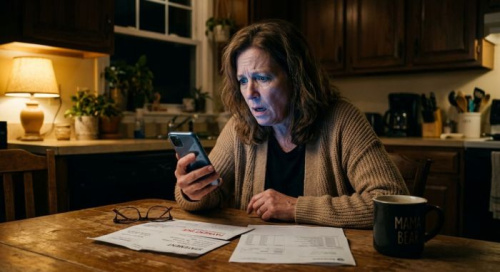
The night I watched Chet Moran open my mother's mailbox with a flashlight in one hand and thin gloves on the other, I told myself I was seeing things. It was 2:10 in the morning, and the motion light above our garage had been dead for weeks. That's why I'd finally ordered the little solar camera from the catalog my mother kept beside her recliner. The red light blinked at the edge of my phone screen, and I leaned closer, certain it was a raccoon or the wind. It was none of those things. It was Chet, the mailman everyone on Rural Route 4 adored, and he was sliding an envelope into the pocket of his own jacket.
I'd grown up on that route. From the low-water bridge to the county line, every family knew Chester Moran. For eighteen years he'd driven the same gray Jeep with the steering wheel on the wrong side, waving from the driver's seat, stopping to hand-deliver packages to whoever was home. He remembered birthdays. He knew which dogs were friendly and which ones would bite. When my father died two winters ago, Chet was the one who found Mama sitting on the porch with the mail still in her lap, and he stayed for two hours until my sister could drive down from Morgantown.
When I moved back to Harlow, West Virginia, to help Mama recover from her hip surgery, Chet made it his personal mission to look after her. He carried her mail up the gravel path so she wouldn't risk the ice. He brought her a casserole the week I unpacked my boxes, and he stayed for coffee, telling her she was the strongest woman on the route. Mama lit up when she heard his Jeep coming. Everyone did. So when I called my sister that night and told her what I'd seen on the camera, she laughed and said I'd been watching too many true-crime shows.
Maybe she was right. Maybe I was letting my imagination run wild. But the proof had been stacking up for weeks, and I couldn't shake the feeling that something in our little hollow had gone horribly wrong.
It started with Aunt June's birthday card. Mama's older sister never missed a year — forty-two birthdays running, always a card and twenty dollars in crisp bills folded into the center crease. The card arrived on time, but when Mama opened it, the envelope was empty. She held it upside down and shook it, then checked the floor, then checked the porch. She called Aunt June, who swore she'd put the money in herself. Mama laughed it off and said the money must have slipped out in the post office. But I saw her go back to that envelope later that night, running her fingers along the inside like she was trying to summon twenty dollars out of thin air.
Then came the Social Security check. Mama's retirement check always arrived on the third of the month, regular as church on Sunday. In April it didn't come. She called the Social Security office and they told her the check had been mailed, same as always, and that she should wait another week. When it still didn't come, we drove to the county office in Redwood, stood in line for an hour, and filed a report for a lost check. Mama was quiet on the drive home. "I'm getting old, Dana," she said. "Things slip past me. I probably forgot where I put it."
That was the part that broke my heart. My mother spent thirty-three years teaching third grade and never once lost a child's permission slip. She kept every receipt since 1974 in a shoebox under her bed. She was not the kind of woman who misplaced things. And yet here she was, blaming herself because someone had taken what belonged to her.
I started paying attention after that. Pearl Winslow down at the crossroads complained to me at the gas station that her pension check had gone missing two months running. Bill Pearson said a package of hunting supplies never arrived, even though the tracking said delivered. And every single time, Chet had an answer. It was the new sorting machine in Charleston. It was kids messing with rural boxes. It was dogs running off with the mail, same thing happened to him once, don't you worry, they'd figure it out.
Nobody blamed Chet. That's what kept gnawing at me. Nobody ever blamed Chet, because Chet was the one who brought the bad news with a sunny smile and a promise that he'd personally keep an eye on things. He told Mama he'd put a card in his visor reminding him to triple-check her box. She told me that story like it was proof of his goodness, and I didn't have the heart to tell her what it really sounded like.
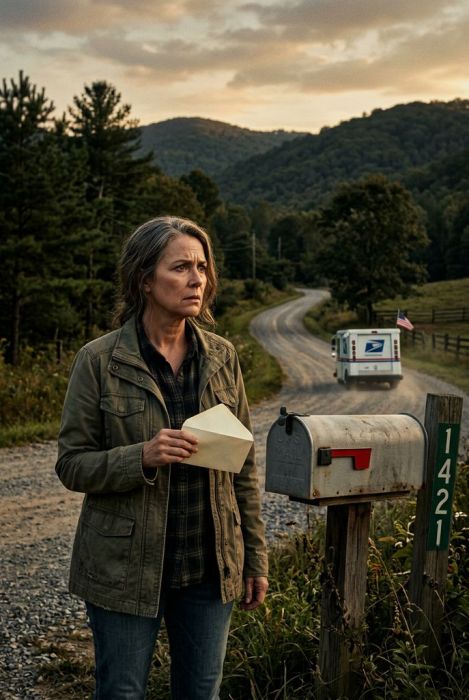
The first time I saw Chet with one of my mother's envelopes, my stomach dropped. It was a Wednesday, and I was home early painting the porch railing. His Jeep pulled up, and he walked the mail to the box, same as always, friendly wave, silly salute. But that afternoon, when Mama went to collect her mail, she came back with three bills and no check. I walked down to the mailbox myself. The flag was up, exactly where I'd left it. And in the grass beside the post, half-hidden, I found a scratched-out address — my mother's name, scratched out with a ballpoint pen.
I didn't tell Mama. I didn't tell my sister. I thanked my years of hospital night shifts for teaching me to keep a calm face while my mind ran in circles. Instead, I started keeping a notebook, just like the ones I used for my patients. Date, time, mail expected, mail received. After three weeks the pattern was plain: anything of value that came to our box in an envelope — checks, cards, anything that looked like it might contain money — only made it to the house if Chet was off duty that day.
The day I went to the post office in Harlow, I almost turned around a dozen times. The clerk behind the counter was a kid with a pimply face who couldn't have been older than my son, and I could feel how crazy I sounded. "Ma'am, the carriers are screened," he said. "They take loyalty oaths. It's federal." I nodded and walked out, and for a few days I convinced myself the whole thing was in my head. Then my mother called me from the kitchen, her voice small and strange. "Dana," she said, "my wedding ring is gone."
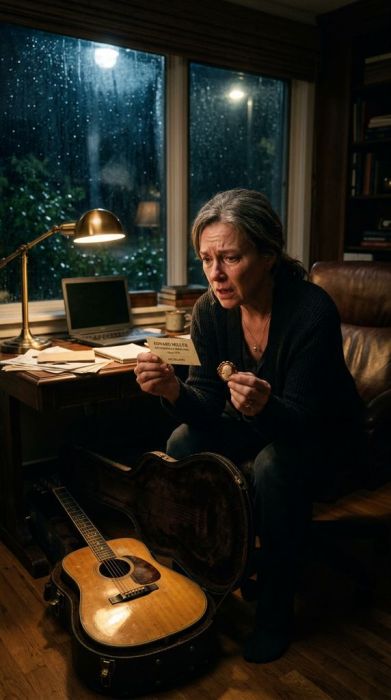
My father's mother gave Mama that ring fifty years ago. Gold, with a tiny diamond, and inside the band the date they got engaged. Mama never took it off, not for surgery, not for anything, except when she washed dishes, and on those rare nights she kept it in the little porcelain dish on the windowsill. I asked her when she'd last worn it. She said the day before, when she'd gone to her doctor's appointment. I searched her bedroom twice and found nothing. I called the clinic and they said they had no lost-and-found ring on record. I didn't have proof of who took it. But I had a pit in my stomach the size of the Chesapeake, and I finally listened to the voice that had been whispering for weeks. I called the U.S. Postal Inspection Service and left a message.
The next day, a woman named Rose Delgado called me back. Inspector Delgado had a calm voice and an accent sharper than anything else in our county, and she listened without interrupting while I told her about the empty card, the missing checks, and the camera I'd installed. Then she asked me to meet her at a diner in Redwood, the kind of place where nobody asks questions. She had a folder with her. "We've had a pattern for about fourteen months," she said. "Rural routes in three counties. Missing pension checks. Banks keep flagging the same name cashing them in Ohio." She slid a photograph across the table. The man in the photo wore a baseball cap and cheap sunglasses, but I would have recognized that slump of the shoulders anywhere. I'd watched it my whole life. "That's his brother-in-law," she said. "And this," she tapped the folder, "is the case we've been waiting for."
I asked her what she needed from me. She said she needed me to be patient, and she needed Mama to request a reissued check — a real one, with a registration number they could track. Then she handed me a small plastic bag, no bigger than a sandwich bag, with a white powder inside that glowed blue under a lamp. "You're going to dust the outside of the envelope before you drop it in the box," she said. "We'll have eyes on the route the whole time."
The next two weeks were the longest of my life. Mama thought we were just testing the new system, and I let her think that, because the thought that her trusted mailman might be the one stealing from her would have broken what was left of her faith in people. We got the reissued check, and I locked it in my car's glovebox until the morning the inspector said to put it in the mail. And I was the one who walked it down to the box, my hands shaking, the little blue-dusted envelope warm and heavy in my palm.
That night, at 2:10 in the morning, my phone buzzed on the nightstand. I'd set the camera to notify me the moment anyone came within ten feet of the mailbox. I watched the grainy footage roll: a dark figure walking up the gravel road with a flashlight held low, the familiar slump of the shoulders, the gloved hand reaching into the box, the envelope disappearing into the pocket of the jacket. I watched it three times before I believed what I was seeing. Then I called Rose Delgado and said, "You'd better come."
They arrested Chet Moran the next morning at the end of our driveway, in front of every neighbor who'd ever loved him. The inspectors came in an unmarked car and two marked ones, and they found the powdered envelope in the pocket of his jacket along with three other pieces of mail he'd lifted along the route. In the back of his Jeep, wrapped in a tarp under the spare tire, they found a shoebox full of cards and cash and a notebook with dates and names written in his tidy hand — every check he'd taken in all those years of small betrayals, and a pawn ticket that traced my mother's wedding ring right back to him.
Mama stood on the porch with her hand over her mouth. When they put Chet in the back of the cruiser, he looked up at her, and for one long second I thought he was going to say something. He didn't. He just looked at the house where he'd eaten casseroles, the porch he'd fixed, the woman he'd told was the strongest on his route, and then he dropped his head and stared at his knees.
The trial wasn't dramatic. It was quiet and sad and exactly as federal as the clerk had promised. Chet admitted to everything. Gambling debts, he said. A habit he'd hidden for twenty years, a monster that ate his paycheck and then his retirement and then, when there was nothing left, his decency. He'd started small — a card here, a stray ten there — and when nobody noticed, he got brave. He told the judge he always believed he'd stop in time. He told the judge he never meant to hurt anyone. And in the gallery, Pearl Winslow sat with her good ear turned toward the front, and my mother held my hand, and neither of them looked away when the judge read the sentence. Six years in federal prison, plus restitution that would follow him for the rest of his life, plus fines that ate his house, his retirement, and the last shred of the goodwill he'd spent eighteen years collecting.
The week after the verdict, the postmaster from Charleston drove to Harlow himself to apologize. He stood in the same spot where Chet's cruiser had been parked and told the neighbors that the Postal Service had failed them, and that a new carrier, a young woman named Mary Calloway, would be taking over the route. Mary is different in all the ways that matter. She waves, and she remembers our dogs, and she opens our box with her bare hand in plain daylight, never once reaching for it after dark.
It's been eight months since that night with the camera. Mama's checks come on the third of every month now. The pawnshop called the inspector the day after the arrest, and a week later I drove to Redwood and picked up the ring, still in its little white box with the clerk's handwriting on the lid. I gave it to Mama on a Sunday afternoon, and she sat on the porch with it in her open palm, turning it in the sun, letting the tiny diamond catch the light. For a long time she didn't say anything at all. Then she looked at me with that teacher's look, the one she used on children who'd done something brave and didn't know it yet. "You believed me, Dana," she said. "That's all I ever needed."
I still have the solar camera. It's pointed at the mailbox, and sometimes at two in the morning, when I can't sleep, I open the app and watch the empty gravel road glowing in the dark. Nothing ever comes down it now. And that, I've decided, is exactly the way it's supposed to be. The mailman everyone adored turned out to be the thief nobody suspected. But my mother got her ring back, her checks come on time, and the flag on our mailbox goes up and down like it's supposed to — trusted again, and finally safe.