The auctioneer's voice rolled over the gravel lot like a carnival barker, and I stood at the back of the crowd with my hands jammed in my pockets, watching them sell my mother's Buick. It was the fourth lot on the list. "Ruth Ellison, two thousand nine Buick LaCrosse," he called out, and the crowd shuffled without a single hand rising. A man in a stained baseball cap nodded toward the back row, and the gavel banged. Sold, to the only bidder, for three hundred and fifty dollars.
Three months earlier, my mother had parked that same car in the church lot on a Sunday morning in June. She'd gone in early to set up the coffee hour the way she always did, and when she came out, the space where her Buick had been was empty. A chalk mark on the asphalt. A faded tow number painted on the curb. She called me with a voice that was small and tight in a way I hadn't heard since my father died.
"Harold," she said, "someone took my car."
I told her to stay put, that I'd handle it. I was fifty-eight years old, retired from the county recorder's office after thirty-one years, and I still thought of myself as the son who fixed things for his mother. Ruth Ellison had spent her whole life taking care of other people, and the idea of her standing helpless in that parking lot burned something in me.
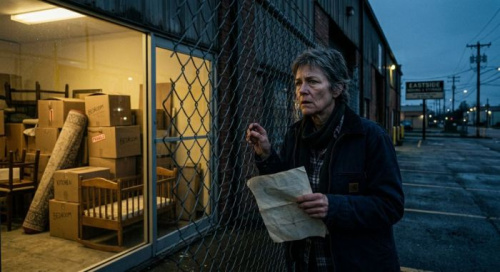
Wade Callahan's towing yard sat on Route 9 at the edge of town, behind a chain-link fence that always needed paint. The office was a trailer with a hand-painted sign: "Callahan's Towing & Recovery — We'll Get You Home." People said he'd built that business from nothing. He'd pulled my father's old truck out of a ditch in the blizzard of '88 and refused to take a dollar. For forty years, Wade was the name every family in the county called when they were stranded. He coached youth baseball, sponsored the fireworks, and stood at the front of the church every Easter Sunday in a suit that always seemed a size too big.
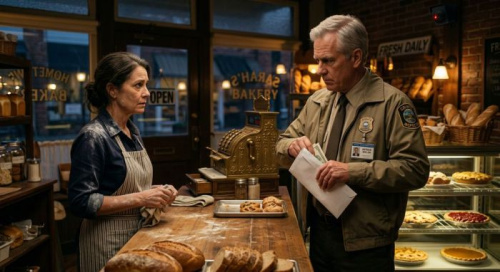
Inside the trailer, he smiled at me from behind the desk like I was an old friend. The room smelled of coffee and dust. He explained the situation slowly, kindly, the way you'd explain something to a child. The parking lot, it turned out, had a posted sign — had for years, he said — warning that vehicles without a current registration sticker could be towed at the owner's expense. My mother's sticker was from the year before, still valid, but the sticker on the plate in the back window had peeled and faded to almost white.
"It's the law, Harold," he said. "I hate it as much as you do."
The total was eight hundred and sixty dollars — tow fee, storage for three days, an administrative fee. I paid it with my credit card because I could see my mother waiting in my truck with her hands folded, and I couldn't stand the thought of her seeing the number. Wade wrote me a receipt by hand, in his big looping signature. I thanked him. I was raised to be polite, even when I was being robbed.
But that night, my mother told me about the glove box. She'd kept my father's wire-framed sunglasses in there for twenty years, along with a little brown rosary her own mother had given her in 1965. She opened the glove box in my driveway and showed me the empty space. "They're gone, Harold," she said. Not angry. Just tired. "Everything, gone."
I wanted to march back to that lot with a crowbar. Instead, I called the police. They were polite and useless. "Civil matter," they said. "We can't search a business over a pair of sunglasses." I knew they were right, and I hated them for it.
Two weeks later, the Buick vanished again, this time from the pharmacy lot on Main Street, where she'd left the car for nineteen minutes. Nineteen minutes. Wade's driver had to have been watching the lot. Storage this time: eleven hundred dollars after a weekend, because the lot closed Saturday at noon and wouldn't open until Monday. My mother called me crying, and I drove straight to Route 9 with my blood up.
This time I didn't pay right away. I stood in the trailer and demanded to see the tow log, the photos, the certification of the sign. Wade's smile never wavered. He showed me a Polaroid of the car on his flatbed, a timestamped log entry, and a photocopy of the ordinance. Everything looked right. Everything looked legal. "I'll tell you what," he said, leaning back. "I'll cut the storage fee in half, as a courtesy to your mother. She's a good woman."
Something in the way he said that — good woman — made my skin crawl. I paid. And while he was "helping" another customer, I took photos of the lot with my phone. That's when I started to see it.
The lot wasn't full of random cars. It was full of old cars — Buicks and Fords and Oldsmobiles, the kinds of cars people drive until the rust wins. Tucked against the fence in a row near the auction shed, I counted nine cars with handwritten storage tickets in the exact same handwriting. Half-covered by a tarp, I recognized Mrs. Kowalski's powder-blue Cadillac, the one her late husband had babied for thirty years. Next to it, Ray Delgado's silver F-150 with the camper shell and the "Honk if You Love Jesus" bumper sticker.
Mrs. Kowalski had complained to me at church potlucks about Wade for years. "Stranded me on Washington Avenue," she'd say, "right after I had my hair done. Nice man, but he charges like a cat burglar." Ray had told me about the time Wade towed his truck from his own driveway because the plates had a cracked screw hole and "didn't look secure." I'd listened and nodded and never connected the dots.
I connected them now.
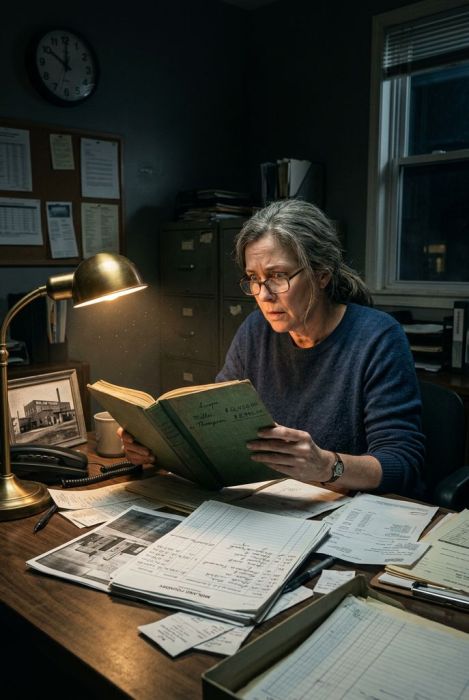
I was retired, but I still knew every clerk in the county office, and more importantly, I knew every form. Over the next month, I spent my mornings in the records room, pulling tow logs, auction filings, and title transfers. What I found made me sick.
Under state law, any towed vehicle had to be reported to the county within twenty-four hours, with a certified letter sent to the owner. Wade's filings were flawless — on paper. But the certified mail receipts I pulled from the county's copies showed a pattern that jumped off the page: on dozens of them, the owner's signature was written in the same heavy, looping hand. The same hand that had written my storage receipts. Wade Callahan had been signing the certified letters for the cars he stole, and nobody had ever looked closely enough to notice.
Then came the auctions. Every unclaimed towed vehicle was auctioned at the county fairgrounds, and the winning bidder, time after time, was a company called Riverbend Auto Sales. I pulled the business registration. Riverbend's address was a post office box in Millbrook — Wade's post office box. His wife Doreen was listed as the sole officer. Wade was buying his own stolen cars at his own auctions for pennies, then selling them to salvage yards downstate for triple. The cars with any value at all disappeared into a network of dealers who paid cash and asked no questions.
Forty-one cars in eighteen months. I counted them myself on a spreadsheet in my kitchen at three in the morning, my mother's LaCrosse number three on the list.
I took the spreadsheet to the state attorney general's office in Columbus. I walked in off the street, an old man with a folder, and asked to see someone who handled elder fraud. The investigator who came down was a woman named Melissa Tran, younger than my daughter, with sharp eyes and a patient way of listening. She opened my folder, and I watched her face change.
"We've had complaints about Callahan's for two years," she said quietly. "Towing charges, missing items, cars that seemed to vanish. But nobody could ever give us the paper trail. Mr. Ellison, this is the pattern we've been waiting for."
Two more weeks, and everything came together. Mrs. Kowalski gave a statement about her Cadillac. Ray produced the cracked title on his truck. The Aiken sisters' lawyer coughed up a letter from Wade demanding storage fees on their mother's old sedan weeks after the old woman had died. And I kept working quietly, because I wanted to be holding the proof when Wade realized he wasn't untouchable.
Wade, meanwhile, got bolder. The county paper ran a profile on him — "The Kindest Man on Route 9" — with a photo of him in front of his lot, arms crossed, smiling like a politician. He announced a charity barbecue for the youth baseball team to be held at the lot on the first Saturday of August. He even sent my mother a typed letter with a check for fifty dollars attached, "as a goodwill gesture." She showed it to me, confused. "He seems like a nice man, Harold," she said.
"Mom," I told her, "just hold onto that letter."
The morning of the barbecue, the lot was transformed. Folding tables, a rented grill, a bouncy castle for the kids. Wade stood on a small stage made of pallets, flanked by two county commissioners and the baseball coach, and gave a speech about community and hard work and the honest American way. He was halfway through presenting the team with a check — a check written from the same account that had bought forty-one towed cars — when the gates at the back of the lot opened.
Two unmarked state police cars came through first, then a third. Nobody noticed at first; everyone assumed they were there for burgers. Then Investigator Tran stepped out in a dark suit, holding a folder, and walked straight toward the stage. The chatter died. The barbecue smoke curled into the August sky.
Wade saw her and kept smiling for half a beat too long. Then the smile dropped.
"Wade Callahan," Tran said, loud enough for the whole lot to hear, "you're under arrest for felony theft, tampering with records, and organized fraud against elderly victims."
The handcuffs went on in front of the bouncy castle and the folding tables and the county commissioners. The search warrant turned up the ledger in his trailer, a green spiral notebook with every car, every fee, every "courtesy," and a milk crate in the corner of the shed. Inside the crate, wrapped in a flannel shirt, were the things people had accused him of stealing for years: watches, jewelry, a pair of wire-framed sunglasses. My mother's rosary was on top.
He tried to blame it on his drivers. He tried to say the recyclers had forged his name. The certified mail receipts and the handwriting analysis buried him. A jury took less than four hours. Wade Callahan was sentenced to seven years, ordered to pay three hundred and twelve thousand dollars in restitution to forty-four victims, and barred from ever owning or operating a towing business again. His lot went up for auction — a real auction, open to the public — and the county's veterans' association bought it and turned it into a proper, regulated towing co-op that charges by the published rate and not a penny more.
The day my mother's Buick was returned to her, she sat in the driver's seat and ran her hands over the wheel like she was greeting an old friend. Melissa Tran handed her the rosary personally. My mother held it for a long time, then looked up at me with wet eyes and said, "Harold, I think the good Lord still keeps a ledger."
I didn't argue with her. I'd spent a month reading the real ledger, and I knew she was right. Some people think karma is a fairy tale for the weak. But I've stood in a towing lot at dawn with a folder under my arm, and I've watched the kindest man in the county get handcuffed in front of his own neighbors. The universe keeps records. Sometimes, the records just need someone to carry them to the door.