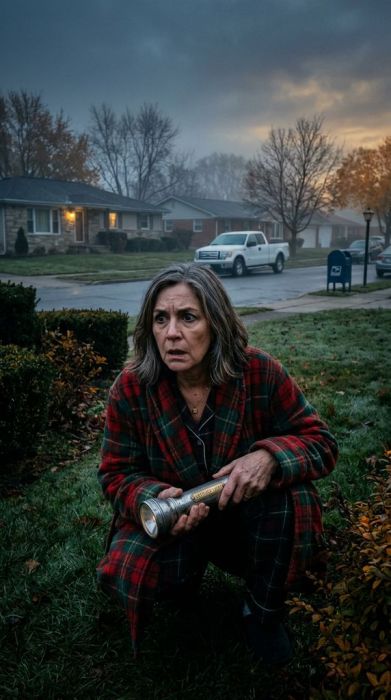
The morning after the fourth burglary, I was on my knees in the wet hedges with rubber gloves, doing what the police had already done but doing it slower. That was how I found it — a silver flashlight with a brass plate, half buried under the boxwood, as if someone had dropped it in a hurry and kicked dirt over it the way you hide a cigarette from your mother.
I turned it over and read the engraving. Gordon Pierce. Twenty-Five Years of Service. Chestnut Ridge Fire Department.
I sat back on my heels and stared at the street. Porch lights were still burning up and down the Willows even though it was past nine in the morning, everyone too rattled to turn them off. Two empty squad cars sat in front of the Parkers' house. And over it all, like a blessing, hung the smell of Gordon Pierce's kitchen, because of course Gordon had been up since six, dropping warm dishes at every door.
Gordon Pierce. Sixty-seven years old. Retired fire captain. Our neighborhood watch captain for eleven years. The man who knew every dog, every teenager's curfew, and every family's vacation schedule, because he kept it all in a binder at the clubhouse so patrol could keep an eye on your place. The man who soothed us after every break-in with the same steady voice he'd used in burning buildings. The man who had told me, three weeks ago, with genuine sorrow in his eyes, "Linda, we're going to catch this guy. I promise you."
The flashlight in my hands was warm. It had been in the ground for at most a few hours. There was dew on the brass, but the dirt under the clip was still loose.
I should have called the detective right then. I didn't. I wrapped the flashlight in a grocery bag, put it in my freezer next to the frozen peas, and spent the rest of the day reliving the last eight months of my life like a movie I couldn't pause.
The first break-in was the Marsh house, the week Diane and Bill flew to Portugal for their fortieth anniversary. Gordon had made a special point of announcing their trip at the meeting — "the Marshes are away, so let's give them extra eyes" — and wrote their dates on the whiteboard in red marker. They were robbed on night three of nine. Gone: Diane's grandmother's pearls, Bill's watch collection, four hundred dollars in traveler's checks they hadn't even gotten to use.
We were furious. We organized a block meeting in the clubhouse, and Gordon stood at the front in his old Fire Department windbreaker, hands on his hips, and told us this was personal. "Somebody's been watching the neighborhood," he said. "They knew the schedule. Whoever it is, they're smart." We all nodded. Nobody asked how a stranger would know the schedule.
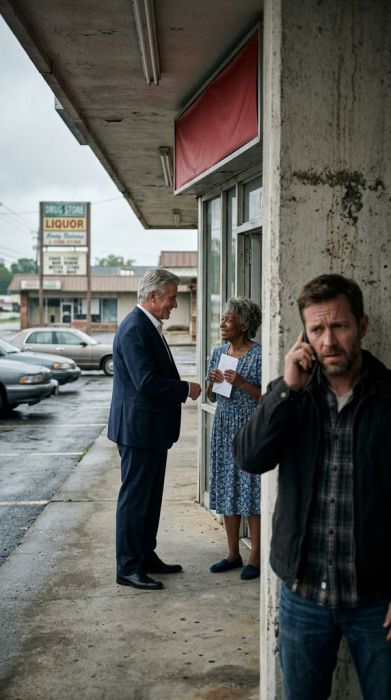
The second break-in was the Kims, in March, during their daughter's wedding in California. The third was the O'Sheas, in June, while they drove their camper to Yellowstone. Every single time, the family had announced their absence at a watch meeting. Every single time, Gordon was the first one at the scene, the first one with a casserole, the first one to hand the police a neatly typed list of "suspicious vehicles" he'd supposedly noted.
I never caught him making a mistake. That was the thing that scared me when I finally started to pay attention. The man was perfect, and a perfect man in a neighborhood with perfect timing stopped feeling like a comfort and started feeling like a pattern.
The fourth burglary was the Parkers. Jim and Tanya had won a trip to Arizona through Jim's work. They mentioned it at the July meeting, nervous and excited, and Gordon beamed like a proud uncle. "You two enjoy that sun," he said. "We've got the street covered." They came home to a house with open drawers, a busted kitchen window, and Tanya's jewelry box sitting empty on the bed, the velvet lining pulled out and tossed on the carpet like trash.
That was the morning I found the flashlight.
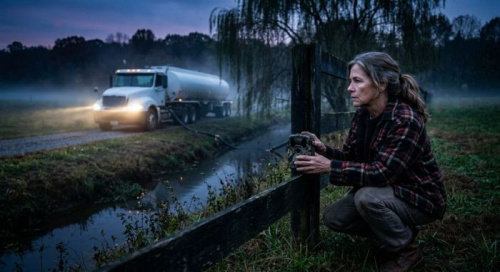
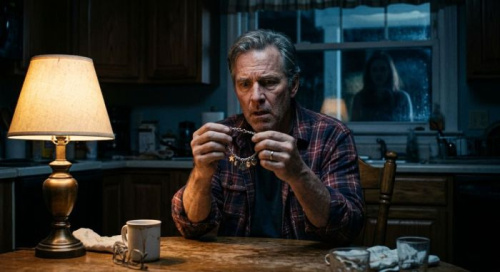
I keep coming back to the question I couldn't answer: why would the burglar leave his flashlight in my hedges? My house is two doors down from the Parkers. I wasn't robbed. I'd never even been on the burglary list, because I never go anywhere. My husband Dan died five years ago, and my idea of a big trip is the Kroger on Route 9. There was no reason for a burglar to be in my yard at all — unless he'd been watching my house too, the way he watched everyone else's.
I stopped sleeping. I lay awake listening to the house settle, replaying every watch meeting in my head, and slowly, piece by piece, the pattern assembled itself like a puzzle from the dollar store. Gordon always assigned himself the "overnight patrol" shift on the exact weeks the houses were empty. Gordon always found the "suspicious vehicle" reports that went nowhere. Gordon was always the one who suggested the whiteboard, the binder, the sign-up sheet with the dates everyone would be gone.
And Gordon, I remembered now, had a habit I'd always found charming. When he handed you a casserole, he'd ask how you were doing, really doing. He'd ask about your kids, your schedule, your plans. He'd ask where Dan's old coin box was, whether I kept the good silver in the attic, whether I had a safe.
I called the county detective, a patient man named Marcus Webb, and told him I had evidence. He came to my kitchen in the afternoon, sat at my table with a legal pad, and let me put the frozen flashlight in a baggie in front of him. He read the engraving. He read it twice.
"Mrs. Mercer," he said gently, "do you know how many engraved retirement flashlights there are in this county? Fire departments hand them out like candy. This puts him at the scene of the Parkers' burglary in the next twelve hours, maybe. It doesn't make him a burglar."
"He was at the scene of every burglary," I said.
"So were half the neighbors, from what I hear. He's the watch captain."
"You don't know our street," I said. "You don't know what it's like to thank a man for protecting you while he's writing down your flight dates."
Detective Webb closed his notepad, but he did something kind. He left me his card. "If you find something concrete," he said, "call me. Anything at all." I kept the flashlight.
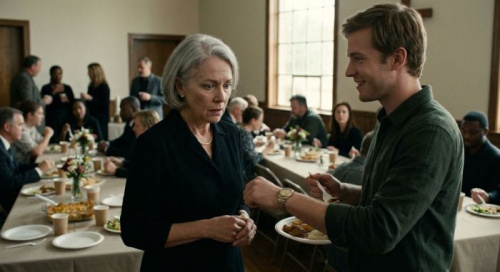
Two nights later, at the emergency watch meeting Gordon called after the Parker burglary, he looked at me across the folding chairs with those kind, tired eyes and said, "Linda, you look awful. You're not sleeping. Are you sure you're okay in that house by yourself?"
The room went quiet. People turned to look at me with pity. Gordon Pierce had just reminded all of them, in the softest voice imaginable, that I was a widow alone in a big house, and that I was losing my grip.
"I'm fine, Gordon," I said. "Just tired."
"Maybe you should stay with your sister for a while," he said. "Get some rest. We'll watch your place." He smiled. "That's what we're here for."
I smiled back and told him that sounded like a good idea, and all night I wondered if the flashlight in my freezer had been a warning or a taunt. By the morning, I knew it didn't matter. I knew I had to do the one thing Gordon would never expect: I asked for help.
Frank Kowalski answered his door at seven a.m. in his slippers, with coffee in his hand and suspicion on his face. Frank had been Gordon's co-captain for years before he quit, suddenly, in the spring, and nobody ever got a straight answer about why. He'd sold his patrol vest at a garage sale and started walking his dog at odd hours, alone, like a man who didn't trust the street he lived on anymore.
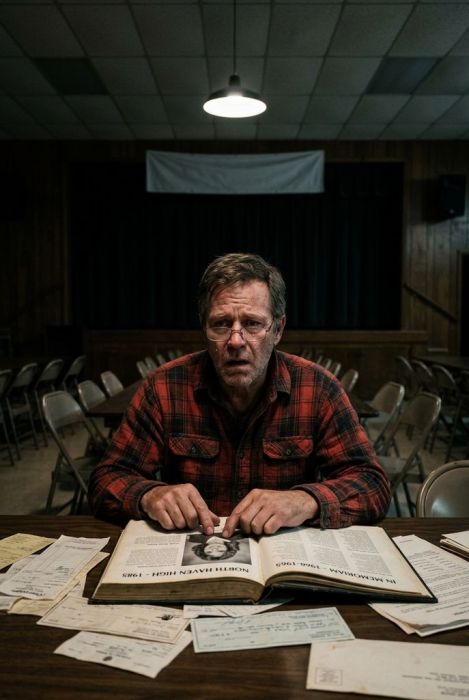
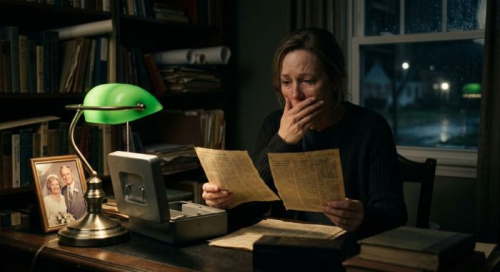
I told him everything. I showed him the flashlight, the dates, the pattern. I read him the list I'd typed out on my old computer: every burglary, every announced trip, every casserole.
Frank was quiet for a long time. Then he said, "I've been waiting for someone to notice."
He told me what he'd never told anyone. Gordon had a storage unit on County Road 12, the kind with the roll-up doors and the bare bulbs. Frank had followed him there once, months before he quit, after Gordon told him he was "running an errand" at a time when he'd told his wife he was at the clubhouse. Frank had watched him open the unit and carry in a duffel bag, heavy and rattling.
"Alright," Frank said. "Alright." And then, with the grim satisfaction of a man who'd swallowed his doubts for years, he pulled on his jacket and said, "Let's go see what's in the shed."
We didn't break in. We didn't have to. Frank knew Gordon's habits better than anyone, and Gordon's habit was to visit the unit on the second Thursday of every month, rain or shine, at ten in the morning. We parked Frank's old truck across the gravel lot with a pair of binoculars, and we watched.
At 10:04, Gordon's white pickup rolled in. He got out, looked around, keyed open the unit, and slid the door up just enough to duck inside. He was in there for eleven minutes. When he came out, he was carrying a flat black case, the kind that holds a rifle, which he wedged into his truck bed and covered with a tarp.
"Dan's case," I whispered. "That's the case Dan used to keep his fishing licenses in." It wasn't. It looked like every other flat black case in Ohio. But I heard myself say it, and Frank heard the crack in my voice, and he put a hand on my arm.
"We're going to need the police," Frank said. "And we're going to need to catch him with his hand in the drawer. Not out here. Not with a tarp over it."
That's when I came up with the only plan I had left in me. And it was the plan that worked.
We called Detective Webb again, and this time I didn't bring him a flashlight. I brought him the year of my life: the meeting minutes I'd saved from the clubhouse binder, the typed list of dates, Frank's sworn statement about the storage unit. He listened the whole way through, and when I finished, he leaned back in my kitchen chair and said the sentence I will never forget. "You know what? I've been getting pawn slips from three counties over. A man matching your neighbor's description has been selling rings and gold watches. Small stuff. Smart stuff. Stuff nobody gets angry enough to chase."
He made two phone calls. Then he made the third one himself, to me, late that night. "Here's what I need you to do," he said. "And I need you to be brave."
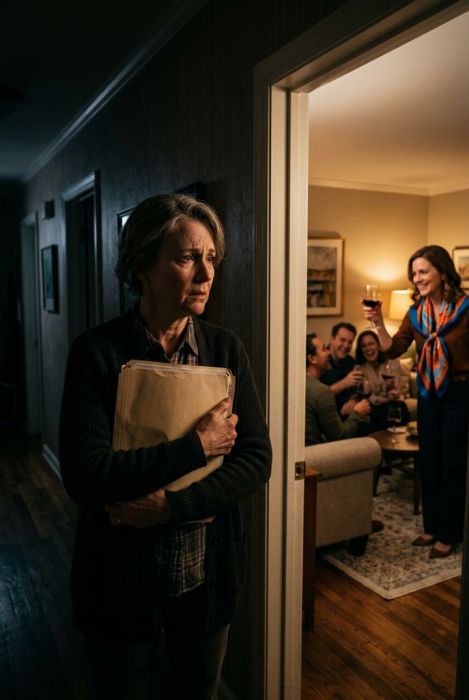
On the first Saturday of August, I stood up at the watch meeting and announced, in the most cheerful voice I could manage, that my sister Carol had finally talked me into a ten-day trip to Florida. Disney World with the grandkids. I was leaving Tuesday. I asked, just like everyone else on our street, if Gordon would keep an eye on my house.
He beamed. "That's what we're here for," he said. He wrote my name on the whiteboard in red marker.
I didn't go to Florida. I watched from Frank's living room window, two doors and a hedge away, as my porch light burned on schedule for three nights. Frank's wife Helen made us soup and told me I was the bravest woman on the street. I felt like the most terrified one.
On the fourth night, at 1:58 in the morning, a figure crossed my lawn. I knew the shape of him before he ever reached the porch — the windbreaker, the careful, unhurried walk of a man who owned the street. He picked my lock in under a minute, same as he'd done to the Marshes and the Kims and the O'Sheas and the Parkers. The cameras Detective Webb's men had mounted in my attic and above my kitchen arch recorded every second of it.
He went straight to my bedroom. He opened the top drawer of my dresser. And then he stopped, because sitting on top of the folded sweaters, in plain view, was an envelope with his name on it, and next to it, Dan's old gold watch, which I had not worn in five years, resting on a bed of marked bills.
Gordon Pierce read his own name. He picked up the watch and slipped it into his pocket. He took the envelope. And he turned around just as the front door opened and the hallway filled with flashlight beams and the calm voice of Detective Marcus Webb saying, "Gordon. Put your hands where I can see them."
He tried, in that moment, the way they all do. He said he was checking my house because he was worried about me. He said he found the door unlocked. He said he was just making sure an old widow was safe. And Detective Webb, who had been patient for six months, played him the footage on his phone, and Gordon Pierce watched himself pick my lock and pocket my husband's watch, and the color drained out of his face like water out of a sink.
They found the storage unit that same night. Twelve rubber bins of other people's lives: Diane Marsh's pearls, Billy Kim's daughter's wedding gift, the O'Sheas' camping money, Tanya Parker's jewelry box, and flat black cases with Dan's name still written on the masking tape labels. The pawn records matched. The engraved flashlight matched.
Gordon Pierce pleaded guilty to eleven counts of burglary and theft. He was sentenced to seven years in state prison and ordered to pay restitution to every family on our street. His wife, who had known nothing, moved in with her daughter in Toledo. The neighborhood watch was quietly retired, and Frank Kowalski, who had quit two years too late and never forgiven himself, became the new block captain at our first meeting of autumn.
I got my porch light replaced the week after the trial. Frank fixed it for me, and when he climbed down from the ladder he said, "You going to sleep okay tonight?"
"Better than I have in a year," I said.
And I did. I slept with the windows open for the first time since Dan died, and when I woke up the next morning, I walked out onto the porch and counted the street. Every single house on the Willows still had its porch light on, all the way down to the corner, like a line of candles nobody had blown out.
We never made a speech about it. There was no ceremony, no plaque. But that's the thing about the Willows now. When one of us is having a bad night, or a surgery, or a loss, the lights stay on. We look out for each other, truly look out for each other, and nobody needs a binder to know who's home and who isn't.
Gordon Pierce thought he was the smartest man on our street. He counted on us trusting him, and we did, because that's what neighbors do. But he made one mistake, and it was the only one that mattered.
He lost his flashlight in my hedges. And I lost my fear.