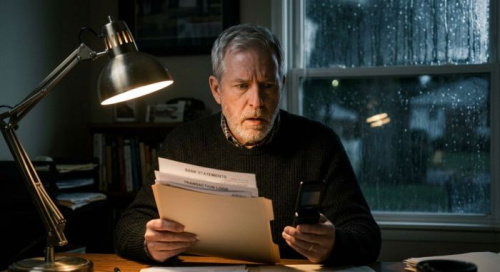
The call came at 7:14 on a Tuesday night, three weeks before our fortieth class reunion. "Tom, it's Connie. From Connie's Country Kitchen," the voice said. "I don't know how to tell you this, but there's no contract. There's no deposit. There was never anything."
I stood in my kitchen with the phone pressed to my ear, staring at the neat stack of receipt books Dana Calloway had color-coded for me. Two hundred and twelve classmates had paid ninety-six dollars each to attend the Millbrook High class of 1985 reunion. I had watched her write every total in her tidy hand. None of it had ever touched the American Legion hall where the event was supposed to happen.
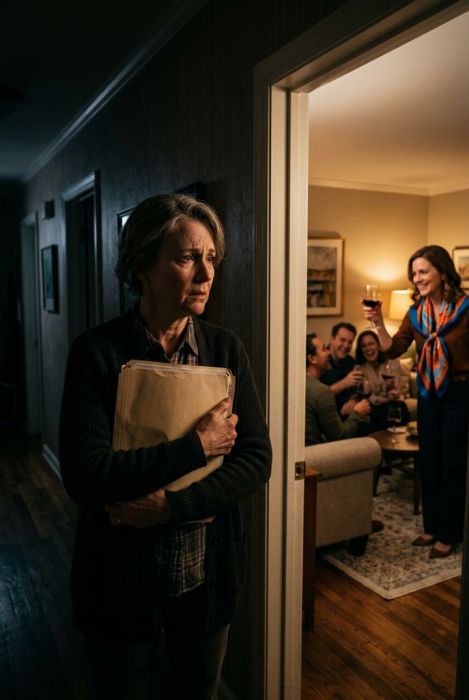
Four months earlier, none of us even wanted the job. The reunion committee was a joke by the time I walked into that February meeting at the library — three tired people, a pot of cold coffee, and a list of names who had all said no. Then Dana walked in, all apologies and warmth, with a leather binder and a smile that made you feel like you'd known her your whole life.
She told us she'd transferred in during senior year, moved away to Dayton right after graduation, and spent forty years regretting that she'd never stayed in touch. She'd been a reunion coordinator for a company in Columbus, she said. She could handle the website, the emails, the catering, everything. We just had to say the word.
I said the word before Peggy O'Dell could stop me. That's on me. I knew better than most people what Millbrook High meant to the class of '85, because my wife Carol had been one of us. Carol died in March of 2022, and the last real thing she asked me to do was keep people together. "You're the one who remembers everyone, Tommy," she'd said. "Don't let us scatter." So I took the reunion on for her. Dana knew how to use exactly that.
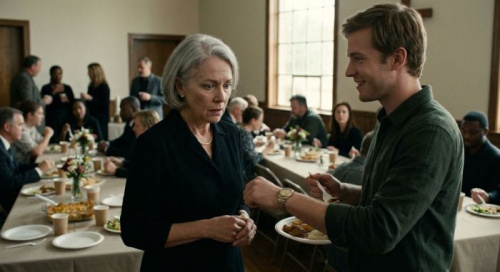
She was good, I'll give her that. Within a month there was a website with our old football photo on it, a countdown clock, and a message board where classmates I hadn't heard from in thirty years were checking in. She collected ninety-six dollars from every single person who wanted to come, plus two hundred dollars apiece for "memory book" ads from the local businesses still standing. She set up a scholarship fund in the name of Cindy Marsh, our classmate who we'd lost to cancer in 2023, and let me tell you, when Dana talked about Cindy Marsh, her eyes got wet every single time. She even built a little memorial table at the planning meetings — Cindy's photo, a candle, a vase of flowers.
The red flags were there. I just didn't want to see them.
She never posed for a photograph. "I look terrible in pictures, and this isn't about me," she'd say, waving the phone away. She preferred checks made out to a company called Halcyon Events, "for bookkeeping," and the venue story changed once or twice before settling on the Legion hall. Peggy O'Dell, who had a memory like a steel trap and worked thirty years as a nurse, asked me one afternoon at the diner, "Tom, how come nobody remembers a Dana Calloway from our class?"
"She said she transferred in senior year, Peg," I told her. "We were busy being seventeen. People move."
Peggy didn't look convinced. "We remember everyone, Tom. That's what we do. That's the whole point of this."
Then, three weeks before the big night, Connie Alvarez made that phone call, and the whole picture started to splinter. I called Bud Whitaker at the Legion hall. No booking, no deposit, no contract — Bud had never heard of Halcyon Events. I called Marv Ellison's cousin, who had supposedly agreed to DJ the night. He'd never been paid a dime and had never signed anything. He was actually relieved, because he'd been planning to back out anyway.
The website's 800 number forwarded to a cell phone in Dayton, routed through a company that had stopped answering. The domain belonged to Halcyon Events LLC, registered in Delaware at an address that turned out to be a UPS store. And Dana Calloway's email, the one she'd used all along, had been created two days before that February meeting.
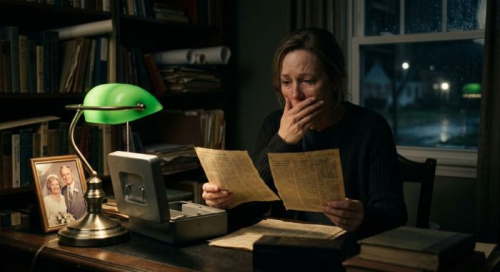
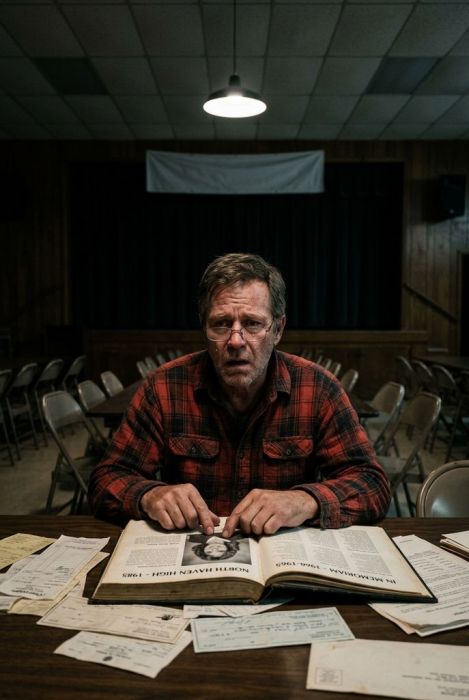
Peggy and I sat at her kitchen table that night with every yearbook we could find. She thumbed through the 1985 volume slowly, page by page, and then her finger stopped on a junior photo. A shy girl with glasses and a thin smile, looking like she wanted to disappear behind the class trip sign-up sheet. Dana Lynn Calloway. "There she is," Peggy whispered. "That's the name. But Tom... that is not the woman at our meetings."
I stared at the photo. It wasn't just that the face was different. The girl in the photo had braces and short dark hair and a nervous posture. The woman at our meetings was tall, confident, polished, with honey-blonde hair she flipped over her shoulder whenever she made a joke. They shared nothing but a name.
Peggy went to the shelf and pulled down the 1990 yearbook, the first one published after our tenth. She opened it to the memorial pages, and there it was, in the middle of a page of black-and-white portraits: Dana Lynn Calloway, 1967–1988. Taken too soon. The caption said she'd died in a car accident outside Dayton two years after graduation, at twenty-one years old.
We sat in silence for a long time. Our Dana Calloway was a woman in her late fifties wearing the name of a girl who had been dead for thirty-six years. She'd picked a ghost, and the ghost couldn't contradict her. Nobody at our meetings questioned her because her name was already carved into a memorial table somewhere. She had counted on us not remembering — and on not wanting to seem rude by asking.
The next morning I walked into the Millbrook police station with the yearbooks, the receipt books, the email records, and a printout of the website. Sergeant Frank Wilkerson listened to the whole thing without interrupting, then leaned back in his chair. "You know how many of these I see in a year?" he said. "Dozens. Charity dinners, retirement parties, reunions like yours, all with a friendly face and a collection jar. But this one's clean. Tell me again about the yearbook."
So I told him. He stared at the photo for a long moment, then picked up the phone and started calling police departments across Ohio and Pennsylvania and Indiana. Twenty minutes later, he put his hand over the receiver and looked at me with something like respect. "Tom, you're going to want to sit down."
In Erie, Pennsylvania, in 2019, a reunion organizer named Linda Sowers collected sixty-eight thousand dollars from the graduating class of 1979 in ticket sales and memory-book ads. She vanished three days before the event. The real Linda Sowers had died in a boating accident in 1980, at nineteen years old. In Fort Wayne, Indiana, in 2023, an organizer named Janie Whitlock took eighty-one thousand dollars from the class of 1988 and disappeared a week before the reunion. The real Janie Whitlock died in 1989 of a heart condition. Same handwriting on the deposit slips, according to the Erie detective. Same habit of crying at the memorial table. Same refusal to be photographed.
They'd finally gotten one photo of her, though. Erie had a security camera at the hotel bar where she'd collected a giant novelty check from a local business. When Sergeant Wilkerson slid the still image across his desk, Peggy O'Dell went white as paper. "That's her," she said. "That's our Dana."
Special Agent Dana Reyes of the FBI joined the case the same week, because this crossed state lines: interstate wire fraud, identity theft, grand theft, possibly twelve states and more dead classmates than we'd ever know. But the case had one serious problem. The woman was a professional. The moment she smelled law enforcement anywhere near Millbrook, she would disappear and we'd never see her again. We needed her in one room, in front of witnesses, long enough to take the money and the spotlight she loved so much.
So I set the bait. I announced on the reunion website that an anonymous donor had offered to match every scholarship dollar raised at the reunion, up to ten thousand. I announced that the venue and catering were fully covered by a benefactor who wanted the class of '85 to have their night. The message board exploded with joy. Dana called me within an hour, warm and thrilled, to ask for details. "Oh, Tom, that's wonderful!" she sang. "We're going to make Cindy so proud."
Frank Wilkerson looked at me across his desk the day she called. "You sure you want to do this? She's going to take your money and run."
I said, "She's going to try."
I paid the Legion hall myself — forty-eight hundred dollars. I paid Connie's Country Kitchen thirty-one hundred. I paid for the helium tanks and the banner and the little corsages and the photographer, because if you're going to catch a snake, you build the perfect garden first. It came out of savings Carol and I had put aside for a trip we never took. Every time I wrote a check, I heard her voice in my head saying, "That's the dumbest thing you've ever done, Tommy Beckett." And then, softer, the way she said everything at the end: "Do it."
The night of the reunion, one hundred and ninety people showed up. The Legion hall looked beautiful in the warm light, balloons along the rafters, tables set with Connie's best china, the DJ spinning Stray Cats and Madonna. The memorial table for Cindy Marsh sat near the front, and our Dana arrived late in a sequined dress, and she worked that room like a politician. She hugged widows, she laughed with the old football players, she spent five full minutes weeping at Cindy's table with her hand over her heart. People were already telling me she was the best thing that ever happened to our class.
At nine o'clock, she took the microphone for the scholarship presentation. The room dimmed, and the projector screen above the stage flickered to life with our old slideshow — senior photos, the homecoming game, the bonfire of '84. People cheered. And then the slideshow kept going, past the last photo, into pages Peggy had scanned that afternoon. The 1985 yearbook page. The 1990 memorial page. Dana Lynn Calloway, 1967–1988. Taken too soon.
The room went quiet in a way that felt physical.
"Dana," I said, standing up near the back. "Tell everyone your full name."
She laughed, a little too high. "It's Dana Calloway, Tom, you know that—"
"Dana Lynn Calloway died in 1988," I said. "Peggy checked with the county. There's a death certificate. So you're going to have to tell us who you are."
The projector clicked to the next slide — the grainy security camera photo from the Erie hotel bar. Dana's smile froze on her face, exactly in the middle of the frame. The door at the back of the hall opened, and Sergeant Wilkerson walked in with Special Agent Reyes and a man in a worn suit coat who I knew, from a phone call the night before, was Detective Madigan from Erie.
She almost ran for it. I saw her eyes go to the side door, and I saw the two officers already standing there, arms crossed. She sagged a little, and then the mask came off. It was the strangest thing — she didn't look angry, or scared, or even sorry. She just looked tired. "They were only checks," she said quietly, as they turned her around and the cuffs went on. "Nobody died."
"No," I said. "But you stole from widows like my wife was, and you used the name of a girl who did."
She didn't look up.
Her real name was Darlene Voss, and she'd been doing this for twenty years. Twenty-six counts of wire fraud, identity theft, grand theft, and enough fake names to fill a phone book. Nine years in federal prison, restitution ordered for every dollar she'd taken from our class and the classes in Erie and Fort Wayne. One hundred and forty victims testified across three hearings, and when the Erie widows flew in to take the stand, the courtroom clapped for them. The judge let it go. She was sentenced in the spring, and I sat in the back row and watched her realize that the girl whose name she'd borrowed had more friends in that courtroom than she did.
The best part came the next week, when the court ordered her restitution returned. Every cent of our class fund came home. And the reunion money I'd put up myself? It came back too, with a letter from the district attorney's office thanking me for my cooperation. I framed it. Carol would have laughed.
The reunion itself, that night after the police left, is a memory I'll keep until I'm gone. The class of '85 stood around in that hall until after one in the morning, hugging each other, telling stories about the people we'd lost, and voting, right there on the spot, to fund the Cindy Marsh Memorial Scholarship for real. Not with stolen money — with our own, from our own pockets, signed over in a bank account in the school's name.
Two years later, the first scholarship went to a girl named Maya Delgado, whose grandmother was class of '85 and cried so hard in the auditorium that Peggy had to fan her with a program. The second one went the year after that. They'll keep going long after we're gone, and that's the part of this story most people don't get. The thief thought she was taking from us. In the end, she was the reason a kid from Millbrook got to go to college.
I drove past the Legion hall the morning after the reunion, and the banner was still up: "Millbrook High Class of 1985 — Better Late Than Never." Somebody had written underneath in black marker, in that shaky handwriting of people our age: "Way better." I laughed out loud at a red light, and then I sat there a minute with the engine running, thinking about Carol.
We didn't scatter. We really didn't.