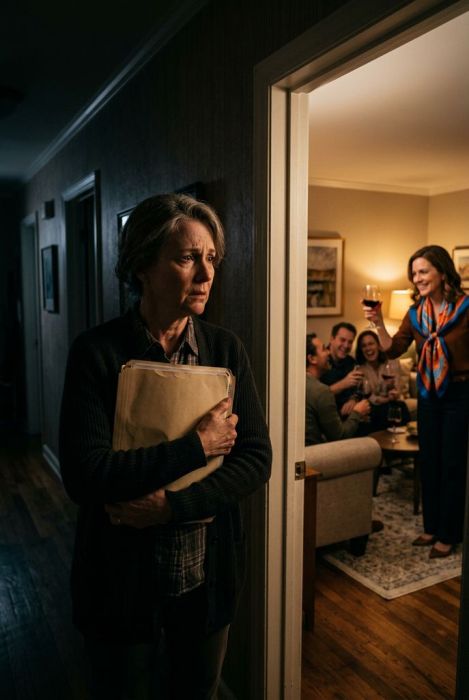
The night Wendy Price announced her cancer had come back, there were twenty-three people squeezed into her living room, and every single one of them was crying. I stood in the hallway with a manila folder pressed against my chest, listening to her describe the new tumors in that soft, brave voice she'd perfected, and I thought about how long I'd been a fool.
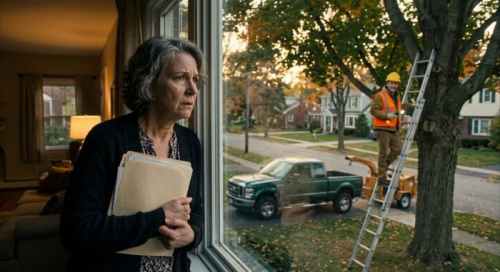
Three years earlier, Wendy had moved into the yellow house on Maplewood Drive with her husband, Greg, and their two kids, and within a month she'd charmed every porch on the block. That's the thing about people like Wendy — they don't sneak into your life. They're invited. She brought zucchini bread to the church small group. She remembered everyone's birthday. She laughed at my stories about the library where I'd worked for thirty-one years, and she never once made me feel like a retired old lady with too many opinions.
Then came the September she walked into the fellowship hall looking smaller than I'd ever seen her, sat down slowly, and told us she had stage four ovarian cancer. The room went quiet. Somebody started to cry. Wendy shook her head, the way she always did when people fussed, and said the doctors in Fort Wayne had given her a plan and she was going to fight it with everything she had.
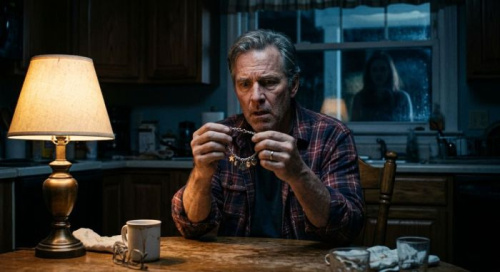
That was the beginning. The meals came first — a calendar where every night for eight months was spoken for. Then the 5K, the bracelet sale, the silent auction. Wendy cried at every event and said she didn't deserve us, which only made us try harder. My granddaughter made her a loom bracelet with a tiny gold bead, and Wendy wore it every single Sunday. She wore it for two and a half years, and I remember thinking: that's how you know someone is real.
The GoFundMe hit a hundred thousand dollars in eleven weeks. By the end of the first year it was at a hundred and eighty-seven thousand. Wendy posted updates from "the infusion center" — photos of her arm, never her face, with those awful hospital blankets. She wrote about how the chemo was gentle on her body but hard on her soul, and the comments section read like a revival. People shared her story nine thousand times.
I don't have a single dramatic moment where I stopped believing her. It happened in pieces, the way a floor rots under your feet. First it was the hair. Wendy said the chemo had made her lose it, and she wore beautiful scarves, but I'd spent thirty years in a public building full of sick kids, and I'd never met a woman on chemo who looked that glowing. Then it was the appointments. She always went alone. She said Greg needed to be at work, and she didn't want to burden anyone. Only two people in the whole county ever saw her inside a cancer center, and both of them were her.
My son-in-law, Mark, works in medical billing at Lutheran. One Sunday he mentioned that he'd seen the fundraiser on the news, and something in my chest went cold. I asked him, very carefully, if he could tell me whether a patient named Wendy Price had ever had oncology claims in the system. Mark is a good man, and he looked at me for a long moment before he answered. "Mom, I can't pull a patient's records. You know that. But there's a thing called the clearinghouse — every claim in the region runs through it. Oncology is the most expensive treatment on earth. If someone's been in chemo for two years, somebody, somewhere, has billed somebody. There is no claim under that name. There never has been. It's like she was never in a hospital."
I stood in his kitchen with a cup of cold coffee and let the world tilt. I wanted there to be a hundred innocent explanations, and there were none. Not one.
I didn't confront her, and that's important, because everyone asks why I didn't. I didn't march over there and demand to see her scans, because that's exactly what she would have wanted me to do — give her a chance to cry, to charm, to drag me back into the lie. Instead I called Darlene Ortiz, who'd been an oncology nurse for thirty-two years before she retired to the same church I'd gone to my whole life. Darlene had been Wendy's most vocal champion. She'd organized three of the fundraisers herself. When I told her what Mark had said, she went very quiet, and then she told me things I hadn't wanted to hear — that she'd noticed Wendy never had a port, never had a PICC line, never had the bone-deep exhaustion that chemo leaves behind, never once slipped on the drug names like a real patient did. "I told myself I was being mean," Darlene whispered. "I told myself God forgive me for my suspicious heart."
We started keeping a notebook. It felt like a betrayal at first, and then it felt like the only honest thing either of us had done in a year. We wrote down every inconsistency: the "hospital selfies" that were clearly hotel rooms, the GoFundMe updates that came at two in the morning, the sixty-eight-thousand-dollar kitchen renovation she posted about three weeks after the "worst scan of her life." Greg, meanwhile, was working double shifts at the mill, gray-faced and thin, because he believed he was paying her medical bills. The children had started eating dinner at my house twice a week because nobody was home to make it for them.
The announcement arrived twelve weeks after I started keeping the notebook, and I'd been waiting for it with the lights on. Wendy called to say the cancer had come back. She wanted a small gathering at her house, just the church women, so she could tell us in person, and she asked me to make the calls. I made the calls. I invited every woman she'd ever charmed, and I also invited a retired teacher from Tucson named Barbara Ellison, who had flown in on a red-eye that morning and was staying in my spare room, smelling of airplane air and quiet fury.
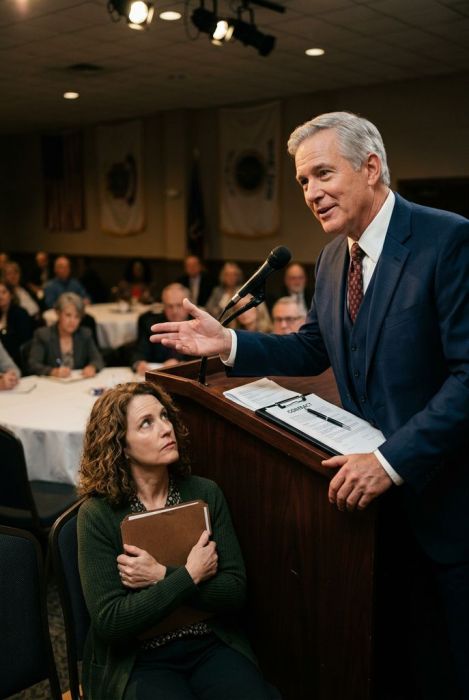
Thursday arrived. Twenty-three people, exactly like she'd asked. Candles on the mantel. Darlene's casserole on the table. Wendy sat in the center of the couch in a beautiful scarf, and she told us the doctors had found new spots, and that she was so ashamed to need us again, and the room dissolved into tears and pledges and prayer. I stood in the hallway with my folder pressed against my chest, watching her work the room like a conductor.
Then Wendy raised her glass and said she had one more piece of news. A gala. The biggest fundraiser yet, to send her to a specialist in Houston. Someone started to clap. And that's when Barbara Ellison stood up from the folding chair in the corner and said, very quietly: "Hi, Candice. I used to be your neighbor. I came all the way from Tucson to see you."
The room went completely silent. Wendy's smile didn't move for a full five seconds, and then it did, in a way I'd never seen a smile move on a human face. She said, "I don't know what you're talking about. Someone call my lawyer." And the front door behind me opened, because Detective Rosa Delgado had been waiting on the porch the whole time, and she stepped into that living room with two sheriff's deputies, and the first thing she said was: "Wendy Price, also known as Candice Melton, you have a federal warrant out of Arizona, and you're under arrest."
You should know that night the way it looked, because I'll never forget it. The way the crying stopped and became something else entirely. The way Darlene Ortiz, my oldest friend in the world, put her head in her hands and wept with relief. The way Greg Price came home from the mill to find his wife being walked out of his own kitchen in handcuffs, and the way she wouldn't look at him, not once, even when the kids ran out onto the porch and called her name.
It wasn't a gala with string lights. It was a living room with a casserole going cold and twenty-three witnesses, which, it turned out, was exactly what the prosecutor needed. Detective Delgado had a file on her desk that was thicker than mine. It had photographs. It had Arizona newspaper clippings. And in the middle of it, a booking photo of the woman who'd called herself Candice Melton three years earlier, in Tucson, where she'd run the exact same play — a fake diagnosis, a community fundraiser, a hundred thousand dollars, an indictment for wire fraud, and a warrant she'd skipped out on before her bail hearing.
That's the part that still makes my hands shake. It was never about us. We were just the second town on her circuit.
The woman who had lied to two hundred people about dying went into court still fighting. At the hearing she blamed everyone but herself — the doctors, the town, Greg, me. She claimed God would judge us for what we did to a sick woman. But the prosecutor had the forged lab reports she'd "found" to support her Houston treatment, and those reports belonged to a real cancer patient in Indianapolis who had never met Wendy Price in her life. That's what turned the case from fraud into something worse. Wendy pleaded guilty to two counts of wire fraud and one count of aggravated identity theft. She got five years in federal prison and was ordered to pay back every dollar: a hundred and eighty-seven thousand, plus interest.
The fundraiser accounts had been frozen within days of the arrest, so most of the money came home. The rest came out of the equity in the yellow house on Maplewood Drive, which she signed away in the divorce, and out of the lease on the new SUV she'd bought with the proceeds of my neighbors' kindness. The gala she'd planned was cancelled, and the forty thousand dollars people had pledged that night was quietly returned, every penny.
Greg got the children. He still lives in town, and on Fridays he brings them to the library, and my granddaughter reads to the little one, and Greg sits at the table where I've been sitting for thirty years and tells me he doesn't know how he'll ever thank me. I tell him he already has. The kids are in counseling, and they're doing better than anyone had a right to expect, which I think says more about Greg than it does about them.
As for the rest of us, we did something remarkable with our shame. The committee that had raised a hundred and eighty-seven thousand dollars for a lie turned itself into a real foundation, and now it pays for gas cards and hotel nights and parking passes for actual cancer patients driving to real appointments in Fort Wayne. Darlene runs it. She named the first grant program after Barbara Ellison's mother, who died of real cancer in Tucson while Candice Melton was raising money off her illness a hundred miles away.
Some people in town still say it to my face: "We should have known." And maybe we should have. The clues were there, in the perfect scarves and the hospital selfies taken in hotel rooms and the woman who felt better on the days she was supposedly being poisoned. But here's what I know now, standing in the quiet of the library with the afternoon sun coming through the windows: we didn't want to see it. We wanted so badly to believe her that we made it easy for her to take everything.
Karma didn't wear a robe in our story. It wore a detective's badge and an airline ticket from Tucson and the tired, steady voice of a retired nurse who finally said the words she'd been afraid to say. It came to a candle-lit living room in a small Indiana town, and it walked through the door in front of twenty-three people, and it did what I couldn't do for two and a half years.
I don't think about Wendy much anymore. But sometimes, on Sundays, I see my granddaughter's loom bracelet with the tiny gold bead, and I think about how Wendy wore it for two years, and how it was the only true thing she ever owned in our town. We got our money back. We got our hope back, mostly. And the woman who thought she'd never be caught in a place where everyone loved her found out, in the loudest possible way, that love is the one thing you cannot forge.