My father called me on a Tuesday night, and for the first time in two years, he sounded like a kid who'd just won the science fair. "Marie," he said, "you wouldn't believe who I met tonight. The most brilliant man you've ever heard speak."
My father was a retired powertrain line worker from the old GM plant in Bay City, Michigan. He had never, in seventy-nine years, been dazzled by a salesman. He haggled with the butcher over pork chops. He checked the math on his own receipts and found the store's errors. When a door-to-door vacuum man tried the old water-trick demonstration in our kitchen, my father handed him back the hose and said, "Son, I've seen better acting at a high school play."
So when he told me he'd signed papers that night at the VFW hall — after a free steak dinner, a free glass of something sweet, and forty minutes of a man named Marcus Sterling explaining how to guarantee nine percent a year forever — I did not panic. I laughed. "Dad, nobody guarantees nine percent."
"Marcus does," he said. "He showed us the charts. He's America's Retirement Coach."
The check for seventy-two thousand dollars had already left his account. Marcus Sterling had driven my father to the credit union himself, held the door open, and watched the wire go out like a proud uncle seeing a kid off to college.
That was the night I learned that the smartest, most careful man I'd ever known had been lonely enough to believe a stranger. My mother, Dorothy, had been gone two years, and my father had filled his evenings with VFW dinners and free seminars because the house at 2141 Chippewa Avenue was too quiet for one person.
I teach algebra to eighth graders in Lansing, two hours away. I'd spent the last two years telling myself my father was fine, that he had his card club and his old buddies and his garden. I hadn't seen how a certain kind of man — the kind with silver hair, a navy suit, and a voice like warm gravel — can walk into a room full of lonely widows and veterans and simply take charge.
Marcus Sterling had that voice. I met him six days later, in a rented room above what used to be a shoe store on the south side of Bay City. The sign on the window said STERLING WEALTH GROUP in fresh vinyl, and if you looked closely you could see the ghost of the old sign underneath: "Pet Palace — Grooming & Boarding."
He was charming even to me, and I'd come there ready to hate him. "You must be Marie," he said, shaking my hand with both of his. "Your father talks about you constantly. A teacher — that's a noble calling. You know what the biggest mistake retirees make? They listen to their children instead of their advisors."
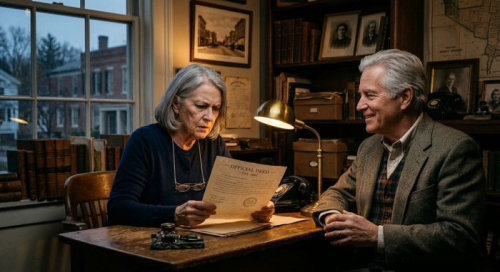
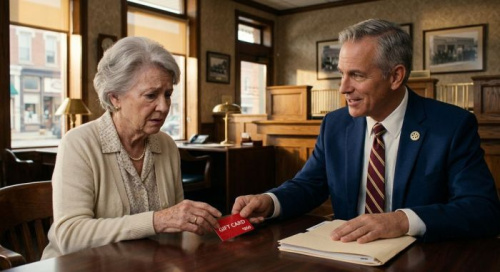
I asked to see the contract. He smiled and slid a folder across the desk. "Meridian Heritage Income Trust," it said. "Fixed Index Annuity — Guaranteed Yield Participation." There was a PO box in Dover, Delaware. There was no phone number that connected to a human being. There was a clause on page eleven that said the "guarantee" was a projection, not a promise, and a clause on page fourteen that said disputes would be settled by arbitration in Delaware, "at the annuitant's sole cost."
I asked if he was licensed to sell securities in Michigan.
He laughed — a warm, generous laugh, like I'd told a joke at his own party. "Sweetheart, licensing is for stockbrokers. I'm in the business of certainty. Your father is going to make money hand over fist, and in five years he'll send me a thank-you card."
Then he leaned across the desk and lowered his voice. "And Marie? Threatening me won't look good for a schoolteacher. Your father signed binding documents. He's a grown man. Let him enjoy his dinner."
The really awful part was that he was right about the dinner. My father was happier than he'd been since Mom died. He'd found people at those seminars. He had a new jacket. He'd started calling Sterling "Marcus," like they were old friends, and he'd started talking about the "bonus window" that was closing Friday.
That Friday, Sterling asked for thirty thousand more.
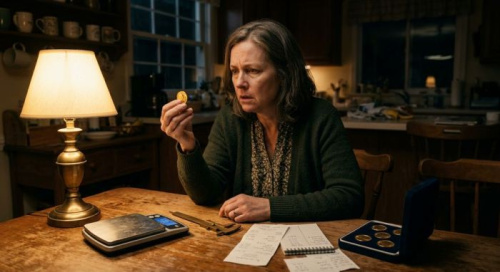
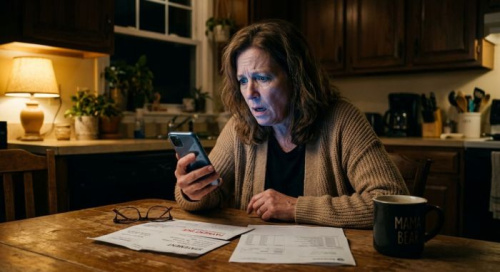
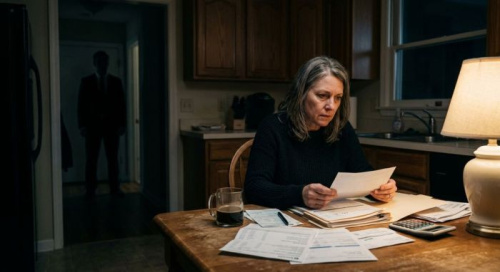
I didn't confront him again. I did what any math teacher does when she can't make the numbers work: I went looking for the pattern. I found Marcus Sterling's website, which featured his smiling face and the words "America's Retirement Coach" and a calendar of free dinners from Traverse City to Port Huron. I found the Meridian Heritage Income Trust's registration in Delaware, dissolved for non-payment of franchise taxes. And then, at two in the morning, in the glowing blue dark of my kitchen, I found the Toledo Blade.
The headline was from eleven years ago: "Retirees Lose $400,000 to 'Guaranteed Income' Coach." The photograph showed a younger, heavier man with the same warm smile and the same confident tilt of the chin. His name was Marvin Stoltz, and he had pled guilty to fourteen counts of securities fraud in Cuyahoga County, Ohio. He'd run free dinners. He'd promised nine percent. He'd used a Delaware trust with a PO box. He'd served four years and been released on parole, and somewhere along the way Marvin Stoltz had become Marcus Sterling, America's Retirement Coach, with a brand-new rental room above a former pet groomer.
I sat in my kitchen and cried — not for the money, though the money was bad enough, but for my father, who had been lonely enough to believe a man who'd made a career of loneliness.
The state investigator called me a week later. His name was Rick Navarro, and he worked the securities fraud unit for the Michigan Department of Insurance and Financial Services. He'd read my complaint — every page of it, including the Toledo Blade clipping I'd scanned and the Meridian registration and the bank records my father had finally, shamefacedly, printed out.
"We've been watching Sterling for eight months," Navarro said. "He ran the same play in Indiana. We have complaints from three counties in Michigan. But nobody will talk to us, Marie. Your father would be the first victim willing to testify."
"Why won't the others talk?" I asked.
"Because they're embarrassed," he said. "And because Sterling is careful. He never takes more than the seniors can hide. He keeps them hopeful. Hopeful people don't call the state."
I told him my father would testify. I told him I would do anything. And that's when Navarro asked me the question that changed everything: "How do you feel about free steak dinners?"
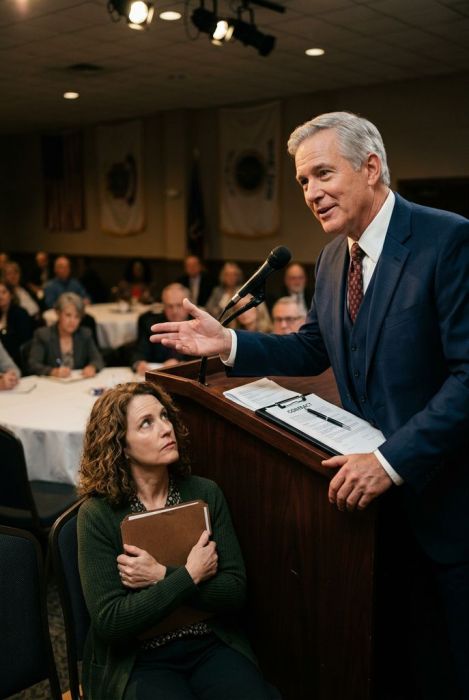
Marcus Sterling announced the Michigan Retirement Expo three weeks later, in the ballroom of the Bay Valley Resort, and the keynote speaker was, of course, himself. America's Retirement Coach, live on stage, with charts and a clicker and a smile that had been perfecting itself in courtrooms and banquet halls for thirty years.
My father was not there. That was the one thing I insisted on. He was two blocks away at the VFW, with his reading glasses on, going through the Meridian paperwork page by page with a retired county clerk named Bud, because I'd asked him to learn the scam so he could help teach other seniors. "Learn it like a weapon," I told him. "You're going to be the one who catches it next time."
I arrived at the expo alone, wearing a dress I hadn't worn since my husband Ray's funeral, carrying a checkbook I had no intention of using. I'd told Navarro I could do this because I was good at two things: math and lying to teenagers about their potential. Playing a grieving widow with a windfall turned out to be closer to the second one than I expected.
Sterling spotted me in the front row. He was magnetic, I'll give him that — the way he worked the room, the way he remembered names, the way he made every retiree in that ballroom feel like the only person in the world. When the keynote ended, he found me before I could find him.
"Ma'am, I saw you sitting there with tears in your eyes," he said, and I almost flinched, because it was true — I'd been thinking about Ray. "Can I ask — are you recently widowed?"
"Three years," I said. "Ray had a policy. A hundred and eighty-five thousand dollars, and I've been too scared to touch it."
He took my elbow gently, the way you'd guide a friend through a crowd. "Then you're exactly who I built this for. Come with me — I want to show you something in private."
The VIP room was small and windowless, with a round table and two chairs and a bottle of water with his face on the label. He walked me through the same charts my father had seen, the same nine percent, the same "principal protection" and "bonus window." I let him talk. I asked the dumb questions the way I'd practiced with Navarro. I said "guaranteed?" and let him swear on his mother's grave, and I said "so my Ray's money would be safe?" and watched him place a hand over his heart.
"Licensed?" I asked at last, nodding at the stack of papers he was sliding toward me.
He laughed that warm, generous laugh. "Sweetheart, licensing is for accountants. I'm in the business of certainty. Do you know what most widows do wrong? They wait. They wait and they wait, and the market eats their future."
I signed the papers with the pen he gave me, and I counted out five thousand dollars in cash — the "same-day deposit discount," he called it — and he put it in a leather satchel like it was the most natural thing in the world.
Then Rick Navarro opened the door, and two state troopers came in behind him, and Marcus Sterling's smile finally, finally stopped working.
Navarro told him he was under arrest for securities fraud, unlicensed sales, and larceny by conversion. He read him his rights while Sterling's hands were still in the air, and the wire in my collar had recorded every word of it — including the part where he'd called licensing "for accountants" and sworn on his mother's grave that the nine percent was guaranteed.
"Do you know how many widows I've helped?" Sterling said to Navarro, and his voice cracked for the first time in thirty years. "Do you know who I am?"
"We know exactly who you are, Mr. Stoltz," Navarro said. "We've known for eight months. We were just waiting for you to get comfortable."
They walked him through the lobby in handcuffs. The expo attendees — a hundred and fifty seniors who'd come for the free lunch and the promise of certainty — stood in the ballroom doorway and watched, and some of them started checking their own paperwork with the sudden, sickened hurry of people who'd just realized they'd been living inside a con.
My father was waiting on the curb when they brought him out. I'd told him not to come. I'd told him it would be too hard. But he was there, in his old windbreaker, and he watched Marcus Sterling go into the back of the state police cruiser, and then he looked at me across the parking lot with something in his eyes I hadn't seen in two years — something light, something settled.
"Your mother would've loved this," he said when I reached him. And then, because he was my father, he added: "She'd have made popcorn."
Marvin Stoltz — Marcus Sterling, America's Retirement Coach — pled guilty to seventeen counts: securities fraud, unlicensed sales, larceny by conversion. The judge sentenced him to nine years, which meant he would be sixty-seven when he got out, which meant he would finally know what it felt like to run out of second chances. The state seized the Meridian accounts and the leather satchel with the marked bills, and restitution went out to forty-one victims across three states — including the full seventy-two thousand to my father, plus interest, which the judge called "a fair price for the aggravation."
Meridian Heritage Income Trust was dissolved, again, for real this time. The room above the old shoe store is empty. The VFW hall where my father ate his first free steak dinner now hosts a monthly workshop called "Scam-Proof Your Retirement," taught by Rick Navarro, with a special guest speaker on the second Tuesday of every month.
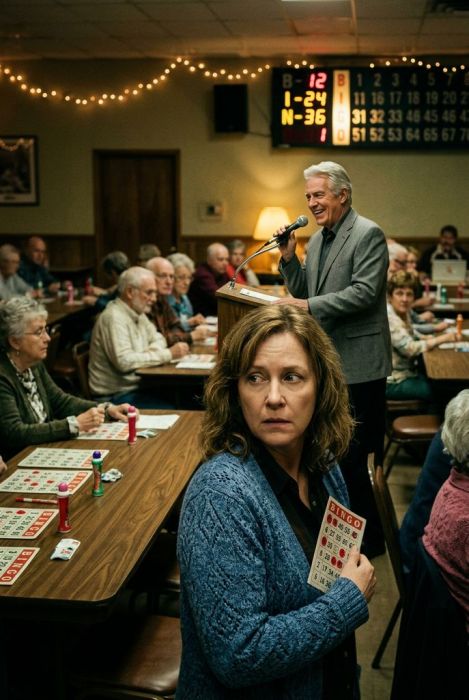
That guest is my father. He stands at the same podium, in the same room, wearing the same reading glasses, and he tells the room full of widows and veterans and lonely people exactly what nine percent guaranteed forever really means. He shows them the Meridian contract, page by page, and he teaches them to read the fine print the way a man who's been burned learns to read smoke.
He still goes to every free dinner in Bay City. He still takes the free pens and the free coffee mugs and the free brochures. But now he brings me, and his reading glasses, and a folder of his own — the one with the Toledo Blade clipping on top, and a photograph of a smiling man who thought he'd gotten away with it.
Some men spend their lives selling certainty. My father spent his retirement learning to recognize the smell of a free steak dinner. And these days, when someone at the VFW says "guaranteed," my father just smiles, reaches for his folder, and says, "Son, let me tell you a story."