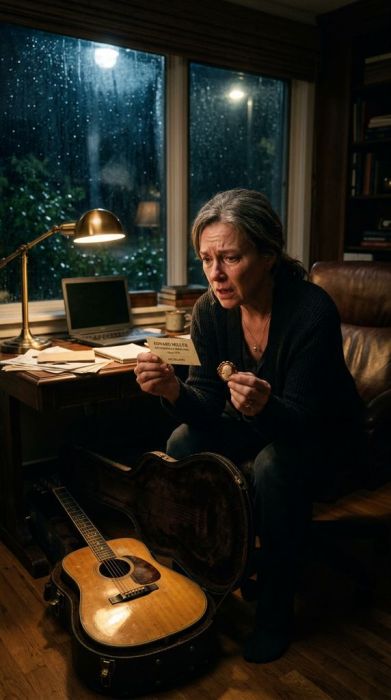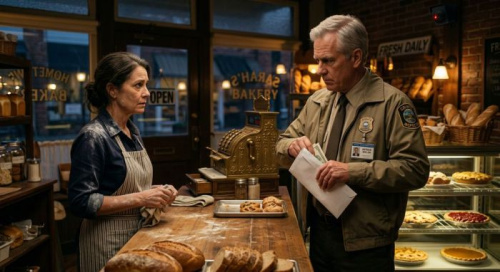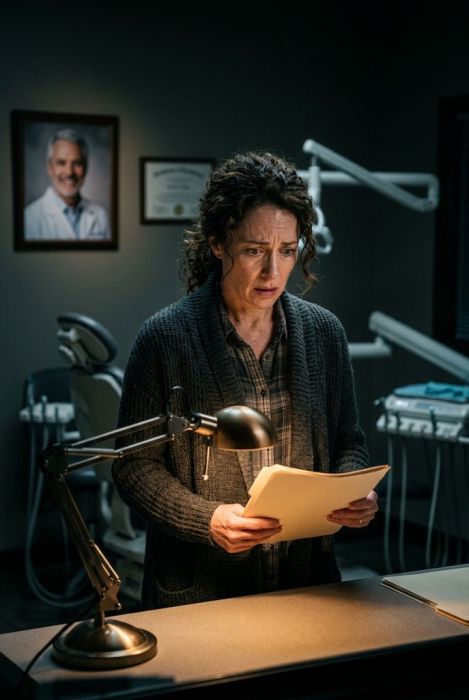
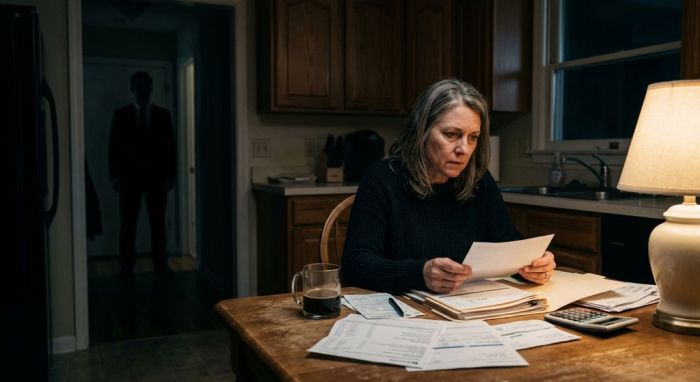
The electric company called at six in the morning, but that wasn't what woke me. My mother called at 6:12, and her voice had that small, apologetic pitch she only used when she suspected something was wrong and didn't want to be a bother. "Joan, honey, did you turn off the lights? The condo is dark and I can't find the switch." I drove over before my coffee had finished. The electricity at my mother's condo had been dead for two days, and the disconnection notice taped to her door said the account was $4,816.79 in arrears. My mother had never missed a utility payment in her life. For the past three years, she hadn't been allowed to touch her own money — the court had given that job to a professional guardian named Graham Prescott, and every month he mailed us a tidy little report insisting everything was paid.
My father died in 2019, plain and sudden, of a stroke at the counter of the hardware store he'd loved since 1974. My mother lost her bearings for a while — anyone would — and then she fell on the back steps and spent a week in the hospital. The social worker used the word "overwhelmed." Wendy, my sister, lived in Nevada with three grandchildren and a mortgage, and I was a school librarian with a waistline full of stress and a heart full of guilt. When our mother's lawyer, a family friend named Margaret Ellison, gently suggested a guardianship, it sounded like the responsible thing. She recommended Graham Prescott. "He's the best in the county," Margaret said. "Judges love him. He sponsors the senior center Thanksgiving dinner every year."
The hearing took eleven minutes. Judge Harriet Vance read the petition, asked my mother a few gentle questions, and signed the order making Graham Prescott her legal guardian. He stood to thank the court — navy suit, silver hair, a voice like warm gravel on a late-night radio station. He shook my mother's hand as if she were made of glass. "You won't worry about a thing, Dorothy," he said. "That's what I'm here for." And for a while, God help me, I believed him.
Every month the reports came, typed on ivory paper with his green ink signature at the bottom, itemized to the penny: rent, utilities, groceries, medications, transportation. Management fee, $1,200. Monthly care coordination, $900. It added up to more than my take-home pay, but nobody in our family complained. We didn't want to seem ungrateful. Graham Prescott was a saint. People said it at church, at the grocery store, at the senior center, where his name was on the big banner for the turkey dinner.
A year in, Prescott recommended my mother transfer to a place called Willow Grove Manor. He sat on its advisory board, which he mentioned only once, casually, the way you mention a coincidence you've almost decided isn't one. My mother's room there was clean and bright. Her neighbors were kind. And things began to disappear. First the pearl earrings Dad had given her for their fortieth anniversary. Then the little porcelain bird collection. Then the grandfather clock — the one Dad had refinished by hand — sold, Prescott explained, because the room was too small, and besides, "she doesn't remember it." I blamed the dementia. I blamed the night staff. I blamed myself for not living closer. I did not blame the man in the navy suit who kept writing me soothing emails.
The pharmacy called next. My mother's Medicare co-pays were eleven months behind, and the kind pharmacist, a man named Sal, took me aside and whispered, "I didn't want to bother her, but the insurance company keeps rejecting the claims because the billing address on file is for a business I've never heard of." The billing address belonged to Prescott Elder Solutions. When I called the office, I got a receptionist who told me Mr. Prescott was in a meeting and would call me back within forty-eight hours. He did not call me back, so I called again. On the third try, he answered, and his voice was smooth as ever. "Joan, you're overwhelmed," he said. "I understand. You're a wonderful daughter. Let me handle the paperwork — that's my job. You go take care of your mother." I hung up feeling foolish and grateful, which is exactly what he intended.
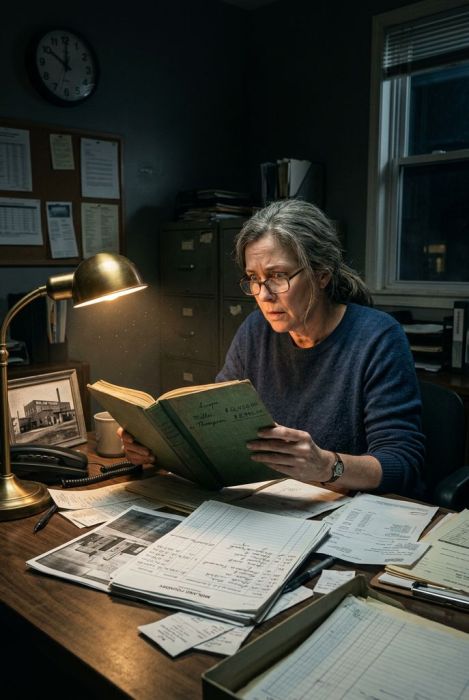
Then Willow Grove called about the bill. Ninety-six thousand dollars over two years, they claimed, and eighteen thousand past due. "That can't be right," I said. "The guardian pays you directly." There was a long pause on the line. "He did, for the first six months," the billing manager said. "After that, nothing but promises." I drove down to the county courthouse the next morning with my mother's original bank statements in my purse — the ones from before the guardianship, the ones Dad's life insurance had seeded with two hundred seventeen thousand dollars. The probate clerk, a tired woman named Delores who looked at me the way nurses look at the grieving, handed me a thick folder of Prescott's sworn annual accountings. I opened the third page and stopped breathing.
Management fees, forty-two thousand dollars over three years. Transportation fees. "Home maintenance" on a condo he'd rented out. "Gifts to family," nine thousand dollars. And there, in black and white, a single line that made my hands shake: "Investment — Prescott Family Ventures, LLC — ninety-two thousand dollars." My mother had never signed an investment document in her life. She'd never even had a brokerage account. I asked Delores, as calmly as I could, whether Prescott had other wards. She didn't answer with words. She slid another folder across the counter — then another, and another. Four families. Four sets of accountings. Four identical lines about Prescott Family Ventures.
I told Wendy everything on a Tuesday night call. She cried, then she got angry, then she got quiet, and I heard her checking flights. "He took Dad's clock," she said, finally. "I want that clock back." We didn't get the clock back. We got something better. I couldn't afford a lawyer, so I found the next best thing: a retired bank fraud examiner named Ruth Calloway who volunteered with the county prosecutor's elder abuse unit. She read the folders in one sitting, then closed them and looked at me with something between anger and relief. "He's been doing this forever," she said. "Everybody in the courthouse suspected. They just needed a family willing to push." Ruth did something extraordinary. She subpoenaed the LLC records — Prescott and his brother had used the "investment" money to buy a boat and a condo in Naples, Florida. And she found the same pattern across all four families: the neat reports, the padded fees, the lucky victims who'd been too trusting or too tired to fight.
Before the hearing, I ran into Prescott at the senior center, at the very Thanksgiving dinner he sponsored. He saw me and opened his arms with a smile big enough for the whole room. "Joan! How's your mother?" he said, loud enough for the ladies at the next table to hear. I told him I knew about the LLC, quietly, just for him. He laughed. "Sweetheart, you're out of your depth," he said, and patted my shoulder like I was a child. Three women at the table stared at me, and one of them — Miriam Alvarez — called me that night. Her mother was one of his wards too. That phone call is how the pattern became a case.
The twist came in October. Prescott, confident and bored, filed a motion asking the court to declare my mother's family "difficult" and restrict our visitation to one hour per month. He attached letters he'd supposedly gotten from Willow Grove praising his devotion. What he didn't know was that Judge Vance's investigator, a patient man named Dale Hutchins, had been quietly auditing Prescott's wards for eighteen months — and that I had already given Ruth the originals of everything. We didn't need to defeat the motion. We needed him to walk into the courtroom thinking he'd already won.
On the morning of the hearing, Prescott arrived with a lawyer from a firm whose name was printed in gold on his briefcase. He shook hands with the bailiff. He smiled at my mother, who had been brought in by my sister and did not smile back. For twenty minutes he talked about his dedication, his certifications, his spotless record. Then Ruth Calloway stood up and asked for permission to approach. Judge Vance nodded. The courtroom was small and old and smelled like dust and floor wax, and the only sound for a long moment was Ruth's heels on the boards as she carried the forty-seven-page report to the bench.
The judge read for a long time. When she finished, she looked at Prescott over her glasses the way my father used to look at me when I'd been caught at something I almost got away with. "Mr. Prescott," she said, "please explain the ninety-two thousand dollars." His lawyer stood and started talking about "record-keeping irregularities," but Prescott made the mistake of answering first. "It was an investment," he said. "A business venture. My ward's money is safe." Judge Vance didn't raise her voice. "Then you won't mind telling us where the boat is registered, Mr. Prescott." The room went quiet. His face went gray. He started to say something about his brother, and then he stopped, and I watched the air leave him the way it leaves a balloon when you hold it too long. The judge ordered him held. The sheriff's deputy stepped forward, and I will never forget the soft hiss of the handcuffs, or the way Prescott's smile finally — finally — slid off his face.
By spring, Graham Prescott had been charged with fourteen counts of felony theft from an elderly person. He pleaded guilty to six and was sentenced to nine years. They seized the boat and the Naples condo and sold them, and the money — not all of it, but most of it — went back to the families he'd robbed. His guardian license was revoked in three states. Willow Grove Manor, whose owners turned out to be connected to his brother's holdings, closed within the year, and my mother moved to a county-run residence called Maplewood, where the staff spell her name right and my daughter volunteers on Saturdays.
Sometimes justice is loud — a verdict, a sentence, the flash of cameras on the courthouse steps. Ours was quieter. The senior center renamed its Thanksgiving dinner after the group of families who testified, which makes my mother laugh every time she remembers. A new state law now requires guardians to file their accountings in a searchable database, and volunteers from our church check them every quarter, the way Ruth taught them. Prescott's name comes up in county history the way a bad restaurant comes up in family dinner conversation: with a shake of the head and a story nobody minds telling.
My mother is eighty-seven now. Some days she asks me who the nice man with the silver hair was, and I tell her he moved away, which is close enough to the truth. Some days she remembers everything, and on those days she holds my hand very tightly and says, "You did good, honey. You did real good." Last week Maplewood had a small lights-on ceremony for the building's new generator, and they asked me to flip the switch. I thought about my mother's dark condo, and the notice taped to her door, and the man in the navy suit who promised to take care of her and instead took her light. I flipped the switch, and the whole building glowed, and somewhere an old woman who taught me how to be brave didn't have to be afraid of the dark anymore. That's the only courtroom victory I ever needed.