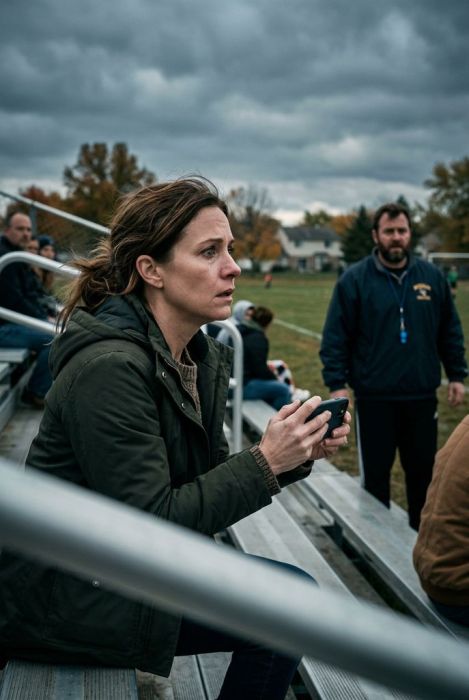
The whistle did it. Not the face at first, and not even the laugh. It was the whistle — two quick notes, the second one falling off the end like a question nobody ever answered. My husband used to blow that exact whistle from the end of our pier to call our son in from the lake, and in eighteen years of marriage I never once heard another man make that sound. When it cut across the soccer field that gray October afternoon, my knees gave out and I grabbed the bleacher rail like a drowning woman grabs at the surface.
The visiting coach had his back to us, barking at a linesman about an offside call. He was taller than Dale had been, or maybe he just stood straighter now. He wore a beard and a pair of wire-rimmed glasses, and his dark hair had gone silver at the temples. He looked nothing like the man I'd buried in my memory. Then he turned to shout something to his bench, and he laughed — that quick, breathless, easy laugh — and all the air left my lungs in one rush.
I didn't scream. I didn't move. I sat there with my hands gripping the cold aluminum rail while the world tilted sideways, and I watched my dead husband jog along the touchline, clapping his hands and blowing that two-note whistle at thirteen-year-old boys who had no idea who he really was.
His name is Dale McAllister, and as far as the state of Michigan is concerned, he drowned in Lake Michigan four years ago while trying to clear his head after a bad day. The Coast Guard searched for six days. They dragged the bottom off the Leelanau Peninsula until the commander said the water was too cold and too deep and the current was doing things to a body that nobody should have to think about. They never found him. The county judge signed the death certificate fourteen months later, and the insurance company paid out $750,000 that following spring, the same spring I put flowers on an empty memorial bench and told our nine-year-old son that his father was gone.
People in Gull Harbor still talk about Dale McAllister the way you talk about a good storm — with respect, and a little fear, and a lot of disbelief that it really happened. He ran the marina on Harbor Street, and he had that rare gift of making every single person in town feel like they were his favorite. He was the man the whole town called when their boats wouldn't start and the man who never once raised his voice at our son, not even when Caleb sank his favorite rod off the end of the pier.
Behind the charm, though, there was always a current of something I couldn't name. He kept money the way other men keep secrets. We fought about it for years — about the second mortgage, about the loan he took out against the marina without telling me, about the way his smile would go tight and glassy whenever I asked a question about the books. Six months before he disappeared, I found a life insurance policy in his desk drawer, taken out fourteen months earlier, with me named as the sole beneficiary. "It's a cushion," he said, and kissed my forehead. "If anything ever happens to me, you and Caleb are taken care of. That's the only thing that matters."
The morning he went out on the boat, we'd had a fight. A bad one. A creditor had called the house at six a.m. demanding payment on a note I'd never signed, and for the first time in our marriage I told him I wanted to see the marina's books. He went pale, then red, then terribly calm. He said he needed to clear his head. He took the twenty-foot Grady White out alone, and he never came back.
They found the boat off Good Harbor Bay, capsized, the radio trailing in the water. Taped inside the console was a note, printed in block letters on a torn piece of marina letterhead: "I'm sorry. I can't keep pretending anymore." The Coast Guard called it a probable suicide. The judge called it enough. Nobody in town wanted to say it out loud, but I could feel them thinking it — that Dale McAllister, who was loved by everyone, had finally cracked under the weight of a wife who pushed too hard.
The grief was a physical thing. It lived in my ribs for two years. I raised Caleb on book fair proceeds and macaroni and cheese, and I stopped going to the pier because I couldn't look at that flat gray water without tasting the note. I told my son his father had an accident, because what do you tell a nine-year-old — that the man who loved him most in the world had decided he didn't love him enough to stay?
And then, last Saturday, at an away game forty-five minutes from home, my dead husband turned around on a soccer field and laughed.
I didn't tell anybody at first. I thought I was seeing things — grief reaches back and shows you a shadow with your loved one's walk. But Caleb noticed I couldn't stop shaking on the drive home, and I told him the coffee had gone cold.
That night, while he slept, I sat at the kitchen table and pulled up the league's website. The game had been live-streamed — every youth match in that league is, so grandparents can watch from out of state. I scrolled through the footage of the other team's huddle until I found him. I paused the video, enlarged it, and looked at the man's left forearm. There it was. A pale, jagged scar, two inches long, running down the inside of his wrist — the scar from the surgery Dale had in 2009, the surgery that saved his hand after a boat winch shredded the tendon. You don't fake a scar like that. You carry it.
I called the state police the next morning. I got transferred three times before I reached a detective named Greta Nilsson, who listened to me for twenty minutes without interrupting, which was more patience than I'd gotten from any man in my life since the day the Coast Guard gave up. She asked me to send her the video still. She asked me to send her a photograph of Dale from the marina's old website. Then she went quiet for a long moment and said, "Ma'am, I need you to understand something. Men like this don't usually change their trades. They're too proud of what they're good at."
Two weeks later, on a Saturday I will never forget, I drove back to that field alone. I brought binoculars and my phone and a thermos full of coffee I didn't drink. I watched him coach from the sideline in a team jacket that said "Harbor Dog FC." I watched him console a crying defender and blow that two-note whistle at the exact same moment in every game. After the final whistle, I followed his car across town to a boatyard with a hand-painted sign: Harbor Dog Marine. And I watched a little girl run out of the office and throw her arms around his legs and call him "Daddy."
Her mother followed, a blonde woman in a puffer vest who kissed him on the cheek while he laughed that breathless laugh. A worker called him "Trent." Trent Halloran, I found out later — a brand-new man with a brand-new name, a rebuilt life ninety miles up the road, and a wife who had no idea she'd married a ghost.
I sat in my car outside that boatyard until the light went out, crying for the four years I'd shoveled grief onto a shrine for a man who was eating fried fish with his second family. The cruelest thing he'd ever done wasn't leaving. It was coming back.
The furious part of me wanted to walk into that boatyard and tear his world apart with my bare hands. But Detective Nilsson asked me for something harder. "Don't confront him," she said. "Play the game. Let him keep thinking he's safe. Arrogance is our best witness."
It took the insurance company's forensic accountant, a quiet man named Ed Pruitt, to find the rest. Four months before the "accident," Dale had quietly moved $184,000 from the marina's accounts into an LLC registered to a Trent Halloran at a Traverse City address. He'd drained his failing business to build the new one, escaped the creditors, let the old debts eat the house and the marina from under us, and left me the insurance money like a tip. Payment for cleaning up his mess. I called it the story of my marriage.
But we had a problem. A man living under a forged identity for four years is careful. Trent Halloran had a social security card, a driver's license, a tax history. His papers were good. We had motive, we had the wire transfer, we had a scar in a freeze-frame. What the prosecutor wanted was a positive in-person identification from someone who knew Dale intimately — a witness who could stand in front of a jury and say, on the record, "That is the man I married."
I was the obvious witness. I was also terrified.
Then, eleven days before the regional final — the game that would bring Trent Halloran's team to Gull Harbor, to our own middle school field, where it all had to end — my son looked up from his phone in the car and said, out of nowhere, "Mom. That coach we saw. He blows the same whistle as Dad."
I nearly drove off the road.
"Dad's whistle," Caleb said, still not looking up. "The two-note one. Remember? He'd do it from the pier when I was out in the kayak. I'd know it anywhere."
I had to pull into a gas station parking lot and sit there with my hands over my face. For four years I had carried the weight of telling my son the truth alone. And the entire time, across forty-five miles of Michigan farmland, the truth had been waving from the sideline, blowing the one whistle in the world that only one man ever made.
Nilsson pulled the streamed footage of the game and ran the audio through analysis. She compared it with an old home video of Dale calling Caleb in from the lake, the one I'd kept on a dusty thumb drive because I couldn't bear to watch it. The waveform matched. The pitch matched. The minute the analyst said "ninety-nine point seven percent" out loud, I started to cry, and so did Detective Nilsson.
The regional final was played on a cold Saturday in November, on our field, in front of our town. Gull Harbor came out in scarves and thermoses. The visiting team ran out in red jerseys, and Trent Halloran jogged to the sideline in his team jacket and wire-rimmed glasses, blowing that whistle, his breath clouding in the cold.
I sat in the third row with Nilsson beside me in plain clothes. My hands were shaking so hard I had to sit on them. At halftime, a deputy walked down the aisle and nodded once at Nilsson. The uniformed officers were in place at the gate. I watched the red team jog back out for the second half, and I watched him walk to the edge of the coaching box with his arms crossed, exactly the way Dale used to stand on the pier.
Then he turned, and for one impossible second he looked straight up into the stands — straight at me. The old charming mask slid into place out of pure muscle memory.
And that's when the two detectives came through the gate behind him. That's when the deputy said, "Trent Halloran? You need to step away from the sideline, please." That's when the woman in the puffer vest stood up in the front row and said, "What is this? What did he do?"
Detective Nilsson raised her voice just enough for the parents in the first rows to hear. "He's Dale McAllister. He's been dead for four years."
The whistle dropped out of his hand. He looked from the officers to the stands to Maggie's white face, and in the space of two heartbeats I watched every man he'd pretended to be die behind his eyes. "I'm Trent," he said, quietly, to her. "I'm Trent. I'm Trent."
I walked down the bleacher steps and stopped in front of him, close enough to hear him breathing. His eyes met mine, and for a second I saw the man who brought me coffee on the pier and kissed my forehead in the kitchen — or maybe I saw the ghost of him, the way you see the sun after it's already gone dark.
"Caleb knows your whistle, Dale," I said. That was all I said.
Something in his face cracked then — the first real thing I'd seen him do since he left. He opened his mouth, but the detective was already reading him his rights, and Maggie was backing away with her hand over her mouth, and the little girl in the red coat was asking why the police were holding her daddy's arms. Nobody had an answer that didn't hurt to say out loud.
The trial was over in a week. The prosecutor stacked it like cordwood: insurance fraud, wire fraud, identity theft, forgery, falsifying public records. The man who'd drowned four years ago sat in an orange jumpsuit at the same county courthouse where the judge had signed his death certificate, and that detail made even the bailiff shake his head. The jury was out for less than a day. Nine counts, guilty on all. Eight years in federal prison, because insurance fraud doesn't care how charming you are.
The court ordered him to pay back every dollar. The house on the bay, the two boats, Harbor Dog Marine — it all went to the auctioneer. The insurance company recovered its money from the sale, and the prosecutor made it clear on the record that I had been a victim of his fraud, not a partner in it. Maggie divorced him within the year, sold everything, and moved to a state where nobody had heard of Trent Halloran. The papers ran the story for a week, and then the world moved on, the way the world always does.
Nobody in Gull Harbor talks about Dale the way they used to. The people who had whispered that I must have pushed him to suicide now bring me casseroles and tell me they always knew something was off, and I let them say it, because forgiveness is a muscle and I'm still learning to use it. I took the memorial bench off the pier myself. It sits in my garage now, covered in dust, the way you'd leave a bad memory to collect dust. In its place I built a small reading corner in the library where I work, with a brass plaque that carries only my name and my son's. His name is on nothing. That was the one thing I got to choose.
Eight months later, on a bright April morning with the ice just going out of the lake, Caleb and I stood on the pier with fishing rods, the water flat and silver as a coin. He's fourteen now, taller than me, with his father's jaw and none of his father's talent for lying. He lifted his chin and blew the two-note whistle — his version now, a little rougher, a little braver — and it rolled out across the water the way it used to, the second note falling off the end like a question.
I didn't flinch. I just cast my line and let it ride.
"That's mine now," he said, grinning. "He gave it up. I found it."
I thought about how some men spend their whole lives pretending to be someone else, and how the only thing they ever really succeed at is giving away the one thing that made them who they were.
The sun came up over the lake. My son reeled in his line, and the whistle was ours again.