The morning my mother asked me to iron her good blue dress, I knew I had to do something. In two hours, Helen Delaney — my seventy-three-year-old mother, a retired bookkeeper who could still balance a checkbook in her head — was going to walk into a strip mall on the edge of Warren, Ohio, and hand over the last four thousand dollars she owned. And she was going to do it smiling, because the man at the prize office had told her she was about to become a millionaire.
"Not a word, Tommy," she said when I tried to speak. "They said the final release fee unlocks everything. Today's the day."
I had heard those words every month for five months. Each time the fee grew a little larger, the prize a little brighter, and my mother a little more certain that Great Lakes Prize Claims — a storefront with a red banner and a hand-painted pot of gold in the window — was the most honest place in the state of Ohio.
You should know something about my mother. She was never a fool. She ran the books at Delaney Hardware for forty-one years and caught a shipping clerk skimming twelve dollars a week back in 1987 by handwriting every invoice into a ledger at night. When Dad died six winters ago, she went through the life insurance paperwork alone, found an overcharge the company had tried to bury, and got every cent back with interest.
So when I tell you that Curtis Vance took her for thirty-one thousand dollars, you'll ask how. The answer is that he didn't take it from the bookkeeper. He took it from the lonely widow.
It started the way these things always start, with a letter. A shiny envelope, a gold-embossed return address, and a single line that could melt any heart: "CONGRATULATIONS, HELEN — FINAL NOTICE OF PRIZE ELIGIBILITY." She showed it to me that first night, thrilled in a way I hadn't seen her since before Dad's funeral. She'd won, the letter said. Two and a half million dollars from the National Sweepstakes Trust. All she had to do was call the claim office to verify her status.
I told her it was a scam. She smiled, tapped the letter, and said they'd printed her full legal name, Helen Marie Delaney. "Scammers don't know my middle name, Tommy."
They didn't need to. The address database they bought knew everything.
The claim office was half an hour away, in a strip mall that had seen better decades, wedged between a laundromat and a tax-preparation place that only opened in February. The banner over the door was bright red. Inside, the walls were covered with framed certificates and a laminated photograph of a man in a suit shaking hands with another man in another suit. Curtis Vance ran that office with the warm, unhurried charm of a man who had all the time in the world.
My mother loved him. Everyone's mother did, I think. He called her "champ" and brought her coffee with two creams, exactly the way she liked it, from the shop three doors down. He talked about his own mother in Toledo, the widow who had raised him alone. He asked about Dad, listened to stories about the hardware store, and somehow always steered the conversation back to the prize. The trust, he explained, needed to verify that she was a real person, a real winner, eligible for the full two-point-five million. The verification required a small processing fee. Refundable, of course. With interest.
The first payment was nine hundred and fifty dollars, and it bought her something money seldom could: importance. At the prize office, Helen Delaney was not a widow eating alone. She was a winner, a woman on the verge of an incredible fortune, welcomed by name, seated in the good chair, treated like somebody.
That's what I failed to understand all winter. We weren't fighting about money. We were fighting about dignity.
The fees came in a rhythm. Fifteen hundred for the "state transfer tax." Twenty-two hundred for "federal escrow registration." Three thousand for the "notarized release filed with the court." My mother paid each one in cash because, as Curtis said, cash kept the paperwork fast and the accountants out of it. She kept every receipt, folded neatly, in the green cookie jar on her kitchen counter. She was a bookkeeper, after all. She wanted to show me, one day, the beautiful trail of paper that led to her fortune.
I tried everything. I showed her news articles about sweepstakes fraud. I printed out the FTC warnings and highlighted every part about strangers asking for money. She read each word politely, thanked me for caring, and then told me Curtis Vance had already explained all that. He'd said scammers were exactly the reason the trust had to be so careful with fees. The scammers were why honest winners had to pay to prove themselves.
By April, my mother had paid out almost twenty-six thousand dollars, and I had started checking on her every single evening after my last class. I teach history at the high school she and Dad sent me to, and last period always ended with me staring at the clock, my keys already in my hand.
The night everything changed, I found her at the kitchen table with a calculator and a spreadsheet of handwritten numbers. She looked up at me with such pride. "Tommy," she said, "he says the release is almost done. One more fee and they wire the whole thing. Four thousand dollars."
"Ma," I said. "Please."
"I'm not stupid," she said, and for the first time I heard the doubt in her voice. "It's just — I want to give your sister the down payment for that house, and I want to fix the porch roof, and I want to take the grandkids to Disney like we always planned. Is that so wrong?"
It wasn't wrong. It was human. And it was exactly what Curtis Vance was selling.
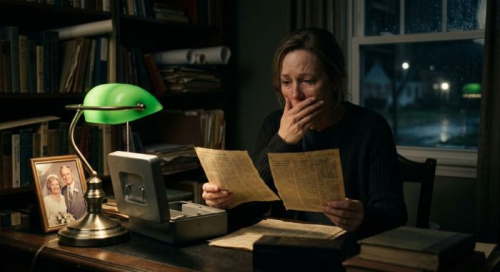
The next morning, when she asked me to iron her blue dress, I waited until she was in the shower, and then I did something I should have done months earlier. I opened the green cookie jar.
There were thirty-one receipts in there. Every payment, every date, every amount, in her perfect tidy handwriting on the line marked "PAID." Thirty-one thousand dollars — and the last receipt was dated for that very morning, the four thousand she hadn't paid yet, with a little pencil checkmark beside it. She'd written the amount in pencil, because it wasn't official yet.
I'm not ashamed to say I cried in my mother's kitchen. Then I dried my eyes, locked the receipts back in the jar, and drove to the strip mall by myself.
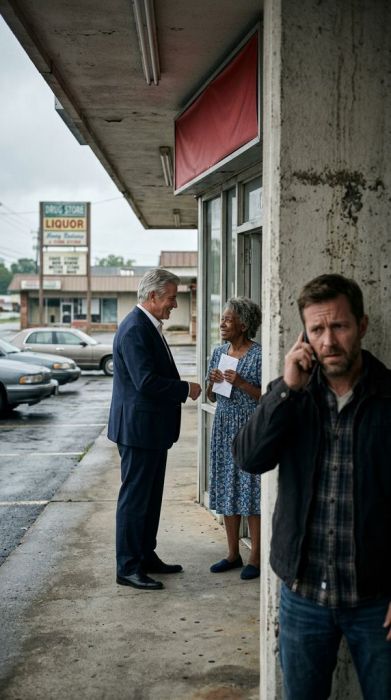
I watched from the parking lot for an hour. I saw Curtis Vance walk out to greet a woman in a lavender coat, help her out of her car, hold the door, and disappear with her into that red-bannered office. He moved like a man with nothing to hide. That was his weakness, I realized. He'd done this so long, in so many towns, that he'd started to believe he was untouchable.
I drove home and called the only person I trusted with the truth: Frank Mazzola, who lived three doors down and had spent twenty-eight years as a detective in the county sheriff's office before retiring to his tomatoes. Frank listened without interrupting, then asked me to bring him the receipts.
An hour later, Frank sat in my mother's kitchen — she was out getting her hair done for the big day — and studied the receipts with reading glasses pushed up on his forehead. Then he asked a question that changed everything.
"This office," he said. "The one with the red banner. Youngstown, roughly ten years back — does the name Bannister mean anything to you?"
It didn't. But Frank's memory was a filing cabinet, and he opened the right drawer. In 2013, a man calling himself Gerald Bannister had run the exact same operation out of a converted garage in Youngstown, selling dreams to widows on the South Side for eighteen months before the place burned down under suspicious circumstances and he vanished. No charges, no trace — just a paper trail of unhappy customers and one elderly woman who had signed over her home.
"Burned down," Frank said, "and the insurance paid out. Think about that."
I thought about it. Then I called the Ohio Attorney General's consumer protection unit and asked for the sweepstakes fraud investigator. I expected a voicemail and a pamphlet. Instead, I got a woman named Alicia Okafor, who answered on the second ring and said, "You're calling about the red banner, aren't you?"
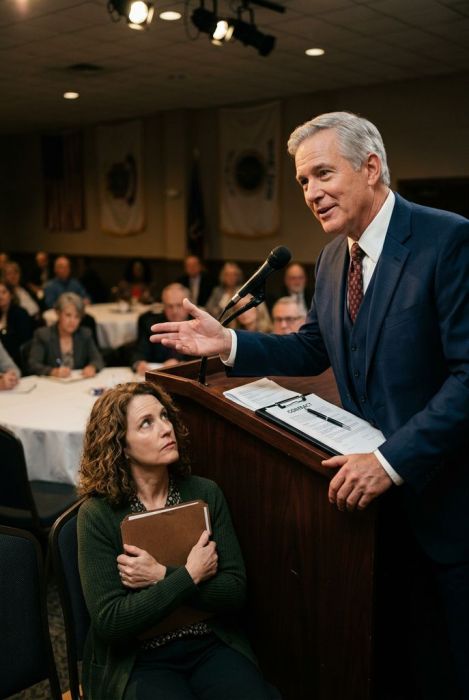
She drove up from Columbus that weekend with a thick folder and a plan. Six complaints had come in about Great Lakes Prize Claims over the past eight months, she told us, but every victim had been too embarrassed, too frightened, or too convinced to cooperate. My mother could change that. If we let her go through with the payout, and if the four thousand dollars was marked and counted in front of witnesses, they could take the whole operation down in a single afternoon — provided she was willing to wear a wire and follow the script they'd give her.
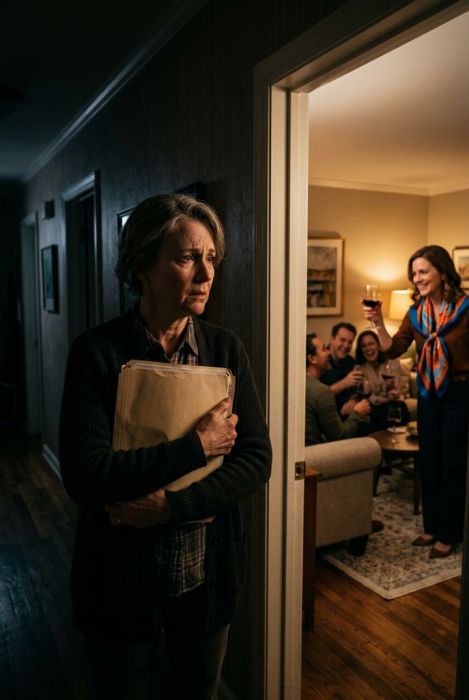
I told Alicia there was no way I was letting my seventy-three-year-old mother help the state of Ohio catch a con man. My mother, who had come home from the hairdresser twenty minutes earlier and was standing in the doorway with her good blue dress on a hanger, told me to hush.
"Thomas Delaney," she said, in the voice that had ended every argument of my childhood, "that man took my grocery money and my dignity. If wearing a little wire is what it takes, I'll wear it with a smile."
The plan was beautiful in its simplicity. Alicia's team would pose as the wire-transfer company Curtis had promised would deliver the funds. The release fee had to be paid at the same moment the transfer was initiated — a coincidence, a quirk of the trust's banking rules. Curtis loved the idea. Money and speed were his favorite words.
On the morning of the payout, my mother asked me to iron her good blue dress, and I did it without saying a single word. I helped her into the car and drove her to the strip mall with the red banner. I kissed her cheek before she went in. She smelled like lavender. She wasn't shaking at all.
Alicia was already inside, dressed as a courier, with four thousand dollars of marked bills in a metal case and a badge in her pocket. Two county deputies waited in a laundry truck behind the building. Frank sat in my car, phone in hand, ready to record everything from the outside.
I watched through the window of the tax office next door as Curtis Vance held the door for my mother, beaming like a proud uncle. I watched him check the cash — he counted it twice, wetting his thumb, the same way Dad's old cashier used to count the register at closing. I watched him sign a receipt and hand it to my mother with a flourish.
And then I watched the most beautiful thing I have ever seen. The courier with the metal case set it down, pulled out her badge, and said, "Mr. Vance, my name is Alicia Okafor. I'm with the Ohio Attorney General's Office. You are under arrest for theft by deception, telecommunications fraud, and identity fraud. You have the right to remain silent."
From the back room, where Curtis kept his coffee maker and his fake certificates, two deputies stepped out. He didn't fight. He didn't run. He looked at my mother, and for one second — one poisoned second — I saw him trying to charm her again, searching for the crack in her faith.
My mother looked at him, then turned to Alicia and said, "He has a binder in the desk. He calls it his winners list. You'll want it."
They found the binder. Sixty-three names, sixty-three addresses, and handwritten notes on each one — what they could afford, what they'd paid, who was "ready for another round." Half of them were Ohio. The rest were Michigan and Indiana. And in the bottom drawer, under a box of red pens, they found something even better: a book of blank certificates with the same signature, Gerald Bannister scraped off and Curtis Vance written over it in fresh ink.
It turned out my mother's instincts had been right all along. Scammers don't know your middle name — but they keep excellent records about the people they steal from. Curtis Vance, whose real name was Dale Pemberton, had been running prize offices for twenty-one years, in four states, under a string of names so long that the FBI agents who flew in from Detroit told Frank they'd been looking for him since 2009.
The arrest made the local paper, then the TV news, then the networks. Sixty-three families got letters from the Attorney General's office telling them their claims had been matched. Forty-one of them, including my mother, got their money back through restitution, dollar for dollar — plus the small amount of interest the court tacked on, which was, as my mother noted with a smile no bookkeeper could hide, more than Curtis had ever given anyone.
Dale Pemberton pleaded guilty to forty-eight counts and was sentenced to nine years in federal prison. He'll be in his early seventies when he walks out, which my mother considers a tragedy. "He'll only have a few good years left to scheme," she said. "And everybody in the system will know his face by then."
She got her blue dress back from the cleaners and wore it to her first meeting of the Winners' Circle, the support group that started in the church basement three blocks from the strip mall. There are fourteen of us now — sons, daughters, and grandchildren of the people that red banner nearly ruined. My mother is the treasurer, of course she is, and the first thing she did was open a savings account with the restitution money. The second thing she did was take the grandchildren to Disney.
I still have the green cookie jar. It sits on my mantel now, with the thirty-one receipts inside, tied with a ribbon. Every time I look at it, I remember the day my mother taught me something no history book ever will: evil people can be charming, patient, and persuasive, but they keep records. And records, eventually, find the people who deserve to read them.