The funeral director cleared his throat and slid a single sheet of paper across the desk. "Just confirm the wording, Mrs. Whitfield." I hadn't slept in two days, and my hands were shaking so badly I could barely hold the page, but the moment my eyes found the words, the exhaustion vanished. Every nerve in my body went cold at once.
It wasn't the fact that the obituary had already been written, polished, and perfectly formatted less than forty-eight hours after my father's heart attack. It was that I had read these exact sentences before. The same odd turn of phrase. The same closing poem about a sailor resting on some far shore. The same woman's name at the bottom, printed as though it had always belonged there. Survived by his loving wife, Evelyn.
Only the names at the top were different. Harold Simms. Wallace Baker. And now, Frank Whitfield.
My father, Frank Whitfield, was a naval architect who spent forty years designing boats he loved more than most of the people he worked with. He was a big, warm man with sunburned forearms and a laugh that carried all the way across a marina. My mother, Maggie, was the anchor of the family, and when she died two winters ago, quietly, in her sleep, my father simply came apart. He stopped cooking. He stopped going to the boatyard. He sat in his recliner with the television off, staring at the wall, and my brother Scott and I took turns driving down from out of state to check on him.
Eight months after Mom died, the pastor at St. Andrew's convinced Dad to join the grief support group that met in the parish hall on Tuesday nights. That's where he met Evelyn Hart. She was a small, silver-haired woman of sixty-one who wore lavender perfume and spoke in a soft Carolina drawl. She'd lost her own husband to "a bad heart" three years before, she told everyone, and the church ladies adored her. She brought Dad casseroles in Pyrex dishes. She laughed at his old stories about sailing the Intracoastal. She told him he had the kindest eyes she'd seen in years, and I watched my father, who had been a ghost for eight months, start to smile again.
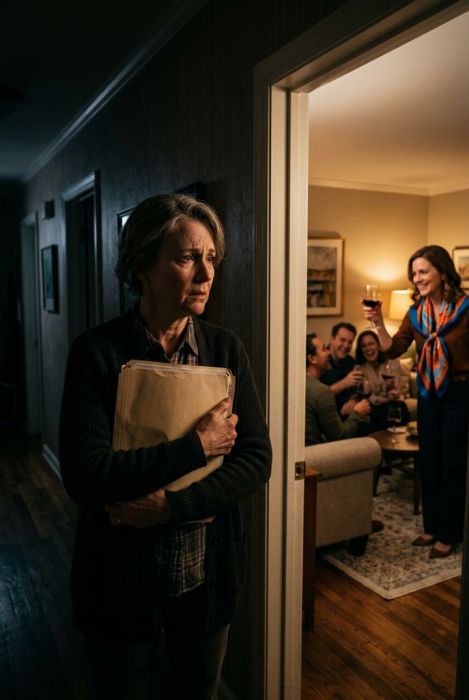
They married eight months after they met, in our backyard, under the live oaks, with the neighbors crying happy tears and the string quartet playing something soft. Scott flew in from Denver and told me privately that it was fast, that something about her felt rehearsed. Evie overheard him say the word "fast" and cried so convincingly that Dad held her for five minutes and Scott apologized on his knees, practically. By the time the cake was cut, even I had been charmed. She was gentle with my children. She insisted on taking Mom's portrait down from the mantel "gently, so it doesn't get broken." She helped Dad with his pills every night because, she said, he was "forgetful about the little things."
Dad turned seventy-five three weeks after the wedding, and Evie threw a birthday party that looked like something from a magazine. Neighbors, sailors from the old yard, the pastor, half the church. Dad was laughing, telling a story about a hurricane in 1988, when he stood up to cut the cake and his face went the color of old concrete. He crumpled beside the table, and the cake toppled onto the grass. Evie screamed, but I remember noticing that she was the first one in the kitchen, already on her phone, and that when the ambulance doors closed, she wasn't talking to 911. I never found out who she called that day. I found out something worse instead.
They told us it was a massive coronary. They told us he never felt a thing. He was buried four weeks and two days after his wedding day, in his navy blazer, in the plot beside Mom, and the whole town came. Evie stood at the grave in black lace and wept into a handkerchief and let everyone hold her, and the minister told us she was the bravest woman he had ever met. She asked me that same afternoon if I could help clear out the study for the realtor because, she said, empty rooms sell faster, sweetheart.
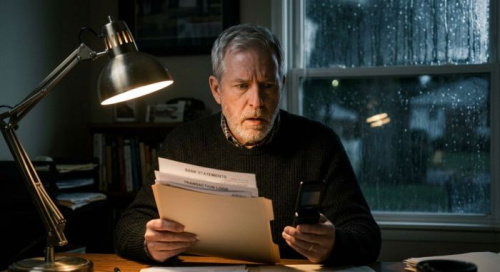
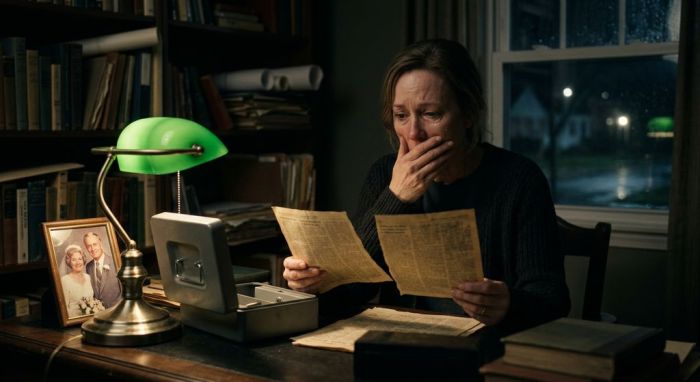
The study was the room where Dad had kept every boat blueprint he'd ever drawn. I went through them slowly, the way I imagined he would have wanted, and it wasn't until the bottom drawer of his desk, under a stack of old charts, that I found the locked firebox. The key was taped to the underside of his chair. I almost didn't open it. I wish, sometimes, that I never had.
Inside were a photo album, two typed obituaries, and a prepaid funeral contract. The obituaries were for Harold Simms of Raleigh, North Carolina, and Wallace Baker of Greenville, South Carolina. Word for word, they were the same as the paper the funeral director had put in my father's hands. Same phrasing. Same poem. Same "survived by his loving wife, Evelyn." The funeral contract was in my father's name, dated six days after the wedding, with a cancellation clause that paid the refund to the primary beneficiary. Evelyn Hart.
I sat on the floor of the study until the streetlights came on. The photo album showed Evie in the same white dress in three different backyards. She had married Harold Simms, and he had died eleven months later of a sudden cardiac event. She had married Wallace Baker, and he had died fourteen months later of a stroke. Both men were in their mid-seventies. Both of them had changed their beneficiary designations within weeks of the ceremony. Both of them, according to the little notes tucked into the album, had believed they were the luckiest men alive.
I flew to Denver and laid it all out for Scott on his kitchen counter. He listened to the whole thing without interrupting, and then he rubbed his face and told me I needed grief counseling. Funeral homes use templates, Ruth. People get remarried. Old men have heart attacks. It's horrible, he said, but it's not a crime. I wanted to believe him. I almost did.
What I couldn't shake was the digoxin. Dad had been on a low-dose prescription for years, and the hospital chart showed a level nearly three times what his dosage could possibly have produced. Nobody questioned it, because nobody ordered an autopsy. His devoted wife told the ER doctors he had a history of heart trouble. He didn't. He had annual checkups like clockwork, and his cardiologist had called him "boringly healthy" six months before.
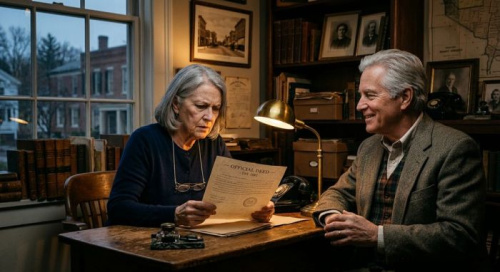
I took the chart to Dr. Peter Voss, the retired Charleston County medical examiner who had taught the first aid course at Dad's boatyard for twenty years. Old Dr. Voss read the file twice, and then he went very quiet and pulled out a folder from a filing cabinet in his garage, a folder labeled "Greenville, 2019." Inside was Wallace Baker's old ER chart, obtained through a friend at the hospital. It had the same signature: a digoxin level that didn't match the prescription, a wife who told the ER he had heart trouble, no autopsy. Dr. Voss had flagged it six years ago, and he had been told to mind his own business. He never threw it away.
He made one phone call, and three days later I was sitting across a sticky table in a diner in Raleigh with Martin Simms, Harold's son. Martin had a box of his own. Identical obituaries. Identical funeral contracts. And a voicemail his father had left him two weeks before he died. Son, Evie's been so worried about my heart, she checks my pills twice a day. I've never felt more taken care of in my life. Martin's eyes were red when he got to the end of it. I told the police in Greenville, he said. They told me grief makes people imagine things. I've been imagining things for six years.
After that, the walls came down fast. Detective Tom Briggs of the Charleston Police Department had been Dr. Voss's patient for years, and he took the file seriously enough to walk it up to the district attorney's office himself. Three states, three counties, one small funeral company that remembered the lady with the lavender perfume buying four transferable packages in fifteen years. Dad's three-hundred-thousand-dollar life insurance policy, with the beneficiary changed ten days before he signed the marriage license. The property deeds. The safe-deposit box. It all sat on a conference table in the county solicitor's office, and everybody at that table knew they were looking at a predator who had been hunting lonely old men for twenty years.
The trap was simple, and it played on the one thing Evie could never resist. Money. I called her with my voice shaking and told her I had found a letter in Dad's things about a second policy, two hundred thousand dollars, taken out years ago and still payable in the event of his death, but the bank required both named parties to be present to release the box. Could she come with me to our family attorney's office on Thursday at three? Of course, sweetheart, she said. Whatever your father would have wanted. She arrived in her black dress and her pearls, already practicing her sad smile.
The conference room at Gerald Whitaker's office had a long oak table and a wall of windows looking out over the marsh. Evie walked in and made for the chair at the head of the table, but the room was already full. Gerald sat at the far end. Beside him sat Detective Briggs in a gray suit, Dr. Voss, Martin Simms, and two assistant district attorneys, one from Charleston and one from Wake County, North Carolina. Evie's smile wavered for just a second before she settled it back into place.
Gerald set the three obituaries side by side on the table. Evelyn, he said, do you recognize these? She laughed, a small, brittle laugh. Every funeral home uses the same template, Gerald. You know that. Then Martin pressed play on his phone, and his father's voice filled the room, cheerful and trusting and doomed. Evie's face did something I had never seen a face do before. Dr. Voss read the toxicology line from the two ER charts, and then he read my father's. Same drug. Same impossible level. Same convenient story about a bad heart.
The assistant district attorney from Charleston told her she had the right to remain silent, and Evie's careful mask slid off her like wet paper. She looked at me, and for one long second I saw the woman who had wept at my father's grave, and then I saw what had been underneath her face the whole time. You have nothing, she hissed, that will hold up in any court. Gerald opened the safe-deposit inventory then, slowly, the way a man deals a winning hand. Three birth certificates. Three marriage licenses. Three death certificates. The same handwriting annotating each one. A lawyer's file from Tulsa, Oklahoma, twenty years old, with a man named Ernest Doyle.
Detective Briggs turned her around and put the cuffs on her. The last thing she saw in that room was my father's memorial card, pinned to the wall by the window, with the poem about the sailor on the far shore. She is still in prison now, and she will be for a long time. What followed was eighteen months of depositions and forensic accountants and a trial the local paper called the Sweetheart Widow case. The jury was out four hours. Guilty on two counts of second-degree murder. Guilty on one count of financial exploitation of a vulnerable adult. Her real name was Della Jean Slocum, and in Tulsa, two decades before she met my father, a quiet man named Ernest Doyle had died the same gentle way, leaving her a house and a small marina. The judge stacked the years until they towered: twenty-two years, and restitution ordered for every family at that table, including mine.
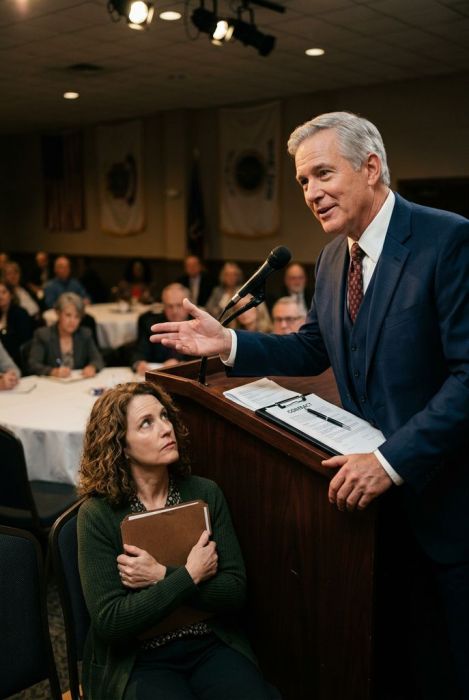
I live in my father's house now. I painted the study seafoam green, and I hung his blueprints back on the walls, and the firebox sits open on a shelf where I can see it, so I never forget that the truth was hiding in the second drawer. Martin and I give talks at senior centers, the ones with the folding chairs and lukewarm punch, and we tell people the same thing every time: look at the paperwork, not the perfume. The grief group at St. Andrew's put a bench under the live oaks with a brass plate on it. For Frank Whitfield, who taught us that love should never rush you past the small print.
Sometimes I sit on that bench and watch the light come through the Spanish moss, and I think about the day the funeral director slid that paper across the desk. I think about how the sweet widow everyone adored taught me to read everything twice, especially the words that look too perfect to be true. And I think about my father, who always said the sea keeps its promises. So does the paper trail. In the end, it brought her home.