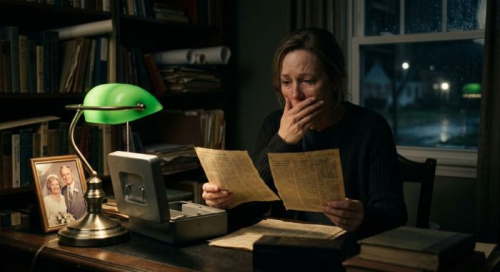

I ran his badge number three times before I believed what I was seeing. Three times the same polite dispatcher at the county line told me there was no Detective Mark Ellison in the state of Iowa, and three times I felt the kitchen floor tilt under my feet. On the table in front of me lay a laminated card that read FEDERAL PROTECTED ACCOUNT — a carbon copy from a receipt book I had found an hour earlier in my mother's hall closet, hidden under the good towels.
"My savings are safe now, Sarah," Ruth said when she walked in and saw me staring at it. She patted my arm like I was the one who needed comforting. "The detective is holding them at the federal office until they catch the identity thieves."
Forty-six thousand dollars. My mother's entire life, folded into a bank envelope and handed to a stranger who smiled like a Sunday-school teacher.
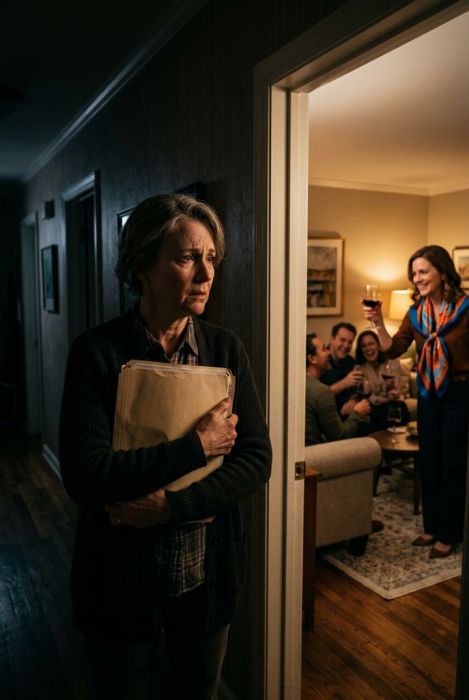
Ruth Whitfield had lived in Juniper Falls, Iowa, for fifty-one years, and she had never once locked her back door. She was the neighbor who brought casseroles, the widow who kept her husband's tools polished in the garage, the woman who could name every kid on Maple Avenue. When she turned eighty-two, I started driving over from Des Moines every other weekend, not because she needed me, but because I needed to see her.
It started with an email. A convincing one — her bank's logo, her real account number, a warning that someone in Arizona had tried to log in. Ruth, who had never fallen for anything in her life, called the number at the bottom of that message because it looked official, and a young man with a smooth voice confirmed the fraud and promised a detective would visit her that week.
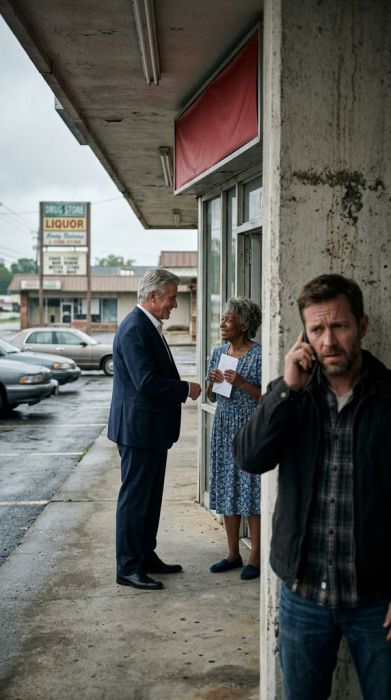
And he did. Mark Ellison arrived at her door two days later in a navy windbreaker with a badge clipped to his belt, silver-haired, warm-voiced, carrying a leather folder. He showed Ruth a business card with the seal of the state fraud task force and told her she was one of the lucky ones — they had caught her case before the thieves drained her accounts. He stayed for coffee. He told her about his mother in Cedar Rapids. He wrote his number on a sticky note and told her to call him anytime, day or night.
Over the next three weeks, Ellison became a fixture in her life. He took her to her doctor's appointment, helped her with the new phone I had bought her, and explained patiently, with charts and printed forms, exactly how the criminals operated. "They monitor your phone, Ruth," he told her gravely. "They watch who you talk to. That's why you can't tell anyone about this — even your daughter. They would drain your accounts the moment they knew we were watching."
The plan, he explained, was simple. The thieves already had her debit card number, so her accounts could never be safe. The only way to protect her money was to move it into a federal protected account while the task force cleaned her files. Ruth asked the right questions — she was no fool — and he had an answer for every one of them. He showed her a government form with her name on it. He gave her a phone number that played a recorded message that said "Federal Protective Services" when she called it. He was patient, kind, and utterly convincing.
So my mother went to her bank and withdrew her savings in five careful chunks, each one under ten thousand dollars so the teller would not ask too many questions. She put the cash in a manila envelope. Ellison came to the door, signed a receipt in triplicate, and told her the money would be returned to her account within ninety days, with interest. Then he hugged her, called her a hero, and drove away in a silver sedan with out-of-state plates.
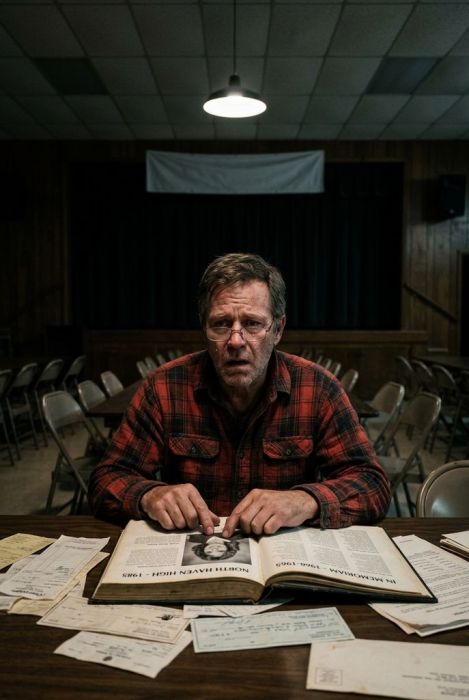
I found the receipt book on a Sunday afternoon, three days later, when I went to fetch a blanket from the hall closet and knocked over the stack of towels he had made her hide it under. A cheap spiral notebook. Carbon copies of FEDERAL PROTECTED ACCOUNT receipts, each one signed M. Ellison, each one for an amount that made my stomach drop.
I did not panic. I am a paralegal; I have seen forged documents before. I called the Juniper Falls police the next morning and asked, politely, to verify a badge number. That is when the floor tilted. There was no Detective Mark Ellison. There was no Iowa fraud task force by that name. And the phone number printed on my mother's receipt was a prepaid cell that no longer existed.
I did not tell my mother right away. I loved her too much to watch her face crumple. So I sat in my car in the police station parking lot for ten minutes, gripping the steering wheel, and made myself think like the paralegal I was instead of the daughter I felt like. The receipt book was evidence. The bank had records. The "detective" had left a trail — and trails could be followed.
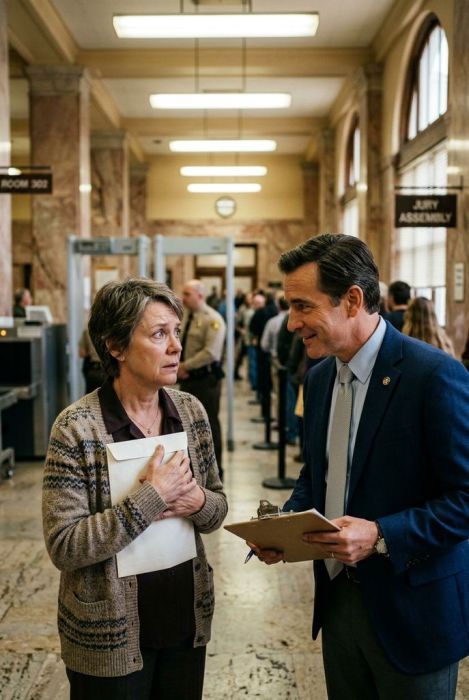
I drove straight into the station with the receipt book in my purse. Detective Rosa Delgado met me in the lobby — a compact woman in her forties with reading glasses on a cord and a voice that had clearly heard every lie in the book. She listened without interrupting, then pulled out a folder of her own. "We have had two other reports like this in the last month," she said quietly. "Same script. Same receipts. Different victims, different names."
The folder held photographs from a bank lobby in Cedar Rapids and a porch camera in the town of Honey Grove. Same silver hair. Same navy windbreaker. Same smile. His real name, according to the warrant attached to the file, was Dale Whitaker, and he was wanted in Missouri for impersonating a peace officer and defrauding an elderly couple of thirty-one thousand dollars. He had skipped parole in April. The Iowa victims were his new territory.
The worst part: he was not done with my mother. The following Tuesday, "Detective Ellison" called her to say the case had expanded and the federal office needed one final processing fee of eight thousand dollars to release her money. Ruth called me, proud and excited, to ask if she could borrow the difference — she only had six thousand left in checking. My hands were shaking when I hung up.
Delgado's plan was clean and simple. Ruth would agree to the fee, and I would deliver the cash myself — in marked bills, with a wire. Whitaker chose the meeting place: the parking lot of First Lutheran Church, after Wednesday prayer service, when the lot would be full of cars and empty of witnesses. What he did not know was that the church secretary, a woman named Betty Kowalski, was one of the victims from Honey Grove — and she had volunteered to run the church's new security cameras herself.
There was one more twist I had not expected. When Delgado played me the recordings of Whitaker's calls to the other victims, I heard a second voice — a woman's voice, smooth and patient, the one who confirmed the fraud and coached the victims through their withdrawals. "That is his wife, Eleanor," Delgado said. "Everywhere he goes, she goes. She is the one who drives the money away."
Wednesday came cold and gray. I parked my mother's Buick in the far corner of the church lot, an envelope of marked bills on the passenger seat, my heart hammering against my ribs. Whitaker arrived at seven, on time, in the silver sedan. He walked to my window with that warm, unhurried smile, and for one sickening second I thought I might lose my nerve. Then I handed him the envelope, and he counted the bills with the calm of a man who had done it a thousand times.
He never heard the footsteps. Delgado and two uniforms came from behind the church, and Whitaker's smile cracked and fell away like cheap paint. He tried the badge — "I am a federal officer, you have no jurisdiction" — but Delgado had been patient for six weeks, and she read him his rights in a voice that carried across the whole parking lot. His phone started buzzing in his pocket as he was cuffed: Eleanor, calling to ask if the money was in the car.
They found Eleanor two hours later at a motel outside Cedar Rapids, the deposit bag from my mother's bank still in the trunk of a rental car, along with forty-one thousand dollars in cash — the bulk of what Whitaker had collected from Ruth, minus what he had already laundered into a boat he had bought under a false name. It was not all there. But it was enough.
Dale Whitaker was convicted on nine counts: impersonating a peace officer, theft by deception, exploitation of a vulnerable adult, and a string of wire fraud charges that stacked like dominoes. The judge gave him twelve years in federal prison and ordered restitution of every dollar he had taken, including the six thousand my mother had scraped from her checking account. Eleanor Whitaker got six years. Two other families from Honey Grove came forward at the hearing, and the courtroom — full of my mother's neighbors — stayed until the last gavel fell.
When the verdict was read, the gallery applauded before the bailiff could stop it. My mother reached over and squeezed my hand, and for the first time in months her grip felt strong. Dale Whitaker did not look at her. He looked at the floor, and I think that was the moment he finally understood what he had done — not to banks, not to accounts, but to people.
They never recovered everything. A piece of my mother's savings was gone for good, laundered through a shell company in Nevada before the arrest. But the bank, embarrassed and contrite, refunded her withdrawal fees and helped her open a joint account in both our names. The Juniper Falls senior center started a fraud-watch workshop every month, taught by a retired postal inspector, and Ruth was the first to volunteer. She stands at the front of that room now with a plastic badge pinned to her sweater and a laminated card in her hand — the receipt, framed, as a warning to anyone who will listen.
The last time I saw Dale Whitaker, he was being led out of the courthouse in an orange jumpsuit, and my mother was standing on the steps with her shoulders straight. She did not cheer. She did not even look at him. She just took my arm and said, "Let's go home, Sarah. I have got a workshop to teach." And I knew, right then, that karma was not just about the man in handcuffs. It was about the eighty-two-year-old woman who had learned, at last, to lock her door — and to make sure nobody else forgot to.