The day we buried Ben, I came home to a dark house and a door that stood open by two inches. I stood on the porch for a long moment, keys in my hand, telling myself the wind had done it. Ben had fixed that latch himself the summer before he died, and he'd fixed it right, the way he did everything. Then I pushed the door open and smelled it: cigarette smoke you never find in our house, and something worse. The workshop door was hanging crooked, and every drawer under it had been pulled out.
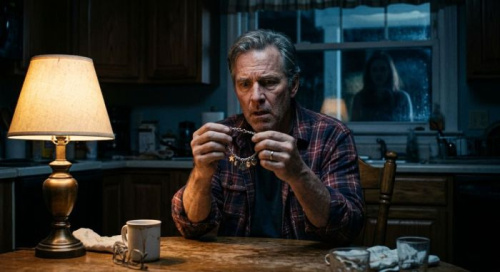
I want to say I screamed, but I didn't. I walked through the kitchen, past the tower of condolence cards, and stood in the doorway of the garage where Ben had repaired watches for forty-one years. The display case stood open, its glass top folded back like a coffin lid. The velvet trays were empty. Every single shelf had been swept clean. Seventy-three timepieces — my husband's personal collection, his grandfather's 1934 railroad watch, and the repair inventory of customers who had trusted him for decades — were gone.
Danny found me on the floor among the spilled screws and broken glass. "Mom?" He was still wearing his funeral suit. He'd driven straight down from Minneapolis the night before and hadn't changed since. I couldn't tell him what was missing, because I couldn't name it. It was the last of Ben. And somebody had come into my house while I stood at his grave and taken it.
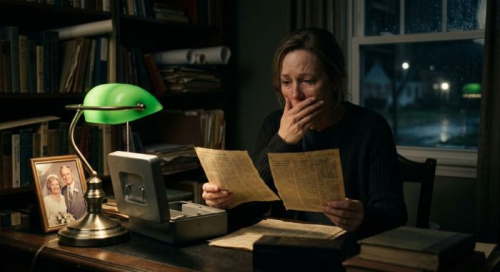
Ben Kowalski had been a quiet man with beautiful hands. For forty-one years, from a workbench in our garage, he'd brought dead watches back to life. People from three counties drove to Granite Falls to leave their heirlooms with him, because he treated each one like it mattered. He kept a ledger of every piece that ever passed through his hands, in handwriting so neat it looked printed. When his heart gave out on a Tuesday morning in early November, the workshop still held almost a year's worth of repairs waiting to be picked up. The customers' names were in the ledger. I'd have to call every one of them and explain that I didn't know where their treasures were.
The first person through our door after I called the police was not an officer. It was Brady Coyle from next door, carrying a casserole dish wrapped in foil. "Margie," he said, setting it on my counter as if he lived there, "you call me if you need anything at all. I mean it." He was twenty-four, tall and clean-cut, with his father's kind eyes and a smile that made old ladies pat his cheek. His father Earl had been Ben's fishing partner for thirty years. Brady had mowed our lawn that summer for free when Ben got tired, and he'd changed our porch lightbulb twice without being asked. Everyone in the neighborhood called him a good boy. I hugged him, and he hugged me back, and I remember noticing he smelled like soap, not cigarettes.
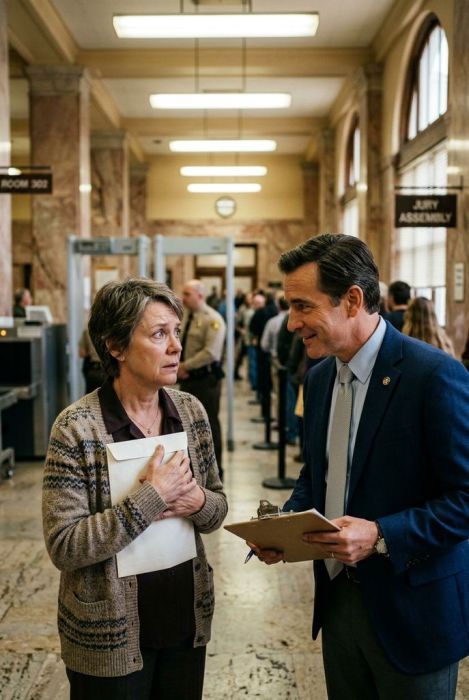
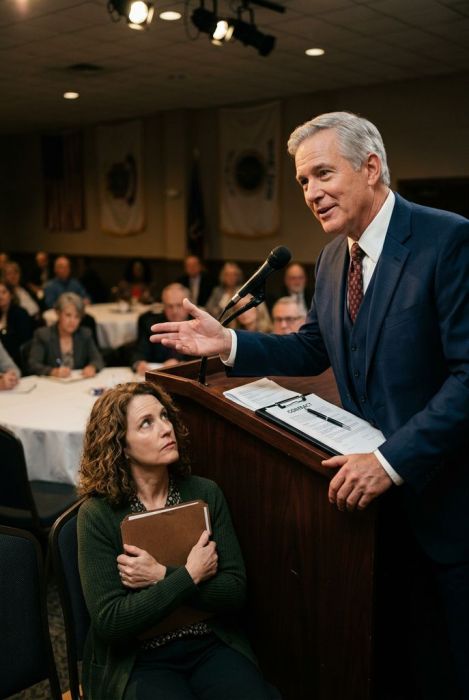
Officer Rosa Alvarez arrived forty minutes later with a notebook and the tired face of a woman who had seen too many Mondays like this one. She walked the house with me room by room, careful and kind, and when we reached the workshop she stood a long time looking at the empty trays. "Mrs. Kowalski," she said finally, "your husband's obituary. When did it run in the paper?"
"Wednesday," I said. "The service was Thursday at eleven at St. Mark's."
She wrote something down and asked if I'd told anyone the house would be empty. I told her everyone, because that's what you do when your husband dies. You put it in the paper so the people who loved him can say goodbye. "That's what I was afraid of," she said. Then she told me something that made my blood go cold.
There was a pattern, she said. Since spring, seven widows in the counties around ours had been robbed on the exact morning of their husbands' services. Each time, the house was empty for a couple of hours during the funeral and burial. Each time, the thief took small valuables — jewelry, coins, watches — things that could be carried in a duffel bag and sold without paperwork. The newspapers had started calling him the Funeral Thief, though the police didn't use that name. What they knew was this: he read obituaries, then he robbed the grieving.
I didn't sleep that night. I kept seeing the empty velvet trays, and I kept hearing Brady's voice saying anything you need at all, Margie. I hated myself for the direction my mind was going. Earl's boy was the one who'd brought us soup after Ben's first ambulance ride two years ago. But the cigarettes bothered me. Ben never smoked. I never smoked. Nobody in our house had smoked in twenty years.
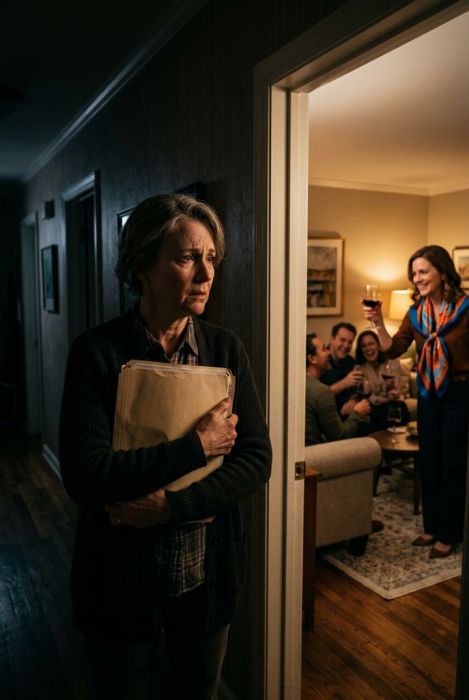
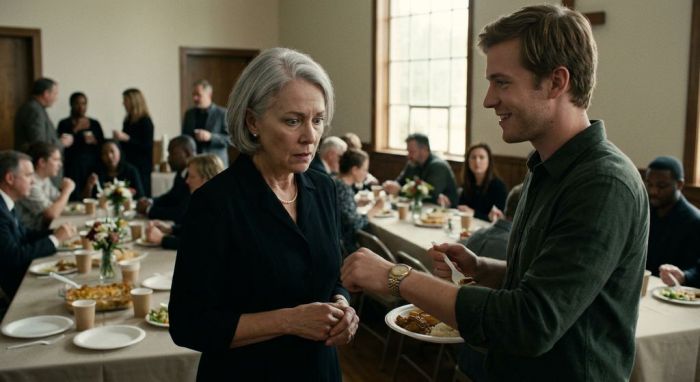
On Sunday, the church held a memorial luncheon at St. Mark's for the out-of-town relatives who couldn't make the burial. There were ham sandwiches and three kinds of Jell-O salad and a long table of photographs, including one of Ben at his workbench that made my throat close. I stood by the punch bowl because it gave me something to do with my hands. And that's when Brady Coyle walked in.
He was wearing a charcoal jacket and a blue shirt, and he looked exactly like the good boy everyone believed he was. He worked his way around the room, squeezing elbows and murmuring condolences. When he reached me, he took both my hands in his and looked at me with those kind eyes. "Margie, I've been thinking about you nonstop," he said. "You let me know the minute you need anything."
I almost said thank you, sweetheart. But the words died in my throat, because in that moment he let go of my left hand to reach for a paper cup, and his jacket cuff rode up.
There it was. A gold watch with a worn leather band and a small chip in the crystal, exactly where Ben had dropped it on the workbench a decade ago and never bothered to fix. The caseback was turned toward me, and I didn't need to read it to know what it said. M&B — June 8, 1974. Our wedding date. Ben had the engraving done six months later, when my grandmother asked why he wore a watch with his wife's initials on the back of his wrist.
I forced my face into a smile. "Thank you for coming, sweetheart," I said, and I let him hug me, and I stood there in the middle of the church hall smelling soap and cologne while my heart pounded so hard I thought the ladies at the next table could hear it.
I didn't touch my plate. I watched him. He wore the watch all afternoon, turning it like a trophy, checking it like a man proud of something new. I remembered that Brady had been at Ben's service, of course he had — the Coyle family had taken up two whole pews. He'd hugged me at the graveside too, right after the last prayer, while the house sat dark and empty and the Funeral Thief was somewhere in my garage with a duffel bag.
That evening I called Danny, and I made him listen without interrupting. "You're sure?" he kept saying. "Mom, you're sure?" And I told him about the engraving, about the chip in the crystal, about how no man his age in all of Granite Falls wore a forty-year-old two-tone watch with his mother's old friend's initials on the back. Danny said he'd fly home tomorrow. I said no. I said I had a better way.
The next morning I drove to the police station and asked for Officer Alvarez. I set Ben's ledger on her desk, open to the page with the serial numbers of every watch in that display case. "Not many people could fence these without attracting attention," I said. "And whoever took them must have a place he brings them to."
Rosa looked at me for a long moment. Then she opened a file folder of her own and slid out three photographs from pawn shop records in the county seat. "We pulled these after your report, Mrs. Kowalski," she said. "Two of your husband's watches turned up at Lou's Loans and Pawn yesterday morning. The seller's name on the ticket is a fake, but we have him on camera. He didn't disguise himself worth a damn."
I looked at the still frame of a man in a blue shirt, grinning at the counter, the same grin that had been in my kitchen a hundred times. I didn't feel angry. I felt something colder and steadier, the same feeling I got when I watched Ben fix a stubborn movement: the knowledge that everything was already in place, and all that was left was to wind it up.
The plan Rosa and I built was careful and simple. She couldn't arrest Brady on a pawn receipt alone — the photo was grainy, and Lou Petrie had a lawyer who'd argue his camera was broken. What she needed was to catch Brady with the evidence in his hands. So I did what any heartbroken widow would do. I told people at the diner that I'd found one last treasure under Ben's workbench, his grandfather's railroad pocket watch, and that I'd set it on the mantel where I could see it when I sat in his chair.
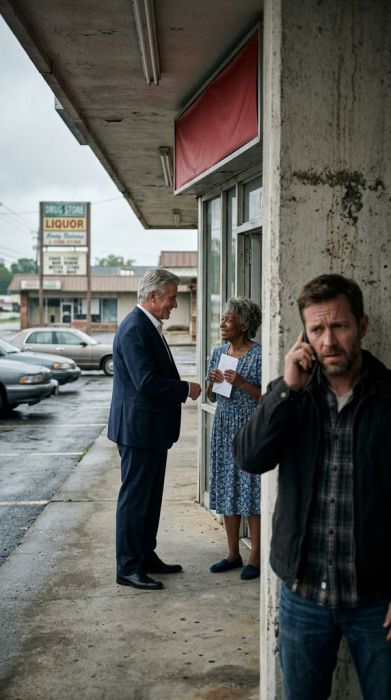
It took four days for the news to reach next door, the way I knew it would. On the fourth evening, Brady knocked on my door with a tinfoil tin of his mother's brownies. "Earl said the insurance gave you a rough time," he said over the threshold. "I thought you might need something sweet."
"Bless you," I said, and I invited him in. I let him stand in the living room, let his eyes drift to the mantel, where the pocket watch lay on a little felt pillow beside Ben's photograph. I watched his gaze stick to it. And I saw him make the calculation, the same immoral arithmetic he'd done a dozen times before: this woman is alone, this woman trusts me, this woman's house is quiet tonight.
The alarm system Rosa's department installed was invisible. The officers were parked at the church lot across the street, out of sight, watching the feed from three hidden cameras. All I had to do was be somewhere else when he came back. So on Monday night I went to Earl's house for tea, because Earl was the one part of this I couldn't forgive myself for. I knew I'd be sending his son to prison. But I also knew Earl would never forgive himself if he found out I'd hidden it from him.
I told Earl everything at his kitchen table, and the old man's face crumbled. "The boy was at his own mother's funeral line taking casseroles for us," he whispered. "He knows what that week feels like. And he did it to you." He was quiet for a minute. Then he reached across the table and put his hand on mine. "You do what you have to do, Margie. And if it helps, I found the box in his closet last night. I was going to bring it to you this morning." He went to his bedroom and came back carrying a cardboard box, the one from our garage display case. It held fifty-one watches, wrapped in flannel like a child's treasures. Earl had washed them, I realized. He'd washed his son's fingerprints off of them without even understanding what he was doing.
I didn't sleep much that night. At 11:40 the camera feed showed a shadow cross the backyard. Brady came in through the garage, through the plywood we'd left loose on purpose, and walked right into my living room like he owned it. I watched him on Danny's phone, watched him lift the pocket watch off the mantel and weigh it in his palm. He smiled. That was the moment Rosa's voice came through the speakers, calm as a prayer: "He touched it. He touched the bait. Move in."
The lights came up. Brady stood frozen with the watch in his hand while the front door opened and three officers walked in. He tried to run through the garage, but the door was blocked, and he went down hard on the concrete, and the pocket watch skittered across the floor in a circle like a coin. Earl watched from his porch, his face blank and wet. I reached his side just as they brought Brady out in cuffs, and I heard him whisper, "Dad?" — and Earl turned away.
He was still wearing Ben's watch. The arresting officer read it off the report later: gold two-tone, engraved caseback, M&B — June 8, 1974. Rosa photographed it against the evidence marker before she let me hold it. I turned it over in my palm and read our date, worn smooth at the edges from forty-one years of Ben's wrist. Then I put it on, and it was heavy in a way that had nothing to do with gold.
At the trial, the district attorney laid out the whole miserable history. Brady Coyle had been the Funeral Thief for eleven months. He'd robbed nine widows in four counties, always on the morning of a service, always taking the small things that couldn't be traced. Lou's Loans and Pawn was raided the same week; Lou Petrie cut a deal and gave up every name in his hidden ledger. The detectives found a shoebox of obituaries under Brady's bed, clipped from three newspapers, with dates and addresses circled in red ink. My husband's was clipped too, and next to it, in Brady's handwriting: house empty 10:30–2:00, alarm off, garage door key under the brick.
Brady pleaded guilty. He got seven years and a restitution order that will keep him paying long after he's out. Lou Petrie lost his license and his shop. The watches came home in stages — fifty-one from Earl's box, nine more from pawn shops, two from a collector in Iowa who returned them when the FBI called. I held a little open day at the workshop and let the owners come pick up what they'd thought was lost forever. Some of them cried. I cried with them, and it didn't feel like shame anymore. It felt like the first clean thing I'd done since the funeral.
I wear Ben's watch now, on the left wrist, the way he did. Danny says it suits me. Earl still lives next door, and he brings me soup sometimes, and we sit on the porch and don't talk about it, which is how we both prefer it. Last month I opened the workshop again, one day a week, just for neighbors. Kids bring in their broken bikes and I straighten their chains; old Mr. Jansen brought me his dead grandfather clock and I found a man in Duluth who still makes the gears. The sign out front says Kowalski Watch & Repair, Est. 1962, and beneath it someone wrote in chalk, "Still tickin'."
Ben's ledger is back in the drawer where it belongs. On the last page I keep a photograph, the one from the memorial luncheon that someone took of me by the punch bowl. I don't keep it because I look happy. I keep it because that was the exact second I understood something Ben once told me: that even the most broken movement will start again, if you're patient enough to find where the pieces went and put them back in the right order. The Funeral Thief thought he could take everything that mattered when I was standing at a grave. He didn't know that the things you bury outlast the people who steal them. And he never once understood that the watch he was so proud of had been telling the truth about him all along — right there on the back, where he never bothered to look.