The pediatrician's office called at 7:14 on a Tuesday morning. I remember the minute because I was pouring Leo's orange juice and the phone slid right out of my hand onto the kitchen tile.
"Mrs. Callahan?" the nurse said. "Dr. Park would like to see Leo again. Can you bring him in this afternoon?"
I asked if it was the rash again. She paused a beat too long. "It's his bloodwork. She wants to talk to you about the bloodwork."
My daughter Heather was on the night shift at the hospital in Crossville, so Leo stayed with me three days a week. He was five years old, with a cowlick that never behaved and a laugh that sounded like gravel in a tin can. The rash had come and gone all summer. We put cream on it and called it eczema.
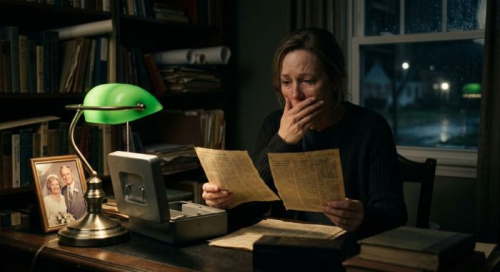
Dr. Park was gentle, which scared me more than anything. She laid two pages in front of me and tapped a circled number. Leo's liver enzymes were high, she said. And there was a trace of something in his blood that she did not expect to see in a child.
"Trichloroethylene," she said. "An industrial solvent. It doesn't belong in a five-year-old's body. I need you to think about his environment. Water, soil, air — what does he play in?"
I laughed, because what else are you supposed to do. We live in Blue Creek, Tennessee, population eleven hundred and change. The only factory within forty miles closed in 1998, and half the town treated that like a holiday.
Everyone, it turned out, was wrong about the water.
My husband Tom and I had lived on the same forty acres since 1986. Our property ran along the back side of the creek — the one everyone called the prettiest water in the county. Tom and his best friend Ray Donnelly had fished that creek together for thirty years.
Ray Donnelly was the closest thing Blue Creek had to royalty. Donnelly & Sons farmed eight hundred acres and ran the biggest equipment dealership in the county. Ray was a deacon at First Baptist, the man who paid for the youth league dugouts, the first one at your door with a casserole when you were sick and a tractor when you were stuck. He spoke at Tom's funeral. He held my hand and told me Tom was the brother he never had.
And Ray was the one who had given the creek its sermon. "That water's sacred," he'd announce at every firehouse pancake breakfast and county meeting. "It's the soul of this town. We don't build on it, we don't pave it, we don't touch it."
He fought the county's walking path along the creek for six years. He started a group called Friends of Blue Creek to fight it. Hundreds of people signed his petition. "Let the creek stay wild," the signs said. "Keep it sacred."
That's why, when I finally understood what was in Leo's blood, I didn't tell anyone. Not Heather, not the neighbors, not the sheriff. Because the man who had blocked every attempt to test that water for a decade was the most trusted man in the world. And I knew, the way you know a snake is a snake, that if I opened my mouth too soon, he would find a way to make me the crazy one.
The clues had been there for years, and I had smoothed them over like everyone else. The well pump that seized up in 2021 — Ray "helped" me replace it for free and insisted on installing a filter system, "on the house," he said. The fish that started floating belly-up below the bend in 2022. The frogs that vanished. The goats at the Hollis place that came down sick and never really got better.
Then came last spring, and the final dominoes. Three kids at the schoolhouse got the same mysterious rash the same week. And Ray Donnelly, who had spent a decade telling us not to touch the creek, bought himself a brand-new silver F-350 and a boat.
Nobody connected it. I was starting to.
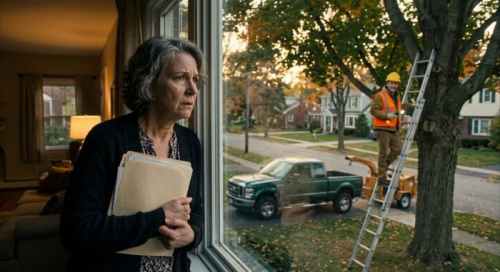
The first time I saw the tanker was a Thursday in June, at 2:17 in the morning. I couldn't sleep — Leo's rash had flared up again, and I'd been up checking on him. I was at the kitchen window with a glass of water when headlights rolled up the gravel lane on the far side of the creek.
That lane only led to two places: the old Hollis barn and the creek's widest bend. Ray had bought the Hollis place "for storage," he'd told everyone. Interesting, I thought. Storage.
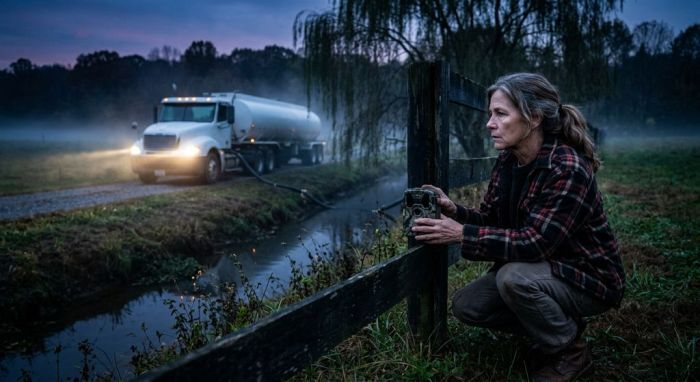
The truck was a white tanker, no markings, moving slow with its lights off. It stopped at the bend. A man got out, walked around to the back, and I watched him pull a hose down to the water's edge. For twenty minutes, nothing moved except the mist. Then he unhooked the hose, got back in, and drove away.
I didn't sleep the rest of the night. And I didn't call anyone, because I still couldn't make the pieces fit in a way that sounded sane. Ray Donnelly, the man who gave the creek its eulogy, dragging a hose into it at two in the morning.
The trail camera cost me eighty-nine dollars at the hardware store in Crossville. I told the clerk it was for deer. It wasn't a lie, exactly — what I was hunting had hooves, in a way.
I set it on the fence post at the Hollis line, aimed at the bend where the weeping willow hung low over the water. Every Thursday night for a month, I checked the memory card in the dark, like a teenager sneaking a look at a phone.
I got him on the second week. Clear as a sermon. The white tanker, the man, the hose, the water. The time stamp: 2:14 a.m. The date: every other Thursday, like clockwork. And once, when a cloud passed over the moon, the man turned his face toward the camera — Ray Donnelly, in his John Deere cap, dragging the hose to the creek he had sworn to protect.
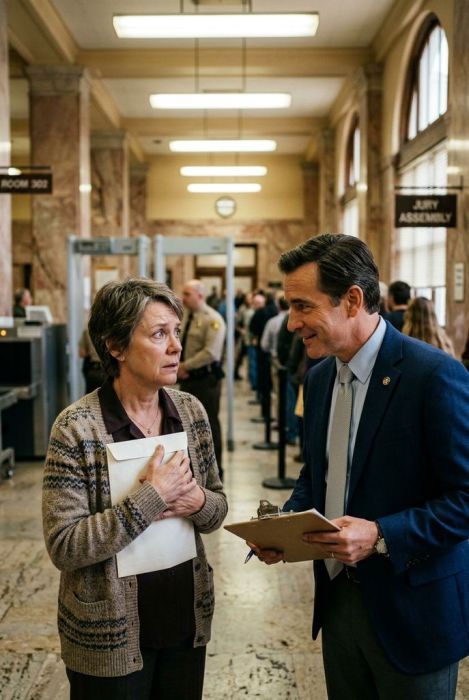
I took the memory card to the county building in Crossville and asked for the new environmental officer. The woman who came out to the lobby was maybe thirty, with a badge on a lanyard and tired eyes. Her name was Melanie Ruiz. And when I started to explain, she held up a hand.
"Mrs. Callahan," she said, "how long have you been waiting to tell someone?"
I cried in that lobby. I hadn't planned to. But she said she'd been waiting too — for someone with proof. She walked me back to her office and unlocked a cabinet full of paperwork filed over the years by people who'd been told to mind their own business. "Everyone who ever mentioned the creek got shut down," she said. "The old county board. The Friends group. The donations to the sheriff's reelection fund. I've been here eighteen months and I couldn't get a water sample past the courthouse door."
Then she showed me the email. Anonymous, sent in March, from a former Donnelly & Sons driver named Dennis Frei. Dennis had attached photographs of a ledger he'd kept for four years — seventy-four loads, three hundred and forty thousand gallons, a delivery schedule marked in a neat hand that matched Ray's signature on church building permits. The waste came from a closed chemical plant cleanup site in the next county, hauled for "disposal" at forty-two dollars a gallon. Disposal, Melanie said, meant the creek.
"There's a reason he fought the walking path so hard," she said. "A public trail means public eyes. He needed that bend private. He needed it sacred."
We did it the right way. Melanie had the state lab mark a special testing kit. Deputy Cole Vickers of the county sheriff's department — a young man whose own grandmother had them over for Sunday dinner — volunteered for the stakeout. The night before the next scheduled delivery, they hid two trucks in the trees at the Hollis line and had me keep my kitchen light on, as if nothing was wrong.
I sat at that window all night with my hands wrapped around a cold cup of coffee. At 2:09, the white tanker came up the lane, lights off, slow as a funeral.
They let him hook up the hose. They let him open the valve, so the lab could prove it in one clean sample. And when he was standing at the water's edge in his John Deere cap, Deputy Vickers hit the floodlights and called his name.
Ray froze. That's the part I'll always remember. Not the shouting, not the cuffs — the frozen second when the most trusted man in Blue Creek looked down at the hose in his hand and understood that the whole town was about to see him for what he was.
"It's fertilizer," he said, to the deputy, to the dark, to nobody. "It's just fertilizer, Cole, you know me."
Cole said, "Sir, the lab sample says otherwise."
It wasn't fertilizer. The lab found trichloroethylene in the sample — the same chemical in my grandson's blood. The ledger matched the camera time stamps. Dennis Frei walked into the state office with the originals a week later, every page notarized to make it stick.
Ray's lawyer tried the obvious defenses. Agricultural runoff. A prank by a disgruntled employee. But the jury heard from Dr. Park about Leo. They heard about the Hollis kids and the goats and the fish. They heard from Melanie, who read the county records showing that every single attempt to test the creek had been blocked by one name, for a decade.
Eight years in state prison, eleven counts, and $2.1 million in restitution, most of it ordered straight to the creek restoration and the waterline extension that would finally bring clean municipal water to every house on my road. Donnelly & Sons went into receivership. The silver F-350 and the boat were sold at auction. His wife Nancy moved to her sister's in Memphis, and the last time anyone saw Ray Donnelly, he was being led out of the courthouse in a jumpsuit the color of a prison wall.
The hardest part came a week later, at the town meeting. The same room where Ray had given his sacred-creek speeches for ten years. I stood up and read the lab report out loud, and for a long time nobody said anything. Then Betty Hollis stood up and said her goats had been sick since 2021. Then Darrell Mabry said his grandson had the rash too. Then, one by one, half the town stood up with their own small piece of the puzzle — the dead fish, the funny taste, the doctor bills they'd never connected.
"We all gave him the creek," I said. "He gave it to the highest bidder."
A year later, on a warm Saturday in May, the county opened the walking path Ray had fought so hard to stop. There's a sign at the trailhead now, scrolled metal: BLUE CREEK CONSERVATION TRAIL. Underneath, in smaller letters, it says the trail was funded by restitution from the Donnelly case. Nobody had the heart to change the name. The creek had been sacred, in the end — just not the way he meant it.
Leo's blood came back clean in September. Dr. Park called me herself, which I think is a small-town doctor's way of celebrating. The rash faded. He grew three inches and developed an opinion about fish that I now have to live with.
We were at the new trail last month, Leo and me, when he spotted a bluegill in the shallows and hollered like he'd found buried treasure. He wanted to catch it, so we went back to the house for Tom's old rod, the one that has hung in the garage for two years, waiting.
I watched him cast into that clear water, the creek running clean under the May sun, and I thought about Tom. He'd have hated the way it all ended for his best friend, and he'd have loved the way it ended for the town.
"Grandma," Leo said, reeling in nothing and grinning anyway, "why do you look like you're gonna cry?"
"Because," I told him, "some things take a long time to come back. But they do come back. The water, the fish, the trust — you just have to keep watching, the way your grandpa taught me. You just have to be willing to stand at the window at two in the morning and believe that wrong things don't get to stay hidden forever."
He cast again, and the line arced over the sacred water, silver in the sunlight. And for the first time in two years, I let myself believe it, too.