The day my daughter Emily called me in tears, I was folding laundry in front of the television. "Mom," she said, and I heard that little catch in her voice, the same one she'd had at six years old, right before she confessed to breaking her arm on the jungle gym. "We got matched. Lorraine matched us. Eighteen months, Mom. We're going to have a baby."
Thirty-eight thousand dollars. That was the number that kept me awake that night. Every penny Emily and her husband Derek had saved since their wedding, plus a loan Derek's parents had signed against their house. I should have felt joy at the sound of her laughing, real joy. Instead I felt a cold little stone settle in my chest, the same stone that had been growing there since the first time I walked into Whitfield Family Adoption Services and counted the reasons not to trust a saint.
Lorraine Whitfield was the kind of woman people described without ever having to think about it. She was sixty-two, with silver hair in a neat bun, kind eyes behind cat-eye glasses, and a voice like warm honey poured over gravel. She had been a licensed adoption counselor for twenty years, people said. She had placed over a hundred children, people said. She volunteered at our church's food pantry, sang in the choir in a clear alto, and brought casseroles to every grieving family in the parish. When Emily and Derek announced their struggle to the congregation, six years of trying, three rounds of IVF, two late miscarriages, and a savings account that had simply given up, it was Lorraine who approached Emily after service and took her hand in both of hers.
"I can help you," she said. "God put it on my heart."
At the time, we all thanked God for Lorraine Whitfield.
The office was above a bakery on Main Street, two rooms of filing cabinets and framed certificates and a love seat so soft you sank into it. There was a framed license on the wall, a bowl of peppermints on the desk, and a box of tissues within reach of every chair, because Lorraine always said that adoption was ninety percent joy and ten percent paperwork, and she wanted to be ready for both. Emily came home from that first meeting glowing. Lorraine had asked about their childhoods, their home, their marriage. She had shown them a photo album of babies with names written underneath in careful cursive. She had promised them, hand on her heart, that she would find their child.
For the first six months, there was progress. Lorraine called every week with updates. A birth mother in Memphis was considering them. A young woman in Nashville had asked to see their profile. Emily bought a secondhand crib and painted the spare room a soft butter yellow, and I helped her fold a stack of tiny onesies and pretend that I was not watching Lorraine's name get dropped in every sentence she spoke.
Then the phone calls started changing. The Memphis mother had a change of heart. The Nashville girl had chosen another family, a sweet couple from Knoxville, but there were others, and Lorraine was so sorry, she knew how much this hurt, but that was the nature of the work. Then came the fees. A background verification through the state registry, twenty-four hundred dollars, non-refundable. A home study update, eighteen hundred. A legal retainer for the adoption attorney she recommended, whose name she never quite wrote down. Every time Emily hesitated, Lorraine would bring out the folder, the one with her name on the tab, and say, "Sweetheart, every family who ever held their baby in their arms paid these same costs. This is how it works."
Derek began to ask questions. Quiet ones, at first. He noticed that the receipts were handwritten on a generic receipt book, the kind you find at any office supply store. He noticed that Lorraine's business card listed a phone number that sometimes rang to a generic voicemail, the greeting clipped and unprofessional. He mentioned it to Emily one night at our kitchen table, and Emily defended her with a ferocity that broke my heart a little. "Mom knows what she's doing," she said. "She's been doing this for twenty years."
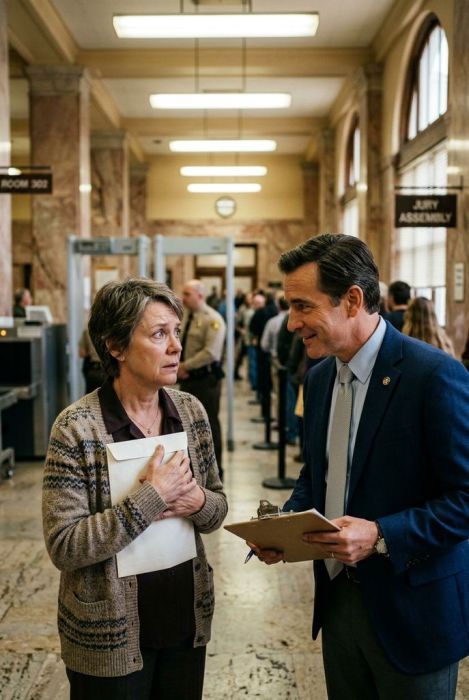
After fourteen months, I started volunteering at the county clerk's office on Tuesday afternoons. I told myself it was to keep busy, to have somewhere to go, some way to feel useful while my daughter slowly fell apart. It was not hard to find the file. It took one polite question and a very patient clerk named Delores, who had known me since Emily was in kindergarten. The license on Lorraine Whitfield's wall had expired nine years earlier. It had not been renewed. It had been flagged by the state as fraudulent, in fact, attached to a cease-and-desist order from the Attorney General's office of the county next door, issued six years ago, ordering one Lorraine Whitfield to stop conducting unlicensed adoption services and to refund all clients immediately.
I drove to that county the next Saturday. I did not tell Emily. I sat in the waiting room of the Assistant District Attorney, a tired man named Frank Odom who looked at me the way you look at someone who has just handed you a winning lottery ticket you are not sure you believe in. He pulled a box from under his desk, a box with fourteen case files in it, fourteen families, fourteen different ways of losing their money. Nine hundred and fourteen thousand dollars, he said, and that was just the ones who had been brave enough to come forward before Lorraine closed her office, changed her name slightly, and reopened across the river in our town.
Frank Odom gave me a list. Names, phone numbers, amounts. He gave me the name of a woman named Sandra DeLuca, whose daughter had been promised to her for three years, Sandra who had stopped sleeping, Sandra who had kept every check she ever wrote. And before I left, he told me the thing that made my blood run cold. "She's been doing this for a long time, Mrs. Pierce. In Arkansas, fifteen years ago, she ran the same operation under a different name. Lorraine Whitfield isn't her real name, and it never was."
I did not tell Emily for three weeks. I could not. I watched her pour herself into a nursery that would never hold a child, and I sat on my hands and said nothing, because I did not have proof yet, not the kind the county attorney would call proof. I had a license that had expired and a box of files from another county. I had Lorraine Whitfield buying a brand-new silver Lexus the same week she told Emily the Tennessee girl had "found another family." I had a woman who smiled at every funeral and wept at every christening and photographed herself holding babies that were never hers.
Then I found Brianna Moore, and everything changed.
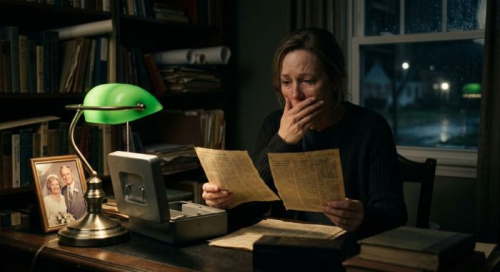
Brianna was twenty-four and had worked for Lorraine for eleven months before she quit without notice, walked out mid-morning and never came back. I found her through Sandra, who found her through a victims' group that met in a church basement on Tuesday nights, across the river, in the same county Lorraine had fled. Brianna was pale and thin and terrified, but she had copies of everything. Lorraine had kept her scripts in a folder in the back office, the folder with the tab marked MISC, which is why nobody ever looked. The scripts for the birth mothers she invented. The letters she typed herself on hospital stationery she'd bought online, telling families that a baby had been born, had been placed elsewhere, had died. And a photo of Lorraine, younger, darker hair, standing beside an older man in an Arkansas courtroom, with a date stamp and a case number that matched the name Frank Odom had whispered to me.
Brianna had kept one more thing. A list. Forty-one families, current and past, with amounts paid. One point six million dollars, in seven years, in two states.
I called the Tennessee Bureau of Investigation, and I got Agent Serena Hollis, who listened to me for forty minutes without interrupting once, and then said the words I will never forget: "Mrs. Pierce, I need you to keep doing exactly what you're doing for one more month. And I need you to get me an invitation to a party."
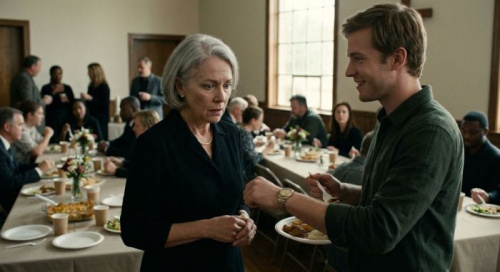
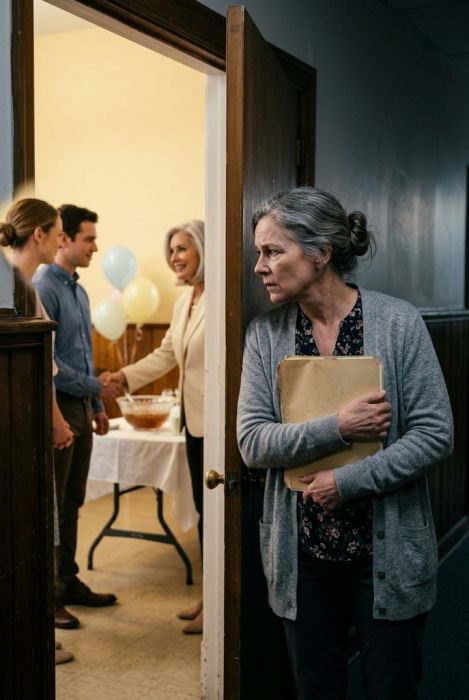
The party was Lorraine's idea, of course. She announced it at church with tears in her eyes, a "Match Celebration" in the fellowship hall, because God had moved in miraculous ways and three families, she said, three families would hear their names read aloud that night. She had balloons printed with tiny footprints. She had a punch bowl and a sheet cake with a stork on it. Emily wept with joy and did not see the way Lorraine's eyes flicked to the back row, counting the new faces, the new couples who had heard the miracle and wanted to believe.
I spent that month doing the hardest thing I have ever done. I let my daughter hope. I watched her talk to the crib in the butter-yellow room, and I said nothing. I watched Derek grip the table at Sunday dinner and tell me he had a bad feeling, and I said, "Give her one more chance, honey, you never know," and I hated myself for every word. But Agent Hollis had a plan, and the plan needed Lorraine to believe she had won.
The night of the celebration, the fellowship hall was full. Sixty people, more. Balloons in the corners, the stork cake on its table, chairs in careful rows. I stood at the door in my church dress with a manila folder pressed against my chest, and I thought of every family in the room, every empty crib, every shredded hope. Lorraine took the stage in a cream blazer, radiant, radiant as a woman who believed she was untouchable. She adjusted the microphone and smiled out at the crowd.
"I am so honored," she said, "to announce the first match of the evening..."
That was when the back door opened.
Agent Hollis walked in with two state troopers, and I have seen the moment a hundred cities pretend to be proud. I have seen the moment the music stops. Lorraine saw the badge and did not stop talking, did not stop smiling, because her whole life had been built on smiles that never once had to answer to the truth. Then the warrant was read, quiet and clear, and the room understood. A woman in the front row began to cry. Another stood up, hand over her mouth. And I walked down the aisle, past the balloons, past the stork cake, past fifty faces I would never stop seeing, and I handed Emily the folder. Her name, Lorraine Caskey. The Arkansas file. The receipts that matched her savings account to the penny. The list of forty-one families.
She opened it with shaking hands. She looked at me. She looked at the woman being led down the side aisle in handcuffs, the silver bun coming loose, the cat-eye glasses fogged with something that might have been rage. And my daughter, my brave, broken daughter, did not scream. She just sat down in the second row, very slowly, with the folder open in her lap, and began to laugh, and then to sob, and I knelt beside her and held her until the hall was empty.
Lorraine Whitfield, whose real name was Lorraine Caskey, pleaded guilty to twenty-two counts of wire fraud and one count of theft by deception. She was sentenced to twelve years in federal prison and ordered to pay restitution, every penny, down to the peppermints. The silver Lexus was sold at auction. The lake house she'd put a deposit on went back on the market. Nine hundred and fourteen thousand dollars was recovered and divided among the families, thirty cents on the dollar, not enough, never enough, but enough for Emily to look at the numbers and know that her pain had been shared by forty other families, that she had never been the one who was foolish, that she had only ever been human.
Two years later, Emily and Derek adopted a little girl through a real agency, an honest one, a licensed one that made them sign for every paper twice. They named her Grace. Not after anyone, Emily said, just after the thing you find when you think you have lost everything. And on the first Sunday after they brought her home, I stood in that same fellowship hall, at that same punch table, and I watched the room fill up with the names from the folder, the survivors, the ones who had turned their grief into a group that now taught other families to check the license, to ask for the receipts, to trust the stone in their chest that says something is wrong.
Every time a baby cries in that hall now, I think of the night justice finally showed up to the party dressed as a state trooper. Lorraine never saw her coming. That is the thing about people like her. They spend so many years rehearsing the lie that they forget to watch the door.
I am sixty-five now. I still fold laundry in front of the television. And every time I hear my granddaughter call my daughter "Mommy," I remember that the folder was never really about Lorraine Whitfield at all. It was about the moment my daughter learned that the universe keeps receipts, that kindness is not the same as truth, and that sometimes the very people we trust the most are exactly the ones we are meant to watch the closest. Grace is two now. She has Derek's eyes and Emily's laugh. And when she asks, one day, about the woman in the cream blazer whose photograph sits in an evidence box in a federal building, I will tell her the truth, that some people choose to build their lives on other people's hope, and that the only way to stop them is to hold up a mirror, a folder, a receipt, in front of everyone they ever fooled.