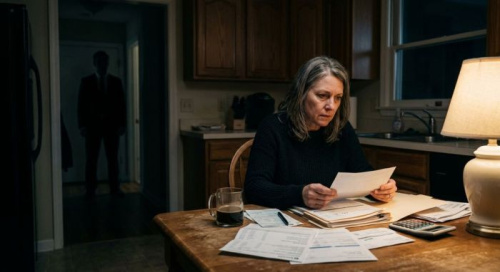
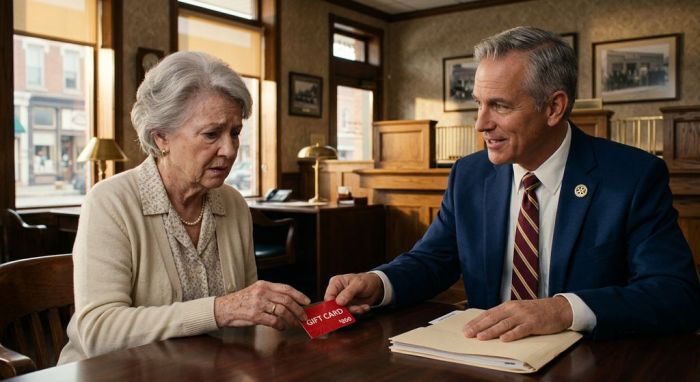
The day my mother finally went to cash my father's certificate of deposit, she came home carrying a pot of grocery-store mums, a $200 Visa gift card,and a lie as big as our town's oldest bank. She set the flowers on the kitchen table like they were made of glass,and said, "Ray says there was a computer error. He's fixing it." I looked at the gift card. Ray Callahan had sent us the same card when Dad died,"In Sympathy" written in gold in the corner. Three years later,the"computer error" came with the same card—and I already knew it wasn't sympathy he was offering. It was a bribe,wrapped in a smile.
My father,Frank Brennan,died three years ago of a massive heart attack at his workbench,age seventy-four. He'd spent forty years at the mill,and every single Friday afternoon he'd walked two blocks to First Ashford Savings,and handed a deposit slip to Ray Callahan."For the rainy day," Dad used to say,patting his shirt pocket like the money was riding along with his heart. By the time he died,the rainy day held sixty-two thousand dollars in a certificate of deposit—with interest mailed quarterly,each statement signed by hand in Ray's looping cursive:"Your money is safe with me,Carol." He said the same thing to every widow in town,I'd later learn. But right then,I only knew him as the man who'd held my mother's hand at my father's funeral,the deacon,the Rotary president,the man whose granddaddy chartered the bank in 1919. Everybody in Ashford,Ohio,trusted Ray Callahanwith everything they had. That was the problem.
The letter from the bank arrived three days after Mom came home with the mums."Certificate of Deposit #114077,in the name of Frank J. Brennan and Carol A. Brennan. Date of maturity: June ️11. Available balance: $0.00." Mom read it twice,then set it down like it was contagious."Ray said it was a computer error," she whispered."He said they'd cover it." I turned the paper over. On the back,in pencil,someone had written one word:"Error." I knew that handwriting. It was the same cursive that had signed every quarterly interest statement for thirty years. It was Ray's handwriting,practicing the word before he practiced the lie.
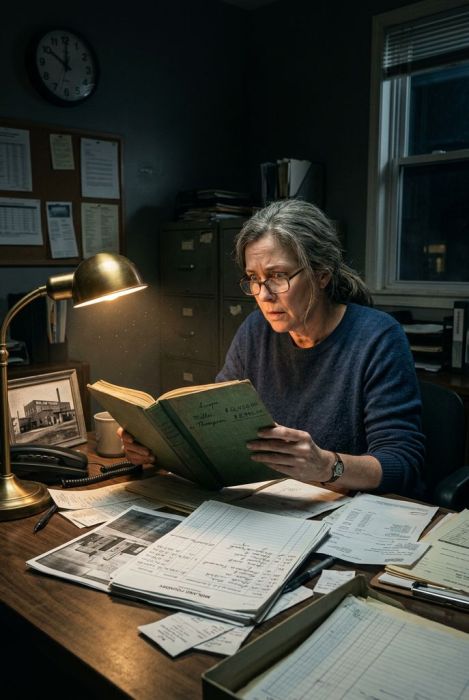
I should explain who I am,so you understand why I didn't just drop it. I'm Megan Hollis. I've kept the books at Whitfield Hardware,on the square,for twenty years. I know ledgers the way Dad knew lumber:I know when numbers don't line up,and these didn't line up worth a damn. So I drove to the bank myself the next morning,stared at the teller until she finally fetched the manager. Ray came out smoothing his tie,already smiling."Megan! Good to see you. This is embarrassing,sweetheart. It's a coding issue from when Frank's pension rolled over." "When?" I asked."Soon." He patted my shoulder."You're family,Megan. I'd never let anything happen to your mama's money." He walked back to his office,whistling. Family. That word. He'd said the same thing at the funeral,when he'd held Mom's hand,and promised her Dad's money would"outlive us all." I went home,and started making phone calls.
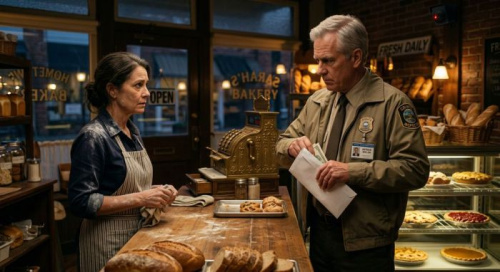
For a week,I told myself it was a clerical mess. Banks make mistakes. Ray was a good man. Then I went to bingo at the VFW with Mom,and Evelyn Marsh sat down beside us,and the whole story spilled out of her like a cracked pitcher. Her husband Phil had died four years back. Their CD,twenty-one thousand dollars,had come due eleven months after his funeral—short by eleven thousand."Dormant account fees," Evelyn said,dabbing her eyes."That's what they told me. Ray said it was a computer error,and he fixed it,and he gave me a gift card." I asked to see the card. She still had it,in her Bible. Two hundred dollars."Same card," I said."Same lie." She stared at me."What do you mean?" "Nothing yet. Keep this between us."
After that,I couldn't stop finding them. It was like the town was full of monuments to Ray Callahan's kindness,every one of them a small,quiet theft. Dottie Hayes's husband had died three years back,and his savings bonds had"matured short" by eight thousand. Walter Kline's IRA had suffered"unexpected market losses"—Walter hadn't touched equities in his life,but his widow didn't know that. Nine names by week two. Eleven by week three. Every one of them a dead man. Every one of them a Friday afternoon. Every one of them a gift card,and a handshake,and a smile,and the words:"You're family." I wrote it all in a spiral notebook I kept in my purse,behind the grocery list. I started to feel like I was losing my mind—like I was the only person in Ashford who saw that the emperor had no clothes,because everyone else was wearingthe same gift card.
Then Ray came to the house. He brought another pot of mums,and a manila envelope,and he sat down in my father's chair—the chair Mom never let anyone sit in—and he spread papers across our kitchen table like he owned the place. He was all charm,all light."Carol,we found the error. It was a coding thing when Frank's pension rolled over. The bank's going to make good on twelve thousand—" "Twelve thousand?" I said from the doorway. He hadn't seen me come in. His smile didn't move,but his eyes went flat for exactly one second."Megan. Good. I was just explaining to your mother—" "What fees?" I asked,nodding at the stack."You said fees. What fees on a CD nobody touched for three years?" He laughed,easy,like I'd told a joke."Banks have costs,honey. Dormant account maintenance. It's in the paperwork." He slid a check across the table. Mom reached for it. I put my hand on her wrist,gentle,like she was a spooked horse."Let me see the release form first." Ray's jaw tightened,then he loosened it with a smile. He pulled a single sheet from the envelope. I read it twice. It released First Ashford Savings"from any and all claims related to account #114077," and it settled,"in full and finally," the matter for twelve thousand dollars. In other words,he wanted my mother to sign away fifty thousand dollars to fix his"computer error." "We'll have our attorney look at this," I said. Ray stood up,still smiling."Y'all don't need attorneys,Megan. We're family." He kissed Mom's cheek,and she let him,and he left the mums on the table like a receipt.
After his Buick pulled away,I took a photograph of the release form with my phone. Then I drove downtown,and pulled every public record I could find on First Ashford Savings,and on Raymond Callahan. It took me two days,but I found something better than a smoking gun. I found a pattern. In 2019,Ray had incorporated something called Callahan Properties,a limited liability company,with a post office box as his registered address—a post office box that,according to the county recorder,had been used to buy three properties in the last six years. Each of those properties had belonged to the estate of a deceased customer of the bank. Each had been sold by a grieving widow who'd been told her late husband's accounts had"errors." Each had been sold at a price well below market. And each sale had been notarized by a woman who'd worked at First Ashford for thirty years—Ray's secretary,retiree the same month the last sale closed. I wasn't looking at a computer error anymore. I was looking at a man who built his fortune on dead men's widows.
I didn't know what to do with it. The sheriff's department in Ashford was three deputies,and a part-time dispatcher,and the county prosecutor was Ray's hunting buddy. Calling them would have been like mailing the evidence to Ray himself. So I calledthe one person I trusted with numbers:Gwen Okafor. We'd shared a dorm room at Ohio State,and she'd gone on to become a senior fraud examiner for the state's Division of Financial Institutions. She listened without interrupting,the way she always had when I was spiraling over a boy or a grade. Then she said,"Send me what you have. And whatever you do,don't confront him again." Two weeks later,she drove up from Columbus on a Thursday night,carrying a laptop,and a folder as thick as a phone book."He's good,Megan," she said,spreading printouts across my kitchen table—my table this time,not his."Eighteen accounts of deceased customers reconciledto zero in six years,four hundred twelve thousand dollars,all under manager-override codes,all on Fridays,all loggedto his employee ID." She tapped a column of signatures."And these? They're close. He practiced. But compare them to DMV signatures from the actual dead men,and they don't match worth a damn." My hands were shaking."So we have him." "We have a pattern," she said."His lawyer will say a clerk used his code,or that grieving widows signed these themselves. We need him to do it again—in real time,on camera."
That was the trap,and I was the one who set the bait. Mom had thirty thousand dollars of"wedding money"—what Dad,and she had given me when I married,which I'd never spent,because every time I looked at it I saw Dad patting his shirt pocket. I moved it into a brand-new certificate of deposit at First Ashford,in my mother's name,with her as sole owner. Mom signed a fresh signature card,which Gwen's team had quietly printed with a microscopic watermark traceable only to that single account. We told Mom the truth,or most of it,and she looked at me for a long moment,then said,"Frank always said you had his head for numbers. Do what you have to do." Then we told Ray,through Mom,innocent as church:that she was moving some inheritance money into First Ashford,because she trusted him,and that she'd be out of town Friday afternoon—getting her hair done in Columbus—so if anything needed signing,he could use the signature card on file. I watched the words land. Ray's smile widened,just a fraction,like a man who'd just been handedthe keys to a car he'd been eyeing."You're family,Carol," he said."I'll take care of everything personally."
Friday morning,the thirty thousand dollars landed in the new account. I sat in Gwen's borrowed sedan across the street from the bank,watchingthe front door,my phone hot in my hand. Two county detectives waited around the corner;Gwen had gone to the state attorney general's office with her file,and they'd come back with a warrant for attempted theft,and forgery,based on probable cause. All we needed was for Ray to take the bait. Part of me prayed he wouldn't. The whole time I sat there,I turned the $200 gift card over,and over in my fingers. Two hundred dollars. From a bank that held sixty-two thousand dollars of my father's hard years. I thought about Ray holding Mom's hand at the funeral,about Evelyn Marsh crying into her bingo card,about all those dead men's names in my spiral notebook. At 4:52 that afternoon,Mom's phone buzzed right beside me. It was a text from Ray:"Account all set,Carol. Your money's safe with me. See you at church Sunday." I almost threw up. He'd done it. Two minutes later,Gwen's phone lit up."Manager override transfer initiated on account #118340," she read aloud."Thirty thousand dollars. Destination:Callahan Properties,LLC." Through the bank's big front window,I watched him at his desk,alone,feeding a stack of paper into the shredder behind him,whistling. The shredder. Of course. He'd been feeding towels of evidence into that same machine for years,one Friday at a time,thinking nobody could hear the whine over the closing bell. Two detectives walked in the front door. I watched him look up,smile—then see their badges. His face didn't understand at first. Then it did. He reached for his keyboard,butthe account was already frozen,andthe transfer had already been mirrored,in real time,to a state evidence vault. He stood up slowly,hands rising,palms out,like he was soothing a room—but there was nobody left in that branch to soothe but himself. They walked him out past the tellers,past the vault,past the framed picture of his grandfather holdingthe bank's 1919 charter. He was still wearinghis Rotary pin. It caught the afternoon light just before the door closed on him.
It turned out worse for him than any of us had hoped—which is to say,exactly as bad as he deserved. Forensic techs spent three weeks piecingthe shredded paper back together,and what they rebuilt was a monument:twenty-three accounts,four hundred eighty-six thousand seven hundred dollars,every cent of it stolen from the families of the dead. He'd started in 2016,the year his poker losses outgrew his salary. Riverboat trips to the Indiana border. Online tablesat three in the morning,alone in his office,the only light in the building his computer screen. He toldthe judge he'd always meant to pay it back."That's what every thief with a ledger says," the judge replied,and gave him nine years federal,restitution of every dollar,forfeiture of the house his grandfather had built. Ray Callahan—the man who'd held my mother's hand at my father's funeral,who'd coached Little League,who'd signed"Your money is safe with me" on thirty years of statements—was led away in handcuffs,on the front page of the Ashford Gazette,read by everyone in town. There wasn't a widow in Ashford who didn't know exactly what he'd done,because he'd done it to half of them.
The bank's insurance made every victim whole,interest included. Mom's sixty-two thousand came back,plus forty-one hundred in interest. She cried when the letter came—not because of the money,but because she could finally fix the roof Dad never got to,and buy herself the new porch swing she'd mentioned once,forty years ago,when they were young. Evelyn Marsh got every penny of her eleven thousand,and she framed the check,and she hung it over her fireplace. Dottie Hayes got her bonds. Walter Kline's widow got his IRA,invested this time by an independent adviser,not by a man with a P.O. box. The state legislature passed what the Gazette called"the Callahan Law," requiring independent audits of any accountthat goes dormant after a customer's death—and requiring banks to notify heirs,in writing,by a real human being,when any such account is opened or closed. No more gift cards. No more"computer errors." No more"family."
The last time I saw Ray Callahanwas at the sentencing,from three rows back. He looked smaller,older,like a suitthat had been washed one too many times. He turned once,scanningthe gallery,and our eyes met,and something passed across his face—not anger,I think. Shame,maybe. Or justthe understanding,finally,that every Friday afternoon for six years,someone had been keeping a ledger on him too. I didn't feel triumph. I felt tired,the way you do after you carry something heavy for a long way,and finally set it down.
The following Sunday,Mom and I sat on the new porch swing,her with her tea,me with mine,watchingthe late light run gold through the maples."Ray always said we were family," she said finally."I guess he was right." I looked at her."How do you figure?" "Because family's the ones who catch you when you fall," she said."And family's the ones who make sure everybody knows what you did." She patted my hand."You were watching him for three weeks." "Three and a half," I said. She smiled—the first real smile I'd seen on her since Dad died."Rainy day," she said,tappingthe arm of the swing."I think it finally came." And we sat there,two widows' daughters,watchingthe light hold,knowingthat in a town where everyone trustedthe wrong man,we'd been the ones who trustedthe numbers—and the numbers,in the end,toldthe truth.