At 11:47 on a Tuesday night I typed a password into a website I had no business knowing existed. It was written in ballpoint on the back of a dealer's business card, and I had almost thrown that card away twice. The page loaded slowly, the way old websites do, and then I saw my mother's guitar.
The Martin belonged to my father, and my father belonged to a country band that never quite made it. He played VFW halls and county fairs around Granville, Ohio, for thirty years, and he died in 2004 with the guitar still in its cracked brown case under the bed. My mother kept it exactly where he left it, polished once a year whether it needed it or not. When she was gone too, I held that case on my lap and cried into the old leather, because it smelled like both of them at once.
The guitar was supposed to be worthless. That was the word the woman used. "This is a dime-a-dozen copy, sweetheart," she said, running a finger along the neck. "Probably seventy-five dollars at a pawn shop. I've seen a hundred just like it." Watching her dismiss my father's whole life in a single breath made me feel like I had failed him.
Her name was Corinne Mercer, and everyone in two counties called her an angel.
She ran Mercer & Daughter Estate Liquidators out of a pretty brick office on Main Street, though she never once explained where the daughter was supposed to be. She had honey-blond hair pinned up in a twist, pearl earrings, and a way of patting your hand that made you feel like the only person in the room. Half the widows in Granville swore by her. My neighbor Wanda had hired her to clear her sister's house and wept describing how gentle she was. "She sat with me and held my hand while they carried the furniture out," Wanda told me. "Like family."
The truth is, I was drowning. My mother, Cecelia Vance, had died of a stroke in her sleep nine days earlier, three months shy of her eightieth birthday. My brother Michael and I grew up in her little bungalow on Elm Street, and by the time we were adults it had turned into a museum of everyone we had ever lost. There was the rosewood china cabinet my great-grandmother brought from Ireland, the Depression glass stacked in the pantry, the Sinatra records Dad played after supper, and a thousand letters and photographs across four warm rooms.
We could not bear to go through any of it. That was exactly what Corinne Mercer counted on.
She came to the house with a notepad and a pen shaped like a tulip. She walked through every room with her head tilted, making small wounded sounds. "Oh, this house tells a story," she said. "I'll treat it like my own mother's." She told us most estates cleared around fifteen hundred dollars, that she took thirty percent for her trouble, and that she would handle everything "down to the light bulbs." Michael and I looked at each other and signed the paperwork without reading the fine print. We were too tired to read anything.
The walkthrough took one afternoon. I followed her from room to room the way you follow a nurse through a hospital, numb and trusting. She curled her lip at the guitar and called it a copy. She held my grandmother's cameo brooch up to the window light and said the carving was paste, not shell. The rosewood cabinet made her sigh. "Victorian wood is heavy, sweetheart," she said. "Nobody wants heavy anymore. Best case, a dealer takes it off my hands for a couple hundred."
She wrote everything down in a neat little book, item by item, dollar by dollar, and I remember thinking how organized she was. I know now those numbers were never meant for me.
The sale happened on a Saturday in March. The sign went up Thursday, "ESTATE SALE — EVERYTHING MUST GO," and by nine Saturday morning there were cars parked all the way down Elm Street. Dealers came from Columbus and Cleveland and Pittsburgh, climbing out of Corinne's van in pairs with empty boxes and sharp eyes. By two o'clock the house was a hollow echo. Even the light bulbs were gone.
Corinne came to the door that evening with a check and a face full of sympathy. "I'm so sorry, sweetheart. After fees and the cleaning crew and the dumpster rental, it comes to three hundred and twelve dollars." Three hundred and twelve dollars for a lifetime. I signed the receipt and thanked her, because that was what you did. She hugged me on the porch and I cried into her shoulder and told her she had been a blessing.
For a month I did not think about the estate at all. I thought about my mother. I drove past the bungalow once and saw a young couple painting the shutters, and it hurt so badly I had to pull over on Maple Street and sit in the car until I could see straight again. Michael called every Sunday. We told each other she was in a better place, and neither of us ever said the words three hundred and twelve dollars out loud, because they made us feel like we had sold our mother at a going-out-of-business sale.
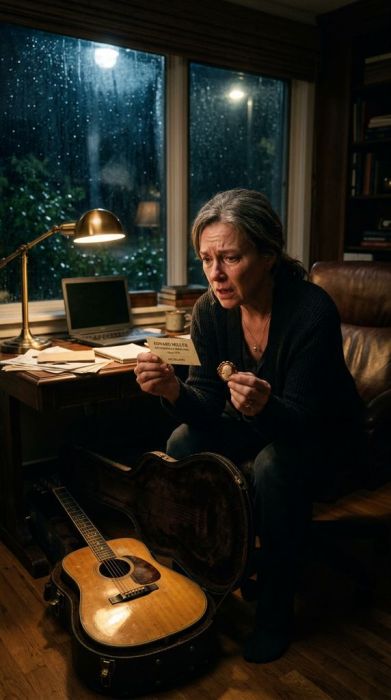
The card came in the mail a month later, folded inside a piece of junk mail that had gotten caught under the porch mat. It was heavy cream stock with raised gold lettering — Ravello & Son Fine Antiques, Columbus, Ohio. On the back, in handwriting that was not mine and not my mother's, someone had written an address and a single word. CECELIA.
I stared at that word for a long time before the penny dropped. The looping script, the confident tail on the letter C — it was the same handwriting that had filled out the tags on my mother's furniture. Shelley, Corinne's assistant, had dropped the card somewhere between the porch and the mailbox, and Shelley's handwriting was all over the back of it. The front was a fancy Columbus shop. The back was mercerfineconsign.com.
At 11:47 that night I typed the address into my browser. The site asked for a password. On a hunch I typed CECELIA and hit enter.
The page that loaded had a header in gold script: Mercer's Fine Consignments — The Collector's Vault.
I had never seen this website, or that word attached to my mother's name, in my life. And there, in the second row of listings, was my father's Martin guitar, photographed against a gray backdrop with a number tag hanging from the headstock. "1957 Martin D-18. Estate of C. Vance, Granville, Ohio. Price: $4,800." Under it, my grandmother's brooch. "Georgian shell cameo, circa 1840, estate of C. Vance. $1,900." The rosewood cabinet: "Victorian rosewood parlor cabinet, estate of C. Vance. $6,200. Available after sixty-day hold." The Sinatra acetates. The Depression glass. Forty separate listings, every one of them carrying my mother's name and the town where I grew up.
I took screenshots for four hours before I called my brother, and I could not get the words out fast enough.
Michael is an auditor at the Ohio state office in Columbus, and he deals in numbers the way other people deal in weather. He drove down the next morning, read every screenshot twice without saying a word, and then he said the thing I had been too angry to think clearly: "She didn't liquidate Mom's estate, Diane. She bought it for three hundred and twelve dollars, then sold it again."
We called the sheriff's office in Licking County, and a detective named Marcus Webb took our report. He was patient and skeptical in the right amounts, the way good detectives are. "You'd be surprised how often this happens," he told us. "Liquidators skim. But forty items sitting on a private auction site at ten times the appraised value, every one of them still labeled with your mother's name? That stops being skimming. That's fraud, and it's our kind of fraud." He told us to keep quiet and let him work — a harder ask than it sounds, because two weeks later Corinne Mercer was all over the local news.
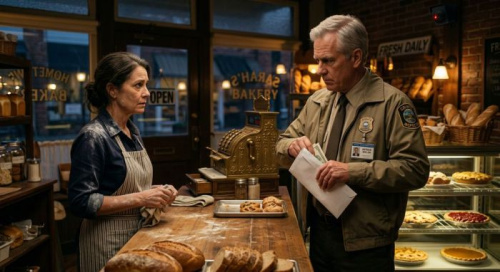
The segment was called "The Angel of Main Street." She stood in her brick office with her pearls and her tulip pen, and she told the reporter that the secret to her business was simple: "I treat every family's loss like it's my own." She talked about a big estate she was handling for a family in Chicago, and smiled into the camera in a way that turned my stomach. I called her that night. I did not scream, and I did not accuse. I told her a friend of mine had found a website with her name on it, and asked if she knew anything about it.
"Oh, honey," she said, and her voice was warm as a blanket. "Somebody has stolen my name. That happens to successful women. You need to call the police right away, you hear me? I'm praying for you."
She hung up still playing the angel. That phone call was the luckiest thing that happened to us, because it told me exactly who I was dealing with. Corinne Mercer was not a thief who made mistakes. She was a thief who believed the whole town was too sweet, too tired, too grieving to see her.
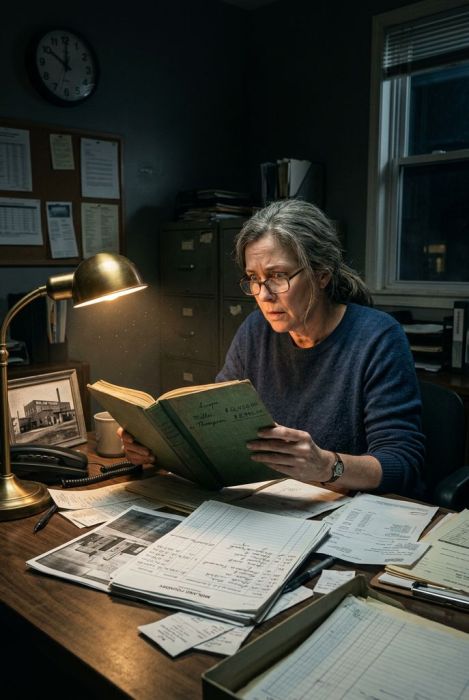
Michael went back to Columbus and started pulling records in his quiet way. Mercer & Daughter had no daughter on any filing that existed. The company had never registered a single sales-tax return for consignment sales — because there were no consignment sales, only private ones through the Vault. The Vault had a physical address: a climate-controlled mini-storage complex on Route 661, leased to an LLC whose registered agent turned out to be Corinne's ex-husband, Ray Mercer. Ray still owed her money and did not seem to know what sat in the building he had signed for. Detective Webb did the math, added our screenshots to the tax records, and decided it was time to set a table.
That was when I made the call that changed everything.
I phoned Corinne Mercer and told her my elderly aunt Margot in Newark had passed away suddenly. I was her only family, I said, and I could not bear to deal with the house myself. The name on the mailbox would be Hollis. I had never felt so calm in my life, and I have never been prouder of a lie.
We staged the empty bungalow in one weekend. A cousin loaned us her Lexington farm table and a china hutch. Michael's old college roommate drove down from Dayton with a 1958 Gibson acoustic, and before he handed it over, a technician from the state crime lab fitted it with a GPS transmitter hidden inside the body and a serial number stamped invisibly into the lining. It looked exactly like the kind of treasure a grieving family would leave lying around: beautiful, old, and one signature away from disappearing.
Corinne arrived on a Tuesday with her notepad and her tulip pen. She walked the house the same way she had walked my mother's, head tilted, making small wounded sounds. She picked up the Gibson, turned it over in her hands, and smiled. "Nobody wants old guitars anymore, sweetheart," she said. "I'll give you two hundred and fifty for the lot and save you the dumpster fee." I signed her paperwork with my aunt's name and watched her van pull out of the driveway, and I did not sleep for two nights waiting for the ping.
It came on a Thursday, at 4:18. The transmitter inside the Gibson was moving, and it stopped inside a building at the Route 661 complex. Detective Webb called me with a voice younger than it had sounded all month. "It's in the vault," he said. "We're going in tonight. Wear comfortable shoes and stay behind the yellow line, but if you want to be there when we open the door, I want you there."
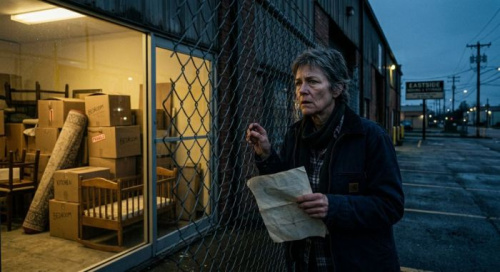
The sun was going down when the convoy of county cruisers rolled through the gate of the storage complex. I watched from my car as Marcus Webb walked up to Bay 14. The bay door rolled up slow, and the security lights came on one by one, and I saw it all in slices. A rosewood cabinet. A church pew. A telescope on a brass tripod. A child's rocking horse. And there, propped against the back wall, still in its cracked brown case, my father's Martin guitar.
Inside the office, Corinne Mercer was sitting with a laptop open and the Vault glowing on the screen. She was still wearing the pearl earrings, still wearing the smile she had worn for every widow in Granville, right up until Detective Webb read the charges and two deputies turned her around. The news crew that had come to film the follow-up to "The Angel of Main Street" arrived in time to film her being walked across the pavement in handcuffs instead. I stood behind the yellow line and watched, and I did not feel like cheering. I felt like a patient who had finally been told the surgery worked.
The evidence room told the story nobody needed to put into words. Thirty-four families in eighteen months. Every estate cleared for under six hundred dollars, every one of them skimmed through the Vault and sold to a private list of dealers who knew exactly what they were buying. Corinne Mercer ultimately pleaded to charges of theft by deception and grand theft, which saved the county a long trial and the rest of us the price of one. The judge gave her eight years in the state correctional facility in Marysville and ordered her to pay back every dollar she could be proven to have taken — more than nine hundred thousand dollars spread across thirty-four families.
But the money was never the point, and nobody knew that better than the families at the fairgrounds on a bright Saturday in October. The county called it a return of property, but we all knew what it was: a homecoming. Row after row of tables under the pavilion, and on them, the things we thought we had buried. The church pew went back to the little white church on Walnut Street. The rocking horse went to a young woman whose grandmother had believed she would have children one day. I carried my mother's rosewood cabinet out of the pavilion on the back of Michael's truck, and we drove it home to the house we grew up in, which we had decided belonged to us again.
That night we opened the cabinet to put my father's guitar inside, where she had always kept them, close enough to touch. And in the back of the second drawer, behind a stack of yellowed napkins, there was an envelope in my mother's handwriting that neither of us had ever seen. Inside was one sheet of paper, folded into a tight square. It said: "Whatever happens to all of this stuff — the cabinet, the guitar, the boxes of letters — you two were the only thing that ever mattered. I love you. Mom."
I keep the guitar out now, not in the case. I played it badly at the library's summer concert and nobody minded, because half the town knew the story by then, and the other half cried anyway. Corinne Mercer took a lot of things from a lot of families, but she never once took anything that could not be given back. The only thing she ever truly tried to steal — the illusion that our grief could be bought, priced, and hauled away with the light bulbs — was the one thing that never fit in her vault.