The first time I heard about Franklin Reyes was over a bowl of my mother's famous beef stew. She had been a widow for eleven years, and in all that time I had never once heard her mention a man's name with that particular nervous little smile. It was the smile that worried me more than anything else in the world.
"He sells vintage boats down at the marina," she said, buttering a second biscuit she never actually ate. "His wife died four years ago, cancer. He's been alone ever since. We just talked, honey. That's all."
I had heard those same words before, from my old girlfriends back in college. I had never heard them from my own mother. She was seventy-eight, sharp as ever when it came to card games and crossword puzzles, but she was also the most trusting soul on God's green earth. She believed in the goodness of people the way other people believed in the weather report, and that alone was enough to terrify me.
Over the next month, Franklin Monroe became a fixed star in our small world. He texted Mother a good morning message every single day at seven o'clock sharp. He showed up with flowers that cost more than my weekly paycheck at the hardware store. He took her sailing on Saturday afternoons and to the early bird special at Luigi's on Thursday nights. He called her his Maureen, and I watched the color rise into her cheeks like she was nineteen years old again.
I wanted to like him. God knows I tried. When he charmed the whole room at Luigi's and threw a generous tip on the table, I told myself to be happy for my mother, told myself that this was what she deserved after fifty good years with my father. When he shook my hand with both of his and called me son, I smiled and let the feeling pass. But there was something in those pale eyes that never quite matched the warmth of his mouth, a flatness I couldn't name. And there was a pattern I could not shake.
Maureen had been a nurse who saved every penny my father brought home for fifty years. She kept a modest retirement fund, a paid off house on Sycamore Street, and a little under a hundred thousand dollars in what she always called her rain fund. She would never touch that money for anything less than a true emergency. So when the charges on her joint account began to climb month after month, I started paying attention in a way that made my stomach tighten.
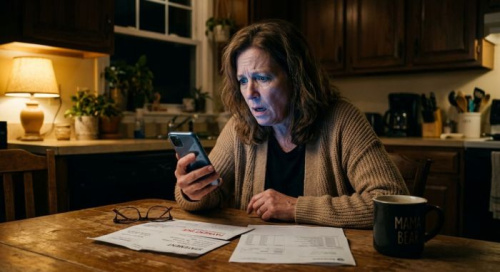
At first it was little things. A hundred here, a hundred and fifty there, dollars spent at shops I knew she would never walk into. Then came a two thousand dollar cash withdrawal at an ATM two towns over, on a Wednesday afternoon when Mother was certainly sitting in her knitting circle. I kept my mouth shut and watched the account statement's low balance as it drained from the bottom, and I told myself there had to be a reasonable explanation.
I watched Franklin that month the way a catcher watches a pitcher he does not quite trust. He was always at my mother's side whenever she smiled, always eager, always ready. He drove a truck that was older than he wanted anyone to notice, but he carried himself as though it were a yacht. He never once let me get a good look at his business, and every time the conversation turned to money, he had a story about the strange boat he was selling that made everything seem perfectly innocent.
On a rainy Tuesday in February, I found his truth. Mother had gone across town to her church group, and I had stopped by the house to fetch a toolbox I needed for the fencing in my own backyard. Her desk drawer was stuck half open, and inside I saw a bank statement, months old, folded over with a single crimp. I did not mean to read it. But the third page came loose in my hand, and the line item near the top of the page froze me cold.
There was a wire transfer of eleven thousand dollars, sent on the third of that month to a business account in another state. Those dates, those numbers, matched the exact day my mother, giddy and pink, had told me her Franklin needed to hire a truck to carry a big boat he had finally sold. I had hugged her then, happy for her happiness. Now I stared at that number until the hens visible watered in my eyes.
I drove the statement down to the county office the next morning, and I asked after the marina in the most casual voice I could find. A clerk with gray hair laughed softly and did not look up. "Franklin Monroe from the marina? Honey, that man doesn't own a paddle. He rents a slip for the weekend, and he lets the tourists believe the rest of it."
My heart dropped through the floor. I waited until the store closed, and then I made a call that I did not want my mother to know anything about. A kind woman in the bank's losses department heard the wire number and the dates, and I listened to her silence. When she spoke, her voice had gone very careful, the way a nurse talks about a test.
"I've seen this number before, and the same account, two different towns over the last two years," she said. "I can't give you a name, but whatever kind man is charming your mother, bank statements that look like this are never the work of an honest one."
That was the moment it all came into focus. He worked a crowd the way a con man works a brand new town. He told them exactly what they wanted to hear, then he bled their savings little by little, careful never to bring it all down at once, so that he would be miles away by the time anyone dared to look. My mother was never his first. She was only his latest, parked neatly at the end of a long, quiet road full of thieves.
I wanted to go to the police that same day. But I understood, finally, that I had to be cleverer than I felt. My mother had started to love me if heart, and if I emptied it, if I put her in the center of a scandal while she still trusted him, the shock would turn her right into a wall. So I kept every receipt, every statement, every photograph, and I did the one smart thing I knew how. I smiled and I waited, and I let him believe I was finally on his side.
The turn came at the start of March. Franklin rang my doorbell on a Thursday night, glowing with the confidence of a man about to close a deal, and he set two folders on my kitchen counter. "Son, I told you I could stand with me," he said. "I'm buying a boat and I need a co-sign, just a formality, to speed it along. It's for Maureen's fees. She knows all about it."
I reached into the top folder to look, and I moved it wrong. The receipt shifted out of it, an output slip from his own bank, printed with his name, his personal account number, and a balance high enough to make my head spin. He didn't notice. He was too busy smoothing his hair. And I, without a sound, snapped that receipt into my jacket.
The whole house went quiet as I nodded and signed nothing. "Let me look it over tonight, Franklin," I said, "and I'll bring her the paperwork in the morning, for the sake of Mother."
He smiled the self-assured smile of a man who believed he had finally won. He left me alone with the proof, and I drove straight to the county station and set four items on the desk of a detective with the surname Hart.
Detective Hart read through everything twice. She looked at the account number the bank woman had flagged, and then she looked back at me, and there was hard, quiet patience in her eyes. "We've been watching this thread cross three states for two and a half years," she said. "He would have come home differently if you hadn't given us the piece we were missing."
We built the case in total silence over the next two weeks. I played the part I had rehearsed: the son who had finally warmed up to his mother's new man. I let Franklin believe the ball was rolling and the entire world was about to become his. And I asked the proudest favor of my life when I invited him to a small dinner for the family at the same berg's restaurant where he had once charmed a room.
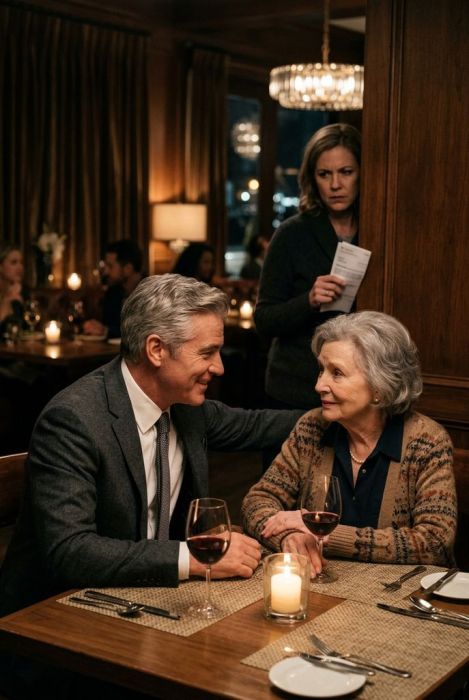
He arrived in a flawless sportcoat the same night I chose, expecting to close the trust over wine. He took his seat across from my mother, she who gave him a quiet, steady smile, and lifted her water. And then I stood, slid the pen and a single piece of paper across the white tablecloth toward his hand, and I said his name softly, just once.
The officers came from both sides of the tent before the words had quiet. Detective Hart read his name and the list of charges, wire fraud and elder financial abuse and the purposely broad language they used to hold a man who had stolen from a dozen scared families. The color left his cheeks the way it leaves a fish on a dock, and he looked not at my mother but at me, astonished, as though the universe had betrayed him.
The truth came out over the following weeks, and it was worse than I had ever guessed. His web reached across three states and reached a dozen more main doors, all of them standing open to an old people who had trusted him with far too much. Officers who had seen these patterns in two towns finally had the missing connection, and the case closed around him like a fist. He was held fully accountable, his money turned over, and every stolen cent of hers was returned to my mother through the years of court orders.
The hardest evening of my life came at the start of spring. I sat down with my mother in her own kitchen, across from her, and I laid out all of it as plainly as I knew how. She read my files in complete silence. Her fingers went the saddest, calmest thing, stroking the checkbook she had once kept so carefully. Then she set it down, and "I let a stranger carry my trust until he emptied it, honey. I am so ashamed."
"No, Mother," I told her, and I put my own hand over hers. "You were not careless. You were caring, and there is a difference in the world. He did not take your heart. He only borrowed your kindness until the law called it for what it was."
She wept then, a quiet handful, and then she pressed my hand because she understood the work her son had done in secret. It was not the money that mattered to her; it was the trust that had been so well returned to her by her own blood. That June, we spent the money and the season rebuilding the rose garden he had made a portable of, and we set a single stone in the center where his drives used, and we didn't speak his name in that house again.
She is older and she is at peace now. My mother sleeps sound and takes her coffee on the porch where she reads the paper to the birds. The last check that came, from the crime victims' fund, covered everything he had taken down to a dollar, and I wrote the card by her and left it with a single phrase: "He did not take a thing, because you kept the only one that mattered."
Justice, when it finally came, came slowly and quietly and completely. A con man who spent years hunting the kindness of widows found, at last, that a son who paid attention could be a trap bigger than any storm he had charmed. It took a long while, but I watched him lose every last thing he had stolen. And the garden grew, and my mother slept, and I have never once regretted the day I opened that drawer, because it was the day I learned what a pair of eyes can do when they finally open.
That is the long and short of it. Franklin thought he was watching a widow's trust, and it turned out he was only ever walking into a trap that had waited like an old friend to close. My mother still believes, which is a thing I will never let him take from her. And when the mail brings her word now that he is far and sealed away, I go stand in the garden with her silent, remembering that some thieves never learn what they are truly stealing at all.