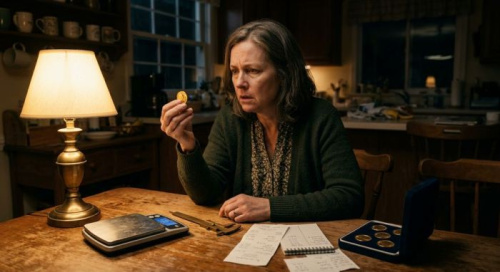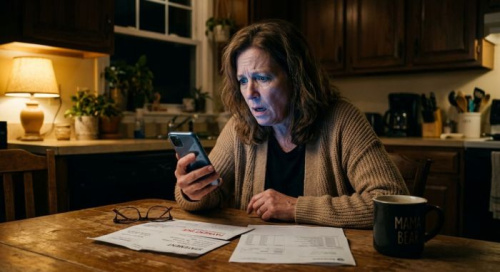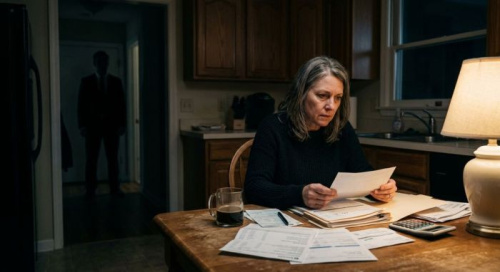
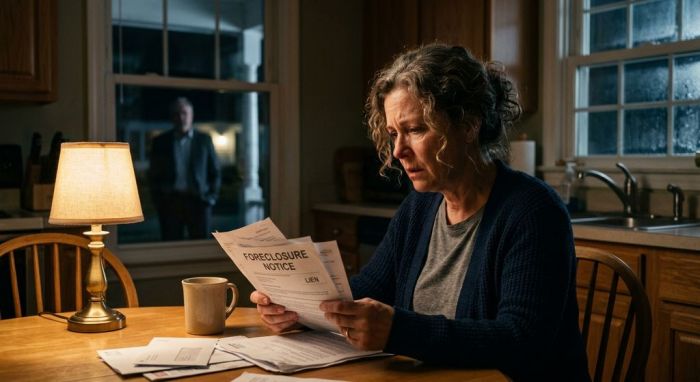
The afternoon the lien notice slid under my front door, I was balancing the books for the church rummage sale, and my hands shook so badly I had to set the pencil down twice. The words "NOTICE OF LIEN FOR UNPAID FINES" sat there in bold block letters, followed by an amount that made my chest tighten: eighteen thousand, seven hundred dollars in fines, late fees, and legal charges. My dues, the notice claimed, had been overdue for "a period of eleven months," which was a lie so audacious it almost made me laugh. My dues were paid. I paid them every January, and I had the receipts to prove it — because I was a bookkeeper, and bookkeepers keep receipts.
The name at the bottom belonged to the man who had run our neighborhood for more than a decade. Warren Callahan. Everyone called him Wes. Wes was the kind of man who made you feel like you'd known him your whole life, even if you had only just met him at the mailbox. He waved from his golf cart every morning, remembered your kids' names, and showed up at every cookout with a cooler full of sweet tea and a story about his fishing trip. He had been president of the HOA board for eleven years, and the neighborhood loved him for it. He got the entrance sign repainted and stood at every annual meeting talking about "our community, our family" until half the room was nodding along. I trusted him too, once. That is the thing about Wes — he didn't look like a thief. He looked like a retired insurance adjuster with a nice smile, which is exactly what he told everyone he had been. He didn't flash money. He flashed charm, which is far more dangerous.
It started, as these things always do, with small things. In the spring of my eighth year in the neighborhood — the first spring after my husband Frank died — I volunteered to help the board put together the annual newsletter. That was how I ended up alone in the clubhouse office one April afternoon, with the filing cabinet open and the HOA's financial statements spread across the table, looking for the minutes from the previous year's budget meeting.
And that was when I saw it. A line item for "Landscape Maintenance — Crown Lawn & Land" for forty-two thousand dollars a year. We had maybe a mile of common grass, a few flower beds, and a drainage pond that grew more algae every summer. Forty-two thousand was almost twice what the landscaping had cost three years earlier, when the board minutes showed the same company being paid twenty-four thousand. I told myself it was inflation. But I was a bookkeeper, and my brain did what bookkeepers' brains do. The address on the invoice was a P.O. box in the same zip code as Hollow Creek Estates. Harmless, I told myself. Small businesses use P.O. boxes all the time.
Then I noticed the "emergency roof repair" on the clubhouse — a line item for nine thousand dollars, with no contractor name, just "Emergency Repairs — CR." And the "pond dredging" that showed up every fall at four thousand a pop, even though the pond had never been dredged once that I could see. I stood there in that dusty office and realized I was looking at eight years of someone's quiet, patient theft. I just didn't know yet whose.
I asked to see the records. That was my mistake, or maybe it was his. According to our covenants, the polite thing was to submit a written request and wait thirty days. I did that, and nobody contacted me for six weeks. So I sent a second letter by certified mail, and the signature on the return receipt belonged to Wes Callahan himself. Two days later, I got a voicemail from him — friendly and folksy. "Ruthie! Wes here. Listen, I got your letter, and I'd love to sit down and walk you through the numbers. I'm at the clubhouse Thursday around four. Come on by and I'll make you a cup of coffee, and we'll get all this squared away."
I should have known better. I had been dealing with men like Wes Callahan my whole life — from the contractor Frank hired in 1998 who disappeared with our deposit, to the bank branch manager who called me "sweetheart" while closing my account after Frank died. Charming men are the most dangerous kind. They have practice. Thursday at four, he was at the board table with a spreadsheet printed out, his reading glasses perched on his nose, looking like everybody's favorite grandfather. He poured me coffee in a Styrofoam cup and spent forty-five minutes explaining the reserve fund, the capital improvements budget, and the "challenges of maintaining a community of this size" in a voice so smooth it could have oiled a garage door. When he was done, he smiled at me over his glasses and asked, "Does that ease your mind, Ruthie?"
I nodded and thanked him and walked out of there feeling like I had been hypnotized. It was only when I got home that I saw what he had actually done. The reserve fund, which he described as "healthy," was supposed to be at a hundred and eighty thousand dollars. The report he showed me listed it at forty-one. The difference — a hundred and forty thousand dollars — you could lose looking at the way he had bolded the "Total Assets" line and let your eyes skip over the "Available Reserve" line just below it. He wasn't showing me the truth. He was showing me a painting of the truth, and it was a good painting. But I had spent thirty years learning to see the numbers behind the paint.
That was when the fines started. First a letter about my driveway — "cracking concrete creates a tripping hazard." Then a warning about "unsightly lawn conditions" during the drought in July, when every lawn in the neighborhood was brown. Each letter was polite, official, and signed by "The Board" — which I knew, by then, meant Wes and two women he had appointed, Rose and Janice, who voted however he asked and never read a single page of the budget.
I started keeping a file. That was when I became dangerous to him, even though I didn't know it yet — or maybe I did. Every letter he sent me went into a manila envelope, along with copies of my paid dues receipts going back eleven years, my certified-mail receipts, and the transcription I typed from his voicemail, because I had learned that charming men always sound different on paper.
The neighbors turned on me in September. That was Wes's real talent — he didn't just steal money, he stole reputations and handed them to you burned. He told people at the HOA cookout that I was "auditing the board" because I was "having money troubles after Frank died" and looking for someone to blame. The Wilsons, who had me over for dinner every Christmas, crossed the street to avoid me. At the fall potluck, someone made a comment loud enough for the whole room to hear about "people who cause trouble just to feel important." I stood at the dessert table holding a plate of brownies, my face burning, and I saw Wes across the room, raising his cup of sweet tea to me in a little salute. He was enjoying it. That was the moment I stopped being scared of him and started being angry, which was exactly what I needed.
In October, I did something I should have done months earlier: I called Diane Chao. Diane was a forensic accountant — certified, the real thing — who had done the books for my church for fifteen years and never charged us a dime extra. She was sixty-four, tiny, and fierce as a wren, and when I told her about the reserve fund and the P.O. box landscaping company, she went quiet on the phone for so long I checked to make sure the call hadn't dropped. "Bring me everything," she said. "Every letter, every receipt, every flyer he's ever mailed. And Ruth — do not let him see you coming."
Over the next three months, Diane did for me what I was too close to the trees to do myself. She pulled the county's business filings and found that Crown Lawn & Land had been registered to an address in Key West, Florida, then transferred to a limited liability company called CRH Holdings, then to another one called Nine Pine Partners. What she found made my hands go cold: the landscaping company that billed us forty-two thousand a year had no employees, no truck, no address — nothing but an invoice template and a bank account, and that bank account was in the name of one Warren T. Callahan.
By Christmas, Diane had a binder three inches thick. Shell companies, double-billed invoices, "emergency" repairs that never happened, and a pattern of "fines" Wes had invented out of thin air, applied only to the people who asked questions. She counted at least nine families who had been hit with bogus fees when they tried to look at the books. She also found the thing that truly undid him: a check from the HOA reserve account, made out to "CRH Holdings" for thirty-two thousand dollars, dated the same week Wes had announced the "new playground fund" — a playground that had, two years later, still not been built.
We took it all to the county prosecutor's office the first week of January. Instead of being shuffled around, we were sitting in front of a deputy district attorney named Carla Reyes within an hour, and she listened to Diane for forty-five minutes without interrupting once. When Diane finished, Carla pushed the binder across her desk and said, "We've had complaints about this man for eight years. Nobody ever brought us numbers." Then she smiled, and it was not the kind of smile you want to be on the receiving end of. "Let's give him a nice, public ending."
The annual meeting was February tenth, in the clubhouse community room, and by seven o'clock that night, most of our two hundred and fourteen residents were there — because the flyer promised a vote on the new dues increase, and nothing gets a neighborhood out like the promise of paying more money. Wes was at the front, in a new polo shirt, his golf cart keys on the table beside his water bottle, looking like the king of a small, tidy country. He talked for twenty minutes about maintenance costs and inflation and "shared sacrifice." He was just about to open the floor for the vote when I raised my hand.
Wes looked at me, and I saw him decide, in a flicker, to be magnanimous. "Ruthie," he said, like I was a slightly eccentric aunt. "You've got something to say?"
"I'd like to introduce someone," I said. My voice came out steadier than I felt. "Her name is Diane Chao. She's a certified public accountant. She's been reviewing our financial records for the past three months."
The room went quiet in that particular way rooms go quiet when everyone realizes they are about to watch something they will talk about for years. Wes's smile didn't move, but I saw his hand slide toward his keys. "Ruth, this isn't the place —"
"The state auditor," Diane said, standing up, "requires an annual review of HOA finances above a certain threshold. Hollow Creek Estates crossed that threshold eleven years ago." She opened her binder, and the sound of the rings clicking was loud as a gunshot in that room. "Mr. Callahan, would you like to explain why the reserve fund shows a balance of thirty-nine thousand dollars when the dues of two hundred fourteen households should have produced a balance of one hundred eighty thousand over the same period?"
Wes laughed. That was his mistake — he laughed, like it was all a misunderstanding, and he said, "Well, I'm sure there's an explanation —"
"There is," Diane said. "It's called embezzlement."
I watched it happen, the way you watch a dam give way in slow motion. Diane went through the shell company, the landscaper with no employees, the checks signed by Wes, endorsed by Wes, deposited into accounts controlled by Wes. The playground fund. The nine families hit with fake fines. When she said my name — "and a lien for eighteen thousand dollars was placed on Ms. Kowalski's home for unpaid fines, for dues she had in fact paid" — the room made a sound I can't describe. Part gasp, part growl.
Wes stood up. "This is absurd," he said, loud and red in the face. "I built this neighborhood! I —"
"Mr. Callahan," said a new voice from the doorway, and that was when everyone turned and saw Carla Reyes in her dark coat, two county officers behind her, a folded warrant in her hand. "I have a warrant for your arrest on five counts of felony embezzlement, one count of filing false legal instruments, and one count of attempted mortgage fraud."
For a second, Wes just stood there, his mouth open. Then he looked at me — a long, flat look, the first honest look he had ever given me, because every other look had been an act. And then the officers were walking toward him, and the room was erupting, and somebody at the back started clapping, and within three minutes the king of Hollow Creek Estates was in the back of a county cruiser, and the neighborhood was never the same again.
The trial lasted three weeks. The jury took four hours. They found him guilty on all counts, and the judge gave him seven years — enough time for everyone he stole from to get their money back, and for the rest of us to get our peace back. The foreclosure on my house evaporated the moment Diane's audit hit the file. The lien was voided, my legal fees covered out of the restitution fund, and the board that replaced Wes — actual residents, elected by ballot, with an annual audit requirement written into the covenant — has been meeting every month for the past year with the minutes published on the website, like they should have been all along.
I still live on Cedar Bend Lane. Nobody crosses the street to avoid me anymore; in fact, people stop me at the mailbox to ask my opinion on things, which still feels strange. Diane comes to dinner once a month, and I never, ever thank her too much, because she says it embarrasses her. The playground got built last summer — swings and a slide and a shade sail, paid for with the recovered money, and I watched the kids play on it and thought about how Wes never once, in eleven years, actually built anything. He just took.
The strange thing — the thing I still think about at night, when I'm sitting at my kitchen table with my ledger and my coffee — is how easy it was, in the end. A charming, trusted man got away with something for eleven years, not because he was clever — he wasn't that clever, once you looked — but because nobody had the nerve to look. I had the nerve, and I had Diane, and I had a file folder that grew fatter every time Wes underestimated me. That's the thing about quiet people. We keep receipts.
And the last time I saw Wes Callahan, at sentencing, in his orange jumpsuit with his golf cart keys long gone, he didn't look like a king at all. He looked like a small, ordinary man who had been caught with his hand in the till. It is, I think, the most satisfying thing I have ever seen in my entire life. When you get moments like that, you savor them. I'm still savoring this one.