Nobody in Cedar Falls trusted a man more than they trusted Walt Pearson. For thirty-one years he had owned Pearson's Hardware & Feed, and for thirty-one years he had been the first to open the doors and the last to lock them at night. He let kids run their lawn-mowing money on credit all summer long. He carried my mother's groceries out to her car even after his own back had given out years before. When my father died, Walt was standing at the kitchen door with a casserole in one hand and a hammer in the other, ready to fix whatever was broken.
So when I tell you that Walt Pearson is the man who tried to throw my entire life away, you will understand why nobody in the whole town believed me at first. You will understand why my own mother looked at me with tears in her eyes and asked me if I was sure. Because the Walt everyone knew could never do such a thing. And that was exactly what made him so dangerous.
I had worked for Walt for six years by then, starting right out of high school, sweeping the bays and loading fifty-pound bags of seed until my shoulders ached. He taught me how to cut a key, sharpen a chain, and read a feed invoice like it was music. He called me the son he never had, and I believed it with my whole heart. I would have taken a bullet for that man. I nearly took the blame for him instead.
The night of the fire I was not there. That is the first and most important truth that the whole town refused to hear. I was home all evening with my younger brother, arguing over which movie to watch. I went to bed after midnight and fell asleep to the low murmur of the television. My phone never rang the entire night. I did not learn a single thing until my mother shook me awake at six in the morning with a ghost-white face and told me the hardware store had burned to the ground.
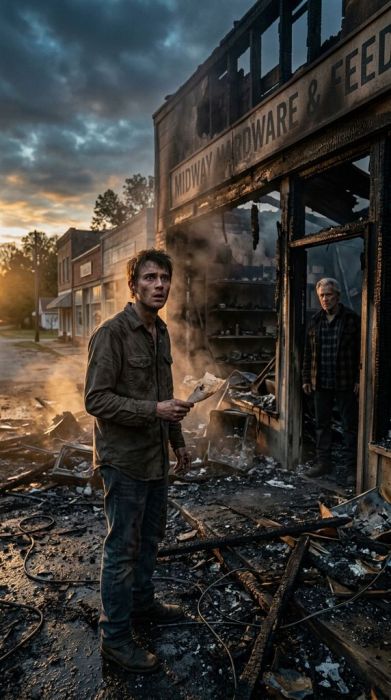
By the time I laced my boots and drove the three blocks, the street was a river of orange and black. Fire hoses sprawled over the pavement like dead snakes. The roof of Pearson's Hardware had caved in under the weight of a cold October sky, and embers still glowed in small angry handfuls where the feed bags had been. I stood across the street with the rest of the town, and I watched Walt Pearson's face in the crowd. I saw no grief on it. I saw something else, something flat and satisfied, and I have not forgotten that look a single day since.
The fire chief wanted to see me later that same morning. Mr. Barlow folded his hands on a table and asked me when I had last set foot in the building. I told him the Friday before, closing up with everyone else while the rain came down. He asked if I had a key. I did not. He asked if I had ever left anything near the back cabinets where the starter fluid and the fuel cans were kept. I said no, and I meant it. But the longer his questions went on, the quieter the whole room became.
And over the next two days, it was done. Someone noticed that the back door had been forced but not broken clean through, as if whoever it was wanted it to look one way and be another. Someone noticed a can of starter fluid on the shelf had been pulled down and left open near the wiring, the kind of expensive can no home workshop ever buys. And then the whispers started about me. Because a week before the fire, I had gotten into a disagreement with Walt, and everyone in that town knew that business had been thin enough that he had told me we might not make it through the new year together.
It had not even been an argument. I had told Walt that I understood, that I knew he had to do what was best for the store. I had even admitted that I was quietly looking around for something else, which I had never told a soul except him. By Monday of the following week, that honest moment had been twisted into a motive for murder. The town decided I had found a way to take revenge on the man who was getting ready to let me go.
I was arrested on a Thursday morning, a day too blue and too crisp for any of it. Two deputy cars parked in front of our house and they walked me out in full view of my mother, who could not stop crying no matter how much I tried to reassure her. They sat me in a small room with a dripping ceiling and they asked the same question from both directions for hours: why did you burn the store. I told them I had been home asleep. I told them nobody saw me anywhere near the building. I told them the truth until my throat was raw, and none of it mattered.
Here is the part that still unravels me to this day. Walt Pearson forgave me publicly. He stood before the newspaper man and the burned remains of his life's work and he wept for me, saying he loved me like a son and that he hoped, for my own sake, that I had not been in my right mind. He offered me the hand of mercy in front of every camera. It was a performance so beautiful, so absolutely convincing, that the entire town began to believe he was the wounded one and I was the villain he had the grace to pity. He used my lifetime of trust as the knife.
I spent ten days in the county holding cell until my father's old friend, a retired fire marshal named Earl Dock, scraped together money and paid my bond. Earl had spent forty years looking at burned buildings across three states, and he was the very first person who said out loud what no one else had dared to whisper. He told me that Walt's store had been under water for years, drowning in debt and a changing town. Then he told me that Walt had quietly renewed his insurance policy for more than double its actual value just weeks before the flames.
"Nobody burns down a dead sinking operation to hurt themselves," Earl said, slow and deliberate. "They burn it down so the claim pays them out clean. Then they point a finger at the nearest soft target and let the town do the rest." He looked at me across the table. "And that soft target was you." It hit me like water, ice cold and across the whole of my body. Because in all those days of being guilty, I had never once stopped to ask the one question that would uncover everything else. Who actually benefits from the fire?
Earl and I drove out to the gas station at the county line, a place run for forty years by a wary old bachelor named Howie. The old diesel pump had always required a signature on the running account, and Walt kept an account there in his own name. He had been smart enough to think he could throw away the signed page. What he had not known was that Howie kept a photocopy of every single page tucked under his register out of habit and suspicion both.
Howie pulled out a black-and-white receipt dated nine weeks before the fire. It showed three cans of diesel, five gallons each, billed to Walt Pearson's account and signed by his own hand. Walt had loaded those cans into his truck in the dead of night before the fire, and he had paid for them on paper that someone had saved. Earl copied the receipt and I carried it myself into the office of Detective Sergeant Ramos, the very man who had arrested me. I set it down on his desk and kept my voice steady as I told him this was the receipt for the diesel Walt filled before the fire he blamed me for.
Ramos went completely still. He studied the paper, then he opened the whole case wide. They pulled every record for the past year. They traced the insurance, the smoke, the new policy, the inflated value. They found the empty diesel cans in the timber behind Walt's house, every last one of them burned at the rim. And they found the phone messages Walt had sent his own sister on the night of the fire, drunk with expecting relief, telling her he had done it and to wait and see. His sister wept on the witness stand and handed the jury the exact words that had been meant to bury me alive.
The trial did not take very long at all. Walt Pearson was found guilty of both arson and insurance fraud. The judge gave him eleven years and said that his greed had tried to burn down an entire young man along with his timber. I was in the room when they took him away. He looked at me then, the old hunting through iron-gray eyes, full of spite. I did not look away, and I did not cheer. It was not that I lacked satisfaction. It was that nothing the sound of his chains could give back the months he had taken from me.
They dropped the charge against me the same week the verdict came down. And the town that had once prayed for Walt's mercy and glanced away from me, did something I still cannot fully wrap my head around. A dozen of the people who had quietly doubted me put up the money to let me rebuild the store in my own name on the soaked land, and Earl drew up the papers himself. They had watched me burn, and then they chose to build with me.
We tore down the the burnt shell and built a warm one. A kid from the end of the street held a hammer for me, and my mother made coffee, and the old retired firemen rolled up their sleeves and painted. The store rises again, its new bell always full with the smell of seed and lumber and honest work, and it belongs to a different owner now.
Walt told everyone that he hoped I would one day find peace. You know, some days I do. I run the same honest hardware that once tried to swallow my future whole, except today it is mine, and that makes every scar on me worth carrying. I open its doors for the community. I close them for the community. And when people ask whether I have forgiven the man who set my life on fire, I tell them the honest truth. No, I have not forgiven him. But I have stopped carrying his fire as my own burning weight, and that is more than justice could find. That is healing.
Walt Pearson thought he could burn down one lifetime and sell me the blame for it. He was wrong. He burned up the kingdom he thought he owned, and the flames built me a home out of the ashes of his empire. Every cold Saturday morning I watch the smoke rise from the new chimney and it is my own smoke, and the honest American pride of the whole hard thing, nearly worth every scar it took to carry it.