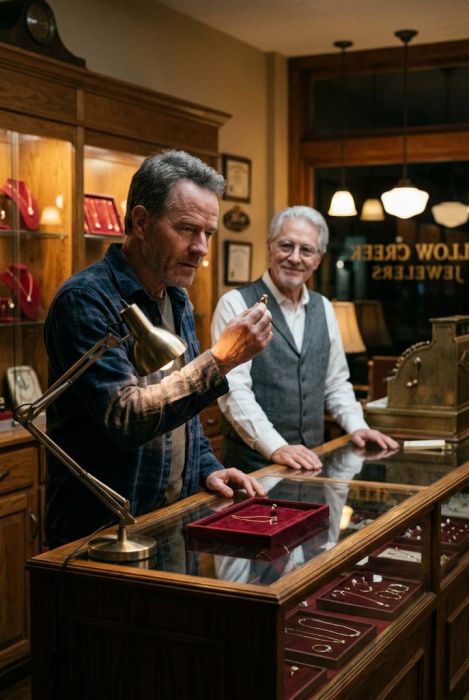
The day I walked into Calloway's Fine Jewelry with my mother's ring, the little bell over the door chimed like the shop was glad to see me. I remember thinking that was a good sign. My mother had believed in signs, and I had spent the eleven days since her funeral trying to believe in anything at all.
Ray Calloway came out from behind the counter wiping his hands on a soft grey cloth, and he looked at me the way he looked at everyone in this town, like I was the only person who mattered in the world. "Well, look who it is," he said. "You're Sarah's boy. I'm so sorry about your mother. She was one of the finest women I ever knew." He said it with his hand on my shoulder, and for a second I felt like a grieving son was being held by the right hands.
I set the little velvet box on the glass counter. "Mom wanted this appraised and insured," I said. "It was her engagement ring. Dad gave it to her in 1968, and after he passed she never took it off."
Ray picked up the box the way a man handles something holy. He opened it, and the lamp on his counter caught the stone, and he let out a low whistle. "My God," he said. "That's a beautiful diamond. Old mine cut, if I'm not mistaken. Do you have any paperwork?"
I shook my head. "She always said the original was lost in a move."
"Then we'll fix that today." He smiled, and it was the smile of a man who loved his work. "Give me an hour. I'll have it cleaned, measured, and certified, and you'll walk out with an appraisal you can hand straight to your insurance company."
I left the ring with him. That was the last time I saw the real one.
Mom had moved to Benton Falls in 2006, the summer after Dad died, leaving the house in Dayton where they'd raised me and my sister. She chose this town because her older sister Carol lived here, and because downtown still had a main street with a hardware store and a diner and a jewelry shop under a red awning that had been there since 1962. Ray Calloway had owned it since 1984. By the time Mom arrived, he was as much a part of Benton Falls as the courthouse clock, and within a year she trusted him with everything she owned. She used to say he was the most honest man in Ohio. She said it the way other people said grace.
The appraisal came back at thirty-eight thousand four hundred dollars. The certificate was beautiful, professionally printed, with the weight, the clarity grade, the cut, and a photograph of the ring. For a week I carried it around like proof that something good could come out of grief.
Then I took it to Clark & Sons Insurance, and Marsha Clark put on her reading glasses and did something that made my stomach drop. She picked up a loupe and looked at the ring herself.
"Beautiful piece," she said, handing it back. "But before we insure it at this value, I want to send it to our lab in Columbus. It's standard for anything over twenty-five thousand. Takes about three weeks."
I said of course. Three weeks felt like nothing compared to forever.
The lab report came back on a Tuesday. Marsha called me at work and her voice was strange, careful, the way people talk when they're about to tell you something they know will hurt. She closed her office door when I arrived. The ring sat on her desk in a sealed bag, and next to it lay a report with a letterhead I didn't recognize.
"The stone in this ring is not a natural diamond," she said. "It's lab-created moissanite. Retail value, roughly six hundred dollars."
I sat down. "That's impossible."
"The grading lab is definitive. The stone has an internal structure that's characteristic of moissanite. And it's been cut in an old mine style, aged to match the setting. Whoever replaced the original knew what they were doing. This wasn't an accident, and it wasn't a random robbery." She paused. "This was a professional swap."
I stared at the ring in the evidence bag, the ring I had handed to Ray Calloway three months earlier, and I felt the floor tilt under me. Ray had cleaned it. Ray had certified it. Ray had been the last person to touch it. I wanted to believe it was a coincidence, because the alternative meant that the most honest man in Ohio had taken my mother's diamond while her grave was still fresh.
I went home and did what any grieving son would do: I tore the house apart looking for anything my mother had kept. I found her Bible on the nightstand, the one she'd read every morning for forty years. And tucked inside it, between the pages of Ecclesiastes, I found something better than hope, a folded, yellowing appraisal from 1998, from a jeweler in Dayton named Feldman's Fine Jewelry.
It described her ring exactly: a one-point-nine-carat old mine cut diamond, color G, clarity VS2. And at the bottom, in the appraiser's careful handwriting, a note I read three times before my hands started to shake. "Inclusion: small black carbon crystal at five o'clock, visible under ten-power magnification."
My mother used to joke about that carbon crystal. She called it her stone's birthmark. "Even diamonds have them, honey," she'd say. "It's what makes mine one of a kind."
There was more in that Bible. A receipt from Calloway's Fine Jewelry, dated 2011, for "cleaning and appraisal of engagement ring, $75." Mom had taken her diamond to Ray Calloway for her yearly cleaning, the way she had every year since she moved to town. She had trusted him with the one thing my father ever gave her.
I did not go to the police that day. I went back to Marsha Clark, and I put the 1998 appraisal on her desk next to the lab report, and I asked her a question that had been forming in my gut for three days. "How many of your clients have appraisals from Calloway's?"
Marsha looked at me for a long moment. Then she opened a filing cabinet I'd never seen her open before. "You're not the first person to ask me about Ray Calloway," she said quietly. "In the last five years, three clients have brought me pieces he appraised. All three came back from the lab flagged as questionable. I marked it down to coincidence every time." She looked up at me. "Every single client was a widow."
My mother was a widow. The pattern clicked into place like a key turning in a lock, and suddenly I understood how a thief could work in a small town for decades without anyone noticing. He hadn't robbed safe-deposit boxes or rich people's houses. He'd robbed the safest place in America: a counter, a trusted name, and a grieving woman's blind faith.
Detective Rosa Alvarez had been with the Benton Falls police for nineteen years, and she told me flat out that they'd heard whispers about Calloway's for most of them. "But you can't arrest a jeweler for being good at his job," she said. "Insurance fraud is a ghost. It only exists in the moment the swap happens, and by the time anyone notices, the stone's been gone for years." She read the 1998 appraisal twice. Then she read the lab report. Then she looked at me and said: "You know what we need? We need to catch him doing it."
For the next month I lived two lives. By day I taught chemistry at Benton Falls High; by night I worked with Detective Alvarez and a forensic gemologist named Dr. Helena Ruiz, who flew in from a lab outside Columbus with a little black case of loaned diamonds. The plan was beautiful in its simplicity. An undercover officer would walk into Calloway's posing as a grieving granddaughter, carrying a documented diamond with photographs of its unique inclusions. Ray would do what he always did, clean it, appraise it, smile, and the moment he handed back a fake, we'd have him on video and in possession.
But I did one more thing. I called the number on the 1998 appraisal, expecting a dead line.
It rang. And an old man answered. "Feldman's Fine Jewelry."
David Feldman was ninety-one years old, and he still answered his own phone out of habit. When I told him why I was calling, he was quiet for so long I thought the line had dropped. Then he said: "I inspected that stone myself when your father bought it in 1968. Your mother brought it in for appraisals every few years, God bless her. That little black carbon fleck, there's not another one like it in Ohio." He paused. "Did you say Calloway's appraised it recently?"
"Yes, sir."
"That's the fourth time this year someone's asked me about Calloway," he said. "Two from Dayton, one from Springfield. Widows, all of them."
I closed my eyes. The pattern was bigger than Benton Falls. It ran across three counties and God only knew how many grieving families, and it had been running for more than twenty years.
The sting went down on a Tuesday, the same day of the week my mother used to get her hair done. Officer Dana Whitfield walked into Calloway's Fine Jewelry at 2:15 wearing a borrowed pearl necklace and a believable grief in her eyes. She carried a documented one-point-five-carat diamond that Dr. Ruiz had photographed at the lab three days earlier, and she told Ray Calloway it had been her grandmother's, and that she needed it appraised before the estate sale. Ray patted her hand. He told her she was doing right by her grandmother. Then he took the ring into the back, and the hidden camera above the door watched him for exactly forty-one minutes.
When he came out, he was still smiling. He handed her a beautiful certificate for forty-two thousand dollars, and she paid the seventy-five-dollar fee, and she thanked him with tears in her eyes, genuine ones, because by then her stomach was in knots, too.
Outside, she handed the ring to Dr. Ruiz. The stone in the setting was a lab-grown cubic zirconia. They had him.
They served the warrant at four-thirty, when the shop was full of the after-school rush. I wasn't there. Detective Alvarez said it was better if I wasn't, and she was right, but I heard about it from her afterward, and I've replayed it a thousand times since. Ray Calloway looked up from the counter where he was helping a young couple pick out an anniversary band, and he saw the badge, and for one moment the famous smile flickered like a bulb going out. They walked him to the back. They opened the drawer.
In the back room, under a second lock, behind a velvet display board that slid out of the wall, they found a drawer lined in grey felt. Inside it were loose stones, diamonds, emeralds, sapphires, a ruby, each one in a small plastic bag with a name written in marker and a date. The names were the names of widows. The dates went back to 1999.
My mother's name was on one of the bags. The date was June 2011. And inside the bag was a diamond with a small black carbon crystal at five o'clock, visible under ten-power magnification. Her birthmark. Her one-of-a-kind stone, which had been sitting in that drawer for eleven years, waiting for someone to come looking.
They also found the ledger, a black notebook with forty-one entries, each one listing a client, a date, a description of the original stone, and the name of the dealer in California from whom he'd ordered the fake. Twenty-two years of theft, documented in his own handwriting, "for insurance purposes," as the file folder on top cheerfully noted.
Ray Calloway's lawyer tried the story that had worked for so many white-collar men before him: a good man, overwhelmed, a tragic lapse of judgment. It lasted exactly as long as it took the prosecutor to hold up the ledger. Then David Feldman, ninety-one years old, drove two hours from Dayton to testify about a stone he remembered like a face, and the jury took four hours to come back with guilty on all forty-one counts of grand theft.
They gave him twelve years in the state penitentiary. The restitution order was over two million dollars, and the shop under the red awning was auctioned off to pay it. The town of Benton Falls had to sit with the knowledge that the most honest man in Ohio had been robbing its widows since before the millennium, and that the reason no one caught him was that he made them all feel so safe.
I picked up my mother's diamond from the evidence lockup on a grey November morning, in a plastic bag with her name and a date on it, exactly as it had been tagged eleven years earlier. I took it to a jeweler in Dayton, a protégé of Feldman's, and I watched him set it back into her original ring. It fit like it had never left. Because it never really had.
My daughter Emily wears that ring now. She got it on her wedding day last spring, and I told her the story of her grandmother's birthmark, the tiny black fleck that made her ring one of a kind, the one that came home after eleven years in a drawer. She cried. I pretended I didn't.
These days, the widows of Benton Falls take their appraisals to the county lab in Columbus, and the jeweler who bought the old shop keeps his certificates in a binder customers are welcome to read. Marsha Clark still has the loupe on her desk, and she uses it on everything over five hundred dollars, and no one in this town thinks that's strange anymore.
I think about Ray Calloway sometimes, the way you think about a bad storm you survived. He had thirty years of smiles and forty-one documented betrayals, and he built his whole empire on one quiet assumption: that grieving people don't look too closely at the things they love. He was almost right. But he forgot what my mother taught me in the pages of that old Bible, that love keeps records, and records have a way of surfacing when the time is right.
Karma doesn't need a warrant, but it's nice when it brings one.