The morning the sheriff's deputy knocked on my father's door, I was still in my pajamas, pouring coffee into the same cracked mug Dad had owned since 1987. Through the screen, he held up a folded paper like it was nothing at all. "Ma'am," he said, "I'm sorry, but this is an eviction notice. You've got thirty days."
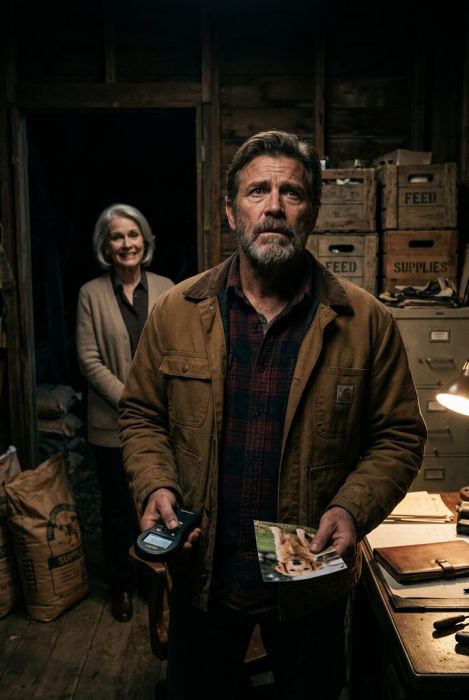
I stared at him. Behind me, my father, Frank Callahan, was buttering toast he'd already buttered twice, the way he did now on the days he forgot things. He was eighty-four, a retired mechanic who'd built this house with his own two hands in 1971 and paid off the mortgage in 1993. Every brick, every window, every stubborn creak in the floorboards was his. Ours.
"There's been a mistake," I said. "This house has been paid off for over thirty years."
The deputy looked at the paper again. "Ma'am, this is the third notice I've served at this address this week. There's also a lien on the property from something called Finch Properties."
Finch Properties. The name landed in my stomach like a stone dropped into still water. I knew that name. Everyone in Silver Pines knew that name.
Marcus Finch had moved into our retirement village two years earlier, and in that time he'd become something close to a saint. He was forty-two, handsome in a used-car-salesman way, with a firm handshake and a Bible on the passenger seat of his truck that he actually seemed to read. He volunteered at the senior center every Tuesday. He fixed Mrs. Alvarez's leaky faucet and changed Mrs. Okafor's smoke alarm batteries. He taught a free class called "Protecting What You've Built" and drove men to their doctor's appointments when their families couldn't.
He brought casseroles. That was the thing people always mentioned first: Marcus Finch brought casseroles to every sickbed, every funeral, every lonely widow's door. He knew everyone's birthday. He remembered your grandchildren's names. He was, by every measure, the best neighbor Silver Pines had ever had.
Dad adored him. That was the part that broke me later. My father, who had never trusted a salesman in his life, who'd caught a contractor shortchanging him on shingles in 1995 and hounded the man until he fixed it, trusted Marcus Finch completely. "That boy's got a good heart, Diane," he'd tell me on the phone. "He's gonna do big things."
The eviction notice was dated March 14. The same week Dad told me, cheerful as ever, that Marcus had "helped him out with the roof."
I hadn't visited that week. I'd been in Austin, buried in spreadsheets for a client who was suing somebody over a property dispute — the irony was so thick I could have choked on it. I only found out about the roof when Dad called me, his voice bright, to say Marcus had spotted some loose shingles and offered to handle it, no charge, just a little paperwork so the insurance could cover it.
"Paperwork?" I'd said. "Dad, what paperwork?"
"Oh, you know, honey. The usual. He said it protects me."
I should have driven down that night. I didn't. I told myself Dad was in good hands, that Marcus was a good man, that I was being paranoid because I'd seen too many property cases in city court. I had a deposition in the morning. I promised myself I'd look at the paperwork the following weekend.
I never got the chance. The following weekend, the sheriff posted a second notice on Dad's door — a foreclosure notice, of all things. And then a third. And by the time I drove down, white-knuckling the wheel the whole way from Austin, the eviction notice was taped to the glass like a verdict.
Dad didn't understand any of it. He kept smiling at the deputy and asking if he wanted coffee. He asked me three times why I wasn't at work. He asked me if Mom was coming home soon, and I had to sit him down and remind him, very gently, that Mom had passed in 2016.
The deputy left. I locked the door, turned to my father, and asked him to show me the paperwork Marcus had made him sign.
He couldn't find it. But he did find something else, tucked into the Bible on his nightstand — the Bible Marcus had given him for his birthday, with a bookmark inside. The bookmark was a business card. "Finch Properties: We Buy Houses. Cash Offers. No Fees."
I called the number. A friendly, warm voice answered on the second ring. Marcus himself. When I identified myself, the warmth didn't drop — it just shifted, like a stage light turning on a different actor. "Diane! How's your dad doing? I've been meaning to call. The roof work is all done, by the way. He's got a brand-new roof."
"Marcus," I said, "my father is being evicted from a house he's owned for fifty years. What did you make him sign?"
A pause. Then, smoothly: "Oh, that. Diane, look, Frank came to me with a problem, and I helped him out. We did everything legal, notarized and recorded. He sold me the house, and I gave him a very fair price for it. He insisted on taking some cash to help with his bills — you know how Frank is."
"He didn't sell you his house," I said. "He thinks he signed an insurance form for a roof."
The line went quiet for a long moment. When Marcus spoke again, the homespun warmth had a new edge to it, thin and sharp as a blade. "Well, Diane, that's between your father and his reading glasses. The deed is recorded. My lawyer has a copy. If you want to fight it, you go right ahead, but I'd hate for you to waste your money. And your father did get a beautiful new roof."
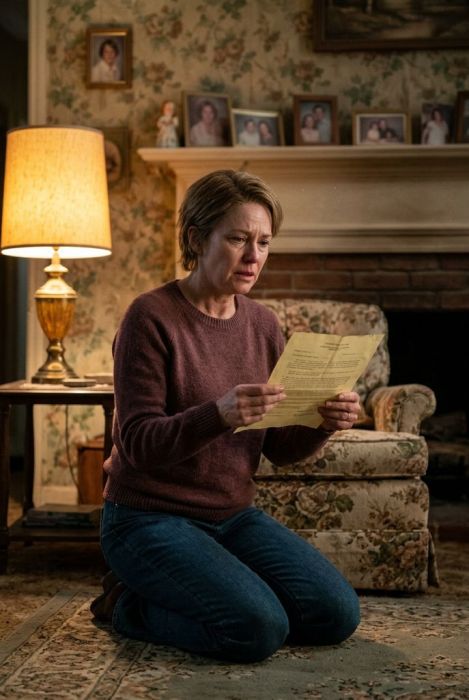
He hung up laughing. I stood in my mother's kitchen — my mother's kitchen, with her yellow mixing bowl still on the counter where she'd left it eight years ago — and I listened to the dial tone until it became a flat, angry hum.
Then I did the only thing that made sense. I called a lawyer.
Marta Delgado ran the senior legal aid clinic in Round Rock. She was a small, sharp-eyed woman in her sixties who'd spent thirty years suing people who stole from old folks, and she didn't once look surprised when I told her the story. The only thing that surprised her was the deed itself.
"Sign this," she said, sliding a form across her desk. "It's a retainer. No fee. We're going to enjoy this one, Diane."
We drove to the Travis County Clerk's office that afternoon, and Marta pulled the deed Marcus had recorded: a quitclaim deed, signed by my father, dated January 9, transferring 42 Carriage Lane to Finch Properties LLC, for the sum of fifty-two thousand dollars. There was a notary stamp on it. Timothy R. Sandoval, a roving notary from Georgetown.
"Fifty-two thousand," Marta said. "For a house worth three hundred and nineteen, on a lot that size, in this market. That's not a sale. That's a mugging with paperwork."
"I know," I said. "But Dad signed it. He said he thought it was insurance forms. We can't prove what he thought."
"We don't have to prove what he thought," Marta said. "We have to prove what he understood. And we have to find out how many times Marcus Finch has done this." She gave me a long look. "Diane, I want you to go back to Silver Pines and talk to your neighbors. Every one of them. Ask who else signed papers for Marcus."
That was the weekend I learned about the pattern.
Mrs. Alvarez, the one whose faucet Marcus fixed, told me he'd asked her to sign a "home improvement consent" for a paint job she'd never ordered. She hadn't done it, but she still had the paper. When I looked at it, it was a grant deed with her address on it — she just hadn't read past the word "consent."
Thelma Okafor told me Marcus had helped her update her "emergency contacts" at the senior center. The form she'd signed gave him power of attorney. She hadn't known what those three words meant, and neither had her daughter, who'd driven in from Houston and found it in a drawer.
And then there was Walter Guzman. Walter was seventy-six, a Korean War vet who'd lost his wife the year before and lived alone in the double-wide at the end of Carriage Lane with a parakeet named Sergeant. Marcus had been bringing him breakfast tacos every Friday. Walter, it turned out, had signed a deed too — same notary, same week, transferring his property for thirty-one thousand dollars.
When I knocked on his door, Walter looked at me with those old, watery eyes and said, "Marcus said it was so the VA could help with my medical bills."
The VA had never received a single form.
Marta put it together that night, in her kitchen, with spreadsheets and a legal pad. Four properties in eighteen months, all from Silver Pines residents, all notarized by the same man, all purchased far below market value. Together they were worth over a million dollars. Marcus had paid about a hundred and forty thousand for all of them.
"He's not a thief," Marta said slowly. "He's a factory."
We went to the Travis County Sheriff's Office. We were lucky — we got Detective Rosa Alvarez, who ran the county's elder fraud unit and had been looking for exactly this kind of pattern for two years. She'd had complaints about Marcus before — whispers from a family in Pflugerville, a suspicious wire transfer flagged by a Georgetown bank — but nothing with paper this solid. She took our statements, copied every document, and shook my hand at the door. "You did good," she said. "Most families bury this. They're ashamed. You came in swinging."
Then she gave me the part that made my blood run cold: "Do not confront him. Do not tell your father. Give me three weeks."
For those three weeks, I did what I was told. I visited Dad, smiled, played checkers with him, and watched Marcus wave at me from his porch like a man with nothing to hide. The eviction deadline came and went; Detective Alvarez's office quietly got the court to stay it. Marcus, I later learned, thought we'd just given up.
He was wrong. We'd been building.
The trap came together in a title company office on the second floor of a brick building in Georgetown. The buyer Marcus had found for my father's house was a real estate firm out of Florida — or so he believed. The "buyer's attorney" was actually an investigator from the district attorney's office, who'd spent a month posing as an out-of-state investor desperate to close fast. Marcus had taken the bait. He was coming in person to sign the final paperwork and collect his wire transfer.
The closing was set for ten a.m. on a Thursday. I was in the room next door with Dad, Walter Guzman, Thelma Okafor, and Mrs. Alvarez, who'd gotten her grant deed set framed as a joke by her granddaughter. We watched through the glass partition — the kind that looks like a mirror from the other side — as Marcus walked in wearing his best boots and a grin.
He sat down, opened his folder, and started talking about comps and quick-closing credits. The "attorney" listened politely. Then he slid a single piece of paper across the table. "Mr. Finch, before we wire anything, could you confirm this signature?"
Marcus glanced at it. "Yeah, that's Frank Callahan. Signed right in front of the notary. We recorded it in January."
"Mm-hmm," said the attorney. "And Mr. Callahan's signature here — is he aware that he signed away a house he didn't legally own?"
The room went very quiet. I saw Marcus's jaw tighten, just a fraction. "What are you talking about?"
"Frank Callahan didn't own forty-two Carriage Lane in January," the attorney said, very gently. "The property's been held by the Callahan Family Trust since 2011. A trustee acted without authority, and the trust, through its successor trustee, has never ratified this sale. That deed you recorded is void. You filed a quitclaim deed on a property that wasn't yours to acquire."
I stepped out from behind the mirror then. So did Dad, though he was mostly following because everyone else was moving. Marcus looked at me, and for the first time in two years, something flickered behind his eyes — not shame, not fear. Confusion. The confusion of a man who genuinely believed the world would keep letting him win.
"You," he said. "Your father had dementia. Everyone said so. That's not a valid sale, and you knew it — you set me up."
"I didn't set you up," I said. "I just found your bookmark."
Later, they told us the rest. Detective Alvarez had executed a search warrant on Marcus's office that same morning. They'd found a spreadsheet on his laptop — fourteen properties in three counties, all purchased under market value from elderly owners, most of them in the last two years. They found gift cards, handwritten notes, a burner phone. And they found a folder labeled "Silver Pines" holding a copy of every deed, including my father's — and on top, a Post-it note in his own handwriting: "Frank = trust? CHECK."
He'd known. He'd known the house sat in a trust, and he'd recorded the deed anyway, hoping nobody would notice. That was the thing that got him in the end: not the fraud, not the forgery — his own notes, his own greed, his own belief that we were all too old, too tired, or too afraid to fight.
The arrest took place at the closing table. Detective Alvarez read him his rights while the notary, Timothy Sandoval, sat in the next room with his own attorney, negotiating his cooperation. By the end of the month, Marcus Finch was in the county jail charged with fourteen counts of exploiting an elderly person, two counts of forgery, and one count of fraudulent transfer. His bail was set at one-point-two million dollars. It took his own lawyer two days to talk him into a plea.
The trial never happened. Marcus Finch took a plea deal in October: nine years in state prison, full restitution to every family, and a permanent ban on holding a real estate license in any state. The judge read his statement from the bench, and I remember how still the courtroom went when she reached the part about "systematic, predatory cruelty against citizens who trusted you." Dad was in the front row. I don't know how much he understood that day — dementia takes things in pieces — but when the gavel came down, he nodded, slow and certain, like a man who'd just heard a verdict he'd been waiting on for a long time.
The state's restitution fund gave us back the equity on the house, but by then Dad couldn't live alone anymore. We sold 42 Carriage Lane — legally this time, no tricks, to a young couple who loved the story of the yellow mixing bowl — and I used the money to buy a little place near me in Austin, with a garden out back and a squeaky porch swing. Dad sits out there in the afternoons and feeds the birds. He still forgets things, every day, but he never forgets that his daughter showed up.
They gave Walter Guzman his double-wide back, and Sergeant the parakeet outlived the whole ordeal. Thelma Okafor's daughter filed her own suit against the senior center for handing over her mother's power of attorney without a call. Mrs. Alvarez put her framed grant deed on the wall in the living room, right above the fireplace, and tells the story at bingo to anyone who'll listen.
As for Marcus Finch — he's nine years into a sentence that let him do the one thing he never wanted to do: settle down, quietly, somewhere that isn't a porch in Silver Pines. On the day he was sentenced, Dad told me something I'll never forget. "Diane," he said, "I may not remember my keys, but I remember that world's got a long ledger. And every single thing gets written down."
He was right. The ledger caught up with Marcus Finch — not in a courtroom, not in a spreadsheet, but on the day a man who thought he'd conned the whole town discovered that the one house he'd stolen wasn't even his to take. And my father, who forgot so much, never once forgot the look on Marcus's face when the mirror went quiet and the truth walked in.