The morning Maya's acceptance letter arrived, I stood at the kitchen counter with the envelope in one hand and a cup of coffee gone cold in the other. She flew down the stairs before I could even call her name, and when she saw the return address from Chapel Hill, she screamed so loudly the dog started barking. Dan lifted her clean off the floor. Owen pretended not to care, but I caught him smiling into his cereal bowl. It was a perfect morning. It was the last perfect morning we would have for a long time.
That same afternoon, I drove to First Piedmont Bank to move money out of the accounts my mother had been "managing" since the twins were born. The teller at the window, Louise Myers, took one look at my license and then looked at me the way people look at you before they deliver bad news. "Rachel, come around to my desk," she said softly. That was the moment the world tilted.
The account that should have held nearly ninety thousand dollars had forty-one dollars and seventy-two cents in it. Louise printed the ledger, and I remember watching the withdrawals crawl up the page like termites through dry wood. Small ones at first, then bigger, until the last twelve months, when the money came out in chunks that made my stomach turn. "I don't understand," I kept saying. "She's their grandmother."
That money had a name. It was my father's last gift to his grandchildren. Walter Barrett dropped dead of a heart attack in the parking lot of the Kroger in 2007, at fifty-three, with a cart full of the kind of snacks he bought for the twins. His life insurance paid a hundred and eighty thousand dollars, and my mother, Diane, announced at the funeral luncheon that half of it would be set aside for Maya and Owen's education. "Your father would want those babies provided for," she said, holding them on her lap.
She insisted on managing the accounts herself. "I've been handling money since before you were born," she told me when I tried to thank her. "You focus on raising those children." So I did. Every Thanksgiving, Nana would pull out her little leather ledger and show the kids their totals, and they would beam at her as though she had hung the moon. She was everyone's favorite grandmother — Sunday school teacher, food pantry volunteer, famous for her peach cobbler.
What I remember now, with the awful clarity of hindsight, is the way she cried at the funeral. Not the polite tears of the other widows. She wailed, right there in the front pew, and the whole congregation held her up. We said she had lost something inside herself when Dad died. We never stopped to wonder what else might have been lost with it.
Looking back, there were signs. Two years after Dad died, Mom married a retired pharmacist named Gordon, and they started taking trips to places my parents never went. Then came the cabin at Lake Lure, which she said she'd bought with "years of careful savings." I had no reason to question it. The statements stopped coming to our house and began going to her post office box, because the mail in our neighborhood, she said, kept getting stolen.
Every time I offered to take over the paperwork, she patted my hand and told me to stop worrying. "I've got it handled, Rachel," she'd say. "You just enjoy those babies." And I did. I enjoyed them right into believing a lie that took eighteen years to build and one afternoon to shatter.
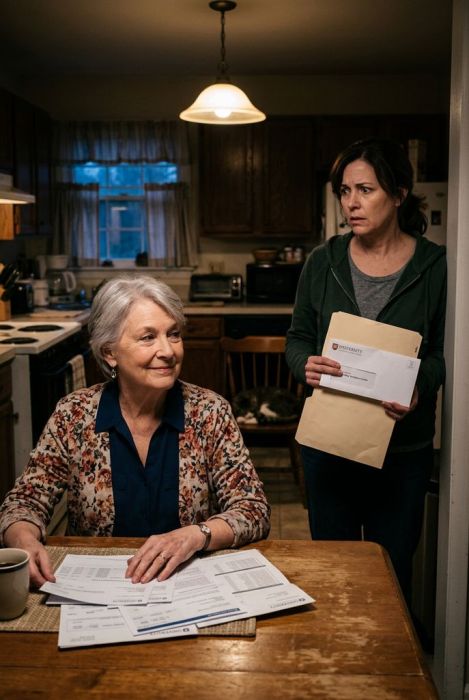
The first crack came three weeks after Maya's letter, in a piece of mail that made no sense. A collections notice. Eight thousand four hundred dollars, in Maya's name, on a credit card that had been opened when she was sixteen years old. Maya had never owned a credit card in her life. She handed me the notice with shaking hands, and I stood at the kitchen counter trying to decide whether my daughter had been scammed by strangers — or whether the scam artist had a key to my mother's kitchen and a reputation for the best cobbler in Henderson County.
I took the notice to First Piedmont anyway, because Louise had told me to bring anything unusual. She took me straight into the manager's office, where a quiet, patient man named Marcus Hale introduced himself as the bank's fraud investigator. Marcus had already been looking at the accounts. The withdrawals, he said, had patterns — always in person, always cheerful, always just under the threshold that would trigger a phone call.
Then he showed me the signatures. The forgeries were the kind an old, confident hand leaves behind. The loop on the "M" in Maya's name was drawn in a way my daughter never drew it. The "B" in Barrett was too smooth, too practiced. Marcus asked me to sign Maya's school forms in front of him, then compared the two hands. He shook his head slowly. "That's not your hand, Rachel," he said. "That's your mother's."
He brought in a forensic document examiner, a woman named Carla Voss whose name I will never forget. She examined the withdrawal slips and the credit card application and produced a report that read like the end of a trial before the trial ever started. The signatures had been written slowly, with exaggerated pressure, by someone copying a young person's handwriting. The credit card had been opened using a social security number the bank had held on file since 2007. My mother had not only spent the twins' futures. She had begun building a second life on my daughter's name.
Anyone else might have marched up to her door and screamed. I wanted to. God, I wanted to. But Marcus had a different idea, and to this day I thank him for it. "People like this can't resist an audience," he said. "Give her a stage, and she will tell you everything." So we built one.
We told Mom that Maya had won a scholarship — this part was true — and that we were having a small celebration dinner, just family, and that I wanted to apologize for the confusion about the college account. She arrived early, golden and glowing, wearing a lavender dress that probably cost more than I spent on groceries in a month. She kissed the twins, hugged Dan, and looked around the kitchen as if she were the guest of honor. She was, in a way. We just had different ideas about what the evening would honor.
Dan cooked steaks. Owen set the table. And I placed my phone on the sideboard, face up, still recording, exactly the way Marcus had taught me. The conversation took an hour to reach the spot we needed. Then Maya, who had been coached carefully for a week, asked Nana how she had managed to keep the accounts growing all those years.
And my mother — my beautiful, grieving, generous mother — smiled at the girl she had robbed and said the words that ended her. "Oh, honey, it's all about being clever. You move it little by little, in cash, so no one notices. And you never, ever put it in your own name. That's amateur hour. I bought that cabin one ten-thousand-dollar withdrawal at a time."
The room went quiet, then loud, all in the same breath. Dan dropped his fork. Maya's face went pale, and Owen stood up so fast his chair scraped the floor. I pressed the button on my phone that sent a copy of the recording straight to Marcus Hale, who was parked two blocks away in an unmarked car with a detective from the Henderson County sheriff's office.
They arrived before the coffee finished brewing. I didn't open the door. The detective did. And when he read my mother her rights in my kitchen, surrounded by the smell of grilled steak and the photographs of her grandchildren on the wall, she looked at me as if I were the one who had done something wrong. "After everything I did for you," she hissed. That was the first true thing she had said to me in years.
The justice was not loud. It was thorough. The cabin at Lake Lure sold at auction. The credit card debt was wiped from Maya's record, and the bank's fraud unit, once they saw Carla Voss's report, made sure the twins were made whole from the insurance recovery before a single cent went anywhere else.
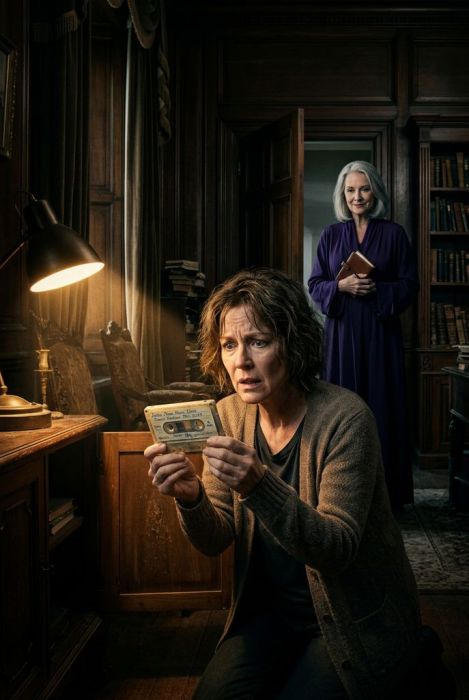
Deputies found her real books in a lockbox under her bed — the ledger she kept for herself, the one with the neat, patient handwriting she'd learned in a bank teller training class in 1974. It didn't win her any leniency. Diane Barrett was charged with felony theft, forgery, and identity theft against a minor. She took a plea, and she will be very old in a way no grandmother should be old by the time she comes out.
The church ladies who signed her casseroles into every sickbed in town stopped returning her calls. The bridge club found a fourth. Even Gordon, her second husband, filed for divorce the week the story got around. It turns out the charm that fooled an entire town had a shelf life, and it had expired the moment the courthouse doors closed behind her.
The remarkable part, the part I did not expect, was what the town did next. When word got around, people showed up. The Sunday school class Maya had taught stayed quiet for a week, and then its members started a scholarship fund in my father's name. A retired teacher from the high school dropped a check at the post office that made me cry right there in the lobby, holding my keys in one hand and a stranger's kindness in the other.
Maya still had her scholarship, but she also got something better: the small, fierce knowledge that when someone you love tries to steal your future, you are allowed to fight back. She cried when she found out. Then she stopped crying, and I watched my daughter, the one Nana had always called "the sensitive one," become someone who could look at a forged document and see exactly who had written it.
Owen surprised us all by choosing the community college's welding program. "I'm not going to let her take that from me, too," he said at his graduation, with his helmet under his arm and the whole gymnasium half listening — not because he was loud, but because a seventeen-year-old talking about his grandmother with that kind of calm is something people remember.
We paid for his first year with money we had recovered, money that felt like it carried my father's fingerprints. I kept the deposit slip — a small, silly thing — in the drawer with his old fishing license and the photo of him holding the twins on the day they were born.
I do not visit her. I send a card at Christmas, the kind you buy at the grocery store, and I never read the letters she sends back. Some people told me I was cruel. But cruelty is spending a child's future on a lake cabin. Cruelty is forging your own granddaughter's name on a credit card application. What I did was survive, and I will not apologize for it.
The twins are in college now. The real account, the one in their names, with Marcus Hale's office keeping a polite eye on it, grows a little more every semester. And on the first day of every school year, I drive past the cabin at Lake Lure — the one with the new owners and the fresh flowers on the porch — and I think about my father, who was a good man, and who would have hated every single thing that happened.
Here is the truth I want people to take from this. The person who loves you and the person who steals from you can be the same person, and that is the hardest lesson I have ever learned. But it is also true that the world has a way of catching up with the ones who think they are clever.
My mother taught the twins that money does not grow on trees. She just never told them where her trees were planted. In the end, the bank, the paper trail, and an old leather ledger she never thought to burn did what she believed no one could do. They brought the whole thing home.