The night they gave Marcus Delaney the key to the city, I found a seat in the back row of the town hall and tried to keep my hands from shaking. Eleven months earlier, I'd sat in the same building and watched him cry at Tom's memorial service. Eleven months earlier, I'd believed every kind word he said about my husband. Now I was holding a folder with copies of everything—every padded receipt, every forged signature, every check he'd written to himself from the charity my husband had helped create. Marcus didn't know what I had. He thought he'd won.
It had started the way all of this had started, with love for Tom. My husband had been the kind of man who noticed when a neighbor's porch light stayed dark too long. Together with Marcus Delaney, his best friend since high school, Tom had founded the Maple Hollow Community Care Fund—a small charity that paid heat bills in January, bought school shoes in August, and kept the food pantry stocked when the mill shut down. Tom served as treasurer because he trusted numbers the way other men trusted church. He kept every receipt in a shoebox in his study, and he balanced the books on the kitchen table every Sunday night.
When Tom died of a heart attack at fifty-two, the town wrapped itself around me and our daughter, Lucy. Marcus was the first one through the door. He brought a casserole, then another, then a bottle of bourbon and a long evening of stories about Tom that made Lucy laugh through her tears. He led the prayer at the funeral, his voice breaking in all the right places. He told me the fund would always be Tom's legacy, and that if I ever wanted to help, the board would welcome me with open arms.
I didn't want to hurt at first. But three months after the funeral, I walked into the church basement where the fund kept its office, and I told Betsy Harwood, the board president, that I wanted to volunteer. I told myself I was honoring Tom. What I didn't know was that I was about to become a target.
For the first few weeks, it was innocent. I answered phones, stuffed envelopes, helped organize the spring drive. And then, because the treasurer's job had never been filled after Tom died, the board asked me—gently, almost apologetically—whether I'd take over the books part-time. Marcus had been covering for months, they said. It would be a relief for him.
I should have noticed the thing that mattered most. When I asked Marcus for the old ledgers, he smiled and told me they'd been lost in the move to the new storage room. "Old Tom's shoebox, gone," he said, and for a moment he actually looked sad. "We'll start fresh. Clean books. That's what he'd have wanted."
Maybe it was grief that kept me quiet. My hands were still shaking over laundry, still reaching for the phone to call a man who wasn't there. I let the fresh start happen, and I started recording the numbers the way Marcus insisted they be recorded.
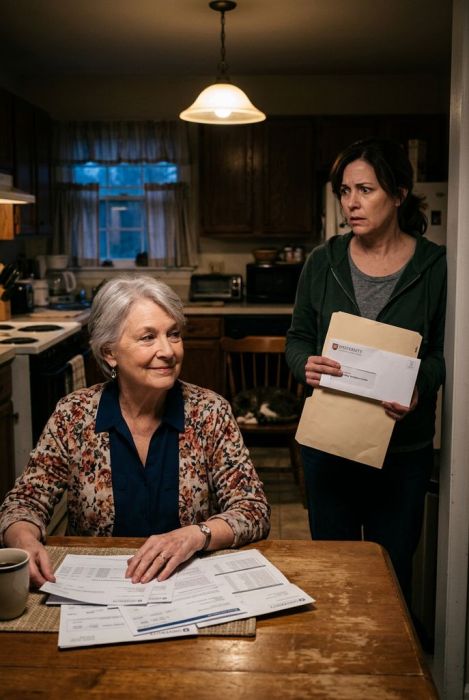
It took me four months to see the pattern. Small things at first. A delivery receipt from Brightside Foods that matched nothing on the pantry shelves. A transportation expense for a van the fund had sold the year before. Fifty dollars here, a hundred there—the kind of numbers that could be honest mistakes. When I asked Marcus about the Brightside receipt, he laughed and told me the vendor had the fund's old tax ID, and I shouldn't worry. He looked me in the eye with that kind, crinkled face of his and said, "Nora, you've been through enough. You don't need to carry this. Let me handle the vendors."
I wanted to let him handle it. That was the cruelest part. I wanted to be the grateful widow, not the snooping one. Then, on a Tuesday in September, the pantry coordinator, Rosa Delgado, told me she'd been waiting eleven weeks for a delivery of canned goods that Marcus swore had been ordered. "I called Brightside myself," she said quietly. "They've never heard of our account."
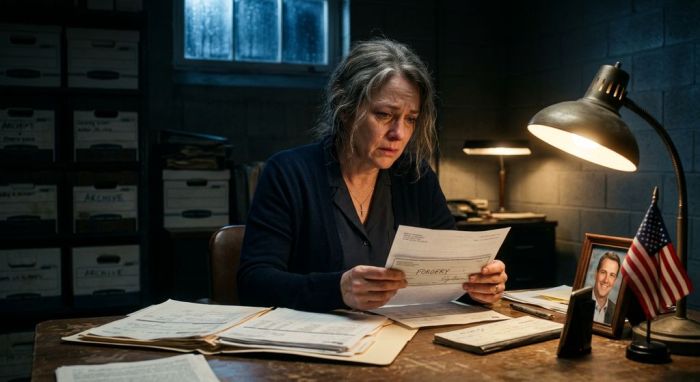
That night I drove to the church basement alone. The office key Tom had kept on his ring still worked. I found the fund's safe in the back of the supply closet—the safe Tom had shown me once, laughing about how he'd picked the combination because it was our anniversary. Inside I found something I never expected: a second set of books. The real ones. Tom's meticulous Sunday night records, continued in careful black ink, and next to them a stack of deposit slips for an account I'd never heard of, in a bank across the county line. Every slip was signed Marcus Delaney.
I took photos of every page. That was the first smart thing I did. And I did it again the next night, because I was too scared to look at what I'd found, and scared people make foolish decisions. I waited too long. I told myself I was gathering proof, but the truth was I was hoping Marcus would stop on his own. Instead, in October, a check came through the mail—a check for six hundred dollars made out to the fund's pantry, signed with my name. Except I'd never signed it. The signature was wrong, slightly. My hand doesn't loop the N that way.
I took the check to Betsy Harwood. I thought I was being careful, giving the board president the chance to examine it privately. I should have known better. Within a week, everyone in Maple Hollow knew that Nora Calloway had been writing checks to herself from the charity Tom had founded. The only proof anyone needed was a whisper from Marcus Delaney, delivered with a sad shake of his head: "I can't believe she'd do this. Tom would be heartbroken."
The board fired me by letter, one paragraph long, no meeting. The sheriff's deputy who came to my door was apologetic but firm: there was an investigation, and I shouldn't leave town. The grocery store got quiet when I walked in. The choir director asked me to take a leave of absence for my own good. Someone keyed the word LIAR into the side of my car, and when I reported it, the dispatcher sighed like I was the problem. Lucy came home from school in tears. She was fifteen, and her only crime was having my last name.
I want to be clear about something: I thought about leaving. I thought about selling the house and starting over somewhere my husband's name didn't trail behind me like a headline. But I had Tom's second set of records in a manila envelope, and I had the forged check, and I had a list in my head of every person who'd looked at me sideways instead of asking a single question.
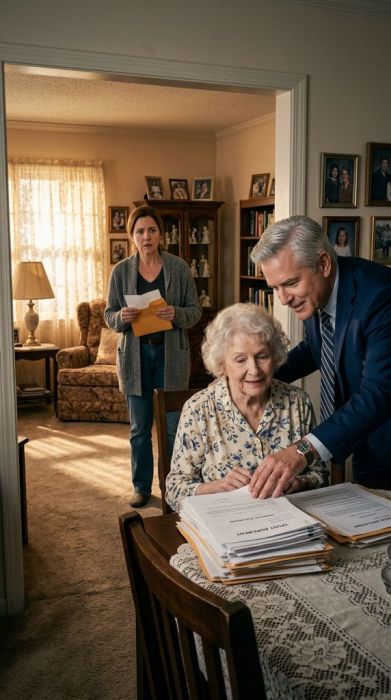
The second smart thing I did was walk into Paul Whitaker's office. Paul was a part-time accountant who did the fund's taxes—a shy, precise man in his sixties who always smelled faintly of peppermint and paper. I handed him the photos and the check and waited for him to ask me to leave. Instead, he took off his glasses, looked at the copies for a long moment, and said, "I wondered when someone would notice."
He'd noticed, too. Years of returns that didn't match the ledgers. A donor list that included names he'd never seen. Marcus had been methodical, but he'd also been greedy, and greedy people make the same mistake eventually: they stop being careful about the people around them.
Paul introduced me to Detective Angela Reyes, who'd been piecing together a complaint from a small church forty miles away. This wasn't Marcus's first charity. He'd drained a youth outreach program in the next county three years before, and the accounting had quietly been settled before charges were ever filed. Reyes had been waiting ever since.
Here's the part I keep thinking about, because it taught me something about how the world actually works. Detective Reyes didn't need my pain. She needed my papers. The original ledger, the forged check with my fabricated signature, the deposit slips—together they turned a cold case into a prosecutable one. "He's clever," Reyes told me that afternoon in her office, "but he did what clever men do. He framed the one person everyone would believe. He never imagined you'd keep records."
The plan was simple, and it was the third smart thing I did. The town had chosen Marcus Delaney as its Citizen of the Year—a fitting tribute, everyone said, to the man who'd carried Tom's charity and soothed a grieving widow. The ceremony was set for the first Friday in December, at the town hall. Reyes asked me if she could arrest him somewhere public, and I asked her one question in return: "Can he get the key first?"
She smiled at that. A real smile. "I don't see why he shouldn't hold it for a few minutes. It makes the paperwork sweeter."
So on a cold December night, I put on the charcoal dress I'd last worn to sit beside Tom's casket, and I walked into the town hall alone. I sat in the back row. I watched the mayor stand and tell a room full of people how Marcus Delaney had carried this town through its hardest year. I watched Marcus accept the key to the city with tears in his eyes, and I heard him say my name.
"I want to say a word about Nora Calloway," he said into the microphone, and the room went still. "I pray for her every night. I hope she finds the help she needs. Tom would have wanted that."
He didn't know I had that man in my sights. He didn't know about Detective Reyes waiting in the hallway. He didn't know the folder in my purse was now four inches thick, or that Paul Whitaker had photocopied every page before handing back the originals. He was standing there, holding the key to our town, forgiving me in public, and I felt something I hadn't felt in eleven months. I felt calm.
Then Detective Reyes came through the side door with two officers, and the mayor went pale, and Marcus's face did the strangest thing: it went smooth. The public grief vanished, replaced by the flat placidness of a man checking his exits.
They gave him the news with a handshake and a warrant. Forgery. Embezzlement. Identity theft—mine, of all people's. The room dissolved into noise. People called out, some in protest, some in my direction. Betsy Harwood was crying. Marcus was escorted out the front door and into a squad car under the town's streetlights, still holding the key in his jacket pocket.
I stayed in my seat until they'd read him his rights. Then I walked outside into the cold December air, and I let myself cry for the first time since the funeral. Not for me. For Tom, who'd spent every Sunday night of his married life balancing those books, and who would have hated knowing his best friend had used his name to steal from his own town.
The weeks that followed were strange. People I hadn't spoken to in months came by with apology casseroles. The church asked me to rejoin the choir. The board called a meeting and offered me the fund's treasurer position, and I could see the shame on their faces when I said I'd take it on one condition: that every account be audited twice a year, by an outside firm, forever.
Marcus took a plea deal in the spring. Five to nine years for stealing more than two hundred thousand dollars from the charity Tom co-founded—money that had bought a second car, a cabin, a boat, and a string of losing bets at a racetrack forty miles from Maple Hollow, which is what he'd actually spent my husband's legacy on. I don't take satisfaction in his sentence the way I thought I would. I take satisfaction in what happened next.
The restitution check was for nearly the full amount, because the court sold the boat and the cabin, and the fund used the money to double the pantry's capacity and start a scholarship in Tom's name. Lucy, who'd spent her whole sophomore year eating lunch in the library bathroom, watched the town rally around her in a way that made her cry and then, eventually, made her stand a little taller. There's a bench outside the food pantry with Tom's name on it now. I walk past it every Tuesday when I drop off the new books.
I still keep the folder. Every so often I open it, just to remind myself what a lie looked like up close, and what the truth did to it. Marcus Delaney spent years of his life playing the kindest man in Maple Hollow. He got the key to the city, the way he wanted. And the very people he'd fooled stood in the street and watched the police car take him away.
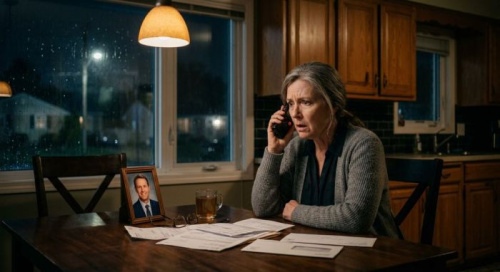
I don't think about him much anymore. I think about the Sunday nights Tom and I spent at the kitchen table, him in his reading glasses with the shoebox open between us, humming off-key, convinced the town's best days were still ahead. He was right about a lot of things. He was right about the books, and he was right about me—though I don't think even Tom could have guessed how far I'd go for his name.
Some people say karma is a myth. Maybe it is. But I know this: the key to the city is a nice piece of brass, and it doesn't open a cell door. Marcus learned that lesson on the worst night of his life, in front of everyone who ever loved him, holding an award he'd earned by lying to a town that had only ever wanted to believe the best of him.
And me? Four years later, I run the fund Tom built, the pantry is bigger than ever, and my daughter is studying accounting in college—because she told me once that she wanted to be the kind of woman who balances the books and nobody has to wonder.
That's not revenge. That's just living, after someone tried to take everything from you, and finding out you were never empty.