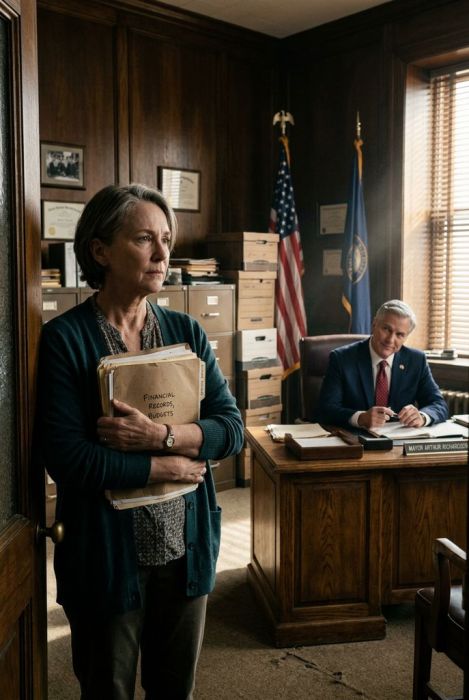
The night Marguerite Ellison received the key to the city, I stood at the back of the packed library atrium with a secret that was about to end her. She was radiant in a sapphire dress, her silver hair catching the chandelier light, and when she lifted the heavy brass key above her head like an Oscar, the crowd roared. Half of Mercer Falls owed her something. The children's wing. The computer lab. The scholarships that kept kids in college. I owed her nothing but the truth, and I had been carrying that truth for nine days, wrapped in wax paper, hidden inside a 1965 yearbook under my arm.
Then I saw Special Agent Marcus Cole nod once from the far door, and I understood that the cameras were about to capture something far more memorable than a ribbon cutting.
I'm Ben Hartley. Sixty-one years old, retired history teacher, and for the last three years I've been the volunteer archivist at the Mercer Falls Public Library. That's how I met Marguerite. That's how everybody met Marguerite, eventually. She arrived in town on a gray November afternoon with a U-Haul full of antiques and a story that fit us like a glove. Her husband, a wonderful man, had died too young. She had sold her real estate business in California and wanted to give back somewhere small, somewhere that still knew its neighbors. Mercer Falls, Pennsylvania, population nine thousand, was exactly that.
She charmed us the way the tide charms a shoreline, slowly and completely. She joined the library board within a month, took charge of the fundraising committee by spring, and when the old library faced closure because the roof was caving in and the state had cut our grant, she wrote a check that saved us. Not a small check. A check that made the mayor weep. Then she wrote another one, bigger, to rebuild the place entirely, and suddenly the woman with the soft California accent was the most beloved person in town. Janet Kowalski, my neighbor across Chestnut Street, said Marguerite was a saint, and she said it often.
I had no reason to doubt her. I truly didn't. But I was the one who volunteered to catalog the donated books, and history teachers are cursed with a habit of cross-referencing. The first thing I noticed was the handwriting. On the bronze donor plaque near the entrance, Marguerite had written her name in a beautiful, looping script. In the board minutes she signed with a firm, flat signature, all sharp angles. People sign differently in different moods, sure. My late wife did. But Marguerite's two signatures shared absolutely nothing. Not one letter. It was like two different people had signed the same name.
I told myself I was being an old fool. I told myself that after thirty-five years of grading papers, I saw patterns that weren't there. So I let it go. I let a lot of things go. The way her stories about California shifted, a town called Redding one evening, Fresno the next. The way she flinched, just slightly, whenever anyone mentioned the Navy, or Nevada, or the year 2004. Little things. The kind of little things you only notice if you're a retired teacher with too much time and an archive full of other people's lives.
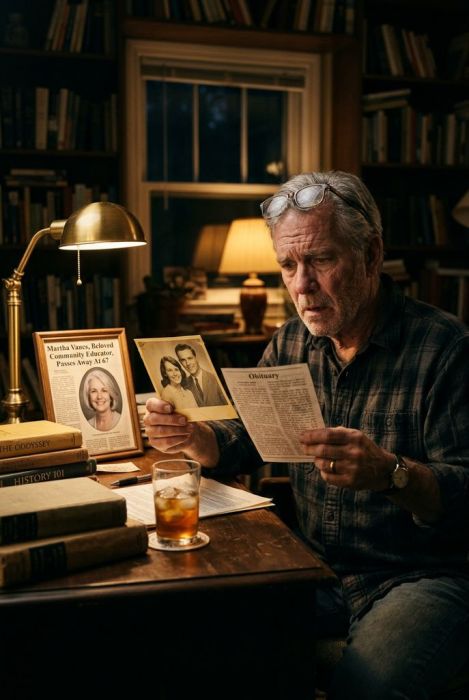
The photograph came to me on a rainy Tuesday in March. A retired farmer's widow had donated a box of yearbooks from the old Mercer Falls High School, and I was sorting them in the basement archive when a loose black-and-white photo slid out of a 1965 volume. Two teenage girls on a porch swing, feet dangling, heads tipped together, smiling like the world owed them nothing. On the back, in a looping schoolgirl hand, someone had written: "Mimi & me, Reno, 1964."
I turned the photo over and felt the hair stand up on the back of my neck. The girl on the left. I knew that smile. I had stared at Marguerite Ellison's donor portrait long enough to memorize the exact curve of it, the way her mouth tilted higher on the left side, the way her eyes crinkled before the laugh landed. It was her face, thirty years younger, on a porch swing in Reno, Nevada, in 1964.
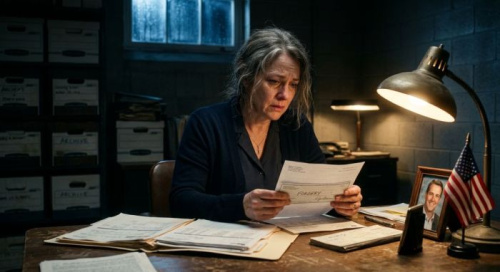
Now, I am not the sort of man who jumps to conclusions. I spent my entire career teaching teenagers that evidence matters, that you check your sources, that correlation is not causation. So I did what I always did. I checked my sources. I sat in the archive with the town's one ancient computer and I searched for Miriam Vance, Reno, Nevada. It took me two nights and three different spellings, and when I finally found the obituary in a Reno newspaper archive from April 2004, I had to read it three times. Miriam "Mimi" Vance, 58, died peacefully in a Reno hospital after a long illness. No children. Survived by a sister, Ruth Ann Vance, of Eugene, Oregon. Memorial services private.
I stared at the screen for a long time. Miriam Vance died in April 2004. And in April 2004, according to a Nevada news archive I found the same night, a fugitive named Darla Whitfield had vanished without a trace. Darla Whitfield, forty-six, former bookkeeper for the Silver State Children's Foundation in Las Vegas, wanted for embezzling one point eight million dollars from a fund that paid for sick kids' treatment. The archived booking photo from her 1998 arraignment showed a hard-eyed woman with dark hair and a bruised jaw. It wasn't the same face as the girl on the porch swing. It was the same face twenty years later. Same eyes. Same tilt of the smile, higher on the left.
I didn't sleep that night. I sat at my kitchen table with the photo and the obituary printout and the booking photo, and I laid them out like evidence in a trial I couldn't stop imagining. The friend, Mimi, who died alone in 2004 with no one to claim her. The embezzler, Darla, who vanished the same month Mimi died. A dead woman's birth certificate. A dead woman's social security number. And then, years later, a new name. A new town. A new life as a generous widow who just wanted to give back.
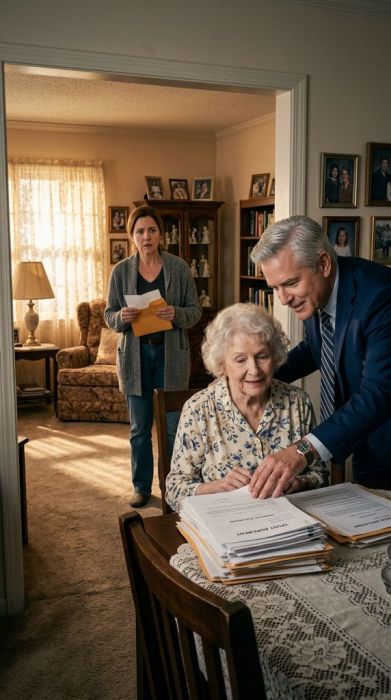
I wanted to be wrong. I wanted it more than I have ever wanted anything. So I kept digging, and the digging made it worse. The five hundred thousand dollars Marguerite donated to the library didn't come from her late husband's estate. It came from a wire transfer out of an account held by something called the Wings of Hope Foundation, a charity Marguerite herself had registered in Delaware three months before she moved to Mercer Falls. The foundation had no website, no office, no employees, and a mailing address that was a UPS store mailbox in Scranton. And yet Marguerite had been collecting donations for it all over town, promising a new senior wellness center that never seemed to break ground. My neighbor Janet had given her eight thousand dollars, her late husband's pension money, after Marguerite promised her nine percent returns and a seat on the foundation board.
I had a decision to make. I could confront her, accuse a beloved saint of a crime I couldn't prove, and watch the whole town turn against me. Or I could do the one thing I was trained to do my entire life. I could check my sources all the way to the end.
So I called Marcus Cole.
Marcus was my student in 1998, the kind of kid who read ahead in the textbook and argued politely about the Battle of Gettysburg. He went to law school, joined the FBI, and now he works financial crimes out of the Philadelphia field office. I called him on a Friday afternoon, told him I had something strange, and asked if he remembered the Darla Whitfield case. There was a silence on the line long enough to hear Philadelphia traffic. Then Marcus said, quiet and careful, "She's been gone nineteen years, Mr. Hartley. What do you have?"
I told him about the photo. I told him about the obituary. I told him about the Wings of Hope Foundation, and the six hundred thousand dollars I estimated she had collected across three counties, and I told him I could get him a fingerprint. He laughed, the way you laugh when you're afraid something might actually be true. "I'll drive up," he said. "Don't tell anyone. Not even your neighbor."
The next nine days were the longest of my life. I made copies of everything, but I didn't hide the originals—I did the opposite. I kept the photograph in my desk drawer, and I put the 1965 yearbook back on the donation cart where I found it, because the truth had survived fifty years in a stack of old books, and I figured it could survive a few more days. Marcus came up on a Tuesday with two other agents. He lifted Marguerite's fingerprints from the donor plaque with a little brush and powder, and he lifted the wine glass I collected after the board dinner, the one she'd handed back to me with a smile and a thank-you, Benjamin, you're such a dear. The prints matched. They matched the 1998 fingerprints of Darla Whitfield, wanted in Nevada for embezzlement, and they matched a second set of prints on file under an alias she'd used in Arizona in 1995. She had been running for a long time. Running with a dead woman's name.
The plan Marcus made was beautiful and cruel, and I have never once felt guilty about it. Marguerite was to receive the key to the city at the library's grand reopening gala, the greatest triumph of her stolen life. The mayor would crown her in front of every important person in Mercer Falls, with two television crews and the local paper and a hundred and fifty neighbors who thought she was a saint. And at that exact moment, at the height of her glory, the FBI would arrest her in front of all of them. Marcus called it the publicity angle. I called it karma, and I have never been more certain of anything in my life.
The only part that scared me was Janet. I had to tell her enough to keep her quiet, and I had to get her to confess that Marguerite had pressured her into the pension investment. Janet cried on my shoulder for an hour, then she played me the recording she'd made on her phone, the one where Marguerite told her not to tell anyone, especially not that nosy teacher across the street, because some people just want to tear down good things. I thanked God for Janet's distrust and her habit of recording every phone call, which I had spent two years teasing her about. She kept the recording, and she didn't tell a soul, not even her sister.
The night of the gala arrived on a warm June evening, the same kind of evening as the photograph on the porch swing, sixty years and a thousand miles away. Marguerite wore sapphire blue. She looked like a queen, and the town treated her like one. She cut a ribbon. She posed with the mayor. She gave a speech about second chances and the goodness of small towns, and I will tell you honestly, watching her, I almost believed her. That's how good she was. That's how good she had always been. The key was presented at eight-fifteen, and the crowd's applause filled the new atrium like a wave.
Then Marguerite looked up, and I saw her eyes find the far door, and I saw her smile change by half a degree. Marcus Cole was walking toward her, flanked by two agents who had been standing near the punch bowl. He had his badge out, held low at his side, the way you do when you don't want a scene. But Marguerite knew. Twenty years of running had trained her for this exact second. She took one step backward, toward the children's wing, and then she looked at the exits and found them full. Police officers in dress blues, the ones I'd been told were there for crowd control, had quietly filled every door.
"Marguerite Ellison," Marcus said, and his voice carried in the sudden silence, "or should I say Darla Whitfield, you are under arrest for identity theft, wire fraud, and elder exploitation."
Somebody gasped. Somebody dropped a glass. The mayor's microphone was still live, because nobody had thought to turn it off, and it carried every word. Marguerite looked at me. That was the part I didn't expect. In all my imagining, she never looked at me. But she did, and for a second, I saw something behind the saint's mask. Not fear. Astonishment, maybe. The look of a woman who had burned every bridge behind her for twenty years and never once imagined that an old teacher in a small town would be holding the match.
The handcuffs clicked. The room erupted. The television crews pushed forward, and the last thing I heard before the chaos was Janet's recorded voice, playing over the PA system because someone had hit the wrong button on the soundboard, saying, "Marguerite, I don't understand, you told me nine percent. You told me it was safe."
She was convicted seven months later in federal court in Scranton. Darla Whitfield, also known as Miriam Vance, also known as Marguerite Ellison, pled guilty to identity theft, wire fraud, and one count of elder exploitation. The judge sentenced her to twelve years. The ledger the FBI found in her safe deposit box listed investors from three towns, seventy-three names, more than two million three hundred thousand dollars. Most of it came back from an offshore account, frozen by court order before she could move it, and I've always taken a private pleasure in knowing that her greed is what saved the money. She was waiting for the gala donations to push the balance higher before she fled. She waited one day too long.
The children's wing of the Mercer Falls Public Library is named for Miriam Vance now. Her sister, Ruth Ann, came from Oregon for the dedication, a tiny gray-haired woman who held my hand and said that Mimi would have loved the light in that room. The Wings of Hope Foundation was dissolved, and its recovered money was given to a real literacy program. Janet got her eight thousand dollars back plus interest, and she tells everyone who'll listen that she has retired from investing, permanently.
I still have the photograph. It sits in my desk drawer, wrapped in the same wax paper, and sometimes I take it out and look at the two girls on the porch swing in Reno, 1964. One of them grew up to spend her life helping sick children, and died alone in a hospital with no one to claim her. The other grew up to steal her name. I like to think that somewhere, somehow, Mimi knows that her name finally means something good again.
As for the 1965 yearbook, I put it back on the donation cart, and someone bought it at the used book sale for a dollar. I think about that sometimes. That somewhere out there, a stranger is holding that book, and if they ever look close enough, they'll find the same loose photograph, and they'll wonder. That's the thing about the truth. It doesn't need to be loud. It just needs to wait. It waited fifty years for me, and I was honored to be the one who finally looked.