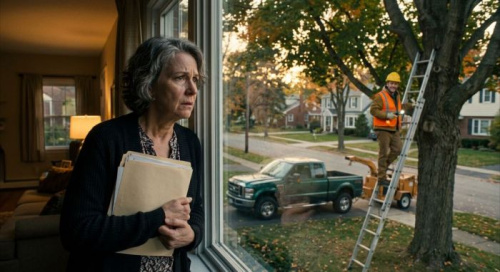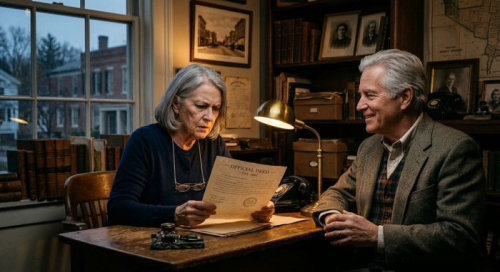
Three nights after Hazel finally whispered his name to me in the dark, I was still sitting at the kitchen table with the porch light on and the coffee gone cold. I had filed the report. I had spoken to the principal. I had listened to every single person in Ridgeline, Ohio, tell me that I was wrong, that he was a saint, that my thirteen-year-old daughter had a crush and an overactive imagination. That third night, Mrs. Okafor knocked on my door at eleven o'clock carrying a cardboard box that smelled like mothballs and old paper. "I've been waiting nineteen years for somebody to ask," she said. "I just didn't know it would be you."
My name is Lena Marsh. I'm an ER nurse, a single mother, and up until that spring I would have told you that my daughter Hazel and I had the kind of life you read about in the feel-good section of the paper. We had a little house on Ash Street with a porch that needed painting. We had a freezer full of casseroles from people who still remembered my husband, who died in a mill accident when Hazel was four. We had each other, and in a town of nine thousand people, that counted for a lot. What we also had, like everyone else in Ridgeline, was a deep and almost religious faith in one man: Ethan Hartley, the seventh-grade English teacher at Ridgeline Middle School.
Everybody loved Hartley. The man was a local institution. He'd been at the school for twenty-two years, and he taught with a kind of theatrical charm that made parents feel like their kids were in the hands of a genius. He wrote little notes on report cards in fountain pen. He remembered birthdays. He ran the after-school creative writing club, and every June he directed the spring pageant that the whole county came to watch. He was married to a sweet woman named Diane, taught Sunday school at the First Methodist Church, and had won Teacher of the Year three times. When my daughter came home in September saying that Mr. Hartley had picked her essay out of a hundred to read aloud at assembly, I practically floated to work that night. I thought she'd won the lottery. I didn't know she'd been chosen for something else entirely.
Hazel changed slowly, the way water changes a riverbank. At first I told myself it was just being thirteen. She stopped talking at dinner. She started wearing her brother's old hoodies even in the warm afternoons. She took to sleeping with the lamp on and her door cracked, and more than once I found her sitting on the floor of her closet with earbuds in, staring at nothing. Her grades didn't exactly fall, because Hazel was too bright for that, but the sparkle went out of her essays. The stories she used to write about dragons and spaceships turned into sad little poems about silence and secrets, and when I asked about them she'd shut the notebook and say, "It's nothing, Mom."
I want to be honest about what I did and didn't do, because I think every parent who reads this has felt the same guilt I felt. I asked. I asked over and over. I asked her pediatrician, who said it was hormones. I asked her school counselor, a nice exhausted woman named Mrs. Price, who said Hazel seemed "a little stressed" and recommended a study group. I even asked Hazel's best friend's mother, Karen, at the grocery store, and Karen just laughed and said, "Oh, they all get dramatic at that age. She'll snap out of it." So I did what we all do in a town where everyone knows everyone: I told myself they were right, and I waited for the good weather to come back.
The good weather never came. Instead, on a Tuesday night in February, I came home from a double shift at the hospital to find Hazel awake in the dark at two in the morning, sitting on the floor of the hallway with her knees drawn up, her phone pressed against her chest like a shield. She didn't hear me come in. She didn't hear me call her name. When I touched her shoulder, she flinched so hard she hit her head on the wall, and that's when she finally looked at me. I have been an ER nurse for fifteen years. I have held the hands of people dying from things I won't describe here. But I have never seen what I saw in Hazel's eyes that night, because I saw my own daughter looking out from behind a wall she'd built to survive.
What she told me that night, in pieces, with long silences, is not something I'll repeat in detail, because it's hers and not mine to share, and because this story is not about the things evil people do in the dark. It's about what happens when the light finally finds them. But I can tell you this much: she said he told her she was special. She said he asked her to stay after class and read her poetry to him alone, with the door locked. She said he made her promise to keep their "secret club," and that when she tried to pull away, he got cold, and then he got scared, and then he got very kind again, in a way that felt like a threat wrapped in a compliment. The next morning, I called the school and demanded a meeting. I was shaking so hard I had to brace myself on the kitchen counter. The principal, a man named Bell who played golf with Hartley every Thursday, listened to me with a sympathetic face and then told me, almost word for word, that Ethan Hartley was "the finest teacher this school has ever had," and that Hazel had been "struggling with changes at home," and that teenagers sometimes fixate on a teacher and build things up in their heads. He suggested Hazel see the counselor. He suggested I see a counselor too. And he suggested, gently, that I not repeat any of this around town, "for Hazel's sake."
I should have screamed. Instead, I drove straight to the county sheriff's office, because I was an ER nurse and I knew exactly how these stories usually went, and I'd rather be called a hysterical mother by an officer than read my daughter's name in a newspaper someday and know I didn't try. A deputy took my statement with a long, uncomfortable silence, and then a detective called me back three days later to say that without corroboration, without physical evidence, and with the child refusing to speak to their counselor about it, there wasn't much they could do. They'd "note the file." They'd "keep an eye on him." They were sorry. They really were. Four months later, the school board voted Mr. Hartley a special award for "tireless dedication to at-risk students," and the town paper ran a photo of him holding a plaque while girls from the writing club surrounded him, beaming. I stood in the checkout line at the grocery store and stared at that newspaper until the cashier asked if I was okay. I said I was fine. I lied to her like I'd been lying to everyone, except that I wasn't lying to myself anymore. I knew what I knew.
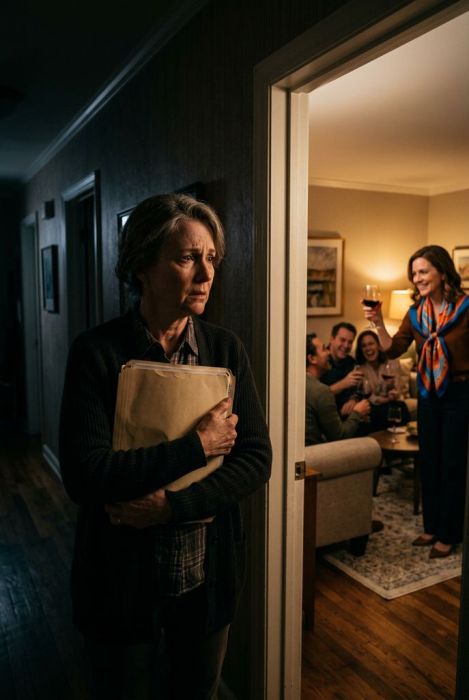
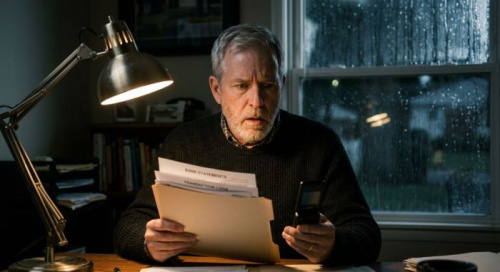
Here's the part where I have to tell you about Mrs. Okafor, because without her this story would have ended the way so many of these stories end: with a closed file, a whispered rumor, and a child who would carry a secret the rest of her life. Beatrice Okafor was the school librarian, sixty-two years old, retiring that spring after thirty-eight years, and she was the only person at Ridgeline Middle School who didn't think Ethan Hartley hung the moon. She watched him the way a hawk watches a field, and for nineteen years, she had kept a box. That's the box she brought to my kitchen at eleven o'clock that night. Inside were the artifacts nobody else had thought to save: a typed list of every girl who'd won Hartley's "creative writing mentorship" since 2006; a stack of poems, all written in the same sad, lonely voice; a yearbook from the year a girl named Clara Wexler disappeared from Ridgeline and was found dead on Buckhorn Road, ruled an accident; and a single page of lined paper with eleven names and dates written in Mrs. Okafor's careful hand. "I knew what I was looking at long before I had proof," she said. "I just couldn't prove it alone. I need you to help me prove it now."
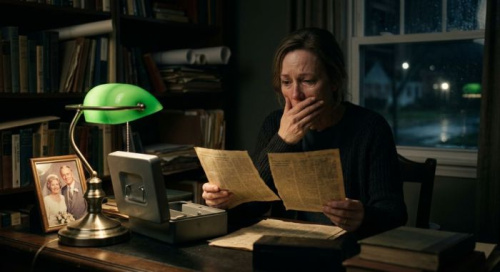
I need to pause here and tell you something important, because I think about it every day. Clara Wexler was seventeen in the fall of 2005. She was Hartley's student, his star pupil, the girl who read her poetry at the county fair and made grown men cry. She died on a rainy Friday night when her car went off Buckhorn Road, and everyone in Ridgeline wept for the brilliant girl taken too soon. Her mother, Dorothy, sat in the front pew at the funeral while the whole town filed past, and nobody ever asked her the question she was dying to answer, which is what her daughter was doing on Buckhorn Road at midnight with her phone full of deleted messages. Dorothy asked. Of course she asked. She took a folder of her daughter's journals to the sheriff's office in 2006 and was told that teenagers keep secrets and that an accident is an accident. Clara had kept a diary, and in the last twelve pages she had written about a teacher who made her feel like the only person in the world, and about the promise she'd made to protect them both, and about wanting to disappear. Dorothy kept the diary. Nobody ever read past page one.
Mrs. Okafor and I put the box on my kitchen table, and like two idiots with our hearts resting on a stack of paper, we started comparing the names. Yolanda, transferred to Columbus in 2008, never graduated. Brittany, 2011, dropped out and moved to Toledo. Amber, 2014, hospitalized senior year for "exhaustion," then homeschooled. Jessica, 2016, quietly changed schools and never spoke to anyone from Ridgeline again. Maya in 2019. Priya in 2021. And my Hazel, the name at the bottom of the list, written in Mrs. Okafor's hand three weeks before she ever knocked on my door. Nineteen years. Eleven girls. One beloved teacher in the middle of all of it, like a spider in the center of a web so clean you couldn't see it unless you were looking for it. I was looking now.
That's when we went to Detective Angela Reyes, and that's where the story turns, the way these stories almost never turn, because Angela Reyes was new to the county, had transferred up from Cincinnati, and had nothing invested in the legend of Ethan Hartley. She listened to us for two hours without interrupting once. Then she pulled out a manila folder and told us that Clara Wexler's case had been quietly reopened six months earlier when her mother wrote a letter to the state attorney general, and that the accident reconstruction had always looked wrong to the cold-case unit. She had Clara's old flip phone in evidence, recovered from the car, and a forensic examiner had pulled twenty-one deleted text messages from it that nobody in 2005 had ever had the technology to see. She had a pattern. She had a box of poems. And now she had a daughter willing to tell the truth on the record, which is the rarest and bravest thing a child can do. Detective Reyes looked at me across her desk and said, "In my whole career, I've only had three cases where the evidence walked in the door like this. We're going to need you and Hazel to be patient. And we're going to need you to keep the box safe. But we're not going to lose this one."
What happened next took five months, and I will spare you the paperwork because you didn't come here for paperwork. A second victim, now twenty-six and living in Illinois, came forward the week the detective called her, because nothing restores a person's voice like knowing they're not alone. A third, now a mother of two in Michigan, consented to a recorded interview. The school district, suddenly very interested in cooperating, handed over twenty-two years of Hartley's lesson plans, and in those plans Detective Reyes found a pattern the man himself had kindly typed out for us: the same essay prompt, assigned to one student at a time, in a locked classroom, every single year. "Write about the secret you have never told." I still get cold when I think about that prompt. I get cold and I get angry, and I have learned to live with both of those things.
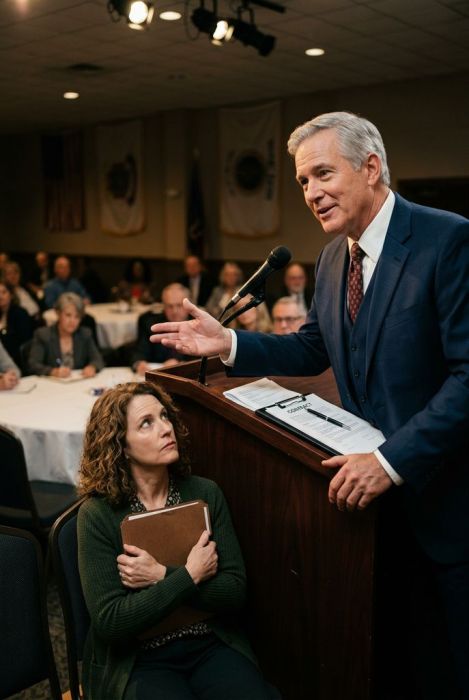
The arrest happened on a Friday night in May, at the county's annual Teacher of the Year banquet, in the ballroom of the Ridgeline Fairgrounds, in front of four hundred people and the local news cameras. Ethan Hartley had just accepted the state's top award for excellence in education. He was at the podium, holding the crystal globe aloft, telling a joke about grading papers on Sundays, when Detective Reyes walked down the center aisle in her plain clothes and badge, with two uniformed troopers fanning out behind the head table. From table four, I watched his face go through all the stages in about six seconds: confusion, irritation, a polished smile, and then the dawning horror of a man who understands, in front of four hundred witnesses, that the performance is finally over. He turned to walk toward the side door, and the troopers were already there. The globe hit the carpet and rolled under a table of untouched salads. They read him his rights in the middle of the standing ovation that never happened.
I'm not going to pretend the whole town turned on him overnight, because that's not how people work, and you deserve the truth. For the first two weeks, half of Ridgeline did exactly what I did when the principal smiled at me and told me to calm down: they refused to believe it. There were letters to the editor. There was a group that raised money for his legal defense. His wife, Diane, who I genuinely believe had no idea what her husband was, threw away his award photos and moved to her sister's in Dayton. And then the preliminary hearing happened, and Detective Reyes unrolled the evidence in a way I still think about late at night: the texts from 2005, read aloud in a courtroom; the lesson plans, entered as exhibits; the poem Hazel had written in February, and the poem a girl from 2008 had written, sitting side by side on an evidence screen, identical in the terrible way that only fear can be identical. You could hear the air leave that courtroom. The defense fund website came down that same night.
The charges were fourteen counts involving nine students over seventeen years. Ethan Hartley sat in an orange jumpsuit at his arraignment and looked, for the first time in his life, exactly as small as he always was. His lawyer floated a defense of false memory, a term that made me want to climb over the rail, but the prosecutor never even had to argue it, because three of the survivors had kept physical proof: letters he'd written them, gifts he'd given them, a voice recording one brave girl made at a writing conference in 2018, in which you can hear him, in his warmest mentor voice, telling her to keep their meetings "just between us." That recording, played once in a conference room with the door closed, is the reason I never had to watch my daughter testify. Five months after his arrest, with a deal on the table that would mean he could maybe, maybe see freedom in his nineties, he pled guilty to eleven counts and was sentenced to thirty-two years in a state prison, followed by lifetime registration and the loss of his teaching license, his pension, and every single one of the trophies he'd collected like they were proof of his goodness.
Here's what I want you to know about the week after that sentence, because it's the part they don't put in the news. Dorothy Wexler, Clara's mother, stood up at a school board meeting three weeks after the trial and read a letter her daughter wrote in 2005 that the school never saw, a letter Clara wrote but never mailed, half apology, half cry for help. She read it without breaking, and when she finished, the board voted to strip the Hartley Award that had hung in the middle school lobby for fifteen years and rename it the Clara Wexler Memorial Scholarship, funded in part by the town that had failed her. The library was renamed the same week, in the same meeting, and they asked Mrs. Okafor to come out of retirement to cut the ribbon, because if anyone deserved the ribbon it was the librarian who kept a box for nineteen years and never stopped watching.
Hazel is fifteen now. She still sleeps with the lamp on, and she still writes poems, and she has a therapist she actually likes, a woman named Dr. Singh who specializes in trauma in adolescents, which I only found out about because Hazel asked for her specifically. She testified in front of a grand jury at sixteen years old, and when she came out, Detective Reyes hugged her for a very long time, and I stood there trying to remember to breathe. Hazel is going to graduate from the school where it happened, because she decided she wasn't going to let him take that from her, and I think that's the bravest thing I've ever seen a human being do. Last month she told me she wants to be a counselor when she grows up, "for kids like me," she said, "so they know they can say it out loud and somebody will believe them the first time." I cried in the car. I cry a lot in the car these days, but it's a different kind of crying than it was two years ago.
I keep the box now. Mrs. Okafor gave it to me the day she retired, and I have it on the top shelf of my bedroom closet, next to the photo of my husband, and I take it down exactly once a year, on the anniversary of the sentencing, and I hold it for a minute and put it back. I don't do it to relive anything. I do it to remind myself what a single person moving quietly can do: a librarian who noticed, a mother who kept a diary, a nurse who didn't stop asking, two women who met at a kitchen table with a box of poems and decided, together, that a town's beloved legend was not bigger than the truth. People ask me all the time, in the checkout line and at the church potluck, how I'm doing, and I always say fine, because it's true now. The best part of the story isn't the arrest or the sentence. The best part is that the girls who were told to keep secrets for twenty years stopped keeping them, and the town that refused to see finally did, and my daughter sleeps in her own room with the door closed and a future ahead of her. They say justice is blind. I think it just takes its time. And when it finally opens its eyes, it sees everything at once.