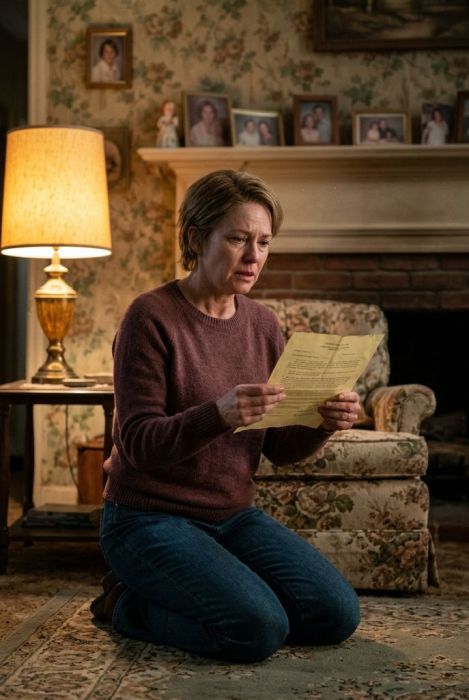
The deputy stood on my mother's porch with his hat crushed in one hand, and I knew before he opened his mouth that something had slipped away. "Ma'am," he said, "I'm sorry. I've got to serve this." It was an eviction notice, addressed to Ruth Drayton, my mother, seventy-eight years old, the woman who had owned the little yellow house on Sycamore Lane outright for forty-one years. The property, the notice read, now belonged to a company called Evergreen Home Equity, and the occupants had seventy-two hours to vacate. I laughed, loud and ugly, because it was absurd. Then I read the second page, and the sound died in my throat. There, under a notary's stamp dated April 3rd, was my mother's signature on a deed she swore she had never signed.
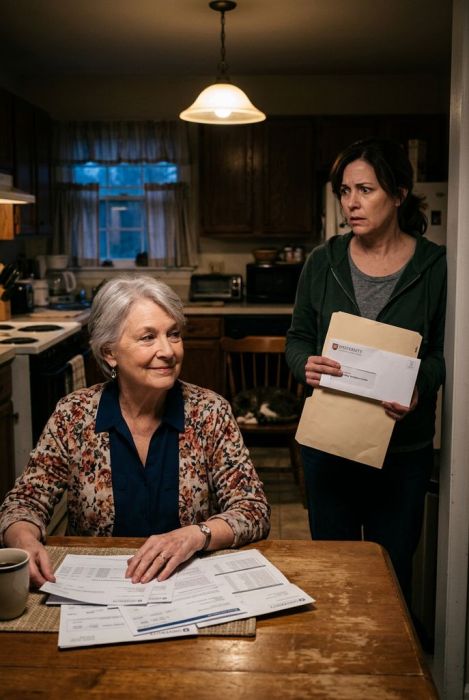
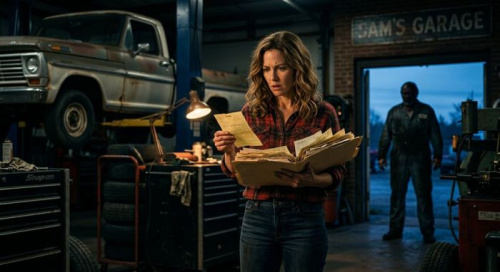
A week earlier I had found the other letter in the basket by the telephone, where Mom kept her coupons, her church bulletins, and the bills she didn't want me worrying about. It was from Evergreen Home Equity, and it said, in the cheerful flat language of a form letter, that her reverse mortgage was in default, that her line of credit had been fully drawn, and that the company was exercising its rights under the Deed of Trust. My mother had never mentioned a reverse mortgage. She had certainly never mentioned owing anyone one hundred and forty-two thousand dollars.
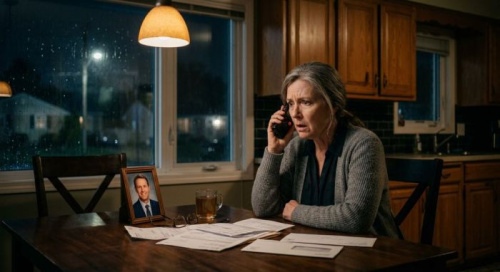
I called the number on the letter that same afternoon. A young man with a gum-crack voice told me the note had been sold, the deed recorded, the occupancy agreement expired. My mother had signed everything herself, he said, willingly, before a licensed notary. "We have the documents, ma'am." He sounded like a game-show host. Click.
I stood in my kitchen in Columbus, two hours from Millbrook, and for the first time in my adult life I understood why old people cry on the phone to customer service. Then I packed a bag and drove home.
Mom met me at the back door with flour on her apron and a brightness in her eyes that made my heart hurt. She was forgetting things now: where she put her keys, the name of the boy who mowed her lawn, the fact that she'd already eaten lunch. But she was not, I would have sworn, a woman who could be talked into signing away her house. "How would you feel about a reverse mortgage, honey?" I asked, careful, the way you test a loose tooth. "A what?" She laughed. "Ellen, I don't even know what that is." I showed her the letter. She read it twice, and her face went the color of dishwater. "I never signed anything like this," she said. "I never would."
But somewhere in Clay County there was a page with her name on it, and the person who put it there had forty-one years of trust to work with. That person was Wesley Kane.
I heard about Wesley Kane long before I met him, because everyone in Millbrook had. He was the silver-haired man in the good suit who ran the free lunch seminars at the VFW hall every third Thursday, talking about home equity the way a preacher talks about salvation. "You've paid for this house twice over, folks," he'd say, and his voice was warm as honey. "You should live off it, not die in it. Our program keeps the house in the family. Nobody can ever take it from you." He said that on tape, at seventeen lunches, and we would have every one of those recordings before it was over.
He'd met my mother at the bingo table at the senior center. He sang in the choir at First Methodist, two rows behind Pastor Bill. He sponsored the kids' fishing derby and paid for the new awning over the pharmacy. He brought my mother a casserole — chicken and rice, in the good glass dish — and ate it with her at this very table, asking about Gary in Arizona, about me, about Dad. He remembered that Dad had been a mechanic. He remembered things my own mother forgot, and she loved him for it.
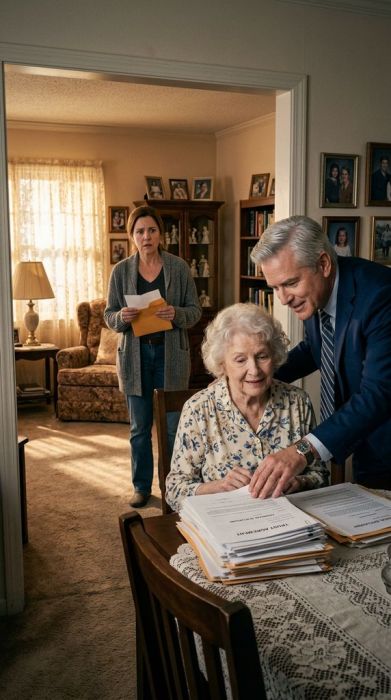
The signing happened on a Tuesday afternoon in April. I know because Mom called me that night, cheerful and proud. "I signed the papers for the new furnace and windows," she said. "That nice Mr. Kane said I qualified for an equity program, and the house stays in the family, and I won't have to pay anything for years. Isn't that wonderful?" "Did you read what you signed, Mom?" I asked. "Oh, honey, it was a lot of pages," she said, and there was something small in her voice. "But Mr. Kane read them all to me while the kettle was whistling."
I hung up with a bad feeling I couldn't name. I called it middle-age paranoia. I did not drive to Millbrook. I did not ask to see the papers. I have to live with that.
The eviction notice arrived seven weeks later. In the seven weeks between my mother's proud phone call and that deputy's crushed hat, Wesley Kane had drained every cent of the hundred and forty-two thousand dollars in nine days, into accounts he controlled, and from there to his own mortgage and a boat slip in Florida. He'd recorded the deed transferring the yellow house to an LLC called Hickory Holdings for "ten dollars and other valuable consideration." He'd had my mother's name signed to a second set of documents she never saw, in front of his own notary, with a signature that looked exactly like hers — because he'd made her practice writing it on a napkin at that first lunch, "for the paperwork," he'd said.
When I started asking questions, Wesley Kane didn't hide. He got taller. He got sadder and kinder and more dangerous. He went to the church ladies with a heavy sigh and told them he was worried about Mrs. Drayton's daughter from Columbus — that she wanted to put her mother in a home and take the house. Pastor Bill took me aside after a Wednesday service. "Ellen, I know you love your mother, but Wes has been a pillar of this community for twenty years." The pharmacist stopped smiling at me. Gary called from Arizona to tell me I was embarrassing him. And then the letter came from Adult Protective Services: I was being investigated, at Wesley Kane's request, for financially exploiting my own mother.
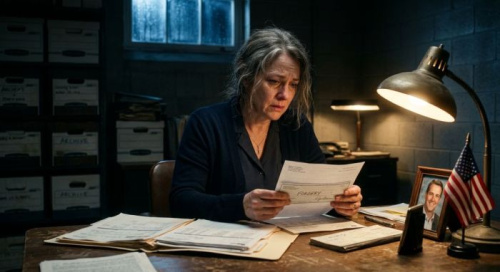
That was the moment something in me went quiet and hard. I stopped being the angry daughter. I started building a folder.
The folder began at the county recorder's office, where I pulled the deed history on every property Wesley Kane's companies had touched. Eleven other houses in three counties had the same shape: a senior, a seminar, a signature on a napkin, a blank page, a notary stamp, an LLC deed, a line of credit drained, and a lease-back that quietly expired. Eleven other families who had smiled at me while their own world was burning.
It was there that I met Stan Ogilvie, eighty-one, a Korean War veteran with a shock of white hair and a handshake like a pipe wrench, fighting his own eviction for a year. "Same company, same house of cards, same silver-haired son of a biscuit," he said. He kept a shoebox of documents, and he also kept something the lawyers had missed. On the first Thursday he'd attended a Kane seminar, suspicious of any man who catered lunch for free, Stan had slipped a little digital recorder into his shirt pocket. He played it for me in the parking lot, and I listened to Wesley Kane promise, on tape, that "this is not a loan, folks — this is equity, and your house can never, ever be taken from you." "Ever, ever," Stan repeated. "Ain't that a peach."
The last piece came from the last person I'd have expected: Nora Delgado, the notary whose stamp sat beneath my mother's signature. Nora was sixty-three, known for thirty years as the town's straight-arrow notary. She'd notarized the April 3rd package believing she was witnessing a refinance. But she'd noticed things, the way straight arrows do: the grant deed page was blank when Mrs. Drayton signed it; the ink didn't match; and every time she raised a question, Wes's paralegal paid her faster, and a little more than her fee. Guilt had been eating Nora for a year. So she'd kept a photocopy of every page she ever notarized for him, in a manila folder she called her second book, in a lockbox under her bed.
The FBI was already there. Special Agent Marlene Cross had been building the file on Wesley Kane for two years, across three counties. She had the seminar recordings. She had a forensic accountant who'd followed the money to the boat slip in Florida. What she needed was final proof: Wesley Kane's own voice, on a clean recording, admitting he'd talked a woman with gauze in her mind into signing away her house. And my mother, God bless her, had just told me she would do anything, anything at all, to get her house back.
The trap Agent Cross set was not elegant. It was better than elegant: it was human. Nora called Wesley Kane and told him, in a shaky voice, that the county was auditing the Drayton file and that she, just a small-town notary, needed him to come to the back office of Evergreen Home Equity and help her tell them the same story, so she didn't mess it up. Wes agreed at once. He loved those moments, the lonely professional, needing him.
Nora wore a wire the way other women wear pearls: one hand steadying it under her blouse, her voice a little too bright. In the van parked behind the hardware store, Agent Cross and two deputies listened to every word. My mother sat in the passenger seat of my car across the street, holding my hand so hard her wedding ring left a mark, while Stan Ogilvie stood sentinel at the corner.
We didn't have to wait long. Wesley Kane walked in with a grease-stained coffee cup and a smile, already rehearsing. Nora began the way they'd rehearsed: nervous, grateful, a woman out of her depth. "I just want to make sure I say it right," she said. "For the audit. Mrs. Drayton signed the loan papers, right? Of her own free will?" "Ruth signed everything," Wes said, and his voice was the same honey that had poured over seventeen free lunches. "She signed the loan papers. She signed the deed. My notary watched her do both. The signature's genuine — that's the beauty of it." "Even the deed transfer to the LLC?" Nora's voice trembled. "Even the page that was blank when she signed it?" Wes laughed. He actually laughed. "Nora, honey, that page was never blank when she signed it. It was blank when I filled it in, after she signed. That's the whole trick. You get the signature first and the words later. Confused ladies never know the difference. Ruth Drayton thought she was fixing her furnace, and she signed the deed to her own house over lunch."
In the van, Agent Cross closed her eyes, exhaled, and whispered into her collar: "We're good."
The door to the back office didn't slam. It simply opened, and Special Agent Marlene Cross stood there in a gray suit, holding up her credentials the way you'd hold up a cross to a werewolf. "Wesley Kane, you are under arrest for wire fraud, bank fraud, and exploitation of a vulnerable adult." Behind her came two deputies, and the back door opened onto the parking lot where the senior center director had set out folding chairs, and eleven homeowners sat in them, watching. Stan told me later that when they marched Wes past the chairs, the man didn't look up once. "He looked at his shoes the whole way, like a boy caught with his hand in the register. Only the register was eleven houses."
My mother did not cheer. She watched from the curb, and then she said, so quietly I almost missed it: "Well. I guess he wasn't so kind after all."
That was the whole thing, I realized. Kind. We trusted him because he was kind, and he was kind the way a fisherman is kind to a worm: gently, patiently, with total confidence in the ending. The ending, as it turned out, belonged to us.
Wesley Kane pleaded guilty to federal charges. His bond was denied when the FBI produced the boat slip keys and a passport in a false name. The LLC's assets were frozen, then forfeited. The deeds were voided in civil court, one by one, under an old law that says you cannot take what was never honestly given. Ruth Drayton's house went back into her name. The hundred and forty-two thousand dollars evaporated like steam off morning coffee.
Stan Ogilvie went to the courthouse on a Tuesday to watch his house be restored to him. When the judge banged the gavel, the courtroom burst into applause, and Stan stood up and said, "Thank you, Your Honor," and for the second time in his life, half the room saluted him.
The church held a potluck, and Pastor Bill, humbled and gray, asked me to say a few words. I stood up and said, "My mother taught me that forgiveness is a gift you give yourself. But she also taught me that the truth is a gift you owe the world. Wesley Kane counted on our town being too polite to open the folder. We opened it. That's all. We just opened the folder."
And it was that simple, in the end. That terrifying, that simple.
The county started a senior fraud-prevention council. Stan is the chairman. Nora Delgado teaches a class now, called Before You Sign. My mother still lives in the yellow house, and she still forgets where she put her keys. But she also has a calendar with a red circle around the third Thursday of every month, and it's not for the seminar. It's for bingo.
And me? I moved my classroom materials into the guest room. I drive to Columbus three days a week and come home to Millbrook the other four. It's not the life I planned at fifty-two. But it's the life I chose, with both eyes open, and I would choose it again.
The last time I saw Wesley Kane, he was being walked across that parking lot in a raincoat, and he looked smaller than the man at the lunch table. The warmth had leaked out of him, and what was left was just a man holding his own hands, watching his shoes.
That's the thing I've come to understand about men like Wesley Kane. They are kind the way a wolf is kind, patient and gentle and full of terrible certainty, right up until the door closes. But doors open, too. That's the part they never seem to figure out.
On Sunday mornings now, Sycamore Lane smells like cinnamon, and nobody knocks with folded papers anymore. And when a new stranger shows up at the senior center with a free lunch and a folder full of promises, somebody always walks over and says the same thing. "Before you sign anything, sweetheart — call my daughter. She keeps a folder."