The man fell four stories and hit the concrete with a sound I will never forget. It was wet and hard, like a bag of cement dropped from a roof. I was standing near my car on the third level of the Stark Street parking garage, fumbling for my keys, when I heard the yelling. Two men. Arguing. One voice pleading. The other voice calm, almost bored.
I looked up just in time to see the push. The smaller man went over the railing without a scream. He just disappeared. The other man stood there for a moment, adjusting his jacket like he had just finished a business handshake. Then he turned and walked toward the stairwell without looking down.
My hands were shaking so badly I dropped my keys twice before I could call 911.
"My name is Frank Delaney," I told the dispatcher. "I'm at the Stark Street garage, third level. A man was pushed. I saw it. I saw the whole thing."
When the police arrived, I gave them everything. I described the man in detail. Six feet tall. Broad shoulders. Dark gray suit. Salt-and-pepper hair. Late forties. Calm demeanor, like he had done this before. I told them which direction he walked. What car I was driving. My license, my phone number, my home address. I wanted to help.
I had been a history teacher for thirty-five years at Cleveland High School in Portland, Oregon. I believed in doing the right thing. I believed the system worked.
Three days later, two detectives showed up at my front door.
Sylvia was in the kitchen making meatloaf. She had the radio on, some old Sinatra song. When she saw the detectives standing on our porch, she turned the radio off so fast the silence felt violent.
"Frank Delaney?" the older one said. He was maybe fifty-five, sharp suit, tired eyes. Badge number 2471. Detective Paul Morrison.
"That's me."
"You need to come with us, sir."
"What for?" Sylvia asked from behind me. Her voice was already breaking.
Detective Morrison didn't look at her. He looked at me. "We'd like to ask you some questions about the death of Arthur Phelan."
"That's the man I saw pushed. I gave my statement already."
"I'm aware, sir. Please come with us."
I thought it was routine. More questions. Maybe a lineup. I told Sylvia I'd be back in an hour. She kissed my cheek and told me to grab a jacket because it was getting cold.
They didn't take me to the station. They took me to an interrogation room with a metal table and a one-way mirror. Morrison sat across from me. A younger detective I hadn't met stood by the door with his arms crossed.
"Mr. Delaney," Morrison said, sliding a photograph across the table. It was a man's wallet. Brown leather. "Do you recognize this?"
"No."
"Your fingerprints are on it. We found it in your garbage can this morning."
My blood went cold. "That's impossible."
"Is it? You told the responding officer you were on the third level. The victim, Arthur Phelan, was on the fourth level. He was pushed from the fourth level. You said you saw a man in a gray suit push him. But here's what doesn't add up —"
He leaned forward and placed both palms flat on the table.
"Your car was parked on the fourth level, Mr. Delaney. Not the third. The garage attendant confirmed you entered at 8:14 PM and that your parking ticket was stamped for the fourth floor."
"I parked on the fourth floor, but I walked down to the third to —"
"To what?"
"To check my tire. I heard a thumping on the drive over. I thought I had a flat."
Morrison smiled. It was not a friendly smile. "Your tire pressure was fine. We checked."
"Because the thumping stopped! Look, I walked down to see if my tire looked low, and that's when I heard the shouting. I looked up and saw —"
"You looked up. From the third floor. And you saw a man push another man off the fourth floor railing."
"Yes."
"In the dark. From a different level. Through concrete pillars."
"I saw what I saw."
Morrison pulled out a second photograph. It was a close-up of the victim's hand. A gold wedding band with an engraving inside. "Arthur Phelan was a real estate appraiser. He was hired by the city to evaluate the Sterling Development Group's new waterfront project. You know what he found?"
I shook my head.
"He found that Richard Sterling — the developer — had bribed two city inspectors to approve substandard materials. Phelan was about to testify before a grand jury in two weeks."
"I don't know anything about that."
"No. Of course not." Morrison stood up. "Here's what I think happened. I think you knew Phelan. I think you had some kind of arrangement. And when he decided to cooperate with the grand jury, you decided to silence him."
"You're insane."
"Am I? You were at the scene. Your prints are on his wallet. Your story changes every time you tell it. And we found a cash deposit of fifteen thousand dollars in your savings account — deposited yesterday afternoon."
Sylvia and I had thirty-eight thousand dollars in savings. We had been saving for a new roof. I had never deposited fifteen thousand dollars in my life.
"I didn't deposit that money."
"Someone did. Using your bank card. At a branch near your house."
"I didn't do this. I'm being framed."
Morrison looked at me for a long moment. Then he slid a piece of paper across the table.
"You're being charged with the murder of Arthur Phelan. You have the right to remain silent."
The next six weeks were a waking nightmare.
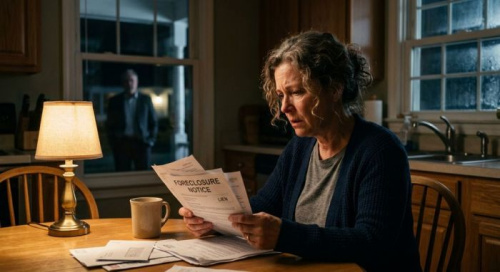
Sylvia had to take out a second mortgage on the house to pay for my bail and legal fees. My lawyer, a nervous young man named Jeffries who specialized in DUIs, told me the evidence was circumstantial but damaging. The DA was offering a plea deal. Fifteen years for manslaughter.
I refused.
My name was in every local newspaper. PORTLAND TEACHER CHARGED IN WATERFRONT KILLING. Former students from thirty years ago were quoted saying things like "He always seemed like a nice guy" and "You never really know a person, do you?" One of my neighbors stopped returning Sylvia's calls. Another put their house on the market.
Sylvia never wavered. She brought me folders of articles she had printed. She called every lawyer in the yellow pages. She told me every night that she believed me.
But I started to doubt myself. That's the thing about gaslighting on a professional scale. When a detective, a district attorney, and the entire court system tell you you're guilty, part of you starts to wonder if maybe you really did do it. Maybe you blacked out. Maybe you're losing your mind.
Sylvia found Martha Cruz in the Oregon Bar Association directory. Martha was sixty-three, a former homicide detective who had retired and become a private investigator. She had gray hair cut short, reading glasses on a chain around her neck, and the patient, skeptical eyes of someone who had been lied to by experts.
She took my case for half her usual rate because, as she put it, "Something about this smells like a police station where nobody mopped the floor."
Within two weeks, Martha found the crack in Morrison's story.
"Richard Sterling and Paul Morrison were roommates at the University of Oregon," she told me, sitting in my living room with a manila folder spread across the coffee table. "Class of 1992. They were in the same fraternity. Delta Tau Sigma."
Sylvia gasped. I closed my eyes.
"That's not all," Martha said. "Morrison has made sixty-two thousand dollars in the last six months from a company called Sterling Consulting Group. That's Sterling's shell company for bribe payments."
"But that's — that's evidence. That proves he's corrupt."
"It proves he's financially connected to Sterling. It doesn't prove he framed you. We need something more."
She found it on a Tuesday afternoon.
There was a traffic camera at the intersection of Stark and Third, two blocks from the parking garage. It recorded continuously, overwriting every seventy-two hours. But Martha discovered that the camera had been malfunctioning on the night of the murder. The footage had been flagged for review by the city's transportation department. Nobody had bothered to check.
Martha got a court order. The footage showed everything.
Richard Sterling's black Mercedes pulling out of the garage at 8:47 PM. The license plate was clear. The time stamp was clear. The driver's face was partially visible through the windshield — enough for an expert to identify.
And directly behind Sterling's car, pulling out of the same garage twenty seconds later, was a dark blue department-issued Ford Explorer.
Detective Paul Morrison's car.
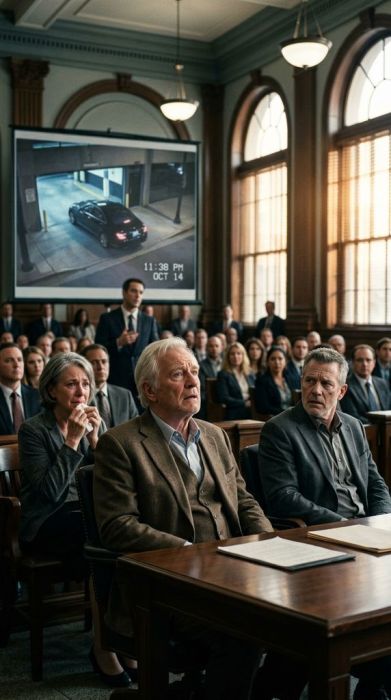
The preliminary hearing was held in Room 307 of the Multnomah County Courthouse. The room was packed. Sylvia sat in the front row, clutching a tissue. Behind her, I saw faces I recognized — former colleagues, former students, neighbors who had stopped returning my calls.
Sterling sat at the defense table with three lawyers in expensive suits. He looked calm. He looked bored. He looked exactly the way he had looked after pushing a man off a parking garage.
Detective Morrison sat in the witness box, his hands folded, his expression neutral.
My new lawyer, a bulldog named Harriet Walsh who Martha had recommended, approached the bench.
"Your Honor, the defense would like to introduce Exhibit C — traffic camera footage from the intersection of Stark and Third, recorded on the night of September 14th."
The DA objected. The judge overruled.
The footage played on a large screen. You could see Sterling's Mercedes exit the garage. You could see it pause at the stop sign. You could see the driver's face.
And twenty seconds later, you could see the police Explorer.
"Detective Morrison," Walsh said, "can you explain why your vehicle was exiting the same parking garage as the defendant's vehicle, twenty seconds apart, at the time of the murder?"
Morrison's face went gray. "I was in the area."
"You were in the parking garage. At the same time as the man who pushed Arthur Phelan to his death."
"I didn't know Sterling was there."
"You didn't know your former college roommate and current business partner was in the same garage as a murder victim?"
The courtroom erupted. The judge banged his gavel. Sterling's lawyers were on their feet, shouting objections.
But it was too late. The dominoes had started falling.
Over the next three weeks, the DA's office opened an internal investigation into Detective Morrison. His financial records were subpoenaed. Three more witnesses came forward — tow truck drivers, garage attendants, people who had been intimidated or paid off.
Sterling's own assistant, a woman named Carol Meecham, testified that she had seen Sterling leave the office early on the night of the murder. "He was wearing a gray suit," she said. "He told me he had a meeting. But I knew he was lying. I'd worked for him for twelve years. I knew when he was lying."
On a cold November morning, the jury returned its verdict.
Richard Sterling: guilty of first-degree murder.
Paul Morrison: guilty of conspiracy to obstruct justice, evidence tampering, and official misconduct.
And Frank Delaney: innocent on all charges.
The judge apologized to me from the bench. The DA shook my hand and said he was sorry. The Portland Tribune ran a front-page story with the headline: "THE TEACHER WHO WOULDN'T BREAK."
Sylvia and I walked out of the courthouse into the gray Oregon light. Reporters shouted questions. Cameras flashed. I held up my hand and said nothing.
We drove home in silence. When we pulled into the driveway, we saw that someone had taken down the For Sale sign from the neighbor's yard. Our next-door neighbor, Betty Kowalski, was standing on her porch with a casserole dish in her hands.
"I made too much lasagna," she said.
I started crying. I couldn't help it.
Sylvia put her arm around me and led me inside. The house smelled like home. The meatloaf she had been making the day they arrested me was long gone, but she had made a new one. It was sitting on the counter, still warm, covered in foil.
We sat down at the kitchen table. Sinatra was playing again on the radio.
And for the first time in two months, I felt like myself again.