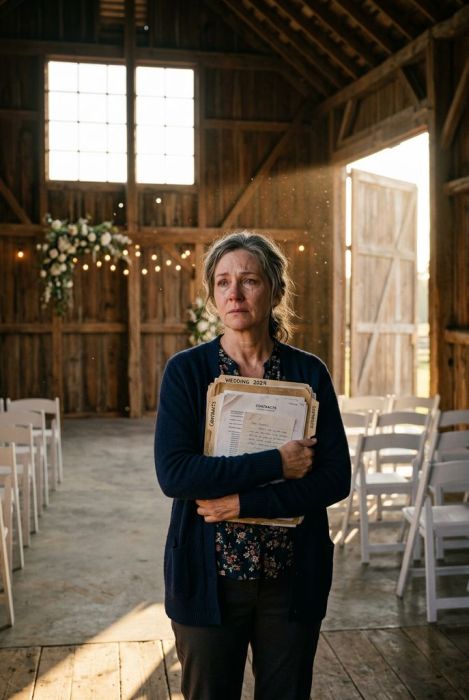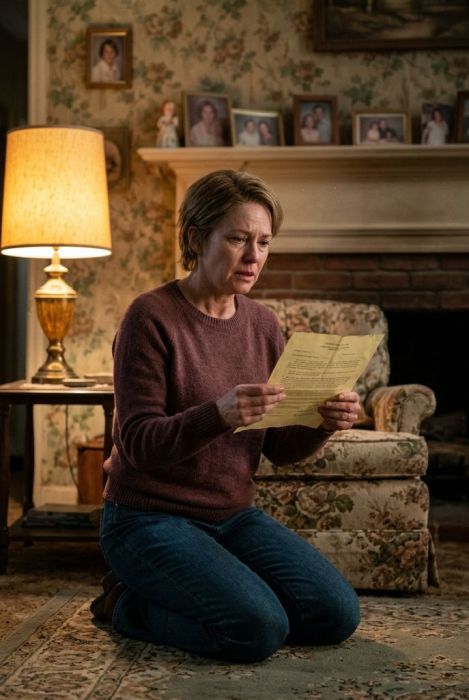
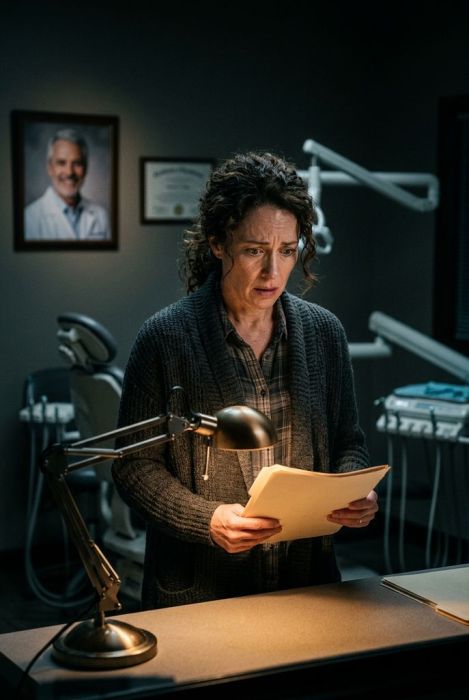
The day I found the chart note, I was kneeling beside a recycling bin in the break room of Prescott Family Dental, and I had to read the scrap of paper four times before my hands would stop shaking. Everyone in Hawthorne, Ohio, called Dr. Owen Prescott the man who built our smiles. He'd been fixing teeth in our town for thirty years, and we'd believed every word he said because we had no reason not to. I was about to learn that the smile he'd built over the last nine months, on my fifteen-year-old daughter's mouth, had cost us nearly fourteen thousand dollars and a tooth she could never get back.
It started the way every awful thing in our family seems to start, with something small and ordinary. Sophie had taken a line drive to the face at softball practice in late April, and her dentist, old Dr. Munson, had just retired to Arizona. So I did what every parent in Hawthorne did. I called Dr. Prescott's office, the big brick one on Main Street with the smiling tooth logo, and I got her in within the week. That speed should have been my first clue. In a town of eleven thousand people, Dr. Owen Prescott didn't take new patients quickly. Unless they were new patients like my daughter, young and healthy and covered by insurance that never questioned a thing.
Dr. Prescott himself came into the exam room wearing a crisp blue shirt and a patient smile that never left his face, not even when he was telling my baby that she'd need a root canal on the cracked molar and a little cosmetic work on the front. The molar, he explained, was her fault for not wearing a mouthguard, but the good news was that he could save the tooth. The front teeth, though, those were a fifteen-minute polish, nothing to worry about. He patted Sophie's hand and told her she was brave. He told me I was a wonderful mother. By the time he walked out, I had signed a treatment plan for two procedures totaling almost six thousand dollars, and I'd felt grateful.
The first sign that something was wrong came in June, on the day of her second visit. Sophie came home with her jaw numb and her eyes glassy, and when I asked the front desk what they'd done, the receptionist smiled and said Dr. Prescott did a deep cleaning and started the crown. I hadn't authorized a crown. I asked her about it, and she handed me a consent form with my signature on it, or something close enough that I couldn't prove it wasn't mine. I remember staring at that form in the parking lot, feeling stupid, telling myself I must have signed it in a hurry. That was my first mistake. I apologized to myself and drove my daughter home, and I pushed the feeling away like a paper cut.
Over the summer, the visits multiplied. Sophie went four more times, always in the late afternoon, always under what Dr. Prescott called light sedation, because, he said, she was a nervous patient and he wanted her comfortable. Every visit ended with a brand-new charge. A night guard for grinding. A bite correction. Two veneers I never asked for. A second root canal on a tooth he claimed was dying. By August, the insurance company had sent three letters questioning the frequency of her procedures, and I had put four dental bills on a credit card I'd never carried a balance on before.
The worst part wasn't the money. It was watching Sophie change. She started flinching when I said the word dentist. She stopped smiling in her school pictures. One night in September, she came downstairs at midnight and sat on the edge of my bed, and she said, "Mom, Dr. Prescott hurts my mouth. He keeps telling me to be brave, and I keep letting him, and my teeth hurt all the time now." I took a flashlight into her bathroom and asked her to open her mouth, and I stood there with my stomach in my throat. The tooth he'd polished so it would match the others had been filed down to a little nub, sharper than it should have been, like a door wedge. It had been a healthy tooth. I'd seen her bite into an apple with it in July.
That was the night I stopped trusting and started watching.
I want to say I marched into his office the next morning, but that's not how it happened. What happened was I called and asked for her records, and the front desk told me there would be a forty-dollar fee and a two-week wait, and then they'd be mailed to me. Records don't take two weeks. I knew that because I work at a title company, and I spend my days reading documents that matter. So I started doing what I do best. I asked questions and took notes.
Sophie had one more appointment scheduled, a final adjustment, and I let it happen, but this time I waited in the parking lot with her file in the passenger seat, reading every insurance explanation of benefits I'd saved since April. That's when I saw it. Code D2950, a core buildup, billed on the same tooth, three times, in three different months. A core buildup is the foundation for a crown. You don't put down one foundation three times. You can't. I looked it up from the parking lot, and I started shaking.
Then I made the call that changed everything. A friend from church mentioned that a hygienist from Prescott's office had been let go in the spring. Angela Reyes, a quiet woman in her forties who'd worked there for eleven years. I found her on Facebook, sent a careful message, and she called me back the same night, crying. She told me she'd been fired for failure to meet production goals after she'd questioned why Dr. Prescott was booking extractions and root canals on healthy teeth. She told me he kept a production board in the break room, a whiteboard where he wrote each hygienist's monthly revenue target in big red letters, with the words BEAT LAST YEAR underlined at the top. And she told me about Mr. Frank Ferro.
Mr. Ferro was eighty-four years old. He'd been coming to Prescott Family Dental for two decades, since long before he lost his wife. In February, Dr. Prescott had convinced him he needed three molars pulled before they caused an infection, and Mr. Ferro, who didn't trust his own memory anymore, had nodded through the sedation and woken up with half his teeth gone. Two weeks later, Mr. Ferro was in the hospital with a life-threatening infection that started in his jaw. He survived. Barely. Angela had been suspended for a week just for looking upset about it.
I think that's the moment I stopped being a frightened mother and became something else. I started making a list.
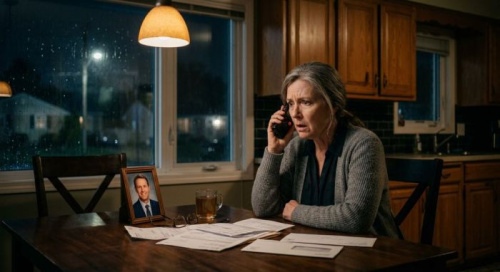
For the next six weeks, I did the most boring, obsessive work of my life, and it turned out to be the most important work of my life. I requested my daughter's full treatment notes, not the summary they'd wanted to mail, but the complete chart, because I knew the law gave me the right to the original. It arrived in a thick manila envelope, and I spread it across my kitchen table and read it until my eyes burned. Then I read it again with a highlighter, and I found the note that someone forgot to throw away.
On the bottom of a page from Sophie's first visit, in handwriting that wasn't Dr. Prescott's, someone had written in pencil: Pt declined crown. No consent on file. X-ray not taken. Then the pencil was crossed out, hard, and in pen underneath it: CROWN, COMPLETED, SEDATION. The date matched the June visit, the day I never authorized a crown.
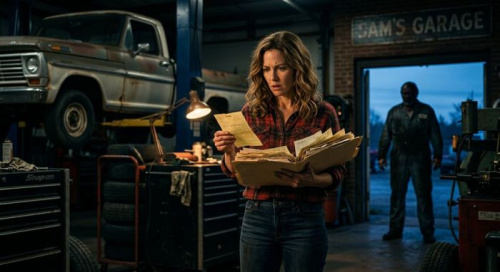
That note became the cornerstone. Because once I knew what to look for, I found the pattern everywhere. Sophie's chart had fourteen procedures billed that never appeared in the clinical notes. Her first root canal, the one we never questioned, had no diagnostic X-ray on file showing the crack at all. And when I compared Sophie's chart to the names Angela gave me, the same names kept appearing on the same dates, month after month, like a school seating chart. Twelve patients. Four procedure codes. Every single month. For years.
I took my folder to the county prosecutor's office first. The woman behind the intake desk was polite and hopeless. But she gave me a card for the state dental board's fraud unit, and that's where I met Lena Voss.
Detective Lena Voss was a short woman with gray-streaked hair and the deadpan delivery of someone who'd heard every lie a town hero could tell. She met me in a conference room at the state building in Columbus, and she listened without interrupting for forty-five minutes while I laid out my daughter's chart, Mr. Ferro's story, and the twelve names on the same dates. When I finished, she smiled, the first real smile I'd seen in months, and she said, "We've been auditing Dr. Prescott for fourteen months. We knew about the production board. We suspected the sedation records. What we didn't have was a patient willing to sit in a deposition and say, 'This procedure never happened.'"
I told her I'd sit in a hundred depositions.
Here's the part that still makes me proud, and I don't say it to brag. We didn't rush. For three months, Lena and I worked the file like a puzzle. She subpoenaed the practice's billing system. I kept a paper trail of everything, every EOB, every text from the front desk, every receipt, every date Sophie's mouth had hurt. Angela drew a map of the break room and showed the state's technicians where the backup drives lived. And Dr. Prescott, in his arrogance, did exactly what arrogant men always do. He scheduled a celebration.
Thirty Years of Smiles: A Community Appreciation Evening, the flyers said. Free barbecue. Live music. A parade of his most loyal patients and a presentation by the mayor. He rented the Hawthorne Community Center for the first Friday of December. Every lawn in town had a flyer. He wanted four hundred people to gather and tell him he was a saint. He got his wish, and then some.
I'll never forget how the night went quiet. The band had just finished Sweet Caroline, and Dr. Prescott was at the podium in his best blue blazer, microphone in hand, telling the town how much he loved us, when the side doors opened. Lena came in first, in her plain gray coat, and behind her came two uniformed officers and a woman from the Medicaid fraud division carrying a black briefcase. They walked all the way up the center aisle, and not one person clapped, because everyone could feel what was about to happen. Dr. Prescott kept talking for a few more seconds. He was still talking when they reached the stage, still smiling, still waving. And then Lena said his name into the microphone and read him his rights in front of his wife, his employees, his neighbors, and every patient who'd ever trusted him with their teeth.
The charges came in a stack a half-inch thick. Insurance fraud on forty-three counts. Medicaid fraud on another nineteen. Two counts of assault arising from procedures performed without consent. They took his license that night, before the barbecue got cold. The whole town stood in the parking lot afterward, shivering in December air, and I heard more than one person say the same thing I'd been thinking for months. "I had a crown from him last year. I never needed a crown."
The trial lasted eleven days. I testified for four of them. Mr. Ferro testified from a walker, and every eye in the courtroom was on him when he told the jury he'd been talked into losing teeth he could still feel aching. Angela testified about the whiteboard with BEAT LAST YEAR underlined at the top. The state's forensic accountant walked the jury through the billing files, and my kitchen-table notebook went into evidence marked with thirty-one tabs. Dr. Prescott's lawyer tried to paint me as a hysterical mother who misunderstood a routine treatment plan. That lasted about as long as it took the jury to see the chart note with the pencil crossed out.
He was convicted on forty-nine of the counts. The judge gave him nine years in a state facility, fined him three hundred thousand dollars, and ordered restitution to every patient whose chart showed a procedure that never happened, including a check, finally, for the fourteen thousand dollars of my daughter's smile that I'd paid to watch her suffer. The dental board revoked his license permanently, and the state opened a claims process that, in the end, paid out to more than two hundred patients. Two hundred. In one small town, one dentist, thirty years of trust, and two hundred people who'd been sold pain they never needed.
Sophie spent the spring seeing a dentist in the next county, a woman named Dr. Ilene Carter, who looked at her chart and said the words I'd been waiting to hear all year. "There's a lot here that never should have happened, but she's young, and her mouth can heal." That second root canal turned out to have been real, the tooth damaged after all, but it was the only fixable thing he'd done to her. The filed-down tooth took a year and a crown of its own before it felt normal again, and Sophie still gets nervous in a dental chair. But by the end of that year, she was smiling in her school picture again, and she didn't flinch when I said the word dentist.
Sometimes people ask me if I feel guilty, the way victims are trained to feel, like I should have caught it sooner. And I used to. I spent plenty of nights replaying that June afternoon, the consent form I couldn't prove I never signed, the four visits I let happen because Dr. Prescott had a kind voice and a blue blazer and thirty years of goodwill in a town of eleven thousand. But here's what I know now, sitting in my kitchen with her old chart in a drawer I rarely open. I wasn't the first mother he did it to. I was just the one who kept the paperwork.
The Prescott building on Main Street is a bakery now. I buy my daughter's favorite cinnamon rolls there every Saturday morning, and every Saturday I look at that smiling tooth logo painted over in soft yellow, and I think about the note in the recycling bin, and the pencil that someone crossed out, and the twelve names on the same dates every single month. Evil doesn't always look evil. Sometimes it looks like a friendly dentist in a small town, cashing checks on healthy teeth, betting that nobody would ever read the fine print. He bet wrong. He bet on a town that didn't ask questions, but he forgot that even the quietest towns keep records, and that mothers keep the ones that matter.