It was a Monday afternoon when I found the key.
Richard was upstairs recovering from hernia surgery, drifting in and out of sleep on a Percocet haze. The house was quiet except for the hum of the ceiling fan and the occasional creak of old floorboards. I was tidying his study — something he never let me do — because the home health aide had called in sick and someone needed to change the sheets on the guest bed.
The key was taped to the underside of his bottom desk drawer. A small brass key, tarnished with age, secured by two strips of yellowing masking tape. I almost missed it. My fingers brushed against it when I reached for a loose paperclip.
I pulled it off and stared at it in the dim afternoon light.
Richard and I had been married for seven years. He was a good husband. Kind, predictable, generous. A retired civil engineer with a pension and a quiet disposition. We met at a grief support group — I had lost my first husband to cancer, and he had lost Carol to what he always described as "a terrible car accident on a rainy night." We bonded over our shared loss. We built a life together.
But in seven years, I had never once seen this key.
I didn't mention it to him that day. I don't know why. Maybe it was the way my stomach tightened when I held it. Maybe it was the small voice that whispers in the back of every woman's mind when something feels slightly off.
The key had a number etched into it: 1147.
Three days later, while Richard was at physical therapy, I drove to the Public Storage facility on Route 9. I told myself I was being ridiculous. That it was probably an old lockbox with tax documents or sentimental keepsakes. Something innocent.
Unit 1147 was in the back corner of the facility, behind a chain-link fence and a rusted gate. The lock clicked open with a satisfying turn. I pulled the metal door upward.
The unit was filled with furniture. A mahogany dresser. A rocking chair. Cardboard boxes stacked to the ceiling, labeled in faded marker: "Kitchen," "Carol's Books," "Misc."
Carol's books.
Richard had told me he donated everything after she died. That it was too painful to keep her things.
I opened the first box with trembling hands.
Inside were photo albums. Dozens of them. And at the bottom, wrapped in a silk scarf, was a leather-bound journal.
I sat on an overturned crate and opened it. The handwriting was feminine, looping, and increasingly frantic as the pages went on.
April 3, 1992 — Richard came home angry again. I burned the meatloaf. He didn't hit me this time, but the way he looked at me... I'm scared.
May 17, 1992 — I called the police today. They came but Richard charmed them. Said I was "emotional" because of my "female problems." The officer actually patted my hand and told me to take a bath. I wanted to scream.
August 8, 1992 — I'm leaving. I have a plan. I've been saving money. I'll go to my sister in Oregon. He'll never find me.
The last entry was dated August 14, 1992.
He knows I'm leaving. He found the bus tickets. Oh God. He's coming up the stairs.
I closed the journal. My hands were shaking so badly I dropped it on the concrete floor.
I didn't sleep that night.
Richard sensed something was wrong. He asked if I was feeling sick. I said it was just a headache. He brought me tea and two Advil, and I watched him from the corner of my eye, searching for something I had never seen before. A crack. A shadow. A monster hiding beneath the gentle face of the man I loved.
The next morning, I called Frank Castellano.
Frank was a retired homicide detective who ran a small private investigation agency out of his basement in Scarsdale. I had met him at a dinner party two years ago. He was blunt, unimpressed by anything, and he had the kind of eyes that had seen too much to be surprised by anything.
We met at a diner off the highway. I slid the journal across the table.
Frank read through it in silence. He took off his reading glasses and rubbed his eyes.
"You know what this means," he said.
"I need proof," I whispered. "Not just a journal. I need something that would hold up in court."
Frank nodded slowly. "Give me two weeks."
Nine days later, he called me at 7 AM.
"I found something," he said. His voice was different. Tighter.
"What?"
"Not on the phone. Meet me at the old property. Bring the key."
When I arrived at the address he sent me, I realized it was the house Richard and Carol had lived in thirty years ago. The house he sold two months after she disappeared. A young couple lived there now — the Parkers. Frank had somehow arranged access.
Frank was standing next to his SUV with a man I didn't recognize. The man was holding ground-penetrating radar equipment.
"Margaret, this is Dr. Elias. He's a forensic anthropologist I've worked with before."
The anthropologist shook my hand but didn't smile.
Frank led me to the backyard and pulled out a faded blueprint.
"Your husband told you Carol died in a car accident. But there's no record of a Jane Doe matching her description in any coroner's office in the tristate area between August and December of 1992. I checked every single one."
My heart was hammering.
"The buyer did major renovations in 1993 — paved the backyard, added a concrete patio, extended the garage." Frank pointed at the blueprint. "But before those renovations, look at this."
He traced his finger to the back corner of the property.
"There was a garden shed here. The contractor notes mention that the ground underneath the shed had been recently disturbed when they bought the place. They had to compact the soil before they could pour concrete."
Dr. Elias spoke for the first time. "The ground-penetrating radar can confirm if there are anomalies beneath that concrete."
We watched in silence as the equipment hummed across the patio. It took twenty minutes.
Dr. Elias called me over. His face was pale.
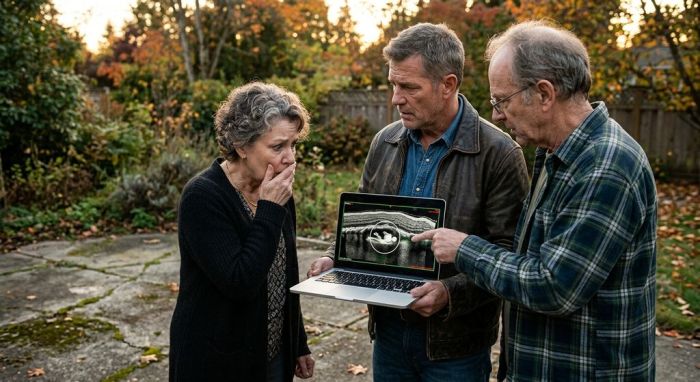
"There's a large anomaly approximately six feet beneath the surface," he said quietly. "Consistent with buried human remains."
He pointed at the screen. The image was unmistakable. A skeleton, curled in a fetal position, wrapped in what looked like a tarpaulin.
I sat down on the grass because my legs wouldn't hold me.
Frank knelt beside me. "Margaret, I need you to decide something. If we call the police, they'll exhume the remains. They'll investigate. And if it is Carol, your husband will go to prison."
I looked at the screen again. At the outline of a woman who had been lying in the cold ground for thirty years while her murderer remarried, collected her life insurance, and pretended to grieve.
"Call them," I said.
The police arrived within two hours. Then the forensic team. Then the district attorney.
The exhumation was scheduled for the following Tuesday.
I went home that evening and cooked Richard's favorite dinner — pot roast with carrots and potatoes. He came downstairs, moving slowly from his surgery, and smiled at the table.
"This looks wonderful," he said. "What's the occasion?"
I poured him a glass of red wine. "I just wanted to do something nice for you."
We ate in the living room, watching the evening news. Richard talked about his physical therapy and how he was thinking about taking up fishing now that he was retired. He laughed at a commercial. He reached over and squeezed my hand.
I squeezed back and felt nothing but revulsion.
The next morning, I quietly packed a suitcase and drove to my sister's house in Connecticut. I left my wedding ring on the kitchen counter.
The arrest happened on Wednesday.
My sister told me she saw it on the local news. Police had arrived at our house at 6 AM with a warrant. Richard was taken in his pajamas, still groggy from pain medication. He kept asking what this was about. When they told him, he collapsed.
The forensic examination confirmed what the radar had suggested. The remains were identified as Carol Anne Mitchell, born 1960, last seen August 14, 1992. Cause of death: blunt force trauma to the skull.
Richard's defense attorney argued that an unknown intruder had killed her and that Richard had panicked and buried the body. But the prosecution had Carol's journal. They had the police report she filed three months before her death. They had three witnesses — former neighbors — who recalled hearing Carol scream on the night of August 14.
And they had the life insurance policy Richard took out on Carol six months before she died. A policy he collected on in November 1992. A policy he never mentioned to me.
I testified at his trial.
I sat in the witness box, looked at the man I had shared a bed with for seven years, and told the jury everything. The key. The storage unit. The journal. The radar image. The skeleton curled in the dirt.
The courtroom was silent.
Richard's lawyer tried to paint me as a bitter, jealous wife who had fabricated the story. But the evidence was overwhelming. The forensic anthropologist testified. The former neighbors testified. The insurance records were entered into evidence.
On the third day of the trial, the prosecution played a recording of a phone call Richard made from jail to his brother.
"I should have buried her deeper," he said. "That was my mistake. I got lazy."
The jury deliberated for four hours.
Guilty of first-degree murder.
The judge sentenced him to life without parole.
It's been eighteen months since the trial.
I sold the house. I moved to a small apartment in a different state. I go to therapy twice a week. Some days I feel like I'm healing. Other days I wake up in the middle of the night convinced I hear his footsteps on the stairs.
I think about Carol often.
She was a woman who loved gardening and classical music. She wanted to be a painter, but her husband told her it was a waste of time. She was thirty-two years old when she died. Thirty-two years old, trapped in a house with a man who was supposed to protect her, planning her escape with nothing but bus tickets and hope.
I think about the last words she ever wrote.
He's coming up the stairs.
I think about the key. That small brass key, hidden in the dark, waiting for someone to find it. Waiting for thirty years.
I think about all the women who have secrets buried deeper than anyone can reach. And I wonder who will find their keys.
If there's one thing I hope you take from this story, it's this: when something feels wrong, trust yourself. The truth has a way of surfacing.
Sometimes, it just takes thirty years.