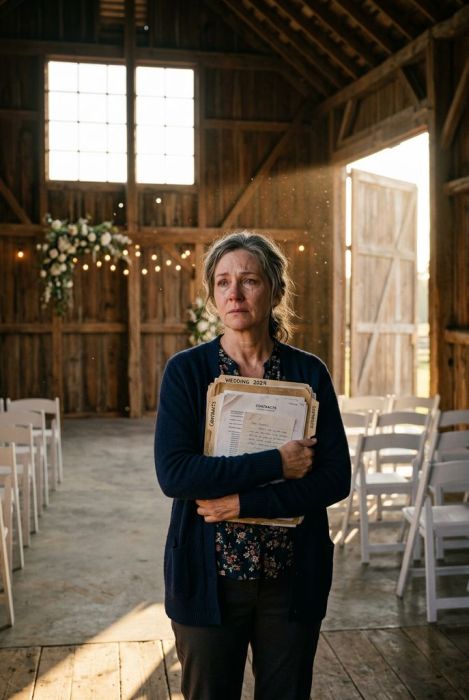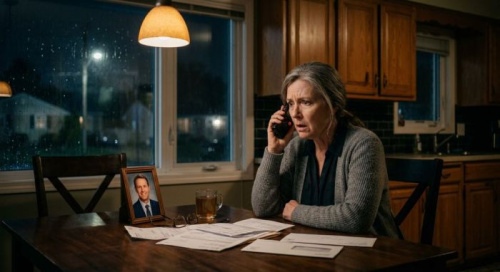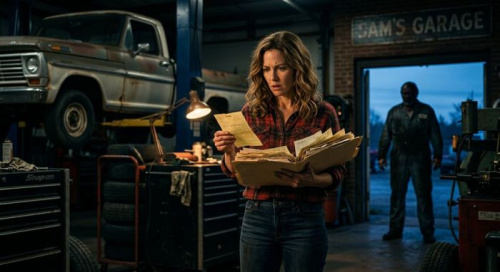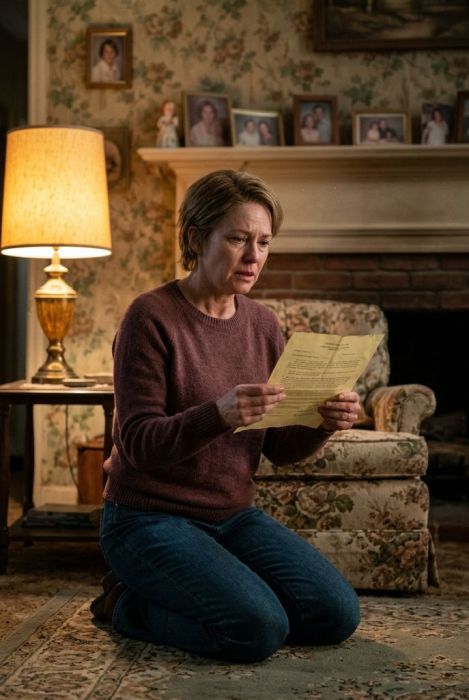
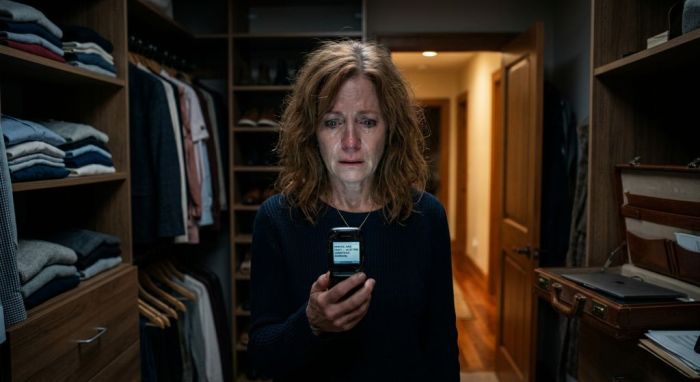
The night I found the burner phone in my husband's briefcase, I was still the grieving daughter everyone felt sorry for. Cole had been so patient since Dad died, holding my hand at the funeral, telling my sister Erin that I just needed time. Nobody knew I'd opened his leather briefcase looking for the car keys and found a cheap flip phone I'd never seen before, its screen cracked and warm from recent use.
The screen lit up when I touched it. A message from a contact saved only as "J" glowed in the dark: "Brightline invoice #2217 padded for 80k. He said he'd handle the audit. Stop worrying."
I stood frozen in the closet with that phone in my hand, listening to Cole whistle downstairs in the kitchen. Two years. Two years since my father died, and for two years I had been slowly, quietly losing my grip on everything I loved. I thought it was grief. I thought I was the problem.
I was wrong about all of it.
My father, Robert Harper, built Harper Metal Works out of nothing in 1978, a welding shop on the edge of Erie, Pennsylvania, that grew into one of the most respected manufacturing companies on the lake. He was the kind of man who knew every employee's name, every kid's graduation year. When I married Cole Bennett fourteen years ago, Dad beamed like he'd gained a son. Cole was a charmer, a numbers man from Pittsburgh with a handshake like a promise, and Dad trusted him completely.
I did too. That was the part that haunts me.
When Dad got sick, I was the one who found him slumped over his desk in the plant office. Cole stepped up beautifully. He took over the day-to-day operations, visited the hospital every evening, and when Dad finally passed, he stood at the graveside with his hand on my shoulder and told me he'd take care of everything. I signed the papers he put in front of me without reading them. Power of attorney. Succession plans. Trust amendments. I was in a fog of grief, and he was the light I trusted to guide me out.
Six months later, the fog started to feel like it was being built around me on purpose.
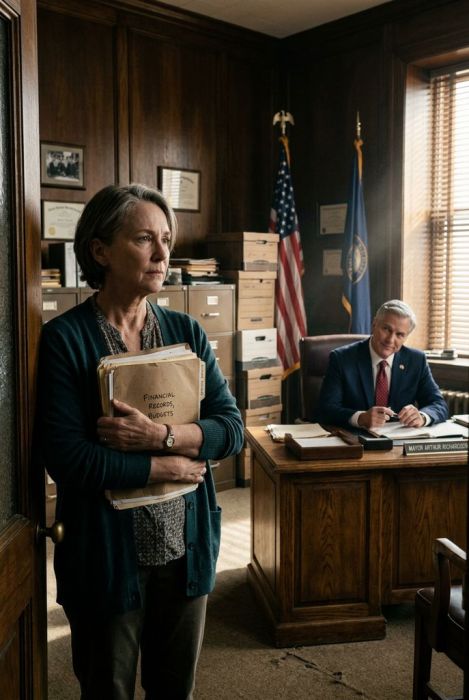
It started small. Cole mentioned, gently, that I'd been forgetful at a dinner with our accountant. Then he started intercepting my calls with Erin, telling her I was having a hard time and needed rest. He hired a woman named Jessa Tanner as his executive assistant, a sharp-eyed blonde in her early thirties who smiled at me like she knew something I didn't. When I asked Cole why we needed an assistant, he laughed and said I was being paranoid.
Paranoid. That word became his favorite.
The first real crack came when I found the scarf. A silk scarf, jasmine-scented, tucked behind the driver's seat of his Mercedes, a car I never drove. I asked him about it calmly. He told me it was a gift for my birthday he'd wrapped and forgotten to bring inside. My birthday was three months away, and he'd never bought me silk in his life. I let it go, because the alternative, that my husband of fourteen years was lying to me, felt too heavy to carry.
But then Dad's old bookkeeper called me. Miriam Oakes, seventy-one years old, retired, the woman who'd balanced my father's books for three decades. She told me she'd been thinking about the Brightline account ever since she saw it on a quarterly statement Cole had mailed to her by mistake. "Your father never used a vendor called Brightline Logistics, Dana. And he would never pay eighty thousand dollars for freight that costs twenty."
I thanked her, hung up, and stood in my kitchen until the sun went down.
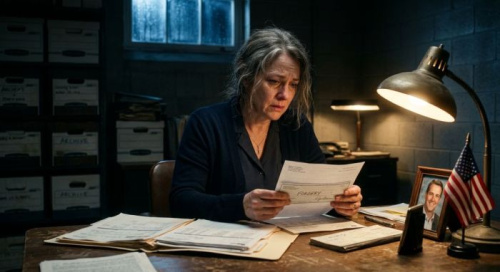
That night I went through Dad's office in our home, the one room Cole never let me touch. He said he'd kept it exactly the way Dad left it, a shrine to my grief. I found the paper trail in the bottom drawer of the old filing cabinet, behind a box of dusty Kan-Du pens: invoices from Brightline Logistics, each one higher than the last, each one bearing a signature I recognized. Not my father's. My husband's.
I could have confronted him then. I should have. But fourteen years with a charmer teaches you a terrible lesson: you learn to doubt yourself before you doubt them. I told myself there was an explanation. I told myself I was being paranoid, the way he'd promised I would be. I almost convinced myself to put the invoices back.
Then I saw that second phone message in my mind, the one that said stop worrying, and I realized Jessa Tanner was not worried about freight invoices. She was worried about me.
I didn't confront him. I got help instead.
A friend of my father's, a retired judge named Walter Kim, gave me the name of a forensic accountant out of Cleveland. Victor Marsh had spent twenty years in the FBI's financial crimes unit before going private, and he had the tired eyes of a man who'd seen every version of greed there was. I brought him the invoices, the burner phone photo, and the memory of Miriam's call. He listened without interrupting, then pushed a folder across his desk.
"Your husband is not just cheating on you, Mrs. Harper. He's gutting your company."
The next six weeks were the hardest of my life, and also the clearest. Victor traced Brightline Logistics to a post office box in Meadville, a holding company called Bennett Holdings, and a warehouse contract that didn't exist. He found that Cole had quietly moved Harper Metal Works' three biggest clients onto consulting agreements that paid a company called Tanner Advisors, Jessa's name, for work that wasn't happening. He found the second apartment, a high-rise in downtown Erie under a shell company, and photographs of Cole and Jessa coming and going like they owned the place. They did, in a way. They were furnishing it with my father's money.
And then Victor found the one thing that changed everything: the buyer.
Cole had spent the fall courting a private equity firm out of Chicago called Wheeler Capital. He'd pitched them on buying Harper Metal Works at a price far below what it was worth, with a stay-on deal that would leave him as CEO of the acquired company and me with nothing but my minority shares. He told our board I was emotionally unstable and that a sale was the only way to save the company from my interference. He told my sister the same thing, and Erin, loyal and worried, started checking in on me like I was a patient.
The irony was almost too cruel to bear. He was building the perfect case that I was crazy, and the evidence of his own crimes was sitting in a folder in my closet.
The plan came together in a diner outside Meadville, of all places, over coffee that tasted like regret. Victor introduced me to a man named Lawrence Wheeler, except he wasn't Lawrence Wheeler. He was Special Agent Lawrence Wheeler of the FBI's fraud task force, and he'd been building a case against Bennett Holdings for eight months, following the same money trail Victor had found independently. When I told him everything, he smiled the way people smile when a puzzle finally clicks.
"Mrs. Harper," he said, "you're not losing your mind. You're our missing witness."
The trap was simple, and Cole was too arrogant to see it. Wheeler Capital would make an offer, a generous one, too good to refuse. Cole would push the sale through, confident he'd structured the deal so the money flowed into Bennett Holdings and from there to accounts overseas. The closing would happen in the Harper Metal Works boardroom, my father's room, with the corporate lawyers present. And on the buyer's side of the table would be a man with a badge and a warrant.
The day of the closing, I got dressed carefully, the way I used to before funeral services. Navy suit, my mother's pearls. Cole kissed my cheek in the driveway and told me he was proud of me for finally doing the right thing. He'd never looked happier. He'd never looked more like a stranger.
The boardroom was full of people I'd known my whole life: our CFO, our plant managers, lawyers from both sides. Cole sat at the head of the table in Dad's chair, and I saw him glance at me with something like pity, and I knew he was already counting the money. When the papers came out, when they told me where to sign, I didn't pick up the pen.
"Actually," I said, "I have something to share first."
I played the recording that Victor had helped me capture, the one from the pen I'd left in Cole's office the week before, hidden in his own briefcase while he was in the shower. His voice filled the room, warm and familiar, the voice I'd loved for fourteen years, confessing to Jessa over the speakerphone exactly how he'd padded the Brightline invoices, how he'd starved the company to make it cheap enough to buy, and how, once the sale closed, "Dana gets nothing and disappears into a nice quiet facility with her daddy's ghost."
The room went very still. Cole's face did something I'd never seen it do: it crumpled, then smoothed back into a smile, the smile of a man who thought he could talk his way out of anything. He opened his mouth.
That's when Lawrence Wheeler stood up, flipped open his badge, and told the entire board that the sale was void, the accounts were frozen, and Cole Bennett was under arrest for wire fraud, embezzlement, and conspiracy. Two agents came through the door before he finished the sentence.
They didn't handcuff him in front of everyone. They did it in the hallway, but everyone heard. The whole company heard. By the time the police cars pulled away from the plant gates, the story was already on every phone in Erie: the golden boy who'd married the boss's daughter had been stealing from his own family the entire time.
Jessa Tanner flipped on him within a week. That's the thing about people who build their lives on other people's trust: they have no loyalty, because they have no center. She traded her testimony for immunity and told federal prosecutors everything, the shell companies, the offshore accounts, the apartment, the plan to have me committed under the guise of caring for my mental health. Her voice on the stand was calm and precise, and Cole's lawyer had no answer for any of it.
Cole Bennett was convicted on nine counts. The judge called his crimes a betrayal of the deepest kind, committed against the woman who trusted you most, and sentenced him to eleven years in federal prison. He'll be sixty-five when he gets out, a stranger to the life he thought he'd stolen.
The FBI froze the accounts before a single dollar crossed the border. Between the restitution order and the seized assets, Harper Metal Works came back to life. We brought back the consultants my father had loved, renegotiated the contracts Cole had poisoned, and this year, for the first time since Dad died, the plant turned a profit that belonged entirely to us.
Miriam Oakes still calls me every Sunday. We talk about the old days, about Dad, about how the man who smiled at his funeral turned out to be the one person he would have hated most. Erin apologized with tears in her eyes, and I forgave her, because holding on to anger is just another way of letting Cole keep stealing from me.
As for me, I kept the navy suit, but I bought a new one. I take the board chair my father built for himself, and I sit in it like I belong there, because I do. I still have the burner phone in a drawer, a reminder of the night I learned that the person who loves you most can also be the person destroying you. But I don't need it anymore. I don't need anything he touched.
The last time I saw Cole was at sentencing. He looked smaller than I remembered, older, deflated, the charm drained out of him like water from a cracked pipe. He asked the judge if he could say something to me. The judge let him. He turned around and said, "Dana, I never meant to hurt you." And I looked at him, this man I'd trusted with my father's legacy, and I said the only true thing I had left.
"I know you didn't mean to. That's what made it so easy to steal from me."
They led him away, and I walked out of the courthouse into a cold Erie morning, and for the first time in two years, the world felt like mine again. My father's name is still on the gate. It always will be. And someday, when I'm ready, I'll tell the millwrights and the welders and the kids who tour the plant on career day that the best thing their old boss ever taught me wasn't how to read a balance sheet.
It was how to spot a lie, and how to live long enough to see it fall.