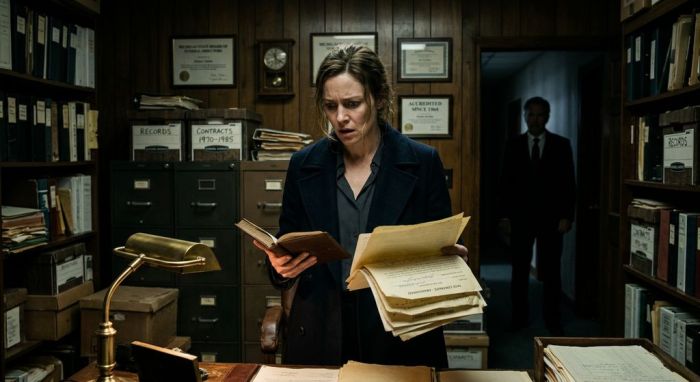
The day they lowered my mother into the ground, Warren Beck placed a warm hand on my shoulder and told me he had "taken care of everything." I remember nodding, grateful, the way you're grateful to anyone who makes the unbearable slightly more bearable. I did not know then that he had taken care of nothing at all, and that the bill he handed me two hours earlier was built on a lie.
My mother, Evelyn Donnelly, had lived in Granite Falls, Ohio her entire life. She was the kind of woman who knew the name of every cashier at the Piggly Wiggly and baked a lemon loaf for every new neighbor who moved onto Cedar Street. When she was diagnosed with the cancer that would take her, her first worry was not her own pain. It was the burden she imagined she was leaving behind.
"Everything is arranged, Claire," she told me from her hospital bed, her voice thin but certain. "I took care of it years ago. Warren Beck has my papers. You won't have to do a thing."
She had known Warren since grade school. Everyone in Granite Falls knew Warren Beck. He had inherited Beck & Sons Funeral Home from his father, who had inherited it from his father before him. Three generations of Becks had carried the town's grief, and Warren carried it with a gentleness that seemed almost holy. He spoke in a low, practiced voice at every service. He remembered every widow's name. He sent handwritten notes on the anniversary of every death. When the town hall needed a sponsor for the Fourth of July picnic, Warren Beck's name was always at the top of the list.
My mother trusted him the way she trusted the sunrise. And so, when I flew home from Columbus to sit at her bedside, I trusted him too.
She died on a Tuesday in March, with her hand in mine and the window open to the first warm breeze of the year. It was the most peaceful thing I had ever witnessed, and also the loneliest. My brother, Danny, drove up from Cincinnati that night, and together we did what grieving children do: we made calls, we made lists, and we made an appointment at Beck & Sons.
Warren met us at the door wearing a charcoal suit and an expression of perfect sorrow. He shook Danny's hand, then took mine in both of his and held it a moment too long. "Evelyn was one of the good ones, Claire. I'm going to make sure she gets a send-off she'd be proud of."
The service was beautiful, I will give him that. There were white lilies everywhere, her favorite. The organist played "Amazing Grace" the way my mother had hummed it while she ironed. Warren spoke for nearly twenty minutes about her volunteer work at the library and the way she always had a kind word for the mailman. Half the town showed up. Danny wept. I wept. It felt like an ending worthy of her.
And then, two hours after we lowered her casket into the ground at Oak Hill Cemetery, Warren Beck pulled me into his office and slid a piece of paper across the desk.
"Your mother's prepaid plan," he said, sighing heavily, "only covered the basic package. But Evelyn, God love her, she picked the upgraded casket and the nicer plot when she made her arrangements. That balance is on me to collect, unfortunately. It's four thousand three hundred."
I stared at the number. I had just buried my mother. I had not slept in three days. My brain could not make the numbers make sense.
"But she said everything was taken care of," I managed.
"Everything's taken care of now," Warren said, and his voice was so gentle, so reasonable, that I almost believed him. "It's just the difference between what she paid for and what she chose. I'm sorry, Claire. I know this is the last thing you need."
Danny looked at me. I looked at the paper. And because we were exhausted, and because we trusted the man who had just eulogized our mother, we wrote the check. Warren thanked us with tears in his eyes and walked us to the door like a shepherd guiding sheep.
I did not sleep that night. It wasn't just the grief. It was the nagging feeling, small as a splinter, that something was wrong.
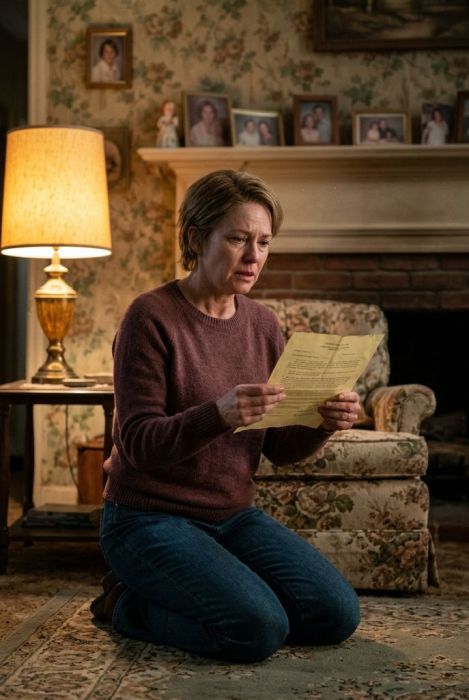
The splinter became a knife three weeks later, when I finally worked up the courage to sort through my mother's things. I found it in her nightstand, beneath a stack of old birthday cards: a manila folder, worn at the edges, labeled "Beck & Sons — Prepaid Funeral Arrangements."
My hands shook as I opened it. Inside was the original contract, dated June 2019, signed in my mother's careful handwriting. And it was not the "basic package" Warren had described. It was the Gold Memorial Plan, paid in full, eight thousand five hundred dollars, receipt attached. It covered the upgraded casket. It covered the nicer plot. It covered everything. Every single thing Warren had charged us double for had already been paid for four years earlier.
I sat on the edge of my mother's bed and read the contract three times, as if the words might rearrange themselves. They did not.
The next morning, I drove to Beck & Sons with the folder in my purse. I did not call ahead. I found Warren in his office, sipping coffee, looking like a man with nothing to hide. I set the contract on his desk.
"Explain this," I said.
Warren glanced at it. For one second — just one — something flickered behind his eyes. Then the mask slid back into place, and he smiled a sad, patient smile.
"Ah, Claire. I was wondering when you'd find that. See, that's the old contract. Your mother upgraded her plans later, and the paperwork got a little tangled. I told you, it's a clerical error. I already refunded part of it, didn't I?"
He had. When I'd called to complain the week before, he'd been so apologetic, so eager to "make it right," that he'd offered to refund two thousand dollars just to keep the peace. I'd accepted, grateful, embarrassed to have doubted him.
Now I understood. The refund had been a bribe. A bandage. A way to keep me quiet.
"Show me the upgraded contract," I said.
Warren's smile tightened. "It's in the archives. I'll have Marge pull it for you by Friday."
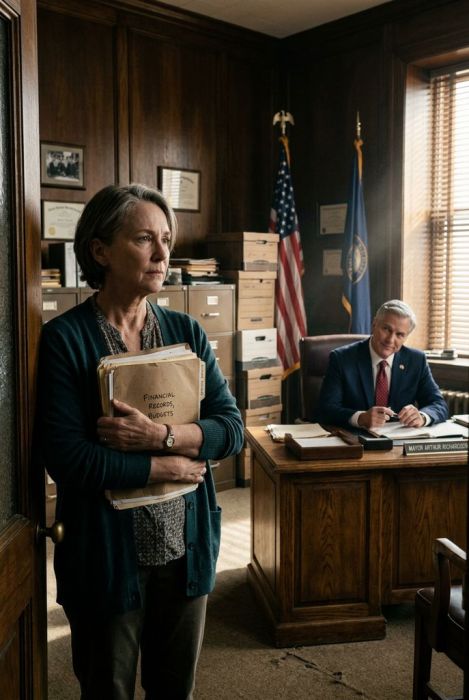
Marge. Marge O'Leary, the bookkeeper who had worked at Beck & Sons for thirty years, since Warren's father ran the place. Everyone in town knew Marge. She had braided my hair at the Fourth of July picnic when I was nine.
I did not wait for Friday. I came back that afternoon, when I knew Warren had his weekly Rotary Club lunch, and I found Marge alone in the back office, sorting files. She looked up at me, and I saw something in her face I did not expect: fear.
"Marge," I said gently, "did my mother ever sign a new contract? A Gold upgrade, after 2019?"
Marge's hands went still on the papers. For a long moment she said nothing. Then she lowered her voice to barely a whisper.
"Your mother never signed anything else, Claire. I've been keeping the books here for thirty years. I know every file in this building."
"Then why did he charge me four thousand dollars?"
Marge looked at the door. Then she reached under her desk, pulled out a battered green ledger book, and set it in front of me with trembling hands.
"Because that's how he's been doing it for years," she said. "Ever since his father died, and Warren took over. He found a way to turn grief into money."
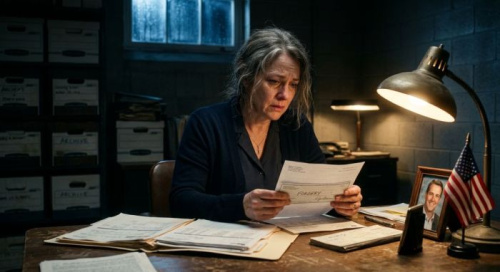
I opened the ledger. It was not a bookkeeping ledger in any normal sense. It was a list. Page after page, written in Marge's neat hand: names I knew, families I had grown up with. The Hendersons, who'd lost their father in 2018 and paid an extra three thousand for a casket their father had already paid for. The Okafor family, charged double for a plot at Oak Hill that Mr. Okafor had purchased in 2005. The elderly Russo sisters, billed for a "memorial video" they never asked for and never received. Forty-two names. Forty-two grieving families. And in the margin beside each one, a single notation: "P.D. 2x" — paid double.
"How long?" I whispered.
"Ten years," Marge said. "At least. I started keeping my own records when I couldn't stomach it anymore. I told him I'd go to the state board. He said he'd make sure I never worked in this town again, that he'd tell everyone I was the one stealing. And he would have. Everyone trusts Warren Beck."
I sat there in the little back office, surrounded by the scent of dust and dried flowers, and I felt something cold settle in my chest. Not just anger. Something worse. Because I had written that check. And I had paid it gladly, because a man I trusted had looked me in the eye and lied to me at my own mother's funeral.
I did not go to the police that day. I went to the county courthouse, and I went to the Ohio Department of Commerce, Division of Real Estate and Professional Licensing, and I filled out a complaint against Beck & Sons Funeral Home. I attached a copy of my mother's contract. And then I called Danny, and I told him everything.
"Stay quiet," he said, after a long silence. "Don't tip him off. Let's see how deep this goes."
How deep it went was deeper than either of us imagined.
A state investigator named Tom Reyes called me four days later. He had been looking into Beck & Sons for almost a year, he told me, but every time he got close, witnesses went quiet. Grieving people don't want to relive the worst days of their lives, and Warren Beck had a talent for making them feel foolish for complaining. "You're the first one who came in with a paper trail," Reyes said. "And I think you're going to help us catch him."
The trap we set was simple, and it was cruel, and it was beautiful.
I went back to Beck & Sons two weeks later, dressed in black, my eyes red from real tears. I told Warren that a dear friend of mine, a widow named Ruth, had just died, and that Ruth had no family left to handle things. I asked Warren to help me arrange her funeral. I asked him, very specifically, whether Ruth had a prepaid plan.
Warren's eyes lit up. I watched him do it. I watched the mask of sorrow shift into something hungrier, and I felt sick, but I held my ground.
"Let me check our records," he said, and he disappeared into the back office for a long time. When he came back, his face was a study in regret. "No prepaid plan on file for Ruth, I'm afraid. She'll need the full arrangement. But don't you worry, Claire. I'll give her a beautiful send-off."
He quoted me a price. I wrote it down with the pen Reyes had given me, the one with the hidden camera in the clip. I asked for an itemized receipt. He printed one, cheerfully, and handed it over. It was nine thousand dollars for a funeral that, I knew from the records Marge had shown me, would have been covered by a prepaid plan Ruth had signed with Beck & Sons back in 2012.
There was no Ruth. There had never been a Ruth.
Three days later, on a gray Tuesday morning, the Ohio Attorney General's investigators, two deputies from the county sheriff's office, and a woman from the funeral board walked into Beck & Sons Funeral Home while Warren Beck was on the phone with a florist. They executed a search warrant on his office, his computers, and the green ledger that Marge had kept hidden for ten years. They found the ledger, and they found the real records, and they found forty-two families' worth of overcharges totaling more than four hundred thousand dollars.
They arrested Warren Beck at his own desk, in the suit he wore to every funeral, with the Rotary Club luncheon agenda still on his calendar.
When the news broke, Granite Falls did not weep for him. The town that had trusted him for thirty years turned on him with a fury that was almost frightening. Families who had stayed quiet for a decade came forward, one by one, holding their own contracts, their own receipts, their own stories of being charged twice for grief. The Okafor family. The Hendersons. The Russo sisters, who had sold their mother's china to pay an invoice Warren had invented. At the county courthouse, the hearing room was so full that people stood in the aisles.
Warren Beck pled guilty to two counts of felony theft, one count of tampering with records, and one count of fraudulent misrepresentation. The judge, a woman whose own father's funeral had been handled at Beck & Sons, sentenced him to eight years in state prison and ordered him to repay every dollar he had taken. His funeral director's license was revoked. The family business, three generations old, was sold at auction to pay restitution. The name "Beck & Sons" was painted over within a month.
I got my four thousand three hundred dollars back. But that was never the point.
The point was the day I stood in the hallway of the courthouse and watched a line of my neighbors — people I had grown up with, people my mother had baked lemon loaves for — walk past me with their heads high and their contracts in their hands. The point was Marge O'Leary, who kept her job with the new owners and told me she'd never once regretted handing me that green ledger. The point was Danny, standing beside me, squeezing my hand.
And the point, I think, was my mother.
Evelyn Donnelly trusted a man her whole life, and he betrayed her in the one moment she could not defend herself. But in the end, her trust is what caught him. If she had not kept that contract in her nightstand — if she had not believed, to the very end, that everything was arranged — I might have written that check and never looked back. Her faith in the world is what exposed the man who preyed on it.
Last month, on the anniversary of her death, I drove out to Oak Hill Cemetery with a thermos of coffee and a folding chair. I sat beside her grave for an hour, watching the light come through the trees, and I told her the whole story. I told her about the ledger and the trap and the trial. I told her about the new name on the funeral home, and the way the town talks about Warren Beck now, not with affection, but with the cold, quiet certainty that he got exactly what he deserved.
I think she would have liked that. She would have said something about how the truth always comes out eventually, and then she would have offered me a slice of lemon loaf and told me not to worry so much.
I'm still learning how to do that. But it's easier now, knowing that in a town where a man in a good suit spent thirty years turning grief into money, justice still found a way to win. It came through a green ledger, a hidden camera, and one grieving daughter who refused to let her mother's trust be the last thing he stole.