The morning my mother's tax refund landed in a bank account she had never opened was the morning the world tilted sideways. I was standing at the kitchen counter with my second cup of coffee when my phone buzzed, and I heard her voice — small and uncertain, the way it only gets when she's trying to make sense of something that shouldn't need making sense of.
"Dana, sweetheart, the deposit went through," Ruth said. "But there's a problem. The statement says the account belongs to R. Whitfield. I haven't been a Whitfield since I married your father in 1968."
I remember pressing the phone harder against my ear, as if that would help me understand. "Maybe it's a typo, Mom. These banks make mistakes."
"No," she said quietly. "It's not a typo. The money's gone, Dana. All of it. And the account is real. I just never opened it."
That was the moment I should have trusted my gut. Instead, I told her I'd call Vince Cutter in the morning. After all, he was the one who had handled her taxes every spring for the last fifteen years, ever since her own longtime preparer had retired and passed the whole neighborhood along to him like a sacred hand-me-down.
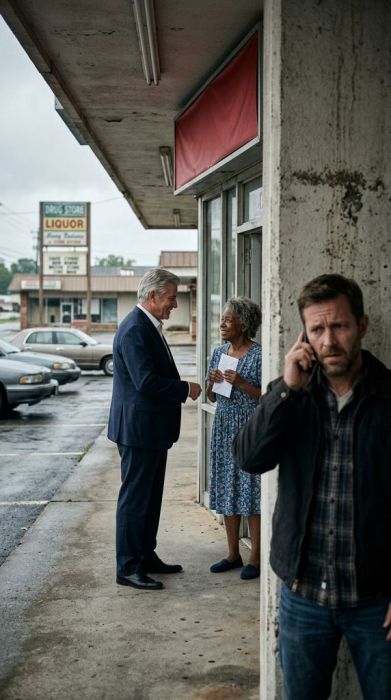
Everybody in Cedar Hollow trusted Vince Cutter. He was the kind of man who remembered your grandchildren's names, who sent a Christmas card with a handwritten note inside, who sponsored the Little League team and never once missed a Sunday at First Baptist. He was sixty-two and looked like everyone's favorite uncle, with silver hair and reading glasses that sat low on his nose and a laugh that could fill a room. My mother adored him.
"He's the only one who's ever understood my pension," Ruth would say whenever I suggested she let me look at her paperwork. "He's been so good to me, Dana. He knew your father, you know. They used to fish together."
She was right about that. Vince Cutter had known my father, and he never let anyone forget it. He mentioned my dad at every appointment, told Ruth she reminded him of a younger version of the woman he used to watch dance at the VFW hall. He made her feel seen. And that was exactly what he needed her to feel.
The first sign of trouble had come the year before, when Ruth's refund had arrived nine hundred dollars lighter than she expected. When I called about it, Vince had sighed into the phone with practiced patience and explained that the government had changed some credits and that, frankly, I should be grateful she was getting anything at all. I let it go. Everyone let things go with Vince Cutter, because Vince Cutter always had an answer, and his answers always made you feel a little foolish for having asked.
But the bank account my mother never opened was not something a government change could explain.
I drove to her house that same afternoon, a modest two-bedroom on Maple Street with the same blue shutters my father had painted the summer before he died. Ruth was at the kitchen table, her glasses on, a stack of papers spread out in front of her like a patient waiting for a diagnosis. Her hands were shaking as she handed me the statement.
"Dana, look at it," she said. "It says R. Whitfield. I haven't been R. Whitfield since the sixties."
I looked. And then I looked again, because what I saw didn't make sense. The account had been opened two years ago, at a bank on the other side of town. There were small deposits going in every month, and then, on the fifteenth of every April, a big lump sum. My mother's refund had not been short last year. It had been rerouted.
I did not call Vince that morning. Something told me not to. Instead, I went to his office.
Cutter's Tax & Bookkeeping was a cheerful little storefront on Main Street, between the bakery and the hardware store, with a dusty ficus in the window and a sign that read "SINCE 1992 — WE HANDLE IT WITH A SMILE." It was mid-February, so the place was already filling up with early-bird clients, mostly retirees clutching manila envelopes and handwritten lists of their deductions. The receptionist, a young woman named Abby, looked up and smiled when I walked in.
"Is Mr. Cutter available?" I asked.
"He's with a client, hon. Want me to squeeze you in this afternoon?"
"No," I said. "I'll wait."
I sat in the plastic chair with the peeling vinyl and watched. I watched an old man shuffle in with a shoebox of receipts, and Vince came out and took his hand in both of his and said, "Carl, you look ten years younger than the last time I saw you." I watched a widow sit down across from him while he listened to her talk about her dead husband's annuity, nodding and patting her hand. He was good. God, he was so good. Every person who walked out of that office did so smiling, certain their money was safe.
When it was finally my turn, I walked in and shut the door behind me. Vince looked up from his desk, and for half a second — just half a second — I saw something flicker behind his glasses before the warmth flooded back in.
"Dana!" he said, standing. "Is Ruth okay? You never come in this time of year."
"My mother's refund went into an account she didn't open," I said. "An account in the name of R. Whitfield."
The flicker again. He recovered so fast I almost missed it. "Oh, honey, that's just a clerical thing with the bank. Happens all the time. They merge accounts when there's a name match. I've seen it a hundred times. I'll call them myself, first thing Monday, get it all sorted."
"She's been a Rutledge for fifty-eight years, Vince. Nobody is merging her account by accident."
He leaned forward, all concern, and lowered his voice. "Dana, I'm going to say something to you that I'd only say because I love your mother like family. She's at the age where things get confused. She's been telling people around town some things that aren't quite right — nothing serious, just little mix-ups. I don't want her to feel bad, but you should keep an eye on her paperwork. Let me handle it. That's what I'm here for."
I felt the heat rise in my chest. My mother, at seventy-nine, still balanced her checkbook by hand every single Sunday. She could tell you the exact price of a loaf of bread in 1985 and the exact date of every grandchild's birthday. She was not confused. But I said nothing. I thanked him, I stood up, and I walked out of that office with the same smile I'd worn my whole life — the smile that let people like Vince Cutter think they'd won.
And then I went to work.
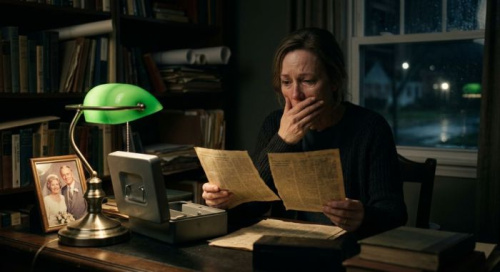
I started with the IRS notice I found in Ruth's files, buried under three years of bank statements. An audit letter, dated last November, questioning a charitable deduction of fourteen thousand dollars on her 2022 return. Ruth gave fifty dollars a year to the church and another forty to a children's fund. She had never claimed fourteen thousand dollars of anything in her life. But someone had.
I called the number on the letter, and after forty minutes on hold, a patient woman in some office somewhere confirmed what I suspected: the deduction had been claimed on a return prepared by Cutter's Tax & Bookkeeping, and the refund had been deposited into a prepaid card account. When I asked for the name on that account, she went quiet.
"I'm going to have to route this to a special unit, ma'am," she said. "You're not the first person to ask."
That sentence changed everything.
The special unit turned out to be an agent named Naomi Reyes, who called me on a Tuesday afternoon and introduced herself with the kind of calm that made me sit down. "Ms. Rutledge," she said, "I've been looking at files like your mother's for eighteen months. I can't discuss an ongoing investigation. But I will tell you this: if you have paperwork, I would very much like to see it."
I did not have much paperwork. But I had something better. I had a name.
Two seasons ago, a young man named Jesse had worked the tax season at Cutter's office, scanning documents and fetching coffee. He had asked one question too many about why so many returns listed dependents the clients didn't seem to know about, and Vince had fired him two weeks before the April deadline, without severance, without a reference. Jesse had kept copies of everything he scanned. Not out of any grand plan — just out of hurt, and a young man's stubborn sense that he hadn't done anything wrong.
I found Jesse through a mutual friend at the bakery. He met me at the public library, and I watched him slide a thin folder across the table the way people pass secrets in movies. "I kept these because I knew someday someone would come looking," he said. "Look at this one. And this one. And this one."
They were all the same. Elderly clients, returns with phantom dependents, inflated deductions, and refunds routed to prepaid cards registered to near-name variations — R. Whitfield, J. O'Donnell, M. A. Kowalski. Forty-three names. Forty-three of the most trusting people in Cedar Hollow, and Vince Cutter had been harvesting their refunds for years while he patted their hands and remembered their grandchildren's birthdays.
"You know what the sickest part is?" Jesse said quietly. "He kept a ledger on his computer. I found it when he made me back up his files one night. He wrote notes next to every name. 'Widow, 82, no family nearby. Careful with this one — she has a daughter who asks questions.' Your mother's note said 'daughter is a school librarian, no financial background, low risk.'"
I stared at him. "He wrote that about my mother?"
"He wrote that about all of them."
I sat in that library for a long time, letting it settle. The man who fished with my father. The man who held Ruth's hand at her kitchen table. The man who had convinced my mother to sign over the direct deposit information for her refund the same year she'd been grieving, the same year she'd have signed anything he put in front of her. He hadn't just stolen her money. He had stolen her trust, and then he had used that trust to make the rest of the neighborhood doubt her.
That was the part I couldn't forgive. Vince hadn't just rerouted my mother's refund. He had told the morning coffee group at the diner that Ruth was "getting forgetful," had let it spread like a quiet stain through the town, had prepared the ground so that if anyone ever asked questions, everyone would believe her own daughter was the confused one. He had done it to a woman who still remembered the exact date of every grandchild's birthday.
So I did what my mother would have done. I was methodical. I made copies of everything. I met Agent Reyes again, this time with Jesse and the folder. And when she read the ledger notes, she looked up at me with something like admiration in her eyes.
"We've been building a case on this man for over a year," she said. "We had the bank records. We had the prepaid cards. We had everything except the thing that ties it to him — somebody on the inside, somebody willing to talk. Jesse's the missing piece. And you, Ms. Rutledge, are the person who brought him here."
She smiled. "How would you like to be at his office on April 15th?"
I thought about it. I thought about my father, who had trusted Vince with a fishing rod and a handshake. I thought about my mother, who had trusted him with her pension and her heart. I thought about forty-three elderly people in this town who had signed their refunds over to a man in a cheerful storefront with a dusty ficus in the window.
"Yes," I said. "I'd like that very much."
We did not tell Ruth. I was afraid she'd warn him — not out of loyalty, but because she still, even after everything, could not believe Vince Cutter would hurt her. Instead, I told her I was taking a personal day on April 15th, and I asked if she'd like to come with me to the diner for breakfast. She lit up. My mother loved the diner.
We got there at nine, and she was telling me about the azaleas she wanted to plant when her voice trailed off. She was looking past my shoulder, out the window, toward the street.
"Dana," she said slowly, "why are there police cars at Vince's office?"
I turned. Four dark sedans were parked in front of Cutter's Tax & Bookkeeping, and the door was propped open with a paperweight. A small crowd had already gathered on the sidewalk — the early-bird clients with their manila envelopes, the baker from next door, the hardware store owner in his apron. And then I saw them: two agents in windbreakers walking Vince Cutter out of his own office in handcuffs.
He looked smaller than I remembered. His silver hair was mussed, his reading glasses were gone, and for the first time in fifteen years, he was not smiling. He looked up as they walked him past the window of the diner, and for one brief moment, his eyes found mine. He knew. He knew exactly who had done this to him.
I did not look away. I watched him all the way to the car.
"Honey," Ruth whispered, her hand finding mine across the table. "What's happening?"
And I told her. Not all of it — not yet. But enough. I told her that Vince had been taking refunds from a lot of good people, that her money was safe, that she hadn't been confused, that she had never been confused, that the only thing that had ever been wrong was him.
My mother sat very still for a long time. And then she did something I will never forget. She let out a long, slow breath, like she'd been holding it for years without knowing it, and she squeezed my hand so hard it hurt.
"Thank you," she said. "Thank you for believing me when I wasn't sure I believed myself."
The charges came down that summer. Vince Cutter pleaded guilty to tax fraud and aggravated identity theft — forty-three victims, more than six hundred thousand dollars stolen. The judge called it "a calculated abuse of trust against some of the most vulnerable members of our community" and sentenced him to seven years in federal prison, plus restitution. His office closed. The sign came down. The dusty ficus went to the dumpster, and someone put a "for lease" notice in the window.
The restitution checks went out to every victim, including my mother, who received the full amount of every refund Vince had rerouted over three years, plus interest. She framed the check. Not for the money — she's never cared about the money. She framed it because it proved what she had needed to hear her whole life: that she had not been confused, that her word meant something, that the town she loved had not believed a lie about her.
Jesse got a job with a real accounting firm and sent me a card at Christmas. "You gave me my career back," he wrote. "But more than that, you gave me proof that asking questions was the right thing to do." I keep that card in my kitchen drawer.
As for me? I do my mother's taxes now, every spring, at her kitchen table. She brings me coffee, and I bring her the numbers, and when we're done she always tells me the same thing: "Your father would be proud of you, Dana." And I believe her.
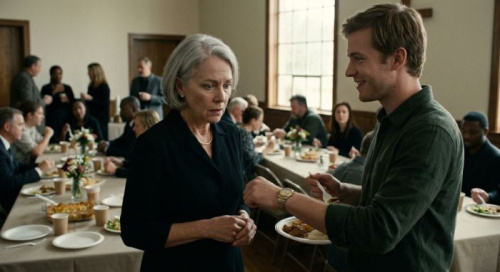
On the first anniversary of the arrest, my mother hosted a potluck on Maple Street. Forty people showed up — most of them victims, some of them strangers who'd just heard the story. There was fried chicken and coleslaw and too much pie, and at the end of the night, someone had taped a banner to the fence that said: "CEDAR HOLLOW TRUSTS ITS OWN AGAIN."
My mother stood in the middle of her yard, laughing at something the baker said, her face lit up like it hadn't been in years. And I stood on the porch, watching her, thinking about how the man who had tried to convince the whole town she was losing her mind had been the one who lost everything instead.
Karma doesn't always come fast. But it always comes. And on a bright spring evening in a small Texas town, it came with a warrant, a handshake, and forty-three people who finally got their names back.