The call came at 3:47 AM on a Tuesday. I remember glancing at my phone and seeing my sister Margaret's name on the screen. My heart sank before I even answered. Nobody calls at 3:47 AM with good news.
"She's gone," Margaret said, her voice flat and clinical. "Mom passed about an hour ago. Peacefully. In her sleep."
I sat up in bed, the words not quite registering. My mother had been at Willow Creek Manor for three years, ever since the Alzheimer's got bad enough that I couldn't care for her alone anymore. We knew this day was coming. But knowing doesn't prepare you for the phone call that changes everything.
"I'll be on the first flight," I said.
"Don't rush," Margaret replied. "Everything is handled. I've already made the arrangements."
That should have been my first clue. Margaret had never handled anything in her life without expecting something in return. She was the older sister, the golden child, the one who could do no wrong in anyone's eyes. But I knew the real Margaret. I knew the girl who locked me in the closet when I was six. I knew the teenager who spread lies about me to my friends. I knew the woman who had been slowly poisoning our mother against me for years.
I landed at O'Hare by noon. Margaret met me at the funeral home with papers in her hand. She was wearing our mother's pearl necklace — the one our grandmother had passed down, the one we had both promised Mom we would never fight over.
"We need to talk about the will," Margaret said, not bothering with a greeting.
I looked at her, really looked at her for the first time in years. She was fifty-two, three years older than me, but she had always carried herself like she was in charge. That condescending tilt of her chin. The way she looked at me like I was still the annoying little sister she used to torment.
"Can we at least bury Mom first?" I asked.
"Time is of the essence, Sarah." She shoved the papers toward me. "Mom signed a new will six months before she went into the home. I have it here, notarized and witnessed by a certified legal professional."
I took the papers and read them. It took me three passes before the words sank in.
Everything. She had left everything to Margaret.
The house in Oak Park, valued at nearly four hundred thousand dollars. The savings accounts totaling two hundred and ten thousand. The lake house in Michigan where I had spent every summer of my childhood. Mom's jewelry collection, her antique furniture, even the family photo albums.
I got nothing. Not a single dollar. Not even a memento.
"This can't be right," I whispered. "Mom promised me the lake house. She said it would be mine. I spent every summer with her after Dad died. You know that."
"You need to understand something, Sarah." Margaret crossed her arms, that smug smile spreading across her face. "I was the one who took care of Mom. I visited her every week at that home. I managed her finances, made sure her bills were paid. You were off in California, living your little writer's life, sending birthday cards and thinking that was enough."
"That's not true and you know it. I flew back every other month. I paid for her private room out of my own savings. I called her every single night, Margaret. Every single night for three years."
"Calls don't count as care, little sister."
The funeral was a blur. I sat in the front row, sobbing, while Margaret sat next to me dry-eyed, checking her phone during the eulogy. I caught her smiling when the priest talked about Mom's generous spirit. It was the smile of someone who had just gotten away with murder.
I tried to let it go. I really did. I told myself that Margaret probably needed the money more than I did. She had two kids in college and a husband who had been laid off twice. Maybe she deserved it. Maybe I was being selfish and bitter.
But something inside me refused to let it go.
I started making calls. Willow Creek Manor, the nursing home where Mom had spent her final years, was a reputable facility. I had chosen it personally. But Margaret had been listed as the primary contact. Margaret had signed the admission papers. Margaret had controlled every aspect of Mom's care.
"Do you keep security footage?" I asked the administrator, a kind woman named Denise.
"We do. Hallways, common areas, and the nurses' station. Why do you ask?"
"Can I see footage from the three months before my mother passed? Specifically, footage showing my sister's visits."
Denise hesitated. "I'm not sure I can release that without a court order or..."
"Please." I could hear the desperation in my voice. "I think something happened. I think my mother was pressured into signing that will. I think Margaret manipulated her when she was vulnerable and confused."
Denise was silent for a long moment. Then she said, "I liked your mother, Sarah. She was a kind woman. She talked about you constantly, you know. Every time I walked into her room, she was holding the photos you sent her. The ones of the lake house. She said you two had the best memories there."
My throat tightened. "She did?"
"She did. And I never once saw her with your sister where she seemed comfortable. There was always tension." Denise lowered her voice. "Come by tomorrow at noon. I'll have the footage ready."
What I saw in that administrative office the next day destroyed any doubt I had.
The video was grainy, black and white, but the audio was remarkably clear. Mom's room, October 12th, 4:30 PM. Margaret sat across from her, a stack of papers on the small table between them.
"Just sign here, Mom," Margaret said, her voice sweet and syrupy. "It's just standard insurance forms. The nursing home needs them updated for your file."
Mom looked confused, her eyes unfocused. She was in the late stages of Alzheimer's by then. Some days she didn't remember my name. "Insurance forms?" she repeated, her voice frail and trembling.
"Yes, Mom. Just sign here." Margaret placed a pen in our mother's shaking hand. "I told you about this last week. Don't you remember?"
"I don't think I should sign anything without talking to Sarah first."
The change in Margaret's face was instant and terrifying. The sweetness vanished. Her eyes hardened into something cold and cruel. "Sarah doesn't care about you, Mom. She's in California living her life. I'm the one here. I'm the one who sacrifices everything for you."
"That's not true," Mom said weakly. "Sarah calls me every night."
"She calls you because she feels guilty. It's not love, Mom. It's obligation." Margaret leaned forward, her voice dropping to a menacing whisper. "If you don't sign these papers right now, I will stop visiting you forever. I will leave you here alone in this room with nobody. You will die alone, Mom. Is that what you want?"
I watched the video with my hands shaking so badly I had to sit down. Mom's face crumpled like paper. She was afraid. I could see it in her eyes — the same terror I had seen as a child when Margaret would corner me in our bedroom.
"Please, Margaret," Mom whispered. "Don't say that."
"Then sign the papers."
And my mother signed.
The notary who had witnessed the document — a woman named Patricia Harrison — had also been caught on film. The footage showed Margaret meeting her in the parking lot of the nursing home, handing her a thick envelope. Cash, I later learned. Five thousand dollars to notarize a will that my mother never knew she was signing in her condition.
I filed a lawsuit the very next day.
Margaret laughed when she was served. She actually laughed in the face of the process server. "Good luck proving anything," she told him. "The will is completely legal. The notary confirmed it. My sister is just bitter because she got nothing."
But Patricia Harrison was not a criminal mastermind. She was a desperate woman who made a terrible mistake. When I deposed her, she broke down in less than ten minutes. She admitted everything — the cash payment, the fabricated notarization, the fact that she never once verified that my mother understood what she was signing.
"It was wrong," Patricia sobbed on the witness stand. "I knew it was wrong the moment I did it. But Margaret was very persuasive. She said her mother was dying anyway and that Sarah was just going to waste all the money on drugs. She lied to me. I believed every word."
The courtroom went silent. Judge Harriet Morrison peered at Patricia over her reading glasses. "You believed a woman who paid you five thousand dollars in cash in a nursing home parking lot?"
Patricia had no answer.
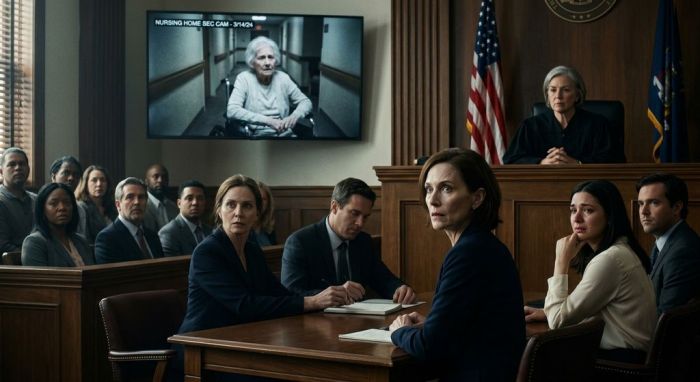
The trial lasted six days. But the moment that sealed everything came when the prosecution played the nursing home video. The entire courtroom watched in silence as Margaret's sweet voice turned to venom. When she said the words "you will die alone," I heard gasps from the jury box.
Margaret's face went white as a ghost. Her lawyer leaned over and whispered something to her. She shook her head violently, tears streaming down her face. Not tears of remorse. Tears of getting caught.
The jury took three hours to deliberate.
"On the charge of fraud by deception, we find the defendant guilty."
Margaret was sentenced to eighteen months in state prison, with an additional five years of probation. The will was declared null and void. The judge ordered that everything — every penny, every property, every piece of jewelry — be split between Margaret's children and me.
I didn't keep a single dollar of it.
I used my entire share to establish a fund in Mom's name — a scholarship program for elderly victims of financial abuse. The lake house I kept, but only because Mom had always wanted it to stay in the family. I spent the first summer there on my own, sitting on the porch where Mom and I used to watch the sunset over the water, her hand in mine.
Margaret's children stopped speaking to her after the trial. Her husband divorced her while she was serving her sentence, taking the kids and moving out of state.
I visited Margaret once, six months into her incarceration. I told myself I was doing it for closure. But when I sat across from her in that sterile visiting room, I realized I had already found the peace I was looking for.
"How is prison treating you?" I asked.
She glared at me with the same hatred I had seen my entire life. "You think you won, don't you?"
"I don't think of this as winning," I said quietly. "I think of it as justice. For Mom. For the little girl you locked in closets. For every person you've manipulated and hurt."
"I'll get out, Sarah. And when I do..."
"You'll do what?" I stood up. "You have nothing left, Margaret. No money. No family. No reputation. The only power you ever had was the fear you created in other people. And I am not afraid of you anymore."
I walked out of that prison with the weight of a lifetime lifted from my shoulders.
Margaret was released after fourteen months for good behavior. She now lives in a small studio apartment in a town three hours from Chicago. She works as a cashier at a discount department store.
She tried to contact me once. A letter arrived at the lake house, asking if we could "start over" and "be sisters again."
I burned it in the fireplace.
Some bridges, once burned, stay burned. And some people don't deserve a second chance. They deserve exactly what they got.