The truck pulled into the stadium lot at 9:07 on a Saturday morning in late August, and every parent on the bleachers stood up to cheer. For three months we had handed Coach Marcus Delaney our cash — eighteen thousand dollars of it, in plain envelopes — for new helmets he swore would change the program forever. My son Jason stood beside me, bouncing on his heels, already wearing his jersey for the season opener that night.
I remember thinking how bright that morning was. I remember thinking how lucky we were to have a coach who cared that much. And I remember the exact second I understood that none of us knew the man at all.
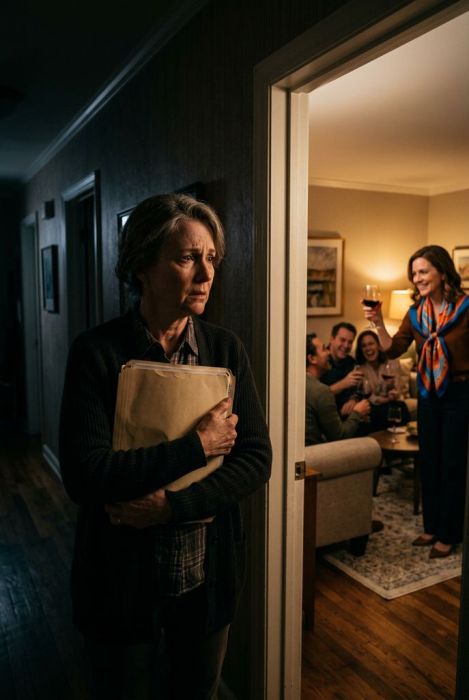
My name is Dana Whitfield, and six months earlier I had agreed to be the new treasurer of the Grant Falls High School Booster Club. I ran the front desk at Dr. Okafor's dental clinic, and I balanced my checkbook to the penny on the first of every month, so when old Carl Monroe packed up and moved to Arizona, everyone looked at me. I figured a ledger was a ledger. I had no idea I was walking into a crime scene with a scoreboard and a PA system.
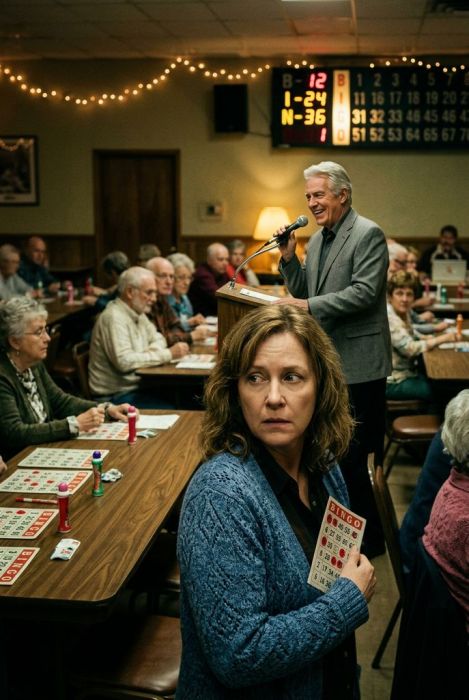
Coach Mac — everyone called him Coach Mac — had been the head coach at Grant Falls for nine seasons. He was fifty-two, silver-haired, with a voice that could fill a locker room and then drop to a whisper when he talked about the thing he loved most. Family. That was his word, his whole sermon. We are not a team, he'd say at every booster meeting, one hand pressed flat over his heart. We are a family. And families take care of each other.
He showed up at every homecomming parade. He visited sick players in the hospital and paid for two funerals out of his own pocket when kids from the program lost grandparents. He remembered birthdays, he knew the names of pet dogs, he hugged the mothers and slapped the fathers and made every single one of us feel like he was coaching our boy like he was his own. Jason's father left when Jason was six and never looked back, so believe me when I tell you: Coach Mac filled a hole in that house. In a lot of houses.
And every spring, for as long as anyone could remember, Coach Mac ran the Helmet Drive. The district budget barely covered lights and bus fuel, so the equipment fund was on us, the parents. Three hundred and fifty dollars a player, cash or check, dropped into a plain envelope at the spring banquet to keep the paperwork down. That was his explanation, and nobody questioned it, because Coach Mac was family, and family didn't need receipts.
For the first few years, the helmets always arrived — late, but they arrived. A white truck with Summit Sports Supply painted on the side would roll in during the last week of August, and the boys would carry box after box into the equipment room like they were hauling gold. It wasn't until this year, my first as treasurer, that I started to notice the smell underneath the fresh paint and the crowd noise.
I first asked for the receipts in June, the week after the banquet, because every dollar that came in had to be reconciled. That was my job now, and I took it seriously. Coach Mac waved me off with that easy laugh of his. Dana, my love, Summit faxes everything straight to me. I'll get you a copy. Don't you worry your pretty head about equipment. I laughed along, because that's what you did with Coach Mac. But I went home that night and wrote in my little notebook: Asked for receipts a third time. Eyes didn't match the smile.
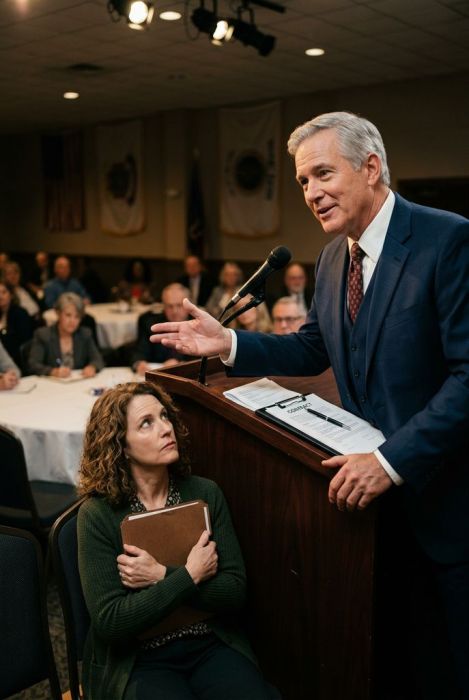
Then the district dropped its bomb in July: budget cuts, no new weight room, no locker room updates, no equipment line at all. And Coach Mac stood up at the emergency booster meeting with actual tears in his eyes, and he gave us the speech of his life. The district is leaving our boys behind, he said. So we're going to do what families do. We're going to raise it ourselves. He set the goal at eighteen thousand dollars, and the room went wild.
He ran a car wash. He ran a barbecue. He ran a silent auction with a signed jersey from a retired NFL player that he got, he said, "through a friend." Old Harold Pemberton, the school board chairman and Coach Mac's regular golf partner, pledged three thousand dollars on the spot and stood up to tell everybody what a saint we had leading our boys. Parents gave from retirement accounts. Grandparents wrote checks they couldn't really spare. At the end of it all, I counted eighteen thousand, four hundred and twelve dollars, and I wrote it in the ledger in neat columns, and I asked for the invoices one more time.
Coach Mac stopped returning my calls.
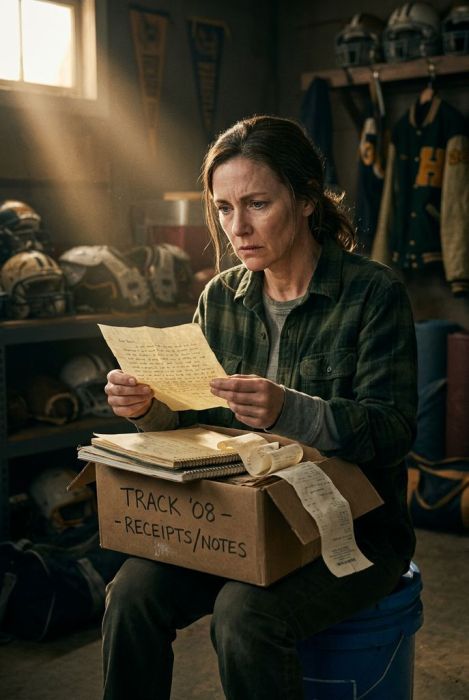
In early August, I was in the equipment shed behind the field house looking for the scoreboard remote that Coach swore existed somewhere in there, and I found a cardboard box under a pile of old blocking sleds. The lid said PLAYBOOKS 2009-2014 in black marker. Inside were playbooks, sure, but underneath them was something no coach ever left behind. A spiral notebook, the kind they carry on the sideline, with pages of handwriting I recognized from a hundred practice plans taped to the field house door.
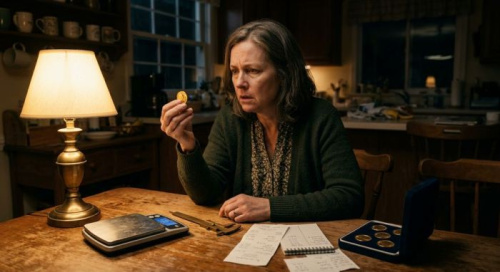
Cedar Grove, it said at the top of one page. Fourteen families, forty-nine hundred cash. Thank-you notes to Summit never sent. The next page said Lakeview. Eleven families, thirty-eight fifty. Paid the garage addition. And the page after that said Ridgemont. Sixteen families, fifty-six hundred. Audit coming. Took the Grant Falls job.
I sat down on an upturned bucket because my knees went soft. I read the notebook twice, then a third time, because my hands were shaking so badly the words swam. Coach Mac hadn't been building a football program in Grant Falls. He'd been running the same season — the same scam — for fifteen years, moving to a new town every few years right before anybody could catch up. The family he loved so much was a customer list. The boys who called him Dad were invoices.
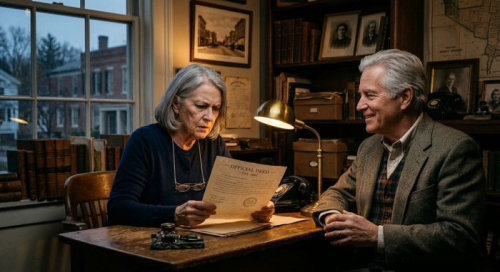
The first call I made was to Cedar Grove High School. A woman named Ella Meissner answered, and when I told her why I was calling, she was quiet for so long I thought she'd hung up. You're the third person who's ever called me about that man, she finally said. No, ma'am, I told her. I'm the first one who's going to do something. Ella was seventy-one years old, a widow whose husband had coached at Cedar Grove, and she'd been their booster treasurer twelve years ago. She had kept everything. Deposit slips, envelopes, letters, and the handwritten list of fourteen families who handed over cash for helmets that never came.
Over the next week, the picture got wider and darker. I called Summit Sports Supply myself, and their regional manager, a man named Vance Okafor, confirmed what the notebook suggested. Summit had cut ties with Coach Mac years ago after what he called a billing irregularity — checks made out to something called MSD Equipment Fund that kept landing in a personal account. He's been running used-gear dealers and keeping the difference for a decade, Vance told me. I always figured somebody would catch him eventually. I asked him if he'd put that in writing. He said he'd been waiting fifteen years for someone to ask.
Then I made the call that changed everything. I reached Detective Wendell Cruz at the county prosecutor's office, a patient-sounding man who listened to the whole story without interrupting once. When I finished, he asked me to hold, and when he came back, his voice was different. Mrs. Whitfield, he said, you're the second complaint we've gotten about Coach Delaney this month. The first came from a school district in Pennsylvania. We've been waiting for the pattern to line up. This is the pattern.
That was the moment I understood the real twist of it all. He wasn't just a small-town thief who got lucky. He was a serial offender with a system, and the system had finally been noticed. Detective Cruz built a file with Ella's records, Vance's bank documentation, and a warrant for Coach Mac's personal accounts. The numbers were brutal. In nine years at Grant Falls alone, more than a hundred and twenty thousand dollars had flowed into the big house on Lake Road — the one with the porch swing everybody admired, the one Coach Mac said he'd bought "with a little inheritance and a lot of luck."
Coach Mac must have felt the walls closing in, because he did something bold. Two weeks before the opener, he called a press conference on the fifty-yard line and announced that the new helmets were coming. A truck from Summit was arriving Saturday morning, and the whole town was invited to the stadium to watch the unveiling. He stood in the end zone with his arms spread wide and told the players, This is what family does. This is what love looks like. The boys roared. Jason hugged me and said, Mom, Coach Mac is the best man I know. I smiled, and I didn't sleep for two nights.
On Friday night, while Jason slept, I met Detective Cruz in the parking lot of the Piggly Wiggly, the way you do in a town like ours when you don't want anyone to see. He's renting a U-Haul from Columbus, Cruz told me. He's got sixty used helmets with cracked shells, worth maybe three thousand dollars, and he's going to pass them off as the eighteen thousand dollar order he collected from your families. Then he probably resigns and moves again before Thanksgiving. Cruz had a warrant, three plainclothes officers, and a plan. You did the right thing, he said, when I started to apologize for how long it had taken. Most people would have let it go. Most people didn't have a son in that program, I told him.
The U-Haul arrived at 9:07, right on schedule, backing up to the fifty-yard line while the crowd cheered and the band played. Coach Mac hopped out in his lucky windbreaker, arms raised like a returning hero, and waved the parents up to help unload. And then the back doors of the truck opened, and Detective Cruz stepped out first, badge up, with two uniformed officers behind him.
I will never forget that sound. Four hundred people cheering, and then the cheer dying all at once, like somebody pulled the plug on a fountain. Coach Mac's smile held for maybe two full seconds while his brain caught up with his eyes. Then it didn't hold at all.
They read him his rights right there on the field, in front of the families who had trusted him and the boys who had loved him like a second father. The used helmets were stacked all over the back of the truck, sixty shells with cracks and faded logos, and Detective Cruz held the rental agreement up for the crowd to see. The rest of that eighteen thousand? Cruz told them, in a voice that carried all the way to the parking lot. It went to Coach Mac's mortgage and a new boat he put a deposit on last week.
Coach Mac was charged with grand theft, wire fraud, and ten counts of financial exploitation of the elderly, because three of the families who had handed him cash were grandparents raising their grandchildren on fixed incomes. He sat in the front row of the courtroom looking small and old, his silver hair suddenly gray, his family speech nowhere to be found. He never looked at Jason. Not once.
The trial didn't take long. Ella Meissner flew in from Missouri with her banker's box on her lap, and she read the names of fourteen Cedar Grove families into the record, one by one, her voice steady the whole time. Victims came from three states. Coach Mac pled guilty on the second day, and the judge sentenced him to nine years in the state prison, with restitution ordered for every single family — including the ones right here in town who had called me a troublemaker, a busybody, a woman who didn't know her place.
The hardest part was never the money. It was the boys. Jason cried the night of the arrest, not for the eighteen thousand dollars, but because he had loved the man. He was like a dad to me, he said, and I held him and told him the truth, the hard one: that Coach Mac had said those exact words to every kid in every town, and that is exactly what made them a lie. Trust, I told him, is the most expensive thing you will ever give anybody. Spend it slowly.
It took a year for the dust to settle. The district hired a real equipment manager and a real accountant. The boosters rebuilt under new rules — every dollar receipted, every invoice public, every meeting open. And the following August, a quiet white truck pulled into the stadium lot with no fanfare at all, and sixty brand-new helmets came out of it, paid for with restitution money the court had recovered. The boys carried them into the equipment room the way they always had, but this time, no one cheered. This time, they just checked the boxes against the list.
Jason starts his senior season tonight, three years after that morning at the fifty-yard line. He is a different boy than the one who cheered for Coach Mac. He is steadier, quieter, harder to impress, and he reads every contract twice. He keeps a little notebook now, just like I do, and last week he told me he wants to coach someday. The right way, he said. I believe him.
Coach Mac always said football teaches boys about consequences. Turned out, it taught him more than it ever taught them. He thought the game belonged to him, that the pattern belonged to him, that the families belonged to him. But karma doesn't run the clock, and it doesn't call timeouts, and it doesn't care how many people call you family. It just waits until you're standing on the fifty-yard line with your arms in the air — and then it hits exactly where it matters.