I hadn't stepped foot in my grandmother's house in twelve years. Not because I didn't love her — I adored her. But because every time I visited, my Uncle Richard made sure I remembered exactly how worthless he thought I was.
"I see you're still collecting those baseball cards, Mickey," he'd say at every family dinner, his voice dripping with that particular brand of contempt he'd perfected over forty years. "You're what, twenty-five now? Must be nice living in your mother's basement, playing with children's toys."
My grandmother, God rest her soul, would always try to change the subject. "Richard, leave the boy alone. He's doing just fine."
"He's a grown man, Mother. When I was his age, I owned two rental properties."
That was Uncle Richard's favorite topic. His properties. His money. His success. He'd bought his first house at twenty-two, flipped it, and spent the next three decades building a small real estate empire in our little Pennsylvania town. Meanwhile, he treated his own siblings like they were beggars on the street.
My mother — his own sister — drove a 1998 Honda Civic with a rusted-out muffler until the day it finally died on Interstate 81. When she asked Richard if he could help her find a reliable used car for under five thousand dollars, he laughed in her face.
"Get a second job, Lisa," he told her. "That's what the rest of us do."
She'd been working double shifts as a nurse for twenty-three years. But Richard never let facts get in the way of his superiority complex.
The bullying wasn't just verbal. I'll never forget Thanksgiving 2008. I was seventeen years old, and I'd saved up six months of lawn-mowing money to buy my grandmother a beautiful Lladro figurine — a porcelain angel holding a harp. It cost me every penny I had, but seeing her face light up when she opened it was worth ten times that.
"Where'd you steal that from?" Richard sneered from across the table.
"I bought it," I said, my voice shaking.
"You? Buy something that nice? Must have been from a yard sale."
My grandmother, the only person in the family who had the courage to stand up to Richard, set the figurine on the mantelpiece with deliberate care. "It's the most thoughtful gift I've ever received," she said, looking Richard directly in the eyes. "It came from his heart, not his wallet."
Richard's face went red. He pushed his chair back from the table, the legs screeching against the hardwood floor. "I'm not hungry anymore."
Three years later, my grandmother passed away. She'd battled lung cancer for fourteen months, and through it all, Richard barely visited. He was too busy, he said. Too many properties to manage.
But the moment she took her last breath, Richard was there. Not to mourn — to execute.
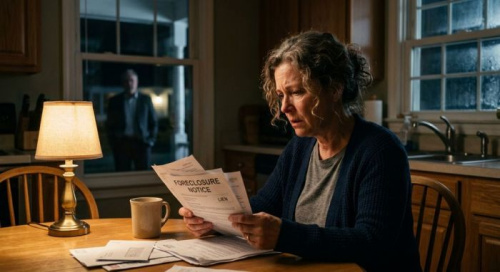
Within twenty-four hours of her death, he'd changed the locks on her house. Within a week, he'd hired a lawyer. And within a month, he'd produced a will that none of us had ever seen before.
"I'm executor of the estate," he announced at the reading, his suit immaculate, his smile barely concealed. "Mother left everything to me. The house, the savings, the life insurance — it's all mine."
"That's impossible," my mother whispered, her face pale. "She told me she was splitting everything equally between us."
"People change their minds, Lisa. She was sick. She was confused. She relied on me to handle her affairs."
The will looked legitimate at first glance. It was typed, notarized, and dated just three weeks before she died. But I knew my grandmother. I knew she wouldn't have cut out her own daughter — the woman who drove her to every chemotherapy appointment, who held her hand through every sleepless night, who bathed her when she was too weak to stand.
Richard didn't just steal the house. He sold it within two months to a developer who tore it down and built a strip mall. The money went straight into his pocket.
The family was devastated. My mother slipped into a depression that lasted nearly a year. My aunt stopped speaking to anyone. The fabric of our family, already frayed by Richard's years of emotional abuse, finally tore apart completely.
I went to law school. Not because I wanted to be a lawyer — I'd always wanted to work for the FBI. But I needed to understand the system. I needed to know exactly how Richard had gotten away with what he did, and I needed to learn how to stop people like him from doing it again.
I specialized in forensic document examination. I learned everything there is to know about handwriting analysis, ink dating, paper composition, and digital signature verification. I became an expert at spotting forgeries.
Fourteen years after my grandmother's death, now a senior forensic document examiner with the FBI, I was visiting my mother for Christmas when she handed me an old shoebox.
"I found this in the attic," she said. "It's some of Grandma's old papers. I don't know why I kept them."
I opened the box, and my breath caught in my throat. Inside were dozens of letters my grandmother had written over the years — birthday cards, thank-you notes, grocery lists. Dozens of samples of her handwriting.
On a whim, I pulled up a digital copy of the will Richard had produced. I'd kept it all these years, a reminder of the battle I was determined to eventually win.
It took me exactly forty-five minutes to confirm what I'd always known. My grandmother's signature on the will was a forgery. A good one — Richard had clearly practiced it. But the pressure points were wrong. The slant was off by three degrees. And most damningly, the letter "e" in "Eleanor" had a distinctive loop that my grandmother always made, a loop that was absent from the will.
I called Richard the next day.
"Uncle Richard," I said, keeping my voice calm. "It's Michael. I need to talk to you about Grandma's will."
"I've got nothing to say to you," he snapped. "That matter is closed."
"It's not closed, Uncle Richard. I'm a forensic document examiner for the FBI. And I've just proven that you forged Grandma's signature."
There was a long silence on the other end of the line. I could hear his breathing growing heavier.
"You're bluffing," he finally said. "You couldn't prove anything. It's been over a decade."
"It's been fourteen years," I corrected him. "And forgery has no statute of limitations in Pennsylvania when it involves real estate fraud. I've already filed the affidavit with the district attorney's office."
"You wouldn't dare. I'm your family."
"Are you?" I asked. "Because family doesn't steal their mother's house. Family doesn't destroy their sister's life. Family doesn't spend thirty years making everyone around them feel worthless."
"You think you're so smart, don't you?" His voice had gone cold, the same tone he'd used on me my entire childhood. "You always thought you were better than me."
"I didn't have to think I was better, Uncle Richard. I just had to wait for the evidence to prove it."
The trial lasted eight days. The prosecution presented my analysis to the jury, along with testimony from the original notary — a woman in her eighties who had been Richard's neighbor. Under oath, she tearfully admitted that Richard had pressured her to notarize the document without my grandmother present.
"I knew it wasn't right," she said, her voice trembling. "But Richard was always so... persuasive. I was afraid of him."
The jury deliberated for less than three hours.
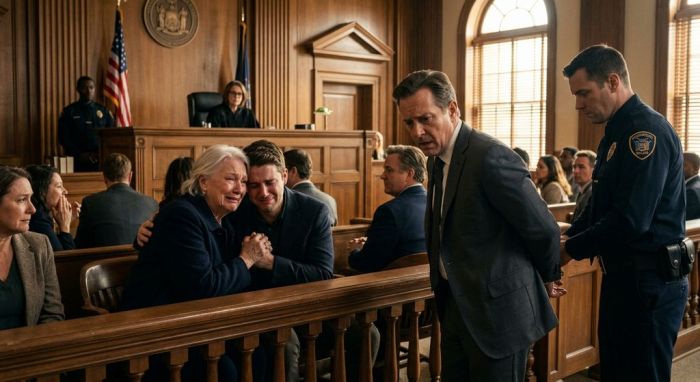
When the verdict was read — guilty on all counts of forgery, fraud, and theft — my mother began to cry. Not tears of sadness, but tears of relief. She reached across the courtroom railing and squeezed my hand.
"Your grandmother would be so proud of you," she whispered.
Richard stood motionless as the bailiff handcuffed him. He was sentenced to five to ten years in state prison and ordered to pay full restitution — over eight hundred thousand dollars, plus interest.
The judge looked at him over her reading glasses. "You stole from your own family, Mr. Thornton. You terrorized them for decades. And you thought you would never be held accountable. I hope these next few years give you time to reflect on the person you've become."
As they led him out of the courtroom, Richard turned and looked at me. For the first time in my entire life, I didn't see contempt in his eyes. I saw fear.
"That porcelain angel you gave Grandma," I called after him. "The one you threw in the trash the night she died? I found it. I kept it. It's sitting on my mantelpiece right now."
His face crumpled. The bailiff pushed him through the door, and he was gone.
My mother turned to me, wiping her eyes. "When did you find that figurine in the trash?"
"The night she died," I said. "I knew he'd done it. I couldn't prove it then. But I've always known exactly what kind of man he was."
She hugged me tight. "You waited fourteen years."
"Justice doesn't have an expiration date, Mom. It just needs someone patient enough to find the proof."
We sold the strip mall property that Richard had illegally sold. The proceeds went back to the family, split four ways among the siblings. My mother finally retired her twenty-five-year-old Honda and bought herself a nice, reliable Toyota.
And that Lladro angel still sits on my mantelpiece today. Every time I look at it, I remember that bullies can win for a while. They can steal, lie, and cheat their way through life. They can make you feel small and worthless. But the truth has a longer memory than they do.
And I would know. I work for the FBI.