My husband Carl died on a Tuesday afternoon. Not from a heart attack or a stroke, but from the quiet kind of death that happens when a man works forty-two years for a company and gets thrown away like a broken tool. The doctors called it complications from stress-induced hypertension. I called it murder, even if no one in the legal system wanted to hear that word.
Carl had been the plant foreman at Willamette Valley Manufacturing for over four decades. He started there at nineteen, back when the company was a family operation run by the Millers. Old Man Miller had shaken his hand on the first day and promised him a pension if he stayed loyal. Carl believed in handshakes. He believed in loyalty. He believed that if you gave a company your whole life, they would take care of you when you got old.
He was wrong.
In 2019, a private equity firm called Sterling Pacific Group bought Willamette Valley Manufacturing. They didn't buy it to run it. They bought it to strip it. Within six months, they had cut the workforce by forty percent, frozen all pensions, and replaced the family healthcare plan with something so thin you could read a newspaper through it. Carl's blood pressure medication, which had cost him thirty dollars a month under the old plan, suddenly cost four hundred.
He tried to fight it. He went to meetings, wrote letters to the new CEO, stood up at town hall events and asked questions. But the new CEO, a man named Gregory Vance, didn't come to our town for meetings. He didn't shake hands. He sent lawyers.
The day Carl collapsed in his garden, clutching his chest, I knew exactly who had killed him. The problem was proving it.
After the funeral, people told me to grieve. To rest. To let the lawyers handle things. But I had been a schoolteacher for thirty-five years. I had dealt with bullies my entire career, and I could spot one from across the room. Gregory Vance was just a bully in a seven-thousand-dollar suit.
I started small. I called the company's HR department and asked about the pension Carl had been promised. A young woman with a rehearsed voice told me that the pension plan had been "restructured" and that Carl's benefits had been "transitioned" to a 401(k) plan that he had never signed up for. I asked for documentation. She said she would mail it. She never did.
I called again. And again. Each time, I got a different person with a different excuse. After the fourth call, I received a letter from Sterling Pacific's legal department. It was signed by Gregory Vance himself, and it said that any further communication regarding my husband's benefits would be considered harassment and would be referred to their legal team for "appropriate action."
The letter was polite. Professional. And it made my blood boil.
That's when I found out about the stock. Carl had been with the company so long that he had accumulated shares under the old employee stock ownership plan. It wasn't much — maybe two hundred shares — but after the buyout, those shares had become part of Sterling Pacific Holdings. And as a shareholder, even a small one, I had rights. I had access to annual meetings. I had a voice.
I called to register my shares and request information about the upcoming shareholder vote. That's when things got interesting.
A week later, a man showed up at my door.
His name was Derek Foster, and he was Gregory Vance's chief of staff. He was young, maybe thirty-five, with the kind of smile that looked like it had been purchased at an expensive store. He stood on my porch in a charcoal suit and told me, very politely, that Mr. Vance had heard about my inquiries and wanted to "resolve this matter amicably."
"Mr. Vance is prepared to offer you a full buyout of your shares," Foster said. "Above market value. In exchange, you would agree to cease all communication with the company and its affiliates."
"How much?" I asked.
He named a number. It was insultingly low — about half of what Carl's shares were actually worth based on the last valuation I had found in a public filing.
"That's not even close to fair," I said.
Foster's smile didn't waver. "Mrs. Holloway, I understand this is a difficult time. But I want to be honest with you. If you choose to pursue this, the company will have no choice but to defend itself. And Mr. Vance has a very good legal team."
It wasn't a threat. Not explicitly. But the way he said it — the way his eyes didn't blink — told me everything I needed to know.
I thanked him for his time and closed the door.
Then I went to my bedroom, opened my nightstand drawer, and pulled out the digital voice recorder I had used for years to record my lectures. I had turned it on before I opened the front door. I had been recording the entire conversation.
I realize that might sound calculating. But I hadn't gotten to be sixty-eight years old without learning a few things about people. When a man in a tailored suit shows up at a widow's door on a Tuesday afternoon, he's either a salesman or a predator. Derek Foster was no salesman.
Over the next three weeks, the pressure escalated. I received a certified letter threatening legal action if I "continued to interfere with corporate operations." My neighbor told me that two men had come by asking questions about me — what time I left the house, who visited me, whether I had any family in the area. My daughter, who lived in Portland, called to say that someone had contacted her employer and made "anonymous inquiries" about her professional history.
They were trying to intimidate me. And I'll admit, it was working. I stopped sleeping well. I started checking my locks twice before bed. I stopped going to the grocery store after dark.
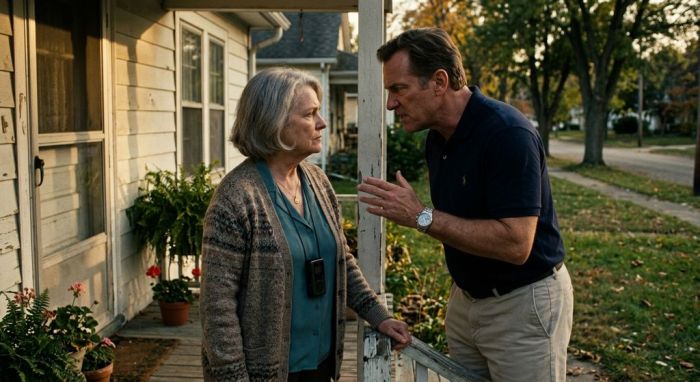
But I also kept recording. I started wearing a small pendant that contained a hidden audio recorder — something I had bought online after watching a true crime documentary. Whenever I went out, it was on. Whenever someone from the company called, I recorded the conversation. I filled an entire memory card with evidence over the course of a month.
The key moment came when Gregory Vance himself showed up at my door.
It was a Saturday morning, and I was in my garden pulling weeds when a black Mercedes pulled into my driveway. He stepped out in casual clothes — khakis and a polo shirt — but he still looked like a man who had never changed his own oil.
"Mrs. Holloway," he said, walking toward me without waiting for an invitation. "I thought it was time we met face to face."
I stood up, brushing dirt off my hands. The pendant was around my neck.
"Mr. Vance. To what do I owe the pleasure?"
He stopped about six feet away and crossed his arms. "I'll be direct with you. You've been making noise, and it's becoming a problem. I have a major acquisition closing next quarter, and I can't have a disgruntled widow stirring up trouble with the board."
"A disgruntled widow," I repeated. "Is that what I am?"
"You're a woman who lost her husband and is looking for someone to blame. I get it. But you're wrong about me. I didn't kill your husband. The market killed your husband. The economy. Globalization. That's not my fault."
I wanted to scream at him. Instead, I took a breath and said, "Carl's pension was promised to him in writing. You took it away. That's not globalization. That's theft."
Vance laughed. It was a short, sharp sound. "You want to talk about theft? Do you have any idea how much money this company was losing under the old management? We saved this town. Without us, that factory would have closed entirely, and everyone would have lost their jobs. I gave people another five years of employment. You should be thanking me."
"Thank you for destroying my husband's health?"
"Your husband had a pre-existing condition."
I felt my hands start to shake. "He did not."
"According to our records, he did." Vance's voice dropped. "And I have a very good team of lawyers who can prove it in court. So here's what's going to happen. You're going to accept the buyout offer. You're going to sign a non-disclosure agreement. And you're going to stop digging into things that don't concern you. If you do that, you walk away with a check. If you don't..."
He let the sentence hang.
"If I don't?" I asked.
"If you don't, I will bury you in legal fees until you have nothing left. I will take your house. I will drain your savings. And when you're sitting in an empty apartment, eating canned soup, you'll wish you had taken my deal."
He turned and walked back to his Mercedes without another word.
I waited until he drove away. Then I went inside, removed the memory card from my pendant, and made a backup on my computer. I now had everything I needed.
The class action lawsuit was filed six weeks later. I wasn't the only former employee's family member who had been mistreated. There were fifty-seven of us in total — widows, retirees, former workers who had been forced out without their benefits. I had found them through Facebook groups and community bulletin boards. We had pooled our resources and hired a law firm that specialized in corporate fraud.
The lead attorney was a woman named Sophia Chen, and when I played her the recordings of Derek Foster and Gregory Vance, she didn't say anything for a long moment. Then she looked up at me and said, "Mrs. Holloway, do you have any idea what you've done?"
"I recorded two men threatening an elderly widow," I said. "Is that illegal?"
"In Oregon, it's a one-party consent state. As long as you were part of the conversation, it's perfectly legal." She smiled. "And this is going to be admissible in court."
The trial lasted three weeks. The evidence was damning. Foster's threats on my porch. Vance's admission that he was trying to silence me. Documents showing that the company had knowingly underfunded the pension plan for years. Internal emails where executives joked about "managing the old folks" by making the benefits process so difficult that people would give up.
The jury deliberated for six hours. They came back with a verdict in our favor. The damages were substantial — enough to compensate every single plaintiff, with enough left over to cover legal fees and then some. But the real victory was watching Gregory Vance's face as the foreman read the verdict.
He looked like a man who had just been told his entire world was about to collapse. And for once, he was right.
Sterling Pacific Group dissolved within a year. The partners lost everything. Derek Foster was disbarred. And Gregory Vance — well, Gregory Vance didn't go to prison. Corporate crime rarely gets that kind of justice. But he lost his company, his reputation, and most of his money. I heard later that he moved to Arizona and started selling timeshares. I like to think that's true.
As for me, I bought a new garden shed and planted roses. Carl would have liked that. And every time I look at the pendant I still wear, I remember that sometimes the most dangerous weapon an old woman can carry isn't a gun.
It's a record button.