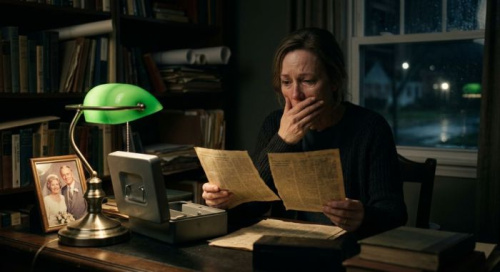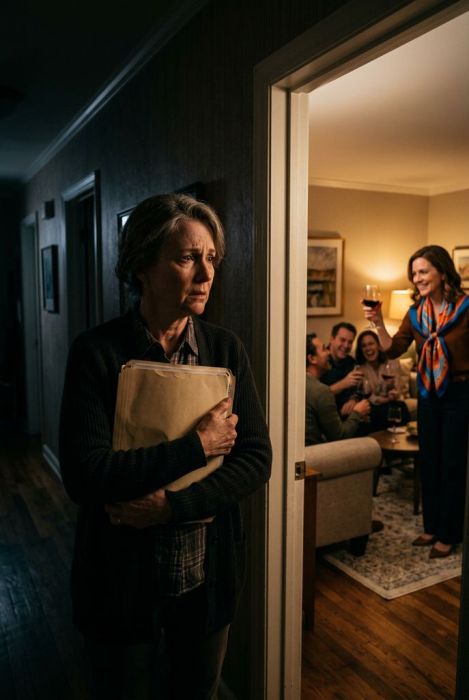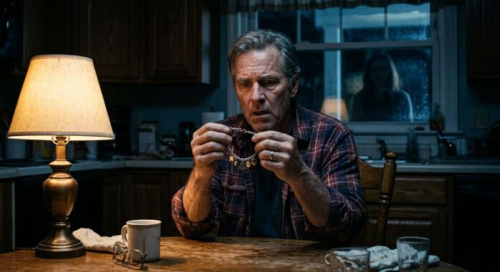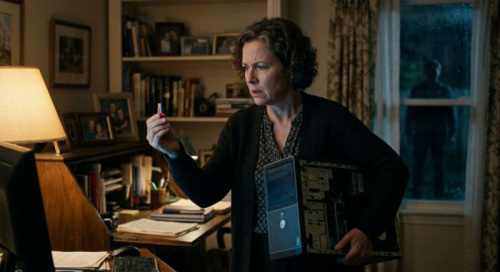
The night of the Spirit Circle, I stood in the dark behind the velvet curtain at the far end of the Jefferson Room in Glenhaven's Community Center, holding a cassette tape that smelled of dust and my mother's tears. On the stage, Madame Seraphina floated between the candles in her violet robes, telling eighty people she could feel their loved ones pressing close from the other side. The man beside me — a detective I had met six weeks earlier — pressed the recorder in his lapel. The speakers crackled to life. And every person in that room heard exactly who had been talking to the dead all along.
This is how we got there, because for nineteen months my mother believed that woman was her lifeline to my father. This is how the most beloved woman in Glenhaven ended up in the back of a sheriff's cruiser with her own voice playing back at her.
My name is Claire Bennett. I moved home to Glenhaven, Ohio, two weeks after my father, Harold Bennett, died of a stroke at seventy-nine. I was fifty-one, divorced, a third-grade teacher for twenty-five years in Cincinnati. When Mom called that Tuesday with her voice cracked and far away, I packed my car without thinking. We buried Dad on a gray Friday, and I stayed because my mother looked at me the way a shipwreck looks at a lighthouse.
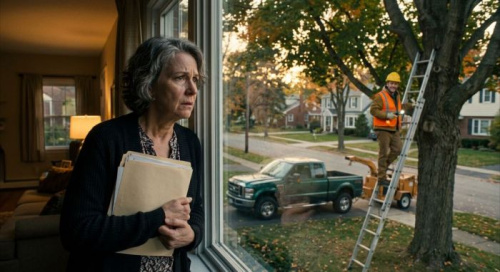
Mom and Dad had been married fifty-three years. They were the couple other people measured themselves against — still holding hands in the grocery store. When Dad went, something in her folded in half. She stopped cooking. She stopped calling her sister. She sat by the back window with his flannel shirt folded on her lap for hours, and no pill or prayer pulled her out of it.
That was how Vivian Thorne found her.
Everyone called her Madame Seraphina, and if you asked anyone in Glenhaven they would have told you she was a saint. She moved to town four years earlier, into the old Victorian on Maple Hill. She ran what she called a grief ministry out of her parlor — candles, silk scarves, a brass bell, a velvet chair by the window. She helped the food pantry, donated to the library's children's wing, and sat with dying Mr. Kohl every afternoon. The widows adored her. When my mother's neighbor Delia Parson lost her husband, it was Seraphina who brought her back to life, as Delia said, with tears shining in her eyes.
Two weeks after the funeral, Delia showed up at our door with a casserole and a suggestion. Call her, Claire, Delia said. She'll help your mama. She gave me back my Danny. I hear him at night, in the wind. I had my doubts — I was a science teacher's daughter who had failed nothing in life but belief in the paranormal. But Mom was withering, and if a kind woman with candles could put one hour of peace in her chest, I thought, then fine. I let Delia write the number down.
It is the single decision of my life I will never forgive myself for.
At first it all seemed gentle. Seraphina came to our house — not the other way around, which I now understand was the first move of a very old con — and held Mom's hands across the kitchen table. She spoke in a honeyed voice about heaven, about Dad being in the room, resting his hand on your shoulder. Mom wept and nodded and told me she felt him there, truly. I wanted to believe it so badly that I ignored the gray ledger Seraphina left on our counter, the one with Light Foundation — Donation printed at the top.
The word donation, I would later learn, was doing a lot of heavy lifting.
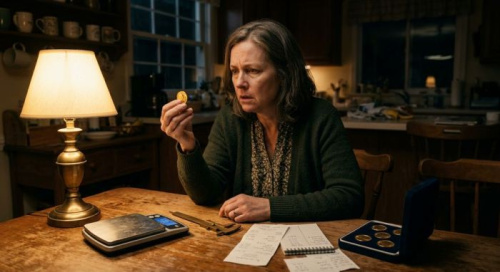
Over the next eighteen months, Seraphina drained my mother of eighty-seven thousand dollars. Not all at once — that would have been clumsy. She worked it in layers, like a landscaper adding topsoil. First the healing sessions at a hundred and fifty dollars apiece, twice a week. Then the cleansing rituals — four hundred each, to wash the dark energy trapping Dad between worlds. Then the spirit box Dad's voice spoke through, rented at six hundred a month. Then the chapel pledge, because Seraphina had seen a vision that Dad could not ascend until his widow made a sacred gift to the Healing Chapel she was building.
And because my mother loved a man who was gone, she paid — out of checking, then savings. And finally, in the cruelest month of all, she paid out of the roll of hundred-dollar bills Dad had kept in his dresser for a fishing trip they never took — money Mom had once shown me, laughing, saying this is our trip to Florida someday. It went, instead, into Vivian Thorne's pocket.
I should have seen it sooner. But I had a job, and Mom hid it the way people hide what they're ashamed of. She hid the receipts in a shoebox under her bed. She told me the bank trips were errands. When I asked gentle questions, her eyes went flat, and once she snapped, You never believed in your father the way she does.
The first crack came on a Thursday in June, when I went to the bank to add my name to Mom's account. The teller, a kid I'd taught in third grade, looked at the statement twice before handing it over. There, in gray ink, was a wire transfer to Seraphina's Light Foundation for nine thousand, four hundred dollars.
I confronted Mom that night. It is the only time I have seen my mother cry and scream at the same time. She told me I was jealous. She told me Dad's spirit had warned her that a jealous daughter is a closed door. I asked her to stop going. She said she would rather I move back to Cincinnati.
So I did the only thing I knew how to do. I went to the library. Nobody builds a life on other people's grief and gets away with it clean. Greed leaves fingerprints.
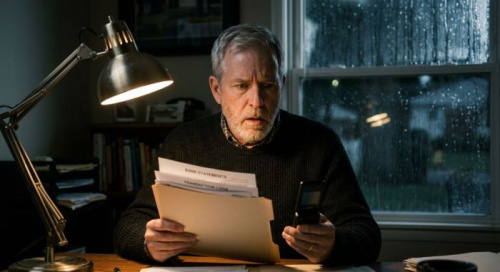
I spent two weeks in the Glenhaven Library's internet room, looking up Madame Seraphina, her foundation, her history. The online trail was bare as a swept floor — a website with stock photos, a post office box, no tax filings, no business registration. A real charity leaves a paper trail the way a real dog leaves footprints in mud.
And then I found Ray Delgado.
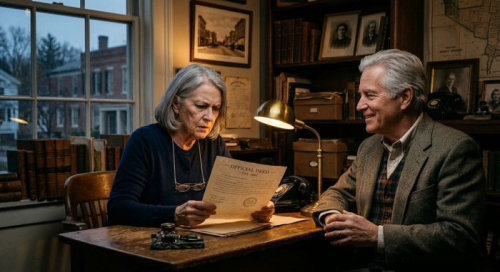
Ray was a retired detective, seventy years old, with a face like a crumpled road map and the patience of a man who waited forty years for people to tell the truth. His aunt, Margaret Delgado, had given Seraphina sixty-two thousand dollars across three years — her husband's pension — believing the woman spoke to her son, who died in Desert Storm. Ray's aunt died in April, and Ray, sorting her belongings, found a drawer of receipts in her sewing room.
It's not the money, Ray told me at the diner on Route 9. It's what they do to people while they're taking it. They break the last good thing a person has — the memory of the person they loved. You can't put a price on that, but you can sure as hell put a name on it.
We compared notes. His aunt's receipts matched my mother's pattern to the dollar. The Light Foundation was a shell. Seraphina's real name was Vivian Thorne, and she had a record — a decade-old conviction for theft by deception in a county two hundred miles away, under a plea deal. She had done this before, in a town called Pine Valley, running grief circles from a rented storefront until a victim's son with a hidden recorder chased her out of town. That was the piece Ray had been waiting for. A pattern.
I still didn't know how we would catch her. She was careful. She never took a check from anyone she hadn't prepared. And every spirit voice that supposedly spoke through the brass bell was always quiet enough, and vague enough, that a grieving person could hear whatever they needed.
The break came in October, during the town-wide Spirit of Autumn fundraiser Seraphina organized to raise money for the Healing Chapel. I volunteered to set up chairs at her Victorian, hoping to look around. God forgive me what I did next.
While Seraphina was out front directing volunteers, I stepped into her study — dark wood, soft lamps, a photograph of her shaking hands with a congressman she never met. I opened the low cabinet under the window, meaning only to be quick, and found a cardboard box.
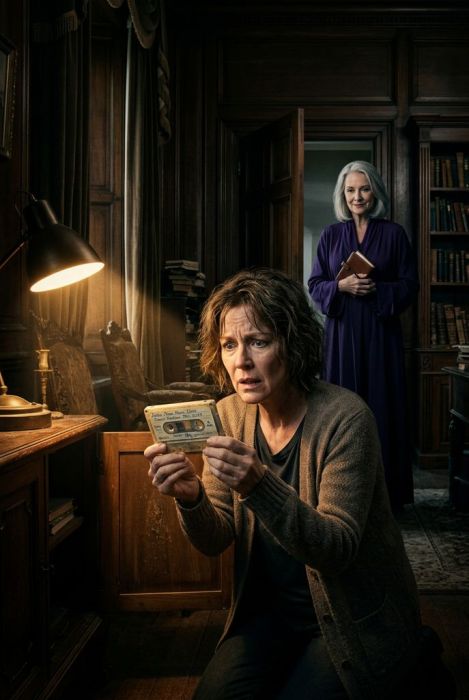
It was full of cassette tapes, each labeled in her handwriting. M. Bennett — practice. M. Bennett — session three. M. Bennett — the voice. There were tapes for dozens of names I recognized. Delia Parson. Margaret Delgado. My mother's name, over and over.
I slid one into the tape player on her desk and pressed play.
It was my father's voice — except it wasn't. It was Vivian Thorne's voice, dropped low and ragged, saying my mother's own words back to her: Claire, my girl. Your mother reads by the back window. She keeps my flannel. Tell her I am proud. Then the tape clicked, and her real voice came back, breezy and satisfied. Good. That's the take. Stanley will loop it through the speaker in the brass bell on Thursday.
Stanley. The spirit in the bell was a man I'd never heard of. I listened to five more tapes and understood, sick to my stomach, that my mother had been talking to a con woman practicing her dead husband's voice in a closet.
I copied the labels into a notebook and drove straight to Ray's. That was the moment I realized the scammer is not brilliant. She is just practiced. And practice leaves recordings.
Ray brought in the sheriff — an honest man named Willard who had suspected Seraphina for years but never had a solid case. Then Ray called the Ohio Attorney General's consumer fraud unit, and a young prosecutor named Dana Whitlock came down from Columbus. In three weeks we assembled twenty-two victims — widows, fathers, a woman who lost her twin sister — who had collectively handed Vivian Thorne two hundred and forty thousand dollars for the privilege of being lied to about their dead.
We set the trap at her biggest night: the Christmas Spirit Circle, which she billed as the night the veil is thinnest, where she would collect the first pledges for the Healing Chapel. Whitlock arranged for an undercover agent named Gus Reilly, a soft-spoken man who had lost his wife three years earlier, to attend a private session wearing a wire. Vivian, greedy as always, told Gus his wife had a special mission for him and that a ten-thousand-dollar pledge would complete her crossing. She didn't know the wire went to a sheriff's van. And she didn't know we had persuaded Stanley — real name Stanley Voight, her brother — that the plea deal on the table was better than the one he faced otherwise.
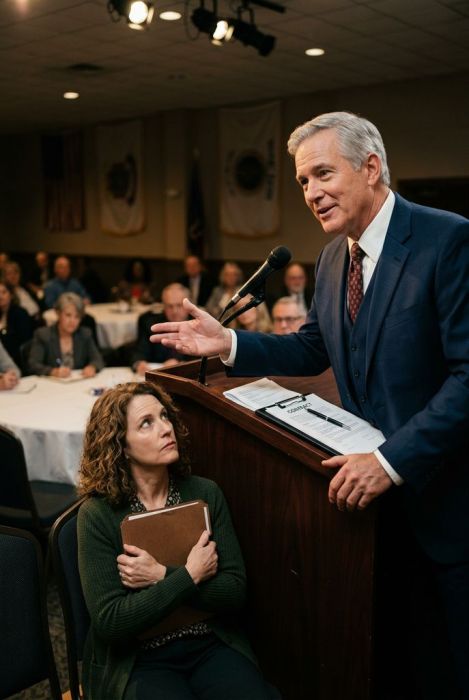
On the night of the Circle, the Jefferson Room was packed. Eighty-one people, candles on every table, a stage draped in violet. Vivian floated across it like she owned the world. She called up widow after widow, took their hands, told them their husbands were here. Then she asked for chapel pledges. Hats opened. Checks came out.
That was when I walked out from behind the curtain.
I had asked Ray if he wanted to do it. He smiled the slow smile of a man who had waited forty years for a clean ending. It should be family, he said. It's always family that ends up holding the truth.
So I held it. I walked onto that stage in front of everyone — my mother was in the third row, and I saw her face go white — and I held up the cassette. Ladies and gentlemen, I said, Vivian Thorne would like to tell you a story about who your loved ones are. I'd like to play you the truth. And I pressed play on the stage microphone, and every speaker in the room filled with my father's voice — which was not my father's voice — saying my mother's words back to her in a cold, practiced growl.
You could have heard a pin drop. Then the gasp went through the room like a wave, and Stanley, beside me with his head down, said loud enough for the microphone to catch it: She made me do it. She made me be the spirits.
Vivian stood frozen in her robes, one hand still stretched toward the crowd like a blessing that had curdled. She tried to laugh it off — this is the devil's interference — but the sheriff's deputies were already coming down the aisle with the warrant. They read her rights in front of eighty-one people. They walked her out through the back door past the same velvet curtain, her own voice still playing from the speakers, like a ghost finally caught wearing a woman's body.
The trial was quick, because Vivian's own practice tapes were the most damning evidence I have ever seen. Nineteen counts of theft by deception, plus felony financial exploitation of a vulnerable adult. The judge said, You didn't steal their money, Ms. Thorne. You stole their dead. That is a cruelty I do not have words for. She got nine years. Stanley got probation and testified for three days. Two hundred and forty thousand dollars was ordered back, and through the sale of her house and seized accounts, most of it came home — including sixty-two thousand of my mother's eighty-seven.
I want to tell you my mother hugged me that night and thanked me. The truth is smaller and better. She sat in the third row while her daughter called her beloved a liar, and when they took Vivian out, Mom just sat there, not moving. I drove her home in silence, and I thought we had lost each other.
Then, three nights later, I found her at the kitchen table with the shoebox of receipts open in front of her. She looked up with eyes that were tired and clear. He never told me you were a closed door, Claire, she said. He told me you were the best thing he ever made. I just forgot how to hear him. We sat there, not talking, until the sun came up.
The town went through its own reckoning. The Light Foundation had funded nothing but Vivian's house and Stanley's truck payments. Some will probably defend her to their graves, because part of being conned is believing the con. But the Community Center took down her stained-glass window, and the library dedicated a reading room to Margaret Delgado's name. My mother volunteers there now, two mornings a week.
Did I get everything back? No. You never get back the months, or the shame, or the way a con artist makes you doubt your own child. But I got my mother. I got a detective's handshake from a man who never gave up on an old woman he loved. And I got to stand on a stage with a tape in my hand and be the person who stopped the lie. That is not a small thing. That is the whole thing.
Vivian Thorne is still in prison, still practicing her voices for the light that never comes for her. But my mother planted tomatoes last spring — the first garden she'd put in since my father died — and when she serves them at dinner, she doesn't say my father is in the room with us. She says he would have liked the salt. It is the most honest sentence I have ever heard her speak.