
The day I cleaned out my mother's apartment, the landlord himself brought me a cup of coffee and offered his condolences. Ray Callahan had a voice like warm honey and a handshake that made you feel like you mattered. Everyone in Cedar Falls trusted that man. He'd tell you, with a sad little shake of his head, that he hadn't raised the rent on Unit 4B in twenty-two years, and he said it like it was a medal pinned to his chest.
My mother, Eleanor Pierce, had lived in that two-bedroom on Maple Street since my father died in 2003. She was a bookkeeper for forty years, a woman who balanced every checkbook to the penny and labeled every box in her closet with a careful hand. She died in her sleep last spring, at eighty-one, with a crossword puzzle open on her lap and the TV tuned to a channel she never watched. The building manager, Dana, found her and called me at work. I drove home to Cedar Falls the same night.
Ray Callahan owned half the rental properties in town. He sat on the zoning board, he sponsored the little league team, and every year he wrote a check that kept the food bank open through December. When my mother's friends told me how sorry they were, they always added the same thing: at least she had Ray watching over her. He's a good man. I wanted to believe it. I needed to believe it, because I lived four hours away and I had trusted Ray Callahan to watch over the only parent I had left.
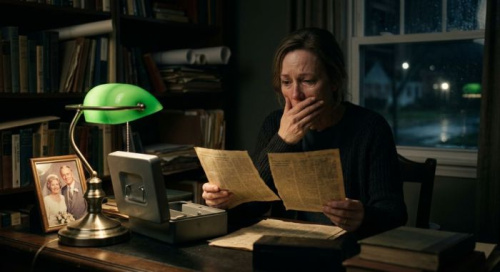
It started with the coffee. It ended with the cancelled checks. When I finally got up the courage to sort through Mom's desk, I found her bank statements in perfect order, every month accounted for, every balance matching to the penny, because that's who she was. And then I found the receipts. She had paid the rent for June. She had a stamped receipt for June. She had, in fact, paid the rent for every single month of the last ten years, and she had kept proof of every payment like a squirrel hoarding nuts for winter.
So when I called Callahan Properties to schedule the move-out inspection, I was not prepared for what Dana told me. There's a balance due, ma'am. Three months of back rent, plus a six hundred dollar late fee, and the deposit will be applied to the arrears. That leaves about three hundred and fifty that's still owed. I remember standing in the empty kitchen with the phone pressed to my ear and thinking I had misheard. That's not possible, I said. My mother paid her rent. I have the receipts. Dana's voice went flat. The computer shows otherwise.
I brought the receipts to the Callahan Properties office the next morning. It was a beautiful building on Main Street with Ray's face on a plaque by the door, and his receptionist gave me the smile people reserve for difficult old ladies. Ray himself came out to see me. He was seventy years old and still movie-star handsome, with silver hair and a courtly way of speaking that made you feel like the most important person in the room. He read through my mother's receipts one by one, nodding, making little sympathetic noises. Then he handed them back and said, I'm sorry, Ruth. These are just copies. The books show three months of arrears, and the books don't lie.
I was furious. I was also smart enough to know when I was being played. I took the receipts to a bank and got certified copies of the cancelled checks, the actual iron-clad proof that Mom had paid. I went back to his office. This time Ray didn't come out. This time Dana met me at the door with a pale face and told me Mr. Callahan was unavailable, and that I should stop harassing his staff or he'd have to involve the police. That's when something in me went very, very cold.
I started talking to the other tenants in the building. There were fourteen units on Maple Street, and most of them belonged to people over seventy. That's when the pattern emerged, quiet as mold growing behind a wall. Doris Whitfield on 2B said her deposit disappeared the same way when her husband died and she downsized to a studio, applied to arrears that never existed. The Feldmans on 3A said the same thing happened when they moved out in 2019. Nobody complained, because everybody was afraid of Ray Callahan, and because Ray Callahan was a good man who donated to the food bank.
Then I found Mom's diary. She had kept one every year since 1987, and the last volume, the one from the final year of her life, was the most precious thing I have ever held. On March 12, she had written: Ray stopped by to check on me. Such a kind man. He says he's worried about the building's foundation and might need to ask tenants for a special assessment. I told him I'd help if I could. I hope the others can, too. And on the same page, in smaller handwriting, she had added: Doris says she never got her deposit back when she moved to the studio. I wonder if that's true. I should ask Ray about it. She never did. She died three weeks later.
I started digging into Callahan Properties. It wasn't hard, a retired bookkeeper's daughter knows how to read a public record. What I found made my blood run cold. Ray Callahan had been collecting special assessments from elderly tenants for years: foundation repairs, roof repairs, elevator modernization, always in cash, always with no invoice, always from the people least able to challenge him. And the building's foundation was just fine. The city inspector's report from 2021 showed zero structural issues. The roof had been replaced in 2019, I found the permit, by a company that didn't exist. The permit was signed by Ray Callahan.
When I took what I'd found to the police, the desk sergeant sighed and said it was a civil matter. When I told my mother's friends, they looked at me like I'd grown a second head. Ruth, honey, said Mildred, who'd been Mom's best friend for forty years, Ray Callahan paid for your mother's funeral flowers. He came to the service. He's a good man. I knew then that I couldn't win this with noise. I could only win it with proof so overwhelming that even the people who loved Ray Callahan couldn't look away.
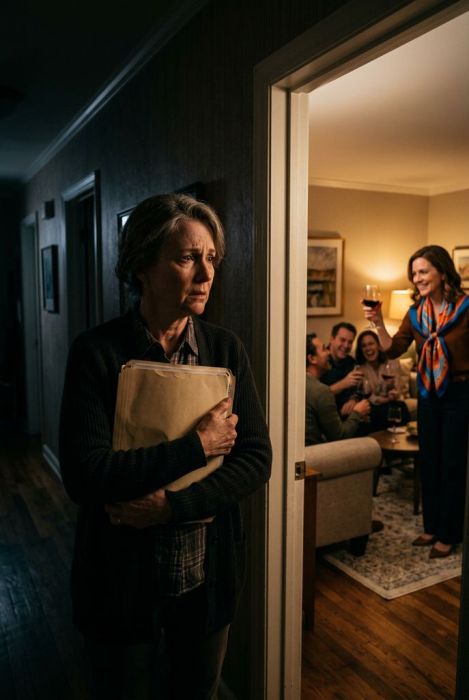
That's when I met Dana, the building manager who'd found my mother's body. She came to my motel room one night, looking over her shoulder, and put a folder on the table. I've worked for him for eleven years, she said. I've watched him do this to every single old person in this building. I have the original ledger, the one he thinks I never saw. And I have a voicemail where he tells me to tell you the deposit was forfeited and to delete the record if you call again. She had been waiting, she said, for someone with the nerve to fight. She was the first person to believe me.
I went to the county district attorney's office, not the police this time. I asked for a prosecutor who handled elder financial exploitation. That's how I found Angela Reyes, a young assistant DA with tired eyes and a stack of files on her desk that never seemed to shrink. She listened to me for an hour without interrupting. Then she leaned back in her chair and said, We've had our eye on Callahan Properties for three years. We just never had a victim willing to testify. Are you willing?
Meanwhile, Ray got bolder. I don't know if someone warned him, or if his arrogance just grew with the spring, but two weeks later I received a letter from his lawyer: a notice that I was being evicted from my mother's apartment, which I'd been cleaning out, because I'd overstayed the grieving period. He was also suing me for defamation. I've been in this town forty years, Ray said, when a reporter from the Cedar Falls Gazette caught him at the hardware store. No woman from out of town is going to tell me how to run my business. The quote ran on the front page. The whole town read it. And most of them believed him.
The eviction hearing was scheduled for the first Monday in June. I walked into that courtroom with one folder, and Ray Callahan walked in with a lawyer from the city and a smile that had charmed a town for four decades. He was so sure of himself. He'd won this fight a hundred times before, against a hundred widows and widowers who had no fight left in them. He didn't know that I had brought more than my mother's cancelled checks. He didn't know about the ledger, or the voicemail, or the six other tenants from this building, and the eleven from his other properties, who had finally agreed to tell their stories.
The judge's name was Marcus Bell, and he was from Cedar Falls, so he knew Ray Callahan. He knew him the way everyone knew him, as a good man who donated to the food bank. But Judge Bell also read the exhibits. He read the ledger, page after page of names and dates and stolen deposits going back fifteen years. He listened to the voicemail, played on a speaker, Dana's voice trembling as she confirmed what the old people in this building already knew. He looked at the forged repair invoices and the fake inspector's signature that matched the fake roofing company's letterhead. When Ray's lawyer objected that this was not relevant to an eviction, Judge Bell looked at him over his glasses and said, Everything about this man is relevant.
It happened right there in the courtroom. Assistant DA Reyes had arranged for a detective to be present, and when Judge Bell ruled that the evidence would be admitted and the eviction denied, that the balance due had been fabricated, and that the court would hear a motion for sanctions, the detective stood up and crossed the room. She told Ray Callahan he was under arrest for theft by deception and financial exploitation of a vulnerable adult. She read him his rights while his lawyer shouted and the courtroom went silent. The man who had charmed Cedar Falls for forty years was led out in handcuffs, still wearing the smile that didn't quite reach his eyes, still unable to believe that anyone, anywhere, had finally said no.
The trial took nine months. By the time it ended, the DA's office had found more than sixty victims, sixty elderly men and women whose deposits, assessments, and rent money Ray Callahan had taken over fifteen years. He was convicted on nineteen counts and sentenced to twelve years in state prison. The restitution order totaled more than eight hundred thousand dollars. His properties were put into receivership, and a tenants' association, led by Doris Whitfield, who was eighty-three and had finally gotten her deposit back, took over the buildings. They raised the rent once, to cover real repairs, and they painted the hallways a color Mom would have hated. Nobody cared. The hallways were clean, and the pipes worked, and nobody was afraid anymore.
I kept my mother's cancelled checks. I keep them in the same box where she kept hers, labeled in her handwriting, because some things are worth holding onto. I think about her often, especially on the first of the month. She would have been so proud of the tenants' association. She would have been proud of Doris, and Dana, and the six strangers who walked into that courtroom. Mostly, I think, she would have been proud of me. Not because I won, but because I proved that even in a town that loves a charming man, the truth has a way of showing up with receipts.