
The morning it happened, I almost didn't answer my phone. I was elbow-deep in potting soil on my back porch in Springfield, Ohio, when my mother's number lit up the screen for the third time in twenty minutes. My mother, Helen, is seventy-eight years old and has never once called me three times in a single day unless someone had died. I dropped the trowel and answered with my heart already pounding.
"Mama, what's wrong?"
"Oh, thank God, honey," she said, and I could hear the wet shake in her voice. "It's Cody. Your nephew. He's in jail, and he's begging me not to tell anyone, and I need you to tell me what to do."
The words came out in a rush. Cody is twenty-three years old, my brother's son, a good kid who fixes lawn mowers and sends my mother a birthday card every year with a doodle in the corner. The idea of him begging his grandmother for bail money was something out of a nightmare.
"Mama, slow down. Who told you this?"
"A policeman. He called from the jail," she said. "He said Cody was in a car with friends and they found drugs, and he's scared because he's got a clean record and starts a new job Monday. He said if I could wire nine thousand dollars for bail, they'd let him out before noon and no one would ever have to know."
I felt the blood drain out of my face. Every instinct screamed that this was a scam, the oldest trick in the book. But my mother wasn't watching the evening news. She still answers her landline on the second ring because she believes that's what a good neighbor does.
"Cody is not in jail, Mama. Hang up the phone right now. Tell me you haven't sent the money yet."
There was a pause. Then a sound I will carry for the rest of my life. My mother, a woman who has balanced her checkbook to the penny every Sunday for fifty years, began to cry.
"I already sent it, Dana. I wired it from the bank first thing this morning. I was so scared, and he was so nice, and he said there was no time to waste."
She kept apologizing, saying she knew she was old and foolish and that I'd told her a hundred times never to trust people who call asking for money. And that's the part that broke me. Not the nine thousand dollars. My mother lives on a fixed income. Nine thousand dollars was her emergency fund, the money she'd saved for a new roof. She hadn't been careless. She had been terrified, and someone had used that terror like a key in a lock.
I drove to her house on Elm Street so fast I'm not sure how I didn't get a ticket. When I got there, she was sitting at the kitchen table with a cup of tea she hadn't touched, staring at the bank receipt like it might explain itself.
I called my brother first. The relief in his voice when I asked if Cody was okay was the most beautiful sound I'd heard all day. Cody was fine. Cody had never been within a hundred miles of a jail cell.
Then I did something that probably saved what was left of my mother's peace of mind. I sat down across from her, took her hands in hers — she has the same square knuckles my father had — and told her we were going to figure this out together. I told her she wasn't foolish. I told her anyone with a heart would have done the same thing if they believed their grandson was scared and alone in a cell.
"Mama, do you remember anything about the policeman's voice?"
She closed her eyes and thought about it, and then she said something that made my blood run cold.
"He had the nicest voice," she said. "Smooth. Kind of like that man who runs the senior center, the one everyone says is such a gentleman. Mr. Whitfield. Do you know him?"
I knew him. Everyone in Springfield knew Gerald Whitfield. He was the volunteer coordinator at the Golden Oak Senior Center, a handsome man in his early sixties with a silver smile and a way of remembering everyone's birthday and everyone's grandchildren's names. He'd been running bingo nights and tax-help clinics for five years, and the town adored him. The ladies at the center called him a saint. He had never, not once, raised his voice or made anyone feel small.
My mother had a stack of his printed newsletters by her easy chair, and she clipped his columns out of the local paper. He had helped her file her taxes for free. He had personally driven her to her cataract surgery consultation. He had told her she reminded him of his own mother.
I told myself it was just coincidence. A lot of voices sound alike, especially to an elderly woman who'd been panicked and crying. Accusing Gerald Whitfield of anything would be insane. But I couldn't shake the feeling. So I started paying attention.
Over the next two weeks, I did something I'm not proud of, though I'll never apologize for it. I started going to the senior center. I volunteered for things I had no business volunteering for. I brought cookies to bingo night. And I watched Gerald Whitfield the way a hawk watches a field mouse.
Here's what I saw: a man who moved through that building like he owned it, shaking hands and remembering names. A man who always seemed to know exactly who was lonely, who was grieving, who had just lost a spouse and might be vulnerable. A man who kept a small spiral notebook in his breast pocket and wrote in it constantly, always smiling, so no one would ever think to ask what he was recording.
Here's what I heard: my mother, more than once, saying Mr. Whitfield had called her just to check in. Mr. Whitfield had asked how her back was feeling. Mr. Whitfield had mentioned he'd heard she recently had the roof repaired, and wasn't it a blessing she'd had the money set aside.
That last one nearly stopped my heart. My mother had told almost no one about her roof fund. She certainly hadn't mentioned it at the senior center. And yet there it was, out of Gerald Whitfield's mouth, wrapped in a velvet voice and a concerned smile.
I called the bank and asked for every detail of the wire transfer. I'm a retired schoolteacher, and schoolteachers know how to gather information from people who don't want to give it. The teller remembered my mother because she'd been crying, and because the man on the other end of the phone had stayed on the line the whole time, coaching her through it. The teller described his voice as "smooth as butter."
The transfer had gone to a personal account at a regional bank in Columbus, in the name of a woman called Patricia Lindqvist. That name meant nothing to me. But I wrote it down, and I kept digging.
The real break came three weeks later, on a rainy Tuesday, when my mother called me in tears again. This time the man on the phone claimed to be from the Social Security Administration, and he told her her benefits were being suspended and that she needed to "verify" her routing number to keep her check coming.
"Don't do it, Mama. Hang up. I'm coming over."
But first I called the senior center and asked whether Mr. Whitfield was around. The receptionist said he was out for the morning — he'd mentioned he had to run to Columbus to pick up donated supplies.
Columbus. Where the account that swallowed my mother's emergency fund was registered. I stared at the phone and felt something cold settle in my chest.
I should have gone to the police then. But I had no proof, only a pattern, and I knew the kind of man Gerald Whitfield was in the eyes of this town. He'd spent five years building an unshakable reputation. If I went to the police with a story about my elderly mother's bank account and a volunteer's smooth voice, they'd pat me on the head and send me home.
So I did the only thing I could. I went to the police anyway — but I went prepared.
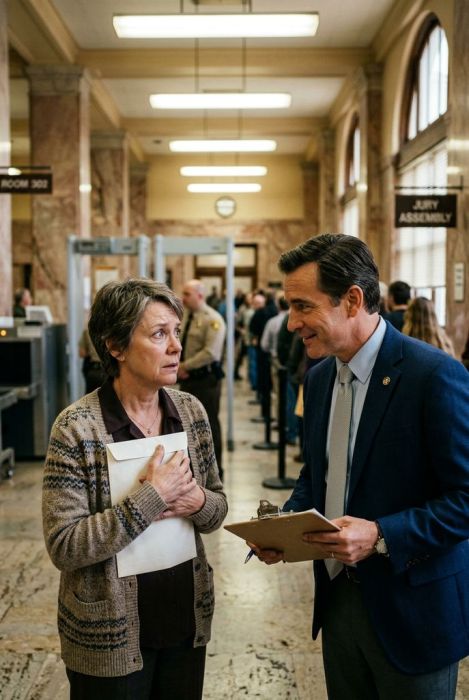
Detective Margaret Osei was the only detective in the Springfield PD who hadn't dismissed me within five minutes. She was a patient woman in her forties with the careful eyes of someone who'd heard every sad story a worried daughter could tell. When I sat down and told her about my mother, she didn't interrupt. She took notes. And when I finished, she pulled out a folder.
"We've had eleven reports of this exact scam in the last fourteen months," she said. "Senior citizens, all of them over seventy, all targeted by a caller with a smooth voice who knows their families' names. Every transfer went to a different account, but they all trace back to the same regional bank in Columbus. We've been waiting for one of these victims to come in with something we could use."
I told her about Gerald Whitfield. I saw her jaw tighten. She told me they'd actually interviewed him six months ago, after a widow named Esther Boyle had lost her entire retirement to a "grandson in jail" call. He'd denied everything, provided an alibi, and charmed his way out of the interview so thoroughly that they'd had to let him go. Esther had been too ashamed to press the issue, and without her cooperation the case had gone cold.
"The thing is," Detective Osei said slowly, "we've never been able to place the caller. And I just told you the name of the bank, not the account holder. So when you said Patricia Lindqvist — that name only came up in one place. In a conspiracy case we've been building against a boyfriend of Esther Boyle's grandson."
My mouth went dry. Esther Boyle's grandson. The young man whose "jail call" had cleaned out his own grandmother's savings.
"Patricia Lindqvist was the account holder for that transfer too," the detective said. "And Patricia Lindqvist, as it turns out, is the maiden name of Gerald Whitfield's mother."
I remember the room spinning, and I remember Detective Osei's steady voice telling me to breathe. For the first time in fourteen months, we had a name in common across every single transfer, a name that belonged to the golden man at the senior center, the saint who organized the coat drive and remembered everyone's birthday.
What Detective Osei found over the next week was a trail so meticulous it was almost beautiful. Gerald Whitfield had been running this operation for years. He'd volunteer at senior centers and churches and community centers, always picking small towns with slow local police departments. He'd charm the seniors, learn their family trees, their grandchildren's names, their fears. And then the calls would start. A grandson in jail. A niece in a car accident. A daughter arrested. Always urgent. Always emotional. Always requiring a wire transfer to a fresh account under a name he could explain away.
He'd been doing this for a decade, Detective Osei said. Roughly two hundred victims. More than four million dollars, laundered through a "senior investment club" he'd created at the center.
The day they arrested him, I was there. I'd insisted on it. They found him at the senior center, in his office, surrounded by thank-you cards from the very people he'd been robbing. He had a folder on his desk with more than a dozen names in it, including my mother's, each with a date and a dollar amount penciled beside it.
His face when they read him his rights was the most peaceful expression I'd ever seen on him. He looked at the detective and said, "I've been waiting for this for a long time," and I realized he'd known, somewhere deep down, that the charm would only carry him so far.
The trial took eight months. Gerald Whitfield was convicted on sixty-four counts of wire fraud, identity theft, and elder exploitation. The evidence was overwhelming: phone records, bank records, the little spiral notebook from his breast pocket, and eleven of his victims — including my mother — testifying about the man with the smooth voice who knew their families' names.
My mother spoke first on her day in court. She walked to the stand in her best church dress, looked directly at Gerald Whitfield, and said, "Mr. Whitfield, I trusted you. I brought you casseroles. I told you about my knees and my grandchildren and my roof fund. And you turned all of it into a weapon."
The judge sentenced him to fourteen years in federal prison and ordered full restitution to every single victim. The court seized his accounts, the house he'd bought with stolen money, the car, everything. The Springfield Journal ran a front-page story headlined "The Saint Who Wasn't."
My mother got her nine thousand dollars back. The restitution payments come quarterly, and she framed the first check and hung it on her kitchen wall, right next to the marigold picture I drew when I was six. She told me once that she looks at it when she starts to feel foolish, and it reminds her that she wasn't foolish. She was human. And so was the man who hurt her — which is exactly why he was able to do it.
These days, my mother is the one who talks to the senior center about scam prevention. She goes to Golden Oak twice a month, the same building, the same bingo nights, and she tells the older folks about the man with the smooth voice and the wire transfer and the detective who believed her. She tells them to always call their children before they call their bank. She tells them that no one who loves them will ever ask them to wire money in secret.
They took Gerald Whitfield away in handcuffs, and the town gave back my mother everything that mattered. Her confidence came back slower — much slower — but it came. And somewhere in Columbus, in a federal prison, a saint with a smooth voice is sitting in a cell, reading letters from the old ladies who finally got their voices back.
That's what karma looks like, in the end. Not a lightning bolt. Not a dramatic fall. Just a folder of evidence, a patient detective, and a hundred brave old women who decided they weren't going to be afraid anymore. My mother taught me that. And I'll carry it with me for the rest of my life.