The Man Everyone Loved
To the people of Springfield, Ohio, Robert Callahan was the kind of man you wanted living on your street. He was a deacon at the local Baptist church, a successful owner of a plumbing business that employed a dozen men, and a volunteer coach for the Little League baseball team. Every summer, he organized the neighborhood block party. Every winter, he donated turkeys to the local food bank. His laugh was loud and infectious, his handshake firm, and his smile could light up any room.
No one knew what happened behind the closed doors of 47 Maplewood Drive.
The Monster Behind Closed Doors
Margaret Callahan married Robert in 1974. She was nineteen, fresh out of high school, and pregnant with their first child. He was twenty-four, already established in his plumbing business, and charming in a way that made young girls weak in the knees. The wedding was small but beautiful — white dress, lilacs in her hair, and a reception in her mother's backyard.
The first time he hit her was three weeks after the honeymoon.
She had burned the meatloaf. It was an accident, a simple mistake that any new wife might make. But Robert had come home tired and hungry from a long day of work. When he saw the blackened edges of the meatloaf, something snapped. He backhanded her so hard that she flew into the kitchen counter and cracked two ribs.
The next morning, he brought her breakfast in bed. He cried. He begged for forgiveness. He told her it would never happen again.
It happened again three weeks later.
The Children Grew Up in Fear
The Callahan household had three children: Michael, born in 1975, Jennifer, born in 1978, and Sarah, born in 1982. The three siblings learned very early in life that survival meant staying invisible. When Robert was in a good mood, the house was the happiest place on earth. He would take them fishing, buy them ice cream, and tell them he loved them. But when he was in a bad mood — and there was no predicting when that would happen — the house became a war zone.
Margaret was always the primary target. Robert had rules. Dinner had to be on the table by 6:00 PM sharp. The house had to be spotless. The children had to be quiet. And God forbid anyone questioned his authority.
The beatings followed a predictable pattern. First came the accusations: she was lazy, she was useless, she was lucky he married her. Then came the yelling. Then came the fists. By the time Sarah was five years old, she had memorized the sound of her mother's body hitting the wall.
Robert never hit the children directly. That was part of his twisted psychology. He knew that physical abuse toward children would eventually attract the attention of teachers or social services. But he didn't need to hit them to terrorize them. He controlled every aspect of their lives. He chose their clothes. He picked their friends. He decided what music they could listen to and what television shows they could watch. Any disobedience was punished with isolation, starvation, or psychological torment.
Michael, the oldest, tried to protect his mother once. He was sixteen, strong from working construction during summer break. Robert came home drunk one night and started beating Margaret in the living room. Michael stepped between them. "Leave her alone," he said, his voice shaking.
Robert stopped. He looked at his son with an expression that Michael would never forget — a cold, calculating smile. "Big man now, are you?" he said. Then he calmly walked to the kitchen, grabbed a butcher knife, and held it against his own throat. "If you ever try to be the man of this house again," he said softly, "I'll kill myself right here, and it will be your fault. Your mother will be a widow. Your sisters will grow up without a father. And it will all be because of you."
Michael broke down crying. He never tried to protect his mother again.
The Escape That Never Came
Margaret tried to leave three times.
The first time was in 1986. She had saved two hundred dollars from grocery money, hidden in a shoebox under the bed. She planned to take the children to her sister's house in Cleveland. But Robert found the money. He didn't hit her that night. Instead, he sat her down at the kitchen table, poured her a glass of wine, and explained to her calmly that if she ever tried to leave again, he would find her. He had friends everywhere, he said. And when he found her, he would kill her, kill the children, and then kill himself. "But I'll make sure you watch them die first," he said, still smiling.
The second time was in 1992. Jennifer, fifteen years old, had found a shelter for battered women in Columbus. She begged her mother to go. Margaret packed a bag. She made it as far as the front door before her legs gave out. Robert was at work and wouldn't be home for hours. But she couldn't do it. The terror was too deep, too ingrained. She unpacked the bag and made dinner as if nothing had happened.
The third time was in 1998. Sarah was sixteen and had become increasingly aware of the injustice in her home. She had read books about domestic violence. She had talked to a school counselor. She had begged her mother to press charges. But Margaret was too broken by then. Twenty-four years of abuse had turned her into a shell of a woman. She had stopped believing that happiness was possible.
Sarah never forgave her mother for staying. But later, as an adult, she would come to understand that her mother was not weak — she was a prisoner.
Sarah's Transformation
Sarah Callahan was different from her siblings. Michael escaped as soon as he turned eighteen, joining the Army and rarely coming home. Jennifer married young, moved to Florida, and tried to forget her childhood. But Sarah stayed. She watched. She learned.
She learned that the legal system failed women like her mother. She learned that abusers like her father were masters of manipulation. She learned that the only way to fight a monster was to become more powerful than the monster.
Sarah graduated high school as valedictorian. She went to Ohio State University on a full scholarship. She studied political science and criminal law. She graduated near the top of her class and earned a spot at The Ohio State University Moritz College of Law.
During her first year of law school, she made a decision. She was going to become a prosecutor. And one day, she was going to put men like her father behind bars.
She didn't know that her father would be her first major case.
The Breaking Point
It happened on December 14, 2009. Margaret Callahan was sixty-four years old. She had been married to Robert for thirty-five years. That night, Robert came home from a business meeting drunk and angry. One of his employees had quit, and he blamed Margaret for it somehow — she had been "too friendly" with the man at the company Christmas party.
He grabbed her by the wrist and dragged her into the garage. He picked up a tire iron. And he broke her left arm in three places.
But this time, something was different. Sarah, now 27 years old and a newly licensed attorney, was home for the holidays. She heard her mother's scream from her childhood bedroom upstairs. She ran downstairs and found her father standing over her mother, who was curled up on the garage floor, her arm bent at an unnatural angle.
Robert looked up at his daughter. "Get back inside," he said. His voice was calm. Controlled. The same voice he had used for three decades.
But Sarah was not a frightened little girl anymore.
"If you touch her again," Sarah said, "I will personally make sure you spend the rest of your life in prison."
Robert laughed. "You think you're tough now because you passed some bar exam? I'm your father. I made you. You don't have the guts."
Sarah pulled out her phone and dialed 911.
"What are you doing?" Robert's voice cracked for the first time.
"I'm calling the police," Sarah said. "And I'm going to tell them exactly what I saw."
Robert lunged for the phone. But Sarah had already learned how to handle men like her father. She stepped aside, and Robert stumbled into a workbench. By the time he regained his balance, Sarah was already on the phone with the dispatcher, describing the scene in precise, calm detail.
The Trial
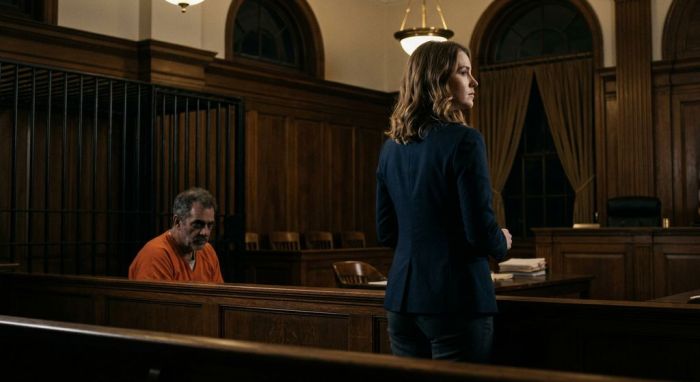
The trial of Robert Callahan became one of the most talked-about cases in Clark County. The local media called it the "Daughter Prosecutor Case." The courtroom was packed every single day.
The prosecution was led by the Clark County District Attorney's office, with Sarah Callahan serving as the lead prosecutor. She had requested the assignment personally, and the DA had approved it after a lengthy ethical review. There was no conflict of interest, the review board concluded, because Sarah was not the victim — her mother was.
Robert hired a high-powered defense attorney from Columbus. The defense strategy was simple: paint Margaret as an unstable woman, Robert as a loving husband, and Sarah as a bitter daughter with a grudge.
But Sarah was prepared.
She had spent two years building this case. She had collected medical records dating back to 1974. She had found diary entries that Margaret had hidden in the attic. She had interviewed neighbors who had heard the screams. She had tracked down former employees who had seen Robert's temper. She had even convinced Michael and Jennifer to testify about the psychological abuse they had endured.
The trial lasted six weeks. The defense called character witnesses from the church who swore Robert was a "godly man." They showed photos of Robert volunteering at the food bank. They played recordings of his warm, booming voice at charity events.
Then Sarah called her first witness: Margaret Callahan.
Margaret's Testimony
Margaret walked to the witness stand with her head held high. Her left arm had healed but still bore the scars of surgery. She looked at her husband of thirty-five years and felt nothing. The fear was gone. The love had died years ago. All that was left was a quiet, burning resolve.
Sarah asked her mother simple questions. "Did Robert ever hit you?" "How many times?" "Did he ever threaten to kill you?" "Did he ever threaten to harm your children?"
Margaret answered each question with dignity. She didn't cry. She didn't shout. She simply told the truth, in a steady voice, as if she were reading a grocery list. The jurors leaned forward in their seats. Several of them had tears in their eyes.
The defense attorney tried to cross-examine Margaret aggressively. He suggested that she was exaggerating, that she had mental health issues, that she was seeking revenge. But Margaret was unshakable. She had waited thirty-five years for this moment, and no lawyer was going to take it away from her.
The Verdict
The jury deliberated for four hours.
Robert Callahan was found guilty on all counts: two counts of aggravated assault, four counts of domestic violence, one count of criminal threatening, and one count of unlawful restraint. The judge sentenced him to fifteen years in state prison.
As the handcuffs clicked around his wrists, Robert turned to look at his daughter. "I'll be out in ten," he said. "And when I get out —"
"You'll be seventy-one years old," Sarah interrupted. "You'll have no business, no family, and no one who remembers your name. You're already dead, Dad. You just don't know it yet."
The Karma
Robert Callahan died of a heart attack in his prison cell four years into his sentence. He was found by a corrections officer during a routine bed check. He was sixty-seven years old.
None of his children attended the funeral. His wife, Margaret, did not claim his body. He was buried in a potter's field — an unmarked grave for prisoners and unidentified persons — paid for by the state of Ohio.
The house at 47 Maplewood Drive was sold. Margaret used the money to buy a small cottage near Cleveland, close to her sister. She spent her remaining years gardening, reading, and watching her grandchildren grow up. She died peacefully in her sleep at the age of seventy-eight.
Sarah Callahan continued her career as a prosecutor. She specialized in domestic violence cases and went on to secure convictions against dozens of abusers. She never married and never had children. When asked why, she would simply say: "I already spent my childhood raising myself. Some people are meant to be the justice, not the mother."
Michael Callahan retired from the Army and became a counselor for veterans with PTSD. He never spoke of his father again.
Jennifer Callahan divorced her first husband after he showed signs of controlling behavior. She remarried at forty-two and became an advocate for domestic violence survivors in her community.
And Robert Callahan? His name was never spoken again by anyone who had once loved him. He died alone, forgotten, and unmourned — the ultimate fate of a man who believed he was untouchable.
The Lesson
The story of the Callahan family is not unique. Every day, across America, women and children suffer in silence behind closed doors. Abusers like Robert Callahan rely on one thing: the belief that no one will stop them. They count on their victims' fear. They count on their victims' shame. They count on the system being too slow, too weak, too indifferent to act.
But sometimes, justice finds a way. Sometimes, the victim grows stronger than the abuser. Sometimes, the daughter becomes the prosecutor. And sometimes, the universe delivers a verdict that no appeal can overturn.
Robert Callahan thought he was the master of his home, the king of his castle. In the end, he died in a six-by-nine-foot cell, remembered by no one, loved by no one, mourned by no one. That is the truest definition of karma.
As Sarah Callahan once said in an interview: "My father taught me one useful thing in life. He taught me that evil exists. And he taught me that evil can be defeated — but only if good people are willing to fight for it."