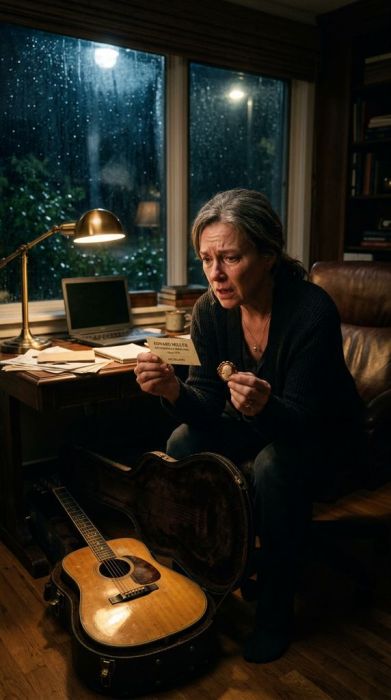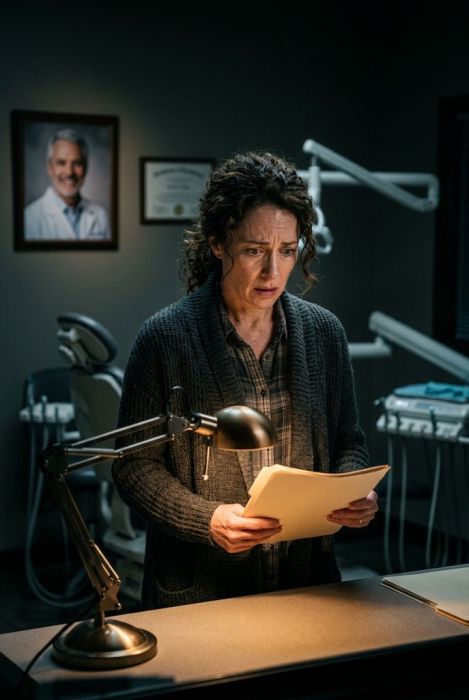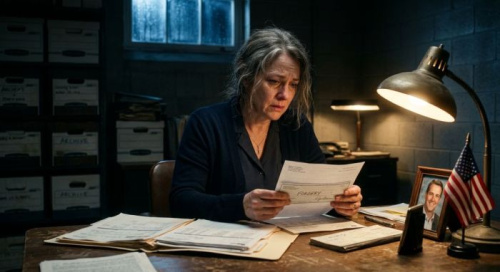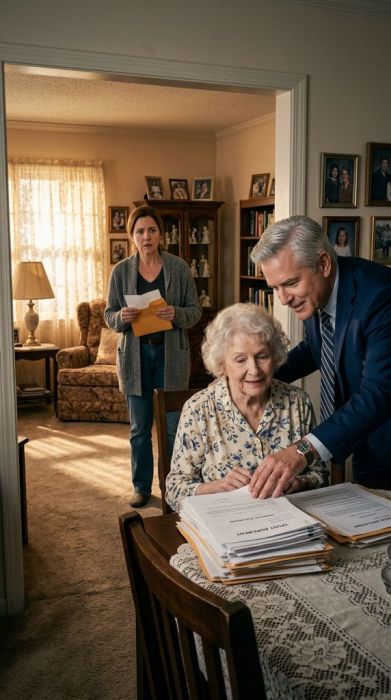

The night I found the camera, the rain was pounding my kitchen windows so hard the old glass rattled. I should have been asleep. Instead I was sitting at my table in my flannel robe, holding a memory card no bigger than my thumbnail, and my hands were shaking so badly I could barely set it down.
Emily Mercer had come to my door at nine o'clock, soaked to the bone, her eyes swollen. She was twenty-four, a college kid who worked the front desk at the gym, and she'd been crying for an hour before she knocked. "Mrs. Callahan," she said, "I don't know who else to talk to. I don't know who to trust anymore."
She held out a little plastic bag. Inside was an SD card. "I found this in the women's locker room," she whispered. "Behind the vent, above the second row of lockers. It was taped in there, Mrs. Callahan. It's been there a long, long time."
I asked her what was on it. She couldn't say the words out loud. She just shook her head and said, "Don't watch it alone."
She'd been fired that afternoon. Mack said she'd been stealing from the register. We both knew that was a lie, and for the first time in five years, I understood why he'd done it.
To understand how this could happen, you need to know about Mack Delaney. Everyone in Pine Grove knew Mack. He was the kind of man who made you feel like the most important person in the room, and he'd built that gift into an empire of sweat and good intentions. His gym, Delaney Fitness, sat at the corner of Main and Carter, all glass and polished steel, with his face on a banner out front that read "Five Years. Five Thousand Lives Changed."
Five years ago, my husband Frank died of a heart attack in our driveway. He was sixty-one, and he'd been healthy that morning. I was fifty-three, a retired school secretary, and I had no idea what to do with myself. It was my neighbor Doris who dragged me to Delaney Fitness for a free week, telling me I'd rot in that house if I didn't start moving.
Mack was the one who found me crying on the treadmill my second day. He didn't make it awkward. He just sat on the machine next to me, handed me a bottle of water, and said, "First year's the hardest. You show up, I'll do the rest."
And he did. He helped me rebuild my knee after the arthritis got bad. He taught me how to lift without hurting myself. He started a grief group that met in the juice bar on Tuesday nights, and he never charged a dime for it. When the high school football team needed new equipment and the district said no, Mack raised eighteen thousand dollars in a month. When the tornado touched down on the west side, he turned his gym into a shelter and slept on a cot in his own office for a week.
He was named Small Business Owner of the Year by the county chamber. The newspaper ran a profile on him with the headline "The Coach Who Lifts More Than Weights." He had three thousand followers on Instagram and he posted a motivational quote every single morning at five.
I trusted that man with my keys, my schedule, my body. I had him programmed into my phone as "Mack" and I bragged about him at every family dinner. My daughter Danielle thought he hung the moon. She came home to visit in May, and he gave her a free membership for the month "for being the best unofficial gym mascot a man could ask for." She laughed and hugged him.
She changed in that locker room every morning that month.
The night Emily came to my door, I stayed up until the rain stopped. I made myself a pot of coffee that I never drank. I paced. I told myself there was a logical explanation—that the card belonged to a lost camera, that it was probably blank, that Emily was young and dramatic and had made a mistake.
Then I put the card in my laptop, and I stopped making excuses for anybody.
The footage went back three years. Three years of a high, wide angle from inside that vent, down at the lockers and the benches. Three years of women changing, showering, thinking they were alone. Some of them I recognized by face even when I couldn't place names—Jean from the pharmacy, the Moore twins, Mrs. Hargrove who taught piano at the middle school. There were dozens of them, and the file names were dates, and the dates went back to the month the gym opened.
I found my own face two files in. The morning of February twelfth, 6:40 a.m., the morning Mack had invited me to a private stretch session before opening because he said my hip looked tight. I remembered that morning. I remembered chatting with him for ten minutes before I changed into my shorts on that exact bench, directly under the vent.
I did the math on the dates. Then I found the file from May, and I watched my daughter Danielle laugh at something on her phone while she changed out of her work clothes, and I closed the laptop so hard the screen cracked.
I sat in the dark for a long time after that. I thought about the day Frank died, and the year of nothing, and the way Mack had been there for all of it. I thought about how a man can hold your hand at a grief meeting and hide a camera behind a vent two doors away. I thought about the word I'd written next to his name in my phone, and I erased it.
Emily had told me something else before she left. She said that three weeks ago, a new girl on the evening shift, a nineteen-year-old named Grace, had pulled her aside and asked if the cameras in the locker room were new. When Emily said there weren't any cameras in the locker room, Grace went pale and said she'd seen a red light blinking behind the vent that morning. The next day, Grace stopped showing up for work. Mack told everyone she'd moved back to her hometown to take care of her mother.
I knew better now. And I knew, with the cold clarity that comes at four in the morning, that if I walked into the police station with that card, it might not be enough. Mack had money, lawyers, and the love of the entire town. A frightened young woman's word against the most beloved man in Pine Grove wouldn't hold.
So I made a plan. I copied the card onto a USB drive and hid it in my freezer, behind a bag of peas, because that's where my mother hid her jewelry and it felt right. Then I put the original back in its bag, and the next morning I drove to the Pine Grove Police Department and asked for the detective who handled the last complaint about the gym.
Detective Lena Ortiz was a small woman with a sharp haircut and eyes that had seen too much. I told her everything, and she didn't look surprised. She didn't look surprised at all. She opened a file folder on her desk and turned it toward me. It was a police report from three years ago, filed by a college intern named Tessa Whitmore, who'd claimed she found a camera in the women's locker room of Delaney Fitness.
"Ms. Whitmore recanted eleven days later," Ortiz said. "Her parents' house got a visit from a very expensive lawyer. After that, she said she'd been mistaken. Then she moved to Colorado, and the case went cold."
Ortiz closed the folder. "You're the second person to walk in here with this. The second person in three years. I've been waiting for someone like you, Mrs. Callahan—someone with the patience to see it through."
She had a plan, and the plan was better than mine. Mack was throwing a fifth anniversary gala at the gym on Saturday night. Three hundred guests, the mayor, the chamber of commerce, the football team, and a photographer from the paper. It was the kind of event where Mack Delaney would be at his most untouchable.
"Give me forty-eight hours," Ortiz said. "He'll be holding a microphone when we take him. In front of every person who ever loved him."
I went to the gym that Thursday like nothing was wrong, because the worst part of the whole nightmare was that I still knew his schedule. I knew he took his coffee black with two sugars. I knew he stayed late on Thursdays to do payroll. And I knew the lockbox in his office closet, the one he laughed about and said held "tax stuff and secrets."
On Friday morning, I did something I never thought I'd do. I walked into Delaney Fitness in a pink sweater and asked Mack if we could talk privately. I told him, voice shaking just the way I practiced, that I'd found a strange device behind the vent in the locker room, and that I was scared to tell anyone because I didn't want to make trouble.
The shift in his face lasted half a second. Then he smiled, and it was the warmest, kindest smile in the world, and he said, "Ruthie, that's probably just the HVAC sensor. I'll have a guy check it today. You did the right thing telling me."
What he didn't know was that I was wearing a wire. What he didn't know was that Detective Ortiz was listening to every word from a van across the street. And what he really didn't know was that while he smiled at me, a sheriff's deputy with a warrant was already unlocking his office closet, where Emily—who'd slipped in through the back door he'd never re-keyed—had told us exactly where to look.
The gala on Saturday was everything Mack had promised and more. Strings of lights, champagne in plastic flutes, a caterer from Nashville, and a banner stretched across the juice bar that read "Five Years. Five Thousand Lives Changed." Mack stood on the little stage in his best suit, microphone in hand, telling the crowd how much this town meant to him, how Delaney Fitness was more than a gym, how every one of us was family.
I was standing near the front, next to Doris, holding a glass I couldn't drink. I saw Emily come in through the side door. I saw Detective Ortiz and two officers move through the crowd like they were part of the party. And I saw the exact moment Mack spotted them, because his voice faltered, just for a beat, and then recovered.
"Before I cut the cake," he said, "I want to thank—"
"Marcus Delaney," Ortiz said, and she didn't raise her voice, but the room went quiet like a stone had dropped into still water. "You're under arrest for unlawful surveillance, fourteen counts, and witness intimidation."
The gasps were loud enough to echo. Somebody's champagne flute hit the floor. Mack's smile hung on his face for an absurd second, like he honestly expected the punchline, and then he saw the evidence bag in Ortiz's hand, and the smile fell off him like a weight.
"You have to be kidding me," he said. "This is—this is Ruthie. Ruthie, tell them. Tell them I fixed the vent."
I couldn't speak. I didn't have to. Ortiz nodded at the deputy, who stepped onto the stage and turned Mack around and cuffed him in front of the two hundred and ninety people who'd come to celebrate him. The mayor's mouth was open. The photographer from the paper was doing her job, and her camera was capturing every second of it.
He was convicted nine months later on all fourteen counts, plus the intimidation charge for what he'd done to Tessa Whitmore. The judge called it "a calculated, systematic violation of trust" and gave him nine years in state prison. He won't get out until he's fifty, and when he does, he'll carry a registered offender status for the rest of his life.
What happened to the gym was the part that healed me. The community didn't tear the building down. Instead, a group of us—me, Emily, Doris, Tessa, who came home from Colorado to testify, and sixty other women who'd walked through those doors—bought it at auction. We opened it in the spring as The Harbor, a women's fitness center, and we rebuilt the locker room so that no corner of it is hidden from anyone: open grid lockers, glass-fronted vents, nothing that could ever conceal a lens again.
Emily runs the front desk, except now she's the manager, and she trains every new hire herself. Tessa teaches the Tuesday night grief group now, the one Mack started, the one we kept. And I still go every morning at six, to the same building, to the same bench, because I decided the day they led him out that he didn't get to take this place from us.
Some nights, when the rain comes down against my kitchen windows, I still think about that memory card and what I saw on it. I think about all those women, and about my daughter, and about the year I spent trusting a monster because I couldn't bear another loss. But I also think about Detective Ortiz, and about Emily showing up at my door in the rain, and about the way two hundred and ninety people watched the most beloved man in Pine Grove finally get what he deserved.
The newspaper ran a second profile a month after the verdict. The headline was "The Women Who Lifted More Than Weights." I keep it in the drawer by my bed, next to the picture of Frank, and I read it whenever I need to remember that patience isn't weakness, that evidence outlasts charm, and that karma, when you give it time, has a very long memory.