The For Sale sign appeared on a Tuesday morning.
I noticed it while watering my petunias, the same way I'd noticed everything on Maple Drive for thirty-two years. Arthur Kowalski's house had been a pale yellow colonial since 1998, the year his wife Betty painted it to match the azaleas. Now it wore a red-and-white sign like a wound in the middle of a sunny Florida morning.
Arthur was sitting on his porch steps at nine o'clock. He wasn't reading the newspaper. He wasn't sipping coffee. He was just sitting there, staring at nothing, his seventy-six-year-old hands resting on his knees like they'd forgotten what to do.
I crossed the lawn, my garden hose still dripping. "Arthur? You okay?"
He didn't look up. "Sold it, Millie. Sold the house."
"The house? But you and Betty have been here twenty-seven years."
"Twenty-seven years, two months, and four days." His voice cracked like old wood. "Betty's garden. The oak tree I planted when Emily was born. The swing set the grandkids played on. All of it."
I sat down next to him on the warm concrete steps. Arthur Kowalski was a man who balanced his checkbook to the penny and alphabetized his spice rack. He didn't make mistakes. He didn't lose things. "What happened, Arthur?"
He finally looked at me, and I saw something I'd never seen in his eyes before. Shame. "Daniel Vance," he said.
The name hit me like ice water in my chest. Daniel Vance was the tall, silver-haired attorney who played golf at the country club every Saturday and spoke at every town hall meeting like he owned the place. Everyone in Sunny Vista knew him. Everyone trusted him.
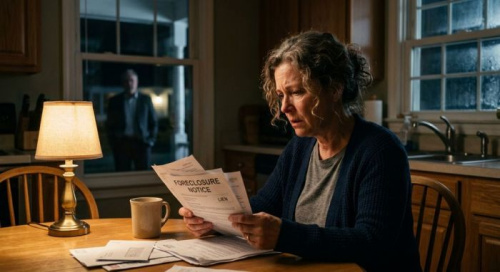
"He said it was an investment opportunity," Arthur continued, his voice hollow, mechanical. "A real estate trust that would double Betty's pension and protect our assets from Medicaid. I signed something. I don't even remember what it was. He had me sign a stack of papers, and I trusted him because he wore a suit and had a fancy office and he called me 'sir.' Then the letters started coming. Late fees. Penalties. Liens. Before I knew it, I owed more than the house was worth."
"Did you show those letters to anyone?"
"I showed them to Vance. He said it was a clerical error, that he'd take care of it." Arthur's hands were shaking now. "Then yesterday morning, a deputy showed up with foreclosure papers and a sheriff's sale notice. He gave me forty-eight hours to vacate. Forty-eight hours, Millie. After twenty-seven years."
I put my hand on his shoulder and felt him trembling. "Arthur, you need a real lawyer."
"I had a lawyer, Millie." He let out a bitter laugh. "His name was Daniel Vance."
That night, I couldn't sleep. I lay in bed staring at the ceiling fan, listening to the hum, thinking about all the things I'd seen in thirty-two years of carrying mail.
I thought about Clara Benson, three houses down. Sweet Clara, eighty-one years old, retired schoolteacher who still baked chocolate chip cookies and left them in a basket for the mailman every Christmas. Two months ago, she'd told me she was "restructuring her assets" on Mr. Vance's advice. Last week, I saw her crying at her kitchen window, holding a letter with shaking hands.
I thought about Ed and Phyllis Torres, who'd quietly moved into the cheap condos on Palm Shores Drive last month, even though they'd owned their beautiful waterfront home outright for thirty years. When I asked Phyllis about it, she said Vance had helped them "downsize for tax purposes." But I saw the way she looked at her old house when she drove past it. Like someone who'd lost a child.
I got out of bed at three in the morning and wrote down every name I could remember. Every elderly neighbor who'd suddenly sold their home. Every friend who'd mentioned Daniel Vance's name in conversation. By sunrise, I had seventeen names on a yellow legal pad.
The next morning, I drove to the Bradenton County Courthouse and spent four hours in the records room. I wasn't a lawyer. I wasn't a detective. But I had been a mail carrier for thirty-two years, and I knew something that no attorney in a thousand-dollar suit could fake: I knew patterns.
Every single quitclaim deed was notarized by the same person. Linda Marsh, Vance's paralegal. And the signatures—wobbly, uncertain, childlike—looked like they belonged to people who didn't understand what they were signing. Some of them were barely legible.
Then I noticed the dates.
Every single transaction had been filed on a federal holiday. Christmas. Thanksgiving. New Year's Day. The Fourth of July. Days when banks were closed. Days when families were distracted. Days when elderly residents were most likely to be alone, lonely, and vulnerable.
This wasn't incompetence. This was deliberate.
I photocopied all seventeen deeds, stuffed them into a manila envelope, and started calling the numbers listed on each document. That's when the threats started.
Three days later, I came home from the Publix grocery store to find my front door hanging open.
My cat, Mister Whittaker, was lying in the hallway. He wasn't breathing. His eyes were open, staring at nothing.
I screamed. I dropped the grocery bags. A jar of spaghetti sauce shattered on the tile floor. I fell to my knees beside him, my hands shaking so badly I could barely touch his orange fur. He was still warm, but there was no heartbeat.
A piece of white printer paper was taped to my refrigerator. Handwritten block letters in black marker: MIND YOUR OWN BUSINESS OR NEXT TIME IT WON'T BE THE CAT.
I called the police immediately.
Chief Stan Kowalski arrived forty-five minutes later, smelling like mouthwash trying to hide gin. He walked through my small house with his hands in his pockets, barely glancing at anything. He didn't take notes. He didn't take photographs.
"Any signs of forced entry?" he asked, not looking at me.
"The front door was wide open when I got home."
"Probably forgot to lock it. Happens to folks your age."
"I've never forgotten to lock my door. Not once. Not in thirty-two years."
He shrugged, a lazy, dismissive motion. "You want me to file a report? Fine. But these investigations never go anywhere. Probably just kids playing pranks."
"Kids left a death threat on my refrigerator after killing my cat?"
He finally looked at the note, squinting at it like it was a minor inconvenience. "Could be anyone. Teenagers on drugs. You're in a retirement community, ma'am. Things like this happen when you get older. Memory gets fuzzy."
"Things like this don't happen. I've lived here for thirty years. I know every single person on this street."
He walked toward the door. "Then maybe it's time to consider moving somewhere safer. A facility, perhaps."
He didn't bag the note. He didn't dust for fingerprints. He didn't care.
My daughter Kate drove down from Tampa that same evening. She took one look at Mister Whittaker's empty bed, at the fear in my eyes that I couldn't hide, and started packing my suitcase without asking permission.
"You're coming home with me, Mom. Tonight. I already made up the guest room."
"I can't, Katie."
"He killed your cat. He broke into your house. The police won't do anything. Next time it could be you lying on that floor."
"That's exactly why I have to stay."
She stared at me like I'd lost my mind. Maybe I had. But something had awakened inside me—something stubborn and righteous and deeply, profoundly angry. The kind of anger that builds slowly over decades and then erupts like a Florida thunderstorm.
"I carried their mail for thirty-two years," I said, my voice steady for the first time in days. "I knew when they were sick. I knew when their grandkids graduated college. I knew when their husbands died because I saw the sympathy cards piling up in the mailbox. I was the first person most of them saw every morning. And now someone is stealing their homes, their savings, their dignity. I'm the only person who noticed, Kate. The only one."
"Then take it to the state bar association. Take it to the news."
"I will. But first, I need the kind of evidence they can't ignore."
I found it in a cardboard box in the basement of the Bradenton Public Library.
Microfiche archives of the Arizona Republic from 2003. A twenty-two-year-old article buried on page fourteen about a young real estate attorney named Daniel Vance who had been investigated for fraudulent property transfers in a retirement community outside Phoenix. The charges were dropped when the primary witness—an eighty-four-year-old widow named Helen Pemberton—died suddenly of what doctors called a "heart attack" just days before she was scheduled to testify.
There was no autopsy. There was no follow-up investigation. The case was quietly closed.
I found Helen Pemberton's grandson through an online obituary. He was a commercial real estate broker in Scottsdale, Arizona. When I called him, the line was silent for a long moment.
"My grandmother was healthy as a horse," he finally said, his voice tight with old grief. "She walked three miles every morning. She'd just had a complete physical and her doctor said her heart was perfect. Then two days before she was supposed to testify against Daniel Vance, she was dead. My mother never believed it was natural causes. Not for one second."
"Do you still have her old files?"
"I have everything. I've been waiting twenty-two years for someone to ask."
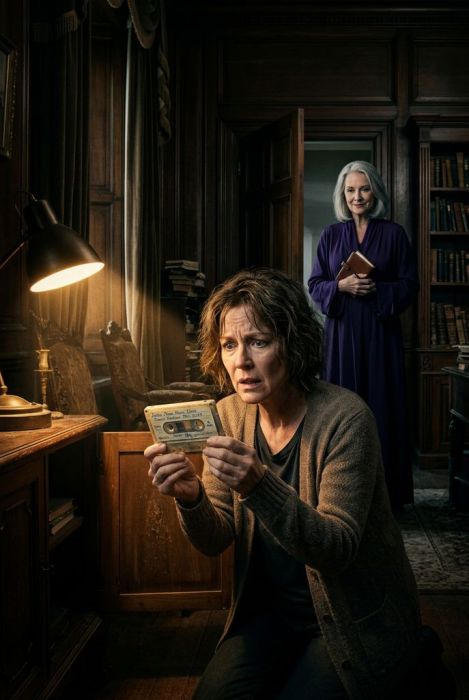
He FedExed me a binder thicker than the Bradenton phone book. Inside were bank statements, fraudulent deeds, handwritten journals detailing every meeting with Vance, and a cassette tape. On the tape, Helen had recorded a phone conversation where Vance threatened to "make her and her entire family disappear" if she didn't drop the lawsuit.
I now had evidence of witness intimidation spanning two decades and two states. And I had a connection that would destroy him.
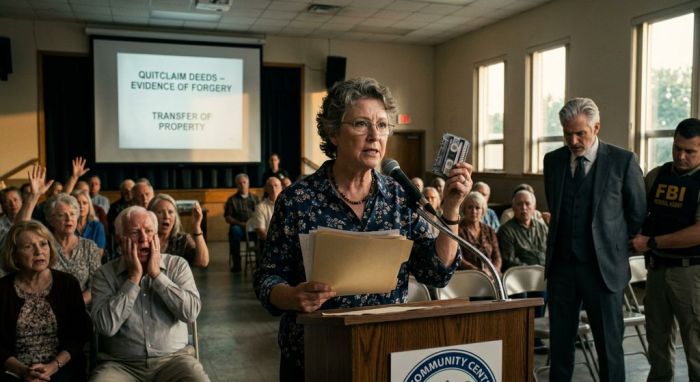
I called a town hall meeting at the Sunny Vista Community Center. I reserved the main hall, printed fifty copies of my evidence binder, and invited every single resident on Maple Drive and Palm Shores Drive.
The night of the meeting, the parking lot was overflowing. Elderly residents packed every seat. They were scared. They were angry. And they were finally ready to listen.
Chief Kowalski showed up, standing in the back with his arms folded, a smirk on his face. Daniel Vance arrived ten minutes late, smiling, shaking hands with everyone, playing the role of the benevolent community leader.
I took the stage, my heart pounding so hard I could feel it in my throat.
"Good evening, neighbors. My name is Millie Preston. For thirty-two years, I delivered your mail. I watched your children grow up. I attended your husbands' funerals. I know you. And I know that something terrible has been happening in this community that none of us had the courage to see."
I held up the quitclaim deeds.
"These are seventeen property transfers filed in the last eighteen months. Every single one transfers ownership of a Sunny Vista home to a shell corporation controlled by the law firm of Vance and Associates."
The room erupted. Voices shouted. Someone screamed.
Daniel Vance stood up, his face flushing red. "This is defamation. I've never—"
"Mr. Vance, would you like to explain why your paralegal Linda Marsh notarized every single one of these documents on a federal holiday?"
He opened his mouth. Nothing came out.
"And would you like to explain why the exact same pattern of fraudulent signatures appears in Arizona property records from 2003?"
The room went completely silent. You could hear the air conditioning humming. I pulled out the cassette tape and pressed play.
Helen Pemberton's voice filled the hall—frail, elderly, but clear: "Mr. Vance, I'm not signing anything until I speak to my own lawyer."
Then Vance's voice, smooth as a snake: "You'll sign it, Helen. You'll sign every page, or I'll make sure your grandson never practices real estate in this state again. I've made people disappear before. Don't test me."
The recording continued. The room remained frozen in collective shock.
I was about to present my final piece of evidence when a familiar voice stopped me cold.
"Millie. Please. Stop."
Doris Chen stood up from the third row. My closest friend in Sunny Vista. The woman I'd shared Sunday dinners with for fifteen years. Her hands were trembling violently. Tears streamed down her wrinkled face.
"Doris?" I whispered.
"I didn't know what he was doing with the information," she said, her voice breaking into pieces. "My daughter married him three years ago. He told me he was helping seniors manage their estates. That he needed to know who might need assistance. He asked me to... to tell him who lived alone. Who had family far away. Who might be getting confused about their finances."
My blood turned to ice. "You were his informant, Doris."
"I thought I was helping people!"
"You pointed a predator at our friends. At Arthur. At Clara. At Ed and Phyllis. You sat at their dinner tables. You knew their life stories."
Doris collapsed back into her chair, sobbing uncontrollably.
Daniel Vance was already moving toward the emergency exit, but three men in dark suits blocked the door. FBI agents. Helen Pemberton's grandson had called them from Arizona. They'd been building their own case for months.
"Daniel Vance," the lead agent announced, pulling out handcuffs, "you are under arrest for mail fraud, wire fraud, financial exploitation of the elderly, and witness tampering across state lines."
The community center erupted. Some people were crying tears of relief. Others were cheering. Arthur Kowalski was on his feet, applauding, tears running down his weathered face.
I just stood at the podium, clutching Helen Pemberton's binder to my chest, watching a predator finally get what he deserved.
Daniel Vance was convicted on twenty-three federal counts. His law license was permanently revoked. He's currently serving a forty-seven-year sentence at a federal penitentiary in Georgia.
Linda Marsh, his paralegal, testified against him in exchange for immunity and is now living in witness protection. Chief Kowalski was investigated by the Florida Department of Law Enforcement and forced into early retirement after evidence emerged that he'd accepted bribes from Vance for years.
Doris Chen sold her house and moved to Oregon to live with her sister. She wrote me a long letter, apologizing, explaining that she had been manipulated, that her daughter had cut her off. I read it twice, then filed it away without responding. Some wounds don't heal with an apology.
I stayed on Maple Drive. I helped Arthur Kowalski fight the fraudulent foreclosure. It took eight months, but he got his house back. The oak tree is still there. So is the swing set.
I set up a free financial literacy workshop at the Sunny Vista Community Center. Every month, I teach my neighbors how to spot scams, how to read legal documents, and most importantly, how to trust their instincts when something feels wrong.
At Vance's sentencing hearing, the judge asked if I wanted to address the court.
I stood up, looked Daniel Vance straight in the eyes, and said: "Mr. Vance, you spent twenty-five years thinking you were the smartest person in every room you walked into. But you forgot one thing. Mail carriers remember everything. We know who sends letters. We know who receives them. We know who's hiding something. And we never, ever forget a face."
He didn't look at me. But I saw his hands trembling on the defense table as the bailiff led him away.
That was enough. That was more than enough.