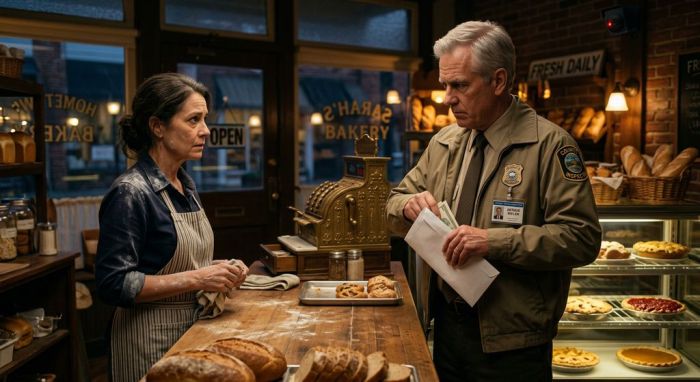
The fourth Monday in April was the day my mother's bakery almost died, every year, like clockwork. For ten years, Arthur Voss had walked through the front door of Rosa's Bakery wearing a county windbreaker and a smile that never reached his eyes, and for ten years he had found something wrong. A hairline crack in the floor tile. A refrigerated case reading one degree warm. A faint odor that my own sister swore she could never smell. And every single time, he would lean close to me, his voice soft and reasonable, and lay out the same two choices: pay a fine and close the doors for three weeks, or pay a "consulting fee" and watch him sign our certificate on the spot.
That is how I ended up in the cramped back office of my mother's bakery on a rainy Tuesday night, watching the same man slide four thousand dollars in cash into his inside pocket while I kept my face perfectly still. I knew exactly what he was doing. I knew because I had counted those bills myself that morning and photocopied every serial number, sealing the copies in an evidence envelope for a woman I had only met once. I knew because the little camera above the cash register had been rolling for forty-five minutes. And I knew because out on Birch Street, in two unmarked sedans with their headlights off, the people who had been building a case against Arthur Voss for eighteen months were waiting for the signal.
Rosalind Bennett started Rosa's Bakery in 1978 with her husband Frank, a newly returned veteran, using his discharge savings and her grandmother's sourdough starter. That starter, older than I am, still lives in the back corner of our kitchen in a ceramic crock my mother hauled west from Ohio. My father built the counters with his own hands, and he installed the big brass register that still sits up front, the one the county inspector always admired because he thought it looked antique. It was not antique. He just liked to pretend the place had not changed since 1978, the way he liked to pretend he cared about us every April.
My father died in 2005, quietly, in his sleep, the way he had always wanted to go. My mother kept baking. She was the kind of person who knew the name of every customer and the birthdays of all their grandchildren, and she priced a loaf of sourdough so low that people told her she was robbing herself. She would laugh and say the bakery was never about the money. It was about the ritual of it, the flour on her hands, the warm room at five in the morning, the line of regulars who shuffled in for coffee before the sun came up.
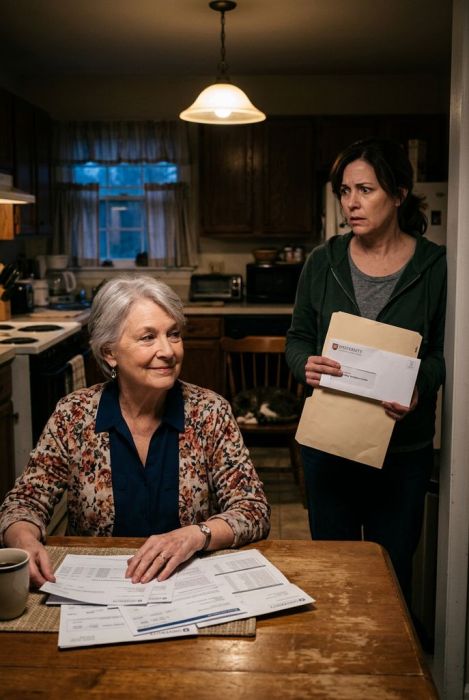
Arthur Voss first appeared in the spring of 2011, three years after I came home to help my mother run the place. I had been a bookkeeper at a trucking company out in the city, and I knew my way around a ledger well enough to spot a pattern when I saw one. On his first visit, he found a single pipe drip behind the dishwasher and wrote us a violation that should have cost us two hundred dollars and a follow-up inspection. Instead, he looked at me over his reading glasses and said, "You know, some places hire a consultant to handle these things. Saves everyone a headache." I had no idea what he meant. My mother did. She went pale, took me into the office, and told me to write him a check for the consulting fee. I refused. I demanded he show me the regulation. And that was the first and only time I ever saw my mother cry in the back office of her own bakery.
"If we fight him," she said, "we close. He can fail us on anything, honey. He can fail us on the dust on the ceiling fan, and there's nobody to appeal to except him."
So I wrote the check. Two thousand dollars, made out to Alpine Consulting Group, a company I had never heard of, with an address that turned out to be a mailbox in a strip mall. And every April after that, the same dance played out: the mild inspection, the tiny artificial discovery, the quiet talk in the office, the check, the sudden smiling approval. The fee crept up over the years. By 2015 it was twenty-eight hundred. By the year my mother died, it was four thousand.
That middle stretch was the cruelest part, because we watched my mother fade and we still had to pay the man. In 2016, the year her hands had started to shake, Arthur Voss gave her a violation for a "warped cutting board" that had been in perfect shape for thirty years. I watched her write that check with a trembling pen, and I watched him thank her like he was doing her a favor. There were customers in the front of the shop that afternoon, laughing, buying her cinnamon rolls, and not one of them knew that the pleasant man in the windbreaker was draining their favorite bakery dry. That is the thing about a small town. The monster is never wearing a mask. He is wearing a badge and a smile.
My mother passed on a Tuesday in October, in the middle of kneading dough, with flour on her apron and a half-finished order of cinnamon rolls on the counter. The doctor said it was fast and painless, and I have always been grateful for that. At the funeral, Arthur Voss came up to me, held both my hands, and said Rosa Bennett was the salt of the earth and he would personally see to it that the bakery kept her standards. I looked at him and said thank you, because forty people were watching and I was too tired to be anything but polite. But I knew. We both knew. That April, my mother's check had been written in her own trembling hand, and he had taken it from her desk drawer the day she died, explaining that he just happened to be in the neighborhood.
I took over the bakery for good after that. I had my sister Janet's help on weekends and a young man named Mateo who had apprenticed under my mother for seven years. We worked from four in the morning until close, and we were good. The town knew it. The line was out the door every Saturday for the sourdough, and the school board ordered three hundred cookies a month for its events. We were everything my mother had built, and Arthur Voss still took his four thousand dollars every April like clockwork.
What finally broke the pattern was a funeral that was not ours. Al Marsh had owned the fish house on River Road for thirty years, and the whole town turned out to send him off. His widow, Helen, found me in the back pew and asked, quietly, if we paid somebody every year too. She told me that in Al's final year he had begged her to sell the fish house because he could not take one more inspection. The county man had found cross-contamination risks in a kitchen that had passed every honest health inspection in the state for a decade. Al paid him six thousand dollars to keep the doors open, and the man kept the money and failed him anyway, because Al had asked for a receipt. She showed me the envelope. Same cheap manila. Same return address to Alpine Consulting Group.
I went home that night and pulled ten years of my own paperwork out of the filing cabinet. Every check, dated within a week of every inspection. Every certificate, signed by the same hand. Every photographed violation, identical, year after year. The same pipe. The same corner. The same odor. I had kept it all because I was a bookkeeper, and bookkeepers keep paper. I told myself it was for tax purposes. It was not for tax purposes.
The real turn did not come from me. It came from a kid named Danny Nguyen, who worked in the county health department's records office and had watched Arthur Voss for years with the same uneasy feeling I had. Danny noticed that Voss assigned himself to the same commercial routes every single cycle, and that the consulting company receiving all those payments belonged to Voss's brother-in-law. He also found the thing that made him leave his job in the middle of the night: a buried complaint file. Fourteen elderly people had been sickened at a church luncheon catered by a buffet restaurant that had passed its inspection three days earlier. Voss had taken six thousand dollars to make a real public hazard disappear, and he had done it with a signature and a stamp.
Danny could not sleep after that. He called a number he found on the county website, and that is how he ended up at a diner booth across from a woman named Grace Delgado, a special agent with the state attorney general's public integrity unit. Grace had been watching Arthur Voss for eighteen months already. She had the shell company, the brother-in-law, the buried complaints. What she did not have was a cooperating victim with a clean file, a business that could prove it had done nothing wrong and still paid, year after year, under the same man's thumb. What she needed was someone willing to do it one more time, on record, with marked bills and a camera rolling.
She asked me in September. I said yes before she finished her sentence.
The plan was simple on paper. Grace assigned a fresh, honest inspector to do our annual inspection early, a real one, and we passed with a perfect score and a certificate stamped in the state capital. Then she arranged for Voss to revisit us himself, prompted by an anonymous complaint that she had filed herself so nobody could trace it back to us. We knew he would find something. He always found something. The trick was that nothing would be planted and nothing would be real, and everything would be filmed. The envelope would be filled with marked bills, and the moment he accepted it, under the pretense of that unregulated consulting fee, his career would end on federal tape.
Janet thought I had lost my mind. She stood in my kitchen the night before and told me I was putting everything our mother built at risk, that he could destroy us out of spite, that we were just bakers and he was the man with the badge. I told her what I had learned from Grace. His power only worked in the dark, in a quiet office with a manila envelope and nobody watching. The moment you turned on the light, he was just a man in a windbreaker with crumbs in his coat pocket.
The night it happened was unseasonably cold for April. I left the bakery lights low, as we always did at close, and I put on my mother's old apron one more time. Arthur Voss arrived at 7:40, smiling, telling me how sorry he was to bother me, how he knew this was all just a silly mistake, how a place like Rosa's should never have to deal with complaints. He walked the floor with a tiny flashlight, pausing here and there, doing the performance I had watched ten times. Then he stopped at the back riser behind the oven, where the old steam pipe had a damp corner that had been there since 1982, and he said, in a voice he clearly thought was fatherly, "Well, Cora. You know the drill."
I did not make it easy. I asked him to show me the mold. He opened his phone and showed me a photograph, the same photograph he had shown me last year, of the same corner. I asked if that meant we had to close. He smiled and said he was sure we could work something out, like he always had. I asked how much. He said forty-five hundred. I said forty-five hundred for a photograph he had taken in 2019? And he laughed, genuinely amused, and said that was the price. That is the thing about men like Arthur Voss. They believe the paper trail is theirs.
I went to the office and came back with the envelope. He slid it into his inside pocket without opening it, thanked me, and told me he would have the certificate in the mail by Friday. Then he stepped out the back door into the alley, the way he always did, and I watched him through the little window while he peeled open the envelope and counted the bills under the security light. That was the signal. Grace Delgado's voice came through my earpiece, calm and steady, two words. "We're moving."
The unmarked cars had not needed their headlights. Arthur Voss was still counting when the first agent took his elbow, and I have never in my life seen a man move from smug to terrified so fast. He dropped the envelope, and the bills scattered on the wet asphalt, and for one long heartbeat the alley was silent except for the rain. Then he saw me watching through the window, and his face went gray. I did not smile. I just stood there in my mother's apron and watched him be handcuffed, and I thought about the fourteen people at that church luncheon, and about Al Marsh, and about every small business owner in this town who had paid a man to be a menace.
The charges came down like a hammer. Hobbs Act extortion, bribery, tampering with public records, and fourteen counts related to the buried food-safety violations. When the local paper ran the story, the calls started. Twenty-one business owners came forward with their own manila envelopes, their own checks, their own horror stories. Helen Marsh testified, calm and composed, the way Al would have wanted. Danny Nguyen testified with a box of records that took the jury half an afternoon to go through. I testified with ten years of paper and one perfect certificate, the real one, the one that proved Rosa's Bakery had never once failed an honest inspection in its entire history.
Arthur Voss did not go to trial. In the end, he did what men like him always do when the proof is on camera and the witnesses are lined up at the rail. He took the plea. Six years in federal prison, restitution to every victim, and a lifetime ban from any public office. The county health department, embarrassed and contrite, overhauled its assignment system, and the new director wrote to every affected business personally, apologizing in writing for what one man's badge had done to their reputations.
The new inspector assigned to our route is a young woman named Priya, and she is the real deal. She loves the way the sourdough smells at six in the morning, and she asks questions because she cares, not because she is looking for leverage. Last spring she gave us a hundred out of a hundred, and she cried a little when I told her the story of the camera above the register. The framed certificate hangs right next to my mother's photograph, and every April when the inspector comes, I offer her a slice of Rosa's sourdough with butter, warm from the oven, and she eats it. My mother would have liked that.
I still open at four in the morning. The line is longer now, because people in this town have long memories, and they remember which bakery stood up to the man who had been shaking them all down. The cash register up front is still the brass one my father installed in 1978, and underneath it, in the back of the drawer, I keep a photocopy of the serial number page and a folded photograph of an alley in April rain.
Some people ask me if I ever think about Arthur Voss, and whether I feel sorry for him. I tell them the truth. I do not think about him at all. I think about my mother, who bent so I would not have to break, and about the twenty-one other owners who found the courage to say his name out loud when he finally could not hurt anyone. I think about the fourteen people at that church luncheon who were spared the next buried file. And every year on the fourth Monday in April, I bake a cinnamon roll in my mother's recipe and eat it sitting on the curb out back, where the security light is, and I do not feel anything but grateful. Karma worked exactly the way it was supposed to. It just needed a camera, a bookkeeper, and one rainy night.