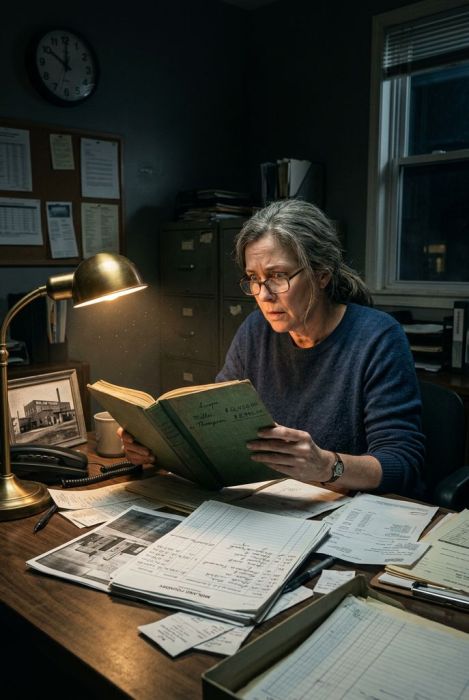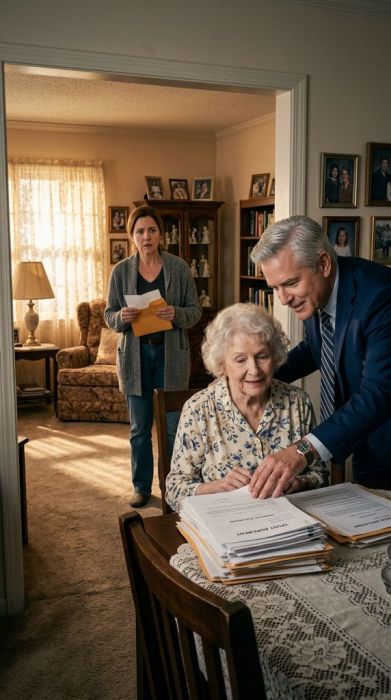
The last time my father sat across from Hal Beckwith's polished desk, he was eighty-one years old and didn't know he was dying. He handed over the premium for his Golden Years Whole Life policy the way he'd done every quarter for twenty years — cash folded into the little envelope Hal kept in his breast pocket. I know exactly when that was, because my father wrote it down. Ray Kowalski kept a ledger for fifty-two years, a plain black book with every dollar he ever spent, and he kept every receipt of everything. Hal never thought about that book. Not once.
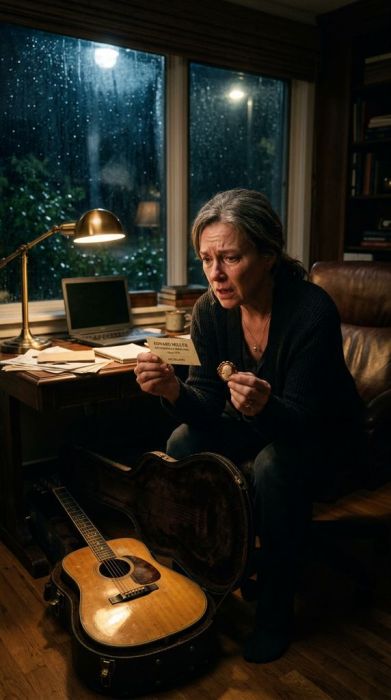
Dad died nine days later. A stroke, fast and quiet, the way he would have wanted it. We buried him on a cold February morning with the ground frozen solid, and for three weeks I did what daughters do after a parent dies: I sorted the tools, the photographs, the fishing lures he'd never cast again. Then I found the folder. It was tucked behind his shoe boxes on the top closet shelf, plain manila, labeled in his careful handwriting — "Ins. Hal. Do not lose." Inside were twenty years of premium receipts from Beckwith Insurance & Financial, every quarter paid, never one missed, and the final one stamped PAID IN FULL on a Tuesday in January.
I called the office to file the claim. The woman who answered was Debbie Fontaine, who I'd known since I was nine and she was six. There was a pause in her voice — a long, shallow pause that made my stomach drop before she even spoke. "There's a problem with your father's policy, Donna. It looks like it lapsed." I laughed out loud and told her I was holding the receipt dated nine days before he died. She went quiet again and said Mr. Beckwith would call me right back.
He called that afternoon, all warmth and sorrow. Hal Beckwith's voice was the same voice that had announced my parents' anniversary party, that had read the Christmas story from the pulpit every year for two decades, that had talked my mother into that policy in the first place. He explained, gently, that Dad had signed a lapse form back in October, deciding to take the cash value instead. "Donna, I know this is painful. Your father was getting older..." He let the sentence hang, kind and pitying. "I'll mail you the paperwork. You'll recognize his signature."
The paperwork came three days later. A standard cancellation form dated October the twelfth, with a signature that looked close to my father's but wasn't. I might have believed it, might have swallowed the shame and let it go, except for one small fact: my father spent five days in the hospital in mid-October with pneumonia. On the twelfth he was too weak to hold a pen. I know because I signed his name to a birthday card for my mother's sister that day, at his own request, and he watched me do it with tears in his eyes. The form was a lie. Which meant the policy might be a lie. Which meant I had to find out how much of Hal Beckwith's world was built on paper that wasn't real.
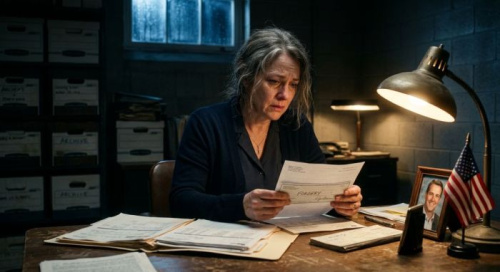
I didn't confront him. I was fifty-nine years old, a retired school secretary with thirty years of typing other people's notes behind me, and I knew exactly what happened to women in Clayborne, Ohio, who accused the town's most beloved businessman of anything. They became the problem. So I did what my father's daughter would do. I started keeping receipts of my own.
First I called the carrier printed on the policy — Great Plains Assurance Company, Des Moines, Iowa. The number rang to a disconnected line. The website was a single page with a photograph of a water tower. I called the insurance commissioner's office and a patient woman named Carol pulled records for twenty minutes and came back with nothing at all. There was no Great Plains Assurance. There never had been. My father had been paying a ghost for twenty years.
Then I found the second wound. In 2014, two years after my mother died, Dad had taken out a small policy naming the Lutheran church as beneficiary — a hundred thousand dollars to fix the roof that he was proud of, bragged about at every potluck. The receipts stopped after four years. When I asked the church treasurer, Betsy Orman, what had happened to it, she told me the policy had "underperformed" and been converted into a different fund. There was no different fund. Betsy just didn't know it yet.
I drove to the other side of town and knocked on Tom Flaherty's door. Tom was a retired machinist whose wife, Ruth, had died of cancer the spring before. Everyone knew the story: Hal had stood at the funeral in his good black coat, held Ruth's policy in both hands like scripture, and promised Tom the payout was coming. Tom had been waiting eleven months. Every time he called there was a problem — a death certificate, a tax form, an irregularity in the application, a new adjuster who had to start from scratch. "Ruth paid every month for forty years," Tom said, standing in his kitchen with a cup of coffee he never drank. I showed him my folder. He set the cup down, walked to the bedroom, and came back with a shoebox of his own.
We found Marlene Bishop that same week, a widow whose ten-thousand-dollar policy had been cashed in and rolled into something called a growth annuity that paid her forty-one dollars a month. Marlene thought she was being coordinated with. She cried when I showed her what the growth annuity actually was — a checking account that Hal controlled. The three of us spread our paperwork across Tom's kitchen table like a crime scene, which is what it was: nineteen families that we knew of, premiums totaling four hundred thousand dollars over twenty years, and those were only the ones we'd found by knocking on doors and asking careful questions.
Hal found out, of course. Small towns are sieves, and the news that Donna Mercer had gone strange after her father's funeral was too good not to travel. I ran into him at the Pick 'n Save three days later. He stood close, smiling for the checkout cameras, and spoke low enough that only I could hear. "Word travels, Donna. And word says you've been stirring up widows." He laughed, a friendly sound that didn't reach his eyes. "Your father was a good man. But toward the end he wasn't himself. You don't want people remembering him that way. Confused. Accusing his friends of terrible things."
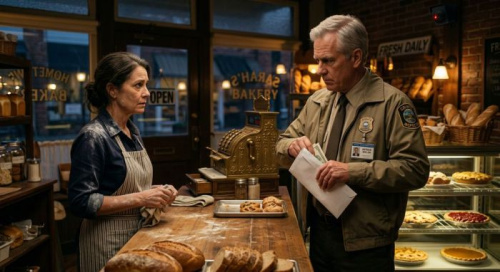
"That signature on the lapse form is a forgery," I said. His smile didn't move. "That's a serious word, Donna. I'd hate to see you embarrass yourself. Or your daddy's memory." He picked up a cart of steaks and walked away. By Saturday the whole town knew I'd lost it after losing my father, that I was in a bad way, that my sister in Arizona had supposedly called Hal herself to express her concern. The whispers followed me into the bakery, into the bank, into the pews of the Lutheran church where Hal served as deacon and read the offering prayer every Sunday. I let them talk. I sat in my pew and smiled and let them talk.
Because while Hal was busy making me the town's cautionary tale, I had taken a phone call from a number with a Columbus area code. Debra Okonkwo was a senior investigator with the Ohio Department of Insurance, and her voice sounded like gravel and patience. "I've been watching Harold Beckwith for three years, Mrs. Mercer," she said. "Anonymous complaints, every one written off as elder confusion. You're the first person who walked in with twenty years of receipts and the sense to keep them dry." We met at a diner in the next county over, and I brought Tom and Marlene. Debra already knew about the shell companies, the money trail from Great Plains into Hal's rental properties, the quiet 2005 lawsuit that had settled for a number nobody ever saw. What she needed was the evidence of his hands: the false policies themselves, the second set of books she was certain he kept locked away.
That was cabinet two. I knew it existed because of a slip of the tongue from Debbie Fontaine, who called me one night crying, a little drunk, saying she was sorry, sorry for everything, sorry about the lapse form she'd typed herself at Hal's dictation in November. "The policies are in two sets," she whispered. "The ones people see and the ones in the green cabinet in his office. Please don't tell him I told you." She hung up before I could thank her. The green cabinet sat behind a framed photograph of Hal shaking hands with the mayor; I knew because I'd seen it at his open house the year before, and I'd wondered why a man with a clean office kept a cabinet nobody ever opened.
Debra's plan was as elegant as it was brutal. Hal was planning a grand celebration — twenty-five years in business, a roast at the community center, the mayor presenting a golden key, a proclamation from the state, three hundred guests and a catered ribs buffet. The whole county would be under one roof listening to Hal Beckwith praise himself. That's where a man like Hal does his worst damage, Debra said, and that's where he'd be most certain he'd won. But a search warrant needs probable cause, and probable cause needs more than widows' memories. "That's where you come in," she said. Me. Fifty-nine years old. Twenty years of typing other people's notes.
On the Friday before the party, I walked into Beckwith Insurance wearing my best sad-widow smile and asked, with great humility, to sign the paperwork accepting the lapse. To put it all behind me. Hal's eyes glittered; he loved a victory lap. He left me in the conference room with Debbie — "just the ladies" — while he took a call, and Debbie, pale and shaking, unlocked his office the moment his car pulled out of the lot.
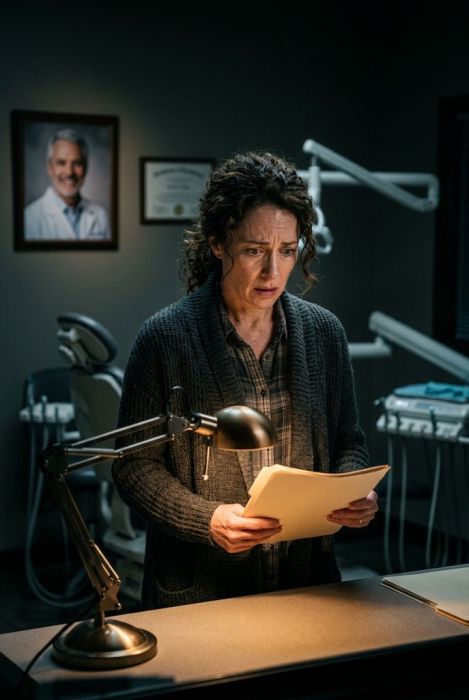
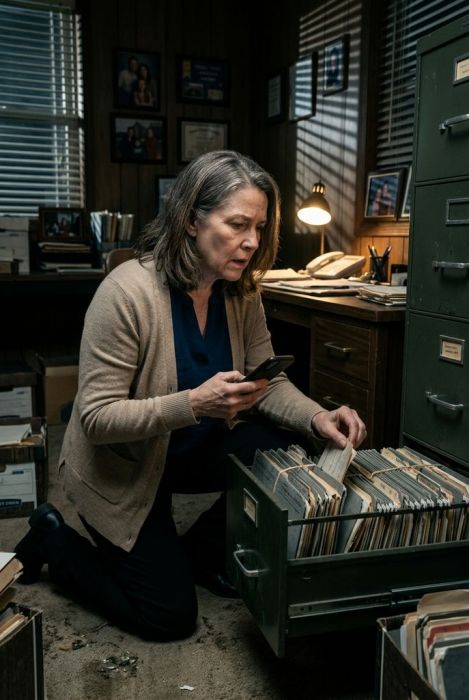
The green cabinet was exactly where I remembered, and the lock was a cheap three-number dial, the kind my father kept on his tool shed. I looked at the plaque under the photo of Hal and the mayor — "Presented to Harold Beckwith, April 21." His birthday. I spun the dial, 4-2-1, and the door clicked open on the first try. Inside were the real files. Not the pretty bonded folders customers were shown, but twenty years of gray cardboard files held with rubber bands, each one stamped in fading red ink: VOID — NOT REGISTERED. Nineteen of them. Four hundred thousand dollars, and that was only counting the ones I could see through the tears.
I took my phone out and photographed every file, front and back, spine and paper, 142 pictures in nine minutes, hands shaking so badly I had to brace the phone against the cabinet. Then I closed the door, spun the dial, straightened the photograph of the mayor, and was back in the conference room signing the lapse paper when Hal returned with a soda for me and a story about his daughter's soccer team. I signed with a steady hand and a silent prayer of thanks to the father who taught me, my whole life, to keep receipts.
On Sunday night, Hal's celebration was everything he'd dreamed. Three hundred people under the community center's string lights, a slideshow of Hal's greatest hits, the mayor's golden key waiting in a velvet box. Debra Okonkwo stood at the back in a sequined blouse she'd bought at Kohl's, looking for all the world like a proud neighbor. Tom sat next to me in the third row, gripping the armrests. I watched Hal take the stage, watched him wipe his eyes with a handkerchief while he talked about family, faith, and the privilege of protecting this community, and I thought about my father's last envelope and the stamp on those gray files. VOID. NOT REGISTERED.
Halfway through his speech, the chief of police appeared at the side door and murmured something to the mayor. I saw the mayor's face change. Hal saw it too — he was a man who read rooms for a living — but he was a performer, and he kept going, kept talking about legacy, while the officers who'd been standing at the buffet table like guests began to move. Hal's car sat in the back lot with its engine idling and a gas can and a bundle of rags in the open trunk. We found out later he'd planned to burn his own office that night — a tragedy, a terrible accident, and with it the green cabinet and every gray file inside. He never knew the real evidence was already photographed, catalogued, and sworn to.
He walked out the back door with the mayor's key still in his hand, and Debra Okonkwo was waiting for him beside his car. I didn't see the handcuffs go on. Tom said I didn't need to. What I remember is the silence inside the community center when the chief came back in and stood at the microphone. "Ladies and gentlemen, I need you all to remain calm. Harold Beckwith is under arrest on charges of insurance fraud, forgery, and attempted destruction of evidence." The slideshow behind him kept playing. Hal's face, twenty years younger, grinned at us from the screen. He'd been reading the offering prayer at my church for two decades. He'd taken my father's last premium with a smile and a receipt stamped PAID IN FULL.
The case came together the way Debra said it would. Nineteen families became thirty-one once the news broke, because the news broke like a dam. Hal pleaded guilty to twenty-two counts rather than face a trial with 142 photographs and a tearful bookkeeper on the stand. The judge sentenced him to nine years in prison, ordered restitution of four hundred and twelve thousand dollars, and seized the rental properties, the shell companies, and the checking account that had once held Marlene Bishop's growth annuity. The church got its roof fund back through the victims' settlement — a little late, but the roof was still leaking, so it mattered.
People asked me, afterward, if I felt triumphant. I don't know that triumph is the word. What I felt, standing in the old Beckwith office a year later with Tom and Marlene and Debbie — who testified, who told the truth at last — was something quieter. We call it Dad's office now. The Ray Kowalski Senior Money Clinic, where volunteers sit at folding tables and help retirees read their statements, understand their annuities, and keep their own receipts. We help them the way nobody helped my father.
Hal sends letters from prison sometimes, to the church, to the clinic, offering his expertise. We don't read them. My father kept a ledger for fifty-two years and never missed a single receipt, and in the end that's what beat a man who thought he was smarter than everyone in the room. The last time I saw Hal Beckwith, he was being walked across a parking lot in cuffs, the golden key still in his coat pocket. I think Dad would have been proud of me. I think he would have written it down.