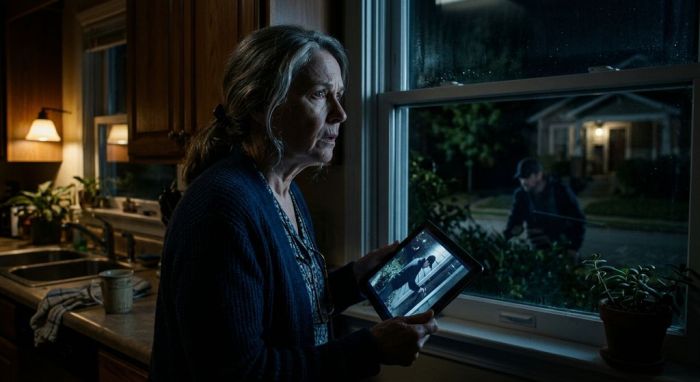
The day Clarissa Boone found her mother's diamond missing from the little velvet box on her dresser, I almost waved it away the way I'd waved away all the others. Another house on our quiet street, another vanished heirloom, another deputy shrugging his shoulders and telling us there was no pattern, just a run of bad luck that had settled over Millbrook like a wet blanket. But I'd spent thirty-eight years in a classroom, and a teacher learns one thing above all else: kids who lie always start with the same innocent little smile, and they always, always repeat themselves.
Arthur Crane had that smile.
He'd moved to town nine years ago, opened Crane's Lock & Key on the square, and within a month he'd become as permanent a fixture as the courthouse clock. There wasn't a door he hadn't rekeyed, a hinge he hadn't oiled, or a widow on Maple Street who hadn't called him when the new wiring from the last storm left her sidelights stuck open. He was the first person you'd call when you locked your keys in the car, and the first person the police recommended when you wanted to feel safe again. He kept a bowl of butterscotch on his counter and knew every dog's name in Millbrook.
So when the break-ins started, everyone agreed it couldn't possibly be anybody from town. It had to be drifters, teenagers from the next county, somebody passing through on the highway that ran grey and indifferent along the edge of our fields.
The first one was in June, the Millers two houses down. They'd gone on a cruise to Alaska, and somebody walked in through the back patio door, pried the lock clean off, and took a silver tea set that had been in Del Miller's family since the Civil War. The deputies dusted the place, took a report, and told the Millers these things happened. Insurance would cover it.
Then in July, the Hendersons on Grove Street got hit while they were at their daughter's wedding three states away. Same kind of door, same clean break, same careful hand. Nothing torn up, nothing smashed, no mess — just the jewelry box emptied of the good stuff and the dresser drawers left neat as a pin.
"My mother would've called that a housekeeper's burglar," Clarissa said to me one afternoon on her porch, clutching a glass of sweet tea. "Tidy. Organized. Like he was trying not to be rude about it."
I laughed, but something cold settled in my chest. Because she was right. This wasn't the work of panicked kids or desperate drifters. This was somebody who knew exactly what he was looking for, exactly how much time he had, and exactly which houses would be empty and when. This was somebody who knew our routines better than we did.
And in a town like Millbrook, there was only one man who had a key to damn near every door on the block.
Arthur Crane.
I told myself I was being paranoid. He was the nicest man in town. He'd restrung the basketball net at the church for the youth group. He shoveled old Mr. Haney's driveway every single winter, without being asked, without taking a dime. The man was a saint. That was what everyone said.
But I started watching. I'm not ashamed of it now. I started keeping a little green notebook in my apron pocket, the same one I'd used for lesson plans, and I started writing things down. Dates. Times. Which houses were hit. Which families were out of town. And, quietly, which man had recently done work on each of those houses.
The pattern that emerged made my blood run cold.
Every single home that had been robbed had one thing in common: within the six weeks before the break-in, Arthur Crane had been inside, changing a lock, rekeying a deadbolt, or "just checking the strike plate" after a repair. Sometimes he'd left a spare key with the family "in case of emergency." And every single family, trusting him completely, had told him exactly when they'd be away.
The Henderson house on Grove Street — he'd replaced the back door cylinder in May, a month before the wedding trip.
The Miller house — he'd installed their new front deadbolt in April, "as a favor," and promised to keep a copy of the key at his shop in case Del ever locked himself out again.
I should have gone to the police. But I had a problem: I had a notebook full of coincidences and not a single scrap of proof. Deputy Brewer, who'd known me since I taught his oldest boy arithmetic, listened politely and told me gently that I was "reading tea leaves." Arthur Crane had been vetted by the county when he renewed his license. He was a pillar of the community. They couldn't run off and accuse the town locksmith on the say-so of a retired teacher with a grudge against nobody.
He wasn't believing me, and I had nothing that would make him.
So I did the only thing I knew how to do. I set a trap.
It was early October when Clarissa came to my door as white as the frost on the pumpkins. Her mother's diamond ring — the one her mother had worn for sixty years, the one Clarissa had promised would go to her own daughter someday — had been lifted from its box while she was at a funeral an hour away. She'd only been gone from nine in the morning till two in the afternoon. And she'd locked everything. She always locked everything.
"Nobody else has a key but me and Arthur," she said, her voice shaking, "and Arthur re-keyed my deadbolt two weeks ago. He's got a spare at the shop. He's had it for years."
I looked at her. She looked at me. And for the first time, we both said the name out loud.
"We need to catch him," I said. "Not accuse him. Not warn him. Catch him."
Arthur Crane's shop closed at five o'clock sharp every Tuesday, and every Tuesday night he drove the seventy miles to visit his "sister" in Fort Wayne. That was his alibi, and it was as solid as a marble countertop because she always posted pictures of them at dinner together. But three of the four break-ins had happened on Tuesday nights.
There was only one way he could be two places at once. He had a key. He came back.
So I hid a camera. Not in my own house — that would've been too easy for him to spot, given that he'd installed my locks, too. I hid it in Clarissa's place, hidden inside a bookend on her dresser, angled at the exact spot where she now kept her mother's second-best ring, the one we'd decided to sacrifice as bait. It was an old ring, worth a few hundred dollars, but to Arthur it would look like treasure.
And I marked it. With a tiny dot of white paint on the underside of the band, the kind of mark a careful jeweler would notice but a thief in a hurry would miss.
For three weeks, nothing. No break-in. The ring sat in its box, untouched, glowing under the camera's quiet red eye. I started to doubt myself. Maybe Deputy Brewer was right. Maybe I had the wrong man, and I was wasting my breath.
Then, on the third Tuesday of October, Clarissa got a call. Her older sister, stranded after her car broke down on the highway, needed a ride. It was the perfect, human excuse to be gone — the kind of thing a predator could never resist, because it meant the house would be empty for hours.
She left at six. She texted me the moment she pulled out of the drive.
I was at my kitchen window, the lights off, watching the street under the streetlamps with my old dog, Max, asleep at my feet. At seven o'clock, nothing. At eight. At nine, I was about to give up and call her back when I saw a pair of headlights sweep around the corner.
They didn't stop at any other house. They eased up, slow and careful, and parked two doors down under the big oak where the streetlight couldn't reach. A man got out. Dark jacket. Baseball cap pulled low. He didn't walk up the drive like he belonged there. He cut across the lawn, stayed in the shadows, climbed the three porch steps, and slid a key into Clarissa's deadbolt.
A key only two people in the world had.
I didn't call the sheriff then. I'd learned my lesson about men in uniform who didn't believe me. Instead, I hit the button on a little app on my phone I'd set up weeks ago — the one that livestreamed Clarissa's bookend camera straight to my kitchen tablet — and I watched.
The man stepped inside. He moved through the dark house with the confidence of someone who'd been there a hundred times, straight to the bedroom, straight to the dresser. He opened the velvet box. He slipped the ring into his pocket, glanced at himself in the mirror, and smiled — the same sunny, harmless smile he used on every customer who came into Crane's Lock & Key.
That smile was on my screen in perfect, unforgiving detail. And the tiny white dot of paint, the one I'd painted on the underside of the band, was still there — winking at the camera as it disappeared into his jacket.
Only then, with the proof safe on my phone, did I call Deputy Brewer.
"Len," I said, my voice steady as a church bell, "you come to Clarissa Boone's house right now. And bring every deputy you've got. I've got Arthur Crane on camera, with a key to her front door, her mother's ring in his pocket."
There was a long silence on the other end. "Hattie, we've been over this—"
"I'm sending you the video. Right now. Open your phone."
I hit send, and a moment later I heard the whole tone of his voice change. "Oh my god," he whispered. "That's Arthur. That's Arthur Crane in her house."
He was at Clarissa's in nine minutes with two cars and lights that turned the whole street blue. Arthur tried to slip out the back, but we'd thought of that — Clarissa's back gate was wired shut, and the fence was too tall for a sixty-year-old man to climb in a hurry. He came around the side of the house, pale as the moon, the ring still warm in his pocket, and walked straight into the deputy's flashlight.
"Evening, Arthur," Deputy Brewer said, calm as anything. "Looks like you're a long way from your sister's in Fort Wayne."
They found more than the ring. When they ran his shop, they found a toolbox in his truck with a set of keys — twenty-seven of them, each tagged with a name and an address. The Millers. The Hendersons. Every single door he'd ever rekeyed for the people he'd robbed, the spare keys he'd solemnly promised to keep safe, right there on his key ring like trophies. And in a safe behind the counter at Crane's Lock & Key, they found the Millers' silver tea set, and the Henderson jewelry, and a dozen other things the town had never even realized were missing yet.
Arthur Crane had been robbing Millbrook for years. He'd planned it like a careful criminal: charm everyone, earn their trust, keep their spare keys, learn their schedules, and steal just enough from each family that nobody would notice until it was too late. He'd been the one recommending himself as the town's safety expert. He'd been the one the police always recommended. And every single crime, he'd blamed on drifters and bad luck.
But he'd made one mistake. He'd underestimated a retired teacher with a green notebook and a stubborn streak the size of Indiana.
At the courthouse, Arthur's lawyer tried to spin it as a momentary lapse — a good man who'd made terrible choices under financial pressure. It might have worked, too, if it hadn't been for the pile of keys, the tea set, the ring with the little white dot, and the thirty-seven years of trail that Deputy Brewer and the county prosecutor unearthed across three counties. This hadn't been a lapse. It had been a career. A whole, cold-blooded career of robbing the people who trusted him most.
The jury was out for exactly two hours. They came back with guilty on every count — burglary, grand theft, and a dozen others I won't bother to list. The judge looked down at Arthur Crane from the bench, this man the whole town had once loved, and told him he'd abused a trust more precious than any lock he'd ever opened. She gave him twelve years for the crimes in our county alone, and the counties he'd hit on either side were lining up to do the same.
I sat in the front row, in my Sunday best, and watched the bailiff take his arm. Arthur Crane looked up once, met my eyes, and for a second there was something ugly behind that famous smile. Then they led him away, and the door closed, and the whole courtroom let out a breath it felt like we'd been holding for years.
Clarissa got her mother's ring back. She wears it now on the same finger her mother did, and I swear it sparkles brighter than it ever did in the box, as if it knows it's home.
As for me, I keep the green notebook in my nightstand drawer. Some nights I pull it out and read it, not out of anger anymore, but out of wonder — at how a whole town could be so blind, and how the quietest person in the room could be the one who saw what everyone else refused to.
These days, when the Millers rebuilt their porch or the Hendersons got new windows, they don't call a locksmith from out of town anymore. They make a point of asking around, checking licenses, keeping their spare keys to themselves. There's a sign up at the church now, right under the basketball net Arthur Crane once restrung for the kids, and it says in plain, honest letters: Trust is earned in drops and lost in buckets.
The town got its locks changed, twice. But more than that, we got our eyes opened. And the man who thought he had a key to every home in Millbrook learned the one thing he never saw coming — that karma keeps its own set of keys, and it knows exactly which doors to open, and when.